
3 THINGS I THINK I THINK…OR 2…

There’s a lot going on again this week, but my fried brain couldn’t think of 3 things I think I think.  So here’s 2 things I think I think:

1)  The math in Europe still doesn’t work…

I’ve gotten quite a bit of backlash from some readers because of my negative stance on Europe.  Last year I highlighted several reports on the potential for peripheral countries to grow their way out of their debt problems.  And the math was simple.  It would take a miracle for austerity to result in the peripheral nations growing their way out of the debt crisis and reaching a sustainable trend.  But the LTRO appears to be working so that means Europe is fixed, right?!  Not in my opinion.  The story remains simple.  It’s a currency crisis and until the currency problem is solved the problems will continue to fester.

The recent economic data across much of Europe only confirms this thinking.  We see a new bout of weakness coming and Europeans are finally beginning to realize that austerity doesn’t work.  So we’re once again seeing bond yields creep higher as private investors stop thinking about the LTRO arbitrage and once again focus on the issue that trumps everything – national solvency.   And even more frightening are the persistent rumors of default and defection by some nations.  This has the potential to set off a frightening chain of events very similar to Lehman.  Europe needs to move towards greater unity, but they must stop kicking the can.  Eurobonds should be moving to the forefront shortly….The only other option is potential disaster.

THE BOTTOM LINE: As I’ve stated repeatedly, this crisis isn’t over until the solvency issue is resolved.  Until then, expect flare ups and new scares.  Same as it ever was….

2)  There have been some signs of Euro contagion in the USA – should we panic?

Many earnings reports note the European weakness.  Chinese data is even more alarming.  Is Hugh Hendry right?  Could it be Europe that triggers a crisis in China?  I don’t pretend to understand the Chinese black box so I’ll leave the gambling there to others.  What I do know is that the European crisis is not likely to substantially alter the US economic outcome unless we see the credit fears unravel leading to a banking crisis.  This can’t be entirely ruled out, but I would be stunned if the world’s leaders are stupid enough to let Lehman 2.0 happen again.

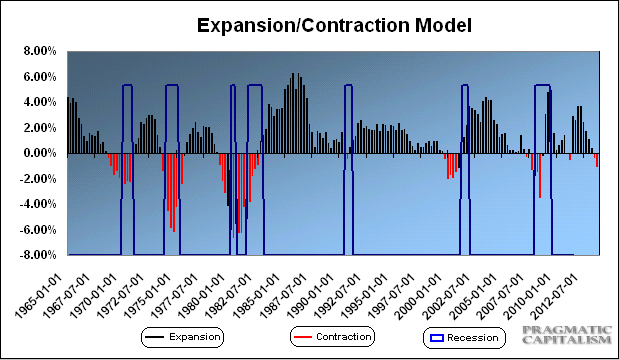
On the growth side, I’ve actually pushed back my recession expectations by one quarter based on recent data.  That’s the good news.  The bad news is growth in the USA appears to be peaking out in Q1 and Q2 of this year.  The expansion/contraction model I use is now forecasting official recession to begin in Q2/Q3 2013.   The “fiscal cliff” is going to send us to the dark place where Europe is.  We’ll see if Congress pulls together later this year and kicks their own can on the inevitable spending cuts….

THE BOTTOM LINE: still no need to panic.  Yet.
 

Cullen Roche

Mr. Roche is the Founder of Orcam Financial Group, LLC. Orcam is a financial services firm offering research, private advisory, institutional consulting and educational services.

More Posts - Website

Follow Me:
TwitterLinkedIn

40 Comments

  1. Calvin says:

    Cullen, haven’t seen any update to your algo for a while? Is it in neutral? Any expected change coming up?

  2. Ted says:

    Cullen, can we have a zoomed-in view of your expansion/contraction model? I think it’s been mentioned before, but it’s pretty tough to read. Maybe a 2005-2015 view would help a lot. Thanks!

  3. Larry says:

    Cullen, thank you for sharing the forecast from your expansion/contraction model. Although your forecast is for recession in Q2 and Q3 of 2013, the bars on your bar chart indicate a slowing of growth starting in Q3 of this year, slowing further into the Q4-12 and Q1-13. It seems to me that today’s equity markets may have priced in growth of at least 2.0 to 2.5%, so if , as your model suggests, we get gdp growth of well below 2% sometime in the 2nd half of this year, then equity markets could be in trouble then.

  4. Squire says:

    Equity markets may not be in trouble if the Fed provides QE.

    • VII VII says:

      @ Squire- What has to happen to get QE? A print of 1205 on the SPX? or what if the entire rally off of October get erased by June?
      The door is about to shut and it’s about to shut quick!

  5. Larry says:

    @Squire, as Cullen has shown, QE has not been effective in growing our economy, it only manages to goose the equity markets for about 3 to 4 months after a new QE program is announced. The wealth effect has only a minor, limited impact on growth, so about 4 to 5 months after a QE is announced, the market usually goes right back to where it was, or possibly lower.

  6. Old Dog says:

    Underemployment is not nearly as bad as some make it out to be.

    Many folks are saying that if the labor force participation rate were as high today as it was in 2008 that the official unemployment rate would be 10.1%, not 8.1%. Maybe not.

    A substantial number of the people who have “dropped out” of the labor force have quietly been put on SS Disability. Current administration has made this so very easy to do.

    • Obsvr-1 says:

      oh good, sweep the unemployment problem under the SS Trust Fund rug, which has been swept under the Unified Budget rug, which has been swept under the National Debt rug, which has been swept under the FED printing press…

      No need to worry, everything is fine and we are on the right trajectory. But it is getting awfully crowded under those rugs.

  7. B Ferro says:

    Naturally with the JPM news tonight I’d expect to wake up tomorrow AM to see futures bid +20 on the SPX…

    I’m guessing the Fed comes out overnight and says they’ll eat JPM’s MTM losses and any other bank’s as well…

    I’m only half sarcastic about this too..

  8. beowulf says:

    “There’s a lot going on again this week, but my fried brain couldn’t think of 3 things I think I think.”

    3. JP Morgan, WTF?

    “The “World’s Largest Prop Trading Desk” Just Went Bust”
    http://www.zerohedge.com/news/worlds-largest-prop-trading-desk-just-went-bust

    • Cullen Roche says:

      Good risk management right there! Apparently the conference call was a doozy…

      • beowulf says:

        the conspiracy theorists are split… :o )

        “first criminal MFGlobal gets taken down, now their trading partner J.P. Morgan begins sliding into the abyss….. the bigger picture begs the question: Who or What is taking the market manipulators out of the market?” Seems whoever it is, is enticing the manipulators into financial traps that are sprung at just the right moment…. we watch!”
        vs.
        “<The company said the loss was driven by $2 billion trading loss in its synthetic credit portfolio.
        Only 2 billion? Doom off. Chump change."
        http://www.godlikeproductions.com/forum1/message1864312/pg1

        • VII VII says:

          WTF!
          I’ve missed u Beowulf. It’s not easy being the smartest person on this site since u left us. :-)
          Happy to see u. My Italian grandmother would be very upset with u for not coming by more often,

          • Colin, S.Toe says:

            Uh oh, the rise he gets out of us with his vivid imagination has gone to his head.

            From ‘bottom of the class’ to ‘second only to Beowulf’ is a pretty big leap.

  9. When you say we’ll see what congress can do about the fiscal cliff later in the year – what exactly do you mean or is your comment just a matter of degree?

    Mr Achuthan suggested in his interviews this week quite rightly that policymakers have been attempting to stave off recessions indefinitely for decades and ultimately they can only do it for so long?

    Say congress gives the can a big kick – how far can the can be delayed? Given the shorter, sharper business cycles most people expect in the new normal, deleveraging world how much longer until we are overdue a new recession in the US?

    • Curvo says:

      Another year of 9-10% deficit can keep kicking the can. The difference between 3% and 9-10% deficit in a $14T economy takes you from ‘recession’ to ‘muddle through’. That is $850B to $1T a year of ‘quiet stimulus’ that has been kicked in since 2009. If it gets cut even in half (say 5.5% annual deficit) the U.S. will suffer tremendously.

  10. Curvo says:

    What is Mr Ferro thinking of late. Last I saw he was sorta long but ready to change. Paging…

    • SS says:

      Ferro’s been guaranteeing 1800 for months now. Can you say permabull?

      • Larry says:

        No, I can’t speak for B Ferro, but he is definitely not a permabull. He uses technical analysis, I think, to determine the market’s primary trend, and then he simply rides that trend, regardless of direction. However, in addition to TA he adds a strong belief that the Fed and new QE’s will prop up the market. Correct me if I am wrong. I think VII’s approach is roughly similar.

    • B Ferro says:

      SPX futures traders dailys sentiment readings at levels they were at last summer/fall’s lows and the 2010 summer lows.

      Bounce likely imminent, though not sure we V-shape bounce out of this 1350-1360 area. Might require some choppy work.

      Gap to fill at ~1390 from last Friday’s jobs report. That level is also top of April’s consolidation zone after the first sell-off.

      Lastly, CBOE equity put vs. call ratio hit ~1.00 yesterday…looking at the all-time highs from 07/08 selling climaxes, that’s the MAX for the 5 day average…moral of story here is that n-t selling is clearly looking washed out coupled with incredibly bearish sentiment…

      However, market’s done a lot of damage to itself recently….you just don’t break out to a new high like we did this year and then bust right below it like we did this week if you’re in a strong uptrend…

  11. jt26 says:

    As Pettis says, China runs a trade surplus … they will always be hit hardest when the world tries to force their deficits down (which will be inevitable as austerity kicks in harder or a trade war). China can postpone the pain now, but only have a bigger blowup later (like Japan), but of course China is a dictatorship, so a Japan-like blowup is not so bad relative to being stuck in a work camp for the next 40 years. There is no fear-induced paradox of thrift when bigger fears lurk behind the curtain. China is also the tail of the bull … anyone who works in back-end cyclicals (airlines, semis etc.) can tell you what happens when the wider market sneezes. A dictatorship only controls its own citizens.

  12. Derfem says:

    Cullen,

    Have you read Michael Pettis recently (I know he is one of the most perma-bears on earth), but the one who adress the “ripple effect”: Subprime crisis in US (who will be the 1st to rebalance and in fact are rebalancing), to Europe (the second domino). The last one will be China as they are the lastest to make the necessary adjustments to correct the imbalances that led to this crisis.

    He also said (which is in line with Gundlach) that as long as China hold, bonds will hold. But Japan will be the first to be affected by a China crisis.

    Action-re-action.

  13. Leverage says:

    “Growth.” “Growth.” “Growth.”

    You still don’t get it, do you? Fail, a lot of fail on economists. This model is done, better start changing the damn tune. Developed nations won’t be able to pull above 1% real growth any more, in a long time at least (when they do is because they come for degrowth periods like 2009). We had to manufacture 3 different bubbles in the last 15 years (stock market, housing and ‘export/import’ bubbles, the last has yet to blow up) to maintain artificial growth levels, and by artificial I mean that the real growth has been really stagnant when you factor several parameters (incomes, net job creating, debt and financial costs, parasitic sectors rent extraction, etc.).

    But that’s not a problem, we have plenty of wealth (the only thing that has kept the whole thing from collapsing). We need stability, that’s what we need. This means better distribution of income and stable (and degrowing maybe) consumption, fixing balance sheets of the private sector, and starting to share productivity gains. Obsession with profits over all sectors have to fall, at this stage of capitalism most sectors are not and should not have high profit margins in developed nations, most should barely break even, breakthroughs and innovation should dynamize the economy, but overall it should be pretty stable. This is the ‘end game’ which is not bad if macro factors are frozen and stabilized, innovation will keep going and maybe at some point we will have a new growth explosion (when we achieve close-to-free energy probably), then welcome it, but it’s unnecessary.

    We still have a model were growth is closely related to consumption of goods and resources, very highly correlated, don’t fool yourself. In the last 10 years the consumption of materials and energy went parabolic with housing bubble (and all wasted on very low and inefficient energy wise construction standards, shameful). This can’t keep going of if developing nations have to grow (which they do, they need it much more than developed nations which don’t need it in reality), is impossible, because as you see commodity prices get too hot and start up revolutions in developing nations (MENA revolutions are all about inflation and prices), and that’s only short term consequences. Inflation threat is real even if we are in a deflationary environment.

    Economist fear of negative or non-exponential numbers and functions is RETARDED, an upside-down case of understanding the things the wrong way (a prosperous economy should grow in line with demographics, otherwise have mild deflation/inflation and increasing purchasing power, the only way this can work is with very limited debt overhangs to reduce negative equity problems). They don’t understand nothing about nature and how societies develop, obsession over things like GDP in isolation make us pursuit wrong ideas and models and panic over things we shouldn’t panic about. The real economy can do fine without more growth, you just need FLOWS of energy (money is the transmission mechanism, money has to move, not being hoarded by wealthy people, savings have to accommodated to a point off course, due to life cycles and investments, so some accommodation is necessary, but money has to constantly flow; maybe we need different ‘money things’ for different purposes) through the system, this is trade and commerce, and things are fine. Everything else = noise and non-solutions.

    This can’t be entirely ruled out, but I would be stunned if the world’s leaders are stupid enough to let Lehman 2.0 happen again.

    I’ve two comments about this:
    a) It has been made very clear that the status quo only purpose its to preserve itself. They will try to do that above anything else, means unlimited liquidity and manufacturing of solvency in an overleveraged system which only works with sufficient nominal growth (there you have why the demand for NGDP targeting by some bankers and their clueless economist acolytes).
    b) The propaganda machine to keep zombies floating is fully functioning and hot, but people buys it less and less. And the political space to save banks is shrinking, so I’m not sure how is an other financial crisis going to be solved when time comes and banks going bust should not be ruled out. Again, is not the end of the world, banking is way oversized and a sector which is not profitable in stable non-growing economies, its size should be very limited (more with developed corporate capital markets).

    BTW there are a lot of ways to solve zombie financial systems (check how Sweden did it for example), giving free money to banks is an other non-solution. Lehman 2.0 is only a problem if you let it be with printing machines in your basement.

    • Colin, S.Toe says:

      If directed at CR, opening tone not called for; but interesting comment.

      I agree that the global economy stands in need of a ‘paradigm shift’ – or will have one forced upon it.

      One thing that might achieve broad support is a redefinition of the objective (‘growth’, if that label continues in use) to entail real overall reductions in ‘consumption of energy and materials’ made possible by increasing the added value of innovation and information content.

    • Peter says:

      http://www.qualitatedmoney.com/wp-content/uploads/2012/05/UN-Groups-Population-Age-Distribution-2012.jpg

      @Leverage: Growth in developed countries will be different moving forward.
      @Colin: Yes, a paradigm shift.

      I also have a theory of why economist/governments/people obsess over numbers like GDP. I am also of the opinion that the housing bubble was good, disruptive but good (not a waste of time, energy, and materials).

      • Leverage says:

        I apologize to CR for the opening tone, but I get tired of the spinning of the same old tune. This also leads to dangerous ideas, like NGDP targeting.

        I’m not against growth but I’m in favour of quality growth if it’s necessary and possible, in production terms it does not make any sense to keep talking about growth because we can produce more that we can consume (this includes leisure and services btw). It’s a problem of incomes, free quality time and distribution, solve that and we may have some real quality growth.

        Also with the demographic picture getting ‘worse’ (an other upside-down case IMO, decreasing population is good and will lead to more resources per capita, diminishing inflation and more production capacity per capita) growth is delusional.

        • Colin, S.Toe says:

          I agree on the deep connection between unsustainable growth, widening inequality, and further, an underlying cultural value system, that among other things, has badly distorted the role of market forces.

          Real change will need to involve that level; CR’s explication of the nature of ‘money’ as a social convention, and at best, a very approximate measure of real human values, moves in that direction.

        • Peter says:

          I agree. The negative connotation with shrinking population and decrease in “real” growth is unwarranted. Growth will be different in the future, and I think it is a good thing. Maybe we should start counting smiles, laughs, and feelings of joy per capita. Haha j/k… sort of… Unfortunately anything we count will get corrupted in some way. For instance I know lots of drugs that can make people smile, laugh, and feel joy. Macro thoughts are overwhelming sometimes. I prefer to look at the people around me, think about them, and see how I can help them thus helping me. Shrug.

  14. JC says:

    Cullen, I need your quick answer or links to the answers.

    1. Is a government surplus (monopoly supplier) ALWAYS bad, i.e. lead to an imminent recession? I think this is the MMT thought process, but not sure if MMR feels the same.

    2. Is Japan FUBAR? Sure their debts are high, but they are a monopoly supplier. Is their aging population and need to seek outside lenders going to kill them? Can the BOJ just make up some new rules and buy all the bonds and keep rates low forever?

    Thanks.

    • Peter says:

      1. No. There are no absolutes rules in economics. Government surpluses can be done for and caused by many things. Price control could be a reason it is done. Innovation could be a reason it happens. I think the government surplus in the US in the late 1990s was a combination of all everything. Increased productivity and decrease in demand in addition to new product/services create by technology.

      2. I dont know. Off the top of my head, BOJ can make up things up forever.

    • Peter says:

      sorry… =[
      that wasnt directed at me.

    • perpetual neophyte perpetual neophyte says:

      I see CR is going to address this in the Q&A but I am thinking his answer will involve sectoral balances.

    • Mr. Market says:

      Yes, Japan is FUBAR. Because of their Current Account Surplusses since 1990 and thanks to the rise of China (extra demand)in the last, say 10 years. A Current Account Surplus means that foreign creditors can’t force a country (in this case Japan) to restructure/reform. So, Japan was able to kick the (reform) can down the road for more than 20 years. And as a result Japan expirienced two decades of anemic (at best) growth and deflation anyway.

      Hugh Hendry notes that the same happened with Japan after WW I. Japan didn’t allow the deflation to run its course. But in 1927 the inevitable collapse came anyway. It only made the economic collapse in 1927 MUCH more severe. And that’s precisely what a number of central banks (including the FED) are trying to do now. Hendry actually thinks that the FED should have let a number of banks go bankrupt when LTCM went belly up in 1998. In this regard Robert Prechter and Hendry are (more or less) on the same page.

      Preventing deflation to run its course simply means that one is economically hollowing out the profitability of companies in one or more countries.

  15. fed says:

    so should the house bubble burst states have one currency and the oild boom states have another?

  16. Octavio Richetta says:

    Hi, haven’t posted intensively for a while. Several reasons for it.

    1. We’ve been busy with farming, hunting and fishing down here in Venezuela.

    2. I am sticking to my stupid fixed income call for 2012. And even more stupid than that my two horses in the race are JG and BG with DBLTX AND PTTRX In about a 5:1 ratio for about 60% of my portfolio. I also have about 15% in TIAACREF RE account, 10% in their insured account, a bit less than 3% I gold-related leaps GLD, GDX, GDXJ, all big money loosers YTD but keeping then as insurance, 2% in a few biotech equities, and the rest in cash. Bottom line, no need to follow the market minute by minute.

    My views on Europe have not changed. I still believe the end result will be worse than US-subprime.

    I worry a lot about the latest screwup at JPM as I am sure The 2 billion is just the tip of the iceberg; so I hear from people who have worked close to Dimon and know his style. The forced press release discloses the bare minimum.

    My key worry if whether I should be 100% cash just in case either JG or BG or both or doing stupid things Dimin style or if a big risk off moment takes averything but treasuries down with a vengeance.

    Greetings from Venezuela, CR, keep up the great work!!!

  17. Mountaineer Mountaineer says:

    Wolf keeps getting closer and closer. The underlying principle of his latest foray into Post Keynesian macro is that the private sector is the driving force behind the government’s fiscal position.

    http://blogs.ft.com/martin-wolf-exchange/2012/05/12/the-journey-towards-becoming-japan/#axzz1ulBoNm00

Contact Us:

Name:

Email:

Verification Image

Enter number from above: