
A Flaw in the QE Expectational Transmission Mechanism?
I wanted to republish and elaborate on some thoughts I expressed in a previous comment regarding the flaw in QE’s expectational transmission mechanism. In case you’re unaware, a number of people have been pointing out how QE3 is “already working” just because some markets have responded favorably. I touched on this here, but it’s important to look into this in some more detail. Here’s what I said in the comments:
“Inflation expectations can rise in the near-term without a long-term follow-thru in wage inflation. It’s my belief that people tend to spend out of current/expected income. So, if inflation expectations rise then there will only be a follow-thru spending effect if wages actually rise as a result (or subsequently rise to sustain current spending). This can be seen best in this chart:
What you see is two big spikes in inflation in the last few years from QE1 and QE2. But what you also see is a persistent decline in wages. Ie, the spending power of consumers isn’t following through from the higher inflation expectations. The result is weak demand and a weak economy. Ie, QE worked in QE1 because we were in a deflationary spiral, but QE2 failed and QE3 is also likely to fail because it won’t result in a follow-thru in consumer spending because it lacks a transmission mechanism to cause a wage spike.”
We can see this a bit more clearly if we zoom in:
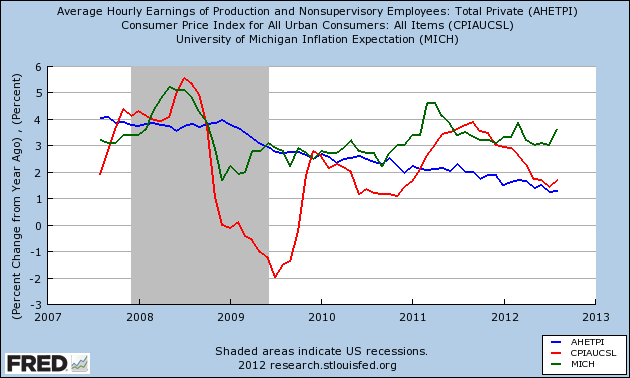
What we have here is inflation expectations in green, CPI in red and wages in blue. The chart starts in 2008 during the big oil spike that led everyone to think high inflation was inevitable. We all know what happened next. Then, in late 2008/2009 we had the QE1 announcement and the government bazookas were brought out. Inflation expectations rebounded in late 2008 and leveled off through QE1. I’d say QE1 was a success because we were in a deflationary death spiral and the Fed helped put a floor under the market. This was inflationary to the extent that it stopped the deflation from panning out. But the inflation didn’t make any meaningful lasting impact as we see in the red line’s clear decline into disinflation in 2010. But inflation expectations surged when QE2 was unveiled. And CPI rebounded briefly before it became clear that QE2 wasn’t causing the hyperinflation or even high inflation that many expected. More recently, we have a spike in inflation expectations following QE3.
But look at the one constant through all of this – declining wages. The impact of falling wages and the relationship with inflation is much clearer in figure 1, but the basic gist of the thinking here is that it doesn’t matter at all what near-term inflation expectations are if there isn’t a transmission mechanism for sustained translation of higher expected inflation into wage inflation which would be consistent with higher economic output and lower unemployment.
Instead, what we’re seeing is a glorious environment for corporations where they’re earning record profits, employees have no pricing power, margins are surging and the sagging demand from the weak consumer results in no urgency to boost wages or hire en masse. And so the problem with QE is that there is no transmission mechanism through which it sustains high inflation expectations which lead to sustained wage inflation. As Fed governor Evans said yesterday, fears of Fed-fueled inflation have been “consistently wrong.” That’s because the transmission mechanism to cause sustained inflation is very weak. Of course, the Fed isn’t just trying to generate inflation, but the environment they’re trying to create would certainly be consistent with higher inflation. So in the near-term markets fret about “money printing” and hope for lasting impacts from “wealth effects”, but the expectations consistently fade without any lasting impact….


31 Comments
David Andolfatto posted that even long future expectations are effectively influenced by QE
http://andolfatto.blogspot.ca/2012/09/qe3-and-inflation-expectations.html
The contrast with your great post illustrates a few interesting things;
a) economists don’t seem to care about realized vs expectational inflation (i.e quantitative back-testing seems optional)
b) expectations markets are useless (ref: the same debate on MR on NGDP futures)
Well there may be a lack of Fed-fueld inflation but gas-flation is kicking my disposable income the curb:
[IMG]http://research.stlouisfed.org/fredgraph.png?g=aQh[/IMG]
Cullen,
What would make the transmission mechanism stronger?
Well, the transmission mechanism for monetary policy is usually rate setting. So they could set rates here at the long end at 0.5% or something and make long bonds virtually cash equivalents. But that doesn’t necessarily help because we’re in a balance sheet recession and demand for debt is low.
The best tool in a BSR is fiscal policy. I’ve talked to David Beckworth about combining NGDP Targeting with fiscal policy. I think that would do the trick here.
I agree that its useless from a wage inflation standpoint, I just think the main purpose it serves now is to limit the downside.
The BOJ is topping up it’s QE program and BOE is hinting at more easing.
Can anyone shed any light on what all this means? There is talk of currency wars and the race to the bottom but Cullen has provided good evidence that this easing program is not going to lead to inflation or credit growth that is essential to economic growth.
So we have FED, ECB, BOJ, BOE,PBOC etc seemingly in some sort of game but of questionable purpose.
Is the whole purpose to support the banks as Paul Brodsky has just posted in the Big Picture think tank? I don’t understand his thesis but he seems to think that once the banks are delevered then gold will appreciate to near $19,000.
The whole financial system seems risky. Does anyone really understand what the game plan is?
If Cullen is correct and the people in charge don’t understand the monetary system then how can the average investor have any faith in what to expect?
I have worked hard to try to make sense of this but it is becoming nonsense. Who else can we turn to for guidance. Everyone makes sense and thus no one can make sense.
I’m spit balling here but many major economies are in or fear a recession and with interest rates already low or near 0% and additional debt/deficit spending being an unpopular political choice at the moment that the central banks prefer the idea of a mysterious QE program. And they talk about how QE will improve confidence in consumers to spend and corporations to hire.
That said, I’m not certain if some or all of the central bankers are ignorant of how QE works but rather I think they are perpetuating the “money printing” the story for some other reason. That is, like a doctor may give a patient a placebo sugar pill to cure your disease claiming it is a cure. I’m not sure if the doctor honestly believes the sugar pill will cure your problem – as much as he is saying that it will cure the problem in hopes that your faith in the mysterious QE pill will cure the problem. That said, once the doctor says (or everyone finds out that QE is only a placebo sugar pill) then its already limited effectiveness is muted. And I think the fact that so few understand QE is part of its charm.
Second if US takes on QE, then perhaps some central banks fear this will depreciate the USD and they need to take appropriate action to depreciate their floating currency to prevent domestic deflation (and protect their export manufacturing jobs).
I concur with your “placebo” view of QE. Apparently a large number of investors are betting on the QE placebo. See: http://blogs.barrons.com/focusonfunds/2012/09/19/etf-traders-piling-on-the-risk-after-qe3/?mod=BOLBlog?mod=BOL_article_full_blog_etf
ETF Traders Piling On The Risk After QE3. The SPDR S&P 500 ETF (SPY) has vacuumed up $5.2 billion, according to XTF.com. Second in line is smallcap iShares Russell 2000 Index Fund (IWM). Money managers often use these broad, heavily traded ETFs as placeholders when they don’t want to miss out. (That is, when they’re chasing the market!)
Third in line in is Vanguard Emerging Markets (VWO), gathering $1.5 billion in a week, followed by rival iShares MSCI Emerging Markets Index Fund (EEM), at $878 million.
Cullen,
Here is a link to a blogger who has some math that supports your position here. He shows the correlation of CPI to wages (.65 Rsquared), CPI to PPI (.7 Rsquared) and then CPI to (wages+PPI)/2 (.82 Rsquared). PPI as far as I know doesn’t have the adjustments of CPI that some argue distort it and PPI represents the producers price for commodities.
This suggests that 82% of the variation in CPI is described by the variations in wages and PPI. He also uses this data to take argue against Shadowstats higher CPI inflation estimates.
http://illusionofprosperity.blogspot.ca/2011/02/wages-ppi-cpi.html
LRM asked: “Can anyone shed any light on what all this means?”. My guess is that Europe’s banks and Spain and its regions are in even worse shape than most investors think. Maybe China is also in trouble. The CB’s know this. They are desperately trying to minimize the downside risk from all the deflationary pressures of so many debts that may not be able to be serviced. As Cullen said, fiscal policy changes are the longer-term answer, but due to gridlock in the US, and austerity policy in Europe, this is not being done. 2013 is likely to be a very difficult year for the global economy.
Some big european banks will be nationalized within the next spring. This is just my opinion of course and I think that this game changing event will start in France because Hollande is the only one that is in the condition to do that. We all know that the balance sheets of almost all the big banks (in EU and the US too) are fake. UK has already nationalized 50% of their banking system, German banks are kaputt and are the main reponsible (with French banks) of the European catastrophe. The German authorities have defended their banks so hardly that they can just prey and hope. Hollande has a chance, he wasn’t in charge and now he can change the course of history. I think he will do it.
I wonder if the Treasury would also try to inject subordinated debt capital into US financial institutions to allow more lending and not look like they’re being nationalized.
@Alberto, How long do you think Rajoy will hold out and not ask the ECB for aid in buying its bonds? Many have said that one of the biggest risks now is if Spain fails to ask for ECB support and waits until it is too late, causing a blow up.
I’m quite sure that Spain will see riots within the next few months and the Rajoy government will resign. But I don’t see Spain follow Greece, the country is more solid. Probably we will see a “save the country government” which will ask for a bail out but the conditions for that will not be that hard. They will obtain plenty of time because economical situation is deteriorating fast, France and Germany will be in recession as early as next quarter but this will just push for a faster solution of the euro crisis and not the contrary. I can just make some assumptions on my knowledge of the european countries. The last Draghi action has just bought time but enough to kick the can up to the German election where the liberals will be cancelled and the influence of the Bundesbank will fade to nil forever. We will see a big coalition between Merckel and SPD backed by the unions and the export industrial complex and eurobonds with a different name in 2014. Europe will be a totally different beast by 2015 then will see what will happen to the US and the sinking to the UK little boat.
Cullen, this is a nice graph. I’ve been using something similar for awhile. I think using disposable personal income works better than hourly wages, but that’s just a personal preference. It does seen to make more since theoretically though, and the data correlation is much stronger during the inflation of the 70s and 80s, which seem to overshoot wages by quite a bit on your original and might make it easier for others to dismiss your core argument of demand-driven inflation.
http://research.stlouisfed.org/fredgraph.png?g=aRw
Thanks Mteer. The wage chart is really smooth which is why I like it. It’s sort like a mean reversion chart in my mind. CPI seems to always come back to it no matter what. Which makes sense. DPI is a bit more volatile, but as you said, in the near-term it’s a bit better. I think it’s a matter of time preference. Thanks for passing it along.
Do Average Hourly Earnings and/or DPI factor in tax cuts/increases?
Thanks.
Yes, DPI is an after-tax number.
The mean reversion argument makes sense. Kind of like a tong-term anchor for ‘trend inflation’ with the short-term vagaries of the business cycle and tax policy responsible for deviations.
I asked a similar question in an early post. My feeling is disposable income matters more now as it includes transfer payments, which is significant in the last few years.
The Fed’s QE idea of a transmission mechanism is to take the Phillips curve and turn it on its head. The Phillips curve is already a somewhat shaky find, but the idea that the causality works both ways (rising unemployment -> rising interest rates, AND lower interest rates -> higher employment) could only be conceived by some twisted academic. The missing piece is that, in a world where workers have no pricing power, rising inflation expectations will not induce companies to raise wages ANYWAY. The result is a short term explosion in corporate margins. However, the strategy eventually bites back as consumers run out of money to buy goods. If anything else, QE tries to cure over-leverage with more leverage, as can be seen in the recent decrease in savings, and in the increase in junk car loans. All of this creates the “illusion” of a recovery, but it is destined to fail as it has many times over in history.
“The Fed’s QE idea of a transmission mechanism is to take the Phillips curve and turn it on its head.”
I’m the Illusion of Prosperity blogger (thanks for the earlier plug whatisgoingon). Here’s something I wrote back in 2010.
The Failed Keynesian Phillips Curve
http://illusionofprosperity.blogspot.com/2010/09/failed-keynesian-phillips-curve.html
I don’t mean to hog the thread but this is why I’ve become a permabear.
The 5 Charts I Shared with My Tax Preparer
http://illusionofprosperity.blogspot.com/2012/03/5-charts-i-shared-with-my-tax-preparer.html
(Apologies for my last comment not being a direct reply to Andrea Malagoli’s comment. That was not my intention.)
Three words for you, Cullen. Cost-push inflation. It is a myth that you can’t have general goods inflation without wage inflation.
Agreed. For the past 20 or more years most Americans have experienced price inflation and wage deflation.
Can it be sustained for a years? I agree that cost push can occur without wage inflation, but it usually results in an inevitable corrective deflationary recession.
Probably not, but isn’t it possible that the cost-push inflation leads a wage inflation?
Could happen, but again, generally results in disinflationary recession or a deflationary recession. Capitalists will always try to minimize the wage negotiating power of their workers. If costs rise in one segment capitalists will usually cut their biggest costs first – workers. So the environment where we tend to see sustained pricing power from the labor class is during economic boom when capitalists must compete to obtain the labor classes production. Depends on the country and specifics of course, but I am talking USA in this case.
I would define a cost-push inflation as inflation caused by a surplus in demand or vice versa a shortage of supply.
This is clearly not the case today (output gap). So the inflationary pressure comes from the money side namely a surplus of money in circulation. So this is an artificial inflation caused by government policies (FED).
If we would have a shortage of supply we would not see a decrease in incomes because companies would not lay off employees but they would let them work more hours and pay higher wages. In the long run they still might lay off workers if they rationalize but these workers would soon find new employment. The employees would just shift from the consumer goods sector (where the rationalization takes place) to the capital goods sector.
Since this is an artificially created inflation during an output gap the companies are under pressure in two ways. First the rising prices through the rising money supply and then the lack of demand. Unfortunately if the incomes fall demand will soon follow even more… a dangerous spiral.
So I doubt that any time soon we will see a wage inflation. Quite the opposite might happen, even more workers will be laid off and put even more pressure on wages and the companies to rationalize.
Cullen,
I have a new theory on how QE3 can improve employment (eventually) and why it is indefinite in length. Granted, this is a bit of stretch.
Basically the inflation that seems to occurs during QE also produces a more damaging import inflation in China who pegs their currency to the USD. This inflation to fuel/food will force the Chinese central bank to either float or gradually raise the exchange rate. And this in turn makes the US exports more competitive and supports local employment (and lowers the trade deficit). The indefinite nature of QE exists to “police” China to float their exchange rate until the trade deficit is more balanced.
Actually I’m not 100% convinced Bernanke is smart enough to think the above through and something else will probably break. But he mentions how part of the way the deflationary forces of Great Depression were addressed was by FDR devaluing the currency (relative to Gold). If effective, this does something similar by devaluing the USD relative to the Yuan and “fixes” the trade deficit.
i think the point about cost-push inflation is a great one, and pretty much explains the reason we’re in a recession; you can’t have prices increasing and wages decreasing for so long without a severe correction like the one we have now. my question is, how are corporations able to remain cash-stuffed while there is weak consumer demand? i understand they cut their staffs but wouldn’t they only be able to cut to the number of people that would be needed to serve customers efficiently, thus having no major impact on cash reserves? seems to me like corporations have been using the “recession” boogeyman to slash wages and benefits, while offshoring as much as possible. in short, companies/executives are cash stuffed cause they’re beating their own workers with the depression stick.