
A GLIMPSE INTO THE LAND OF PAUL RYAN’S AUSTERIA
The Paul Ryans of the world would like to further separate the middle class from their meager savings. Why? Mainly because he can’t overcome his political ideologies and has become convinced (thru a misguided understanding of our monetary system) that America is bankrupt. Of course, that didn’t stop him from asking for a tax cut for the rich in December, but hey – what else is new? The little guy has been getting the short end of the stick (due in large part to the Paul Ryans of the world) for the better part of the last 20 years.
I’ve tried to keep my mouth shut about Ryan in recent weeks, but the never ending press coverage he is receiving over this “bold” and “courageous” (insanely misguided in my opinion) plan has made that pretty difficult. To think that this man (who lacks even the most basic understanding of monetary systems) is the Chairman of the House Budget Committee, is not only embarrassing for America, but a horrifying reality. He knows this plan will never pass, but that hasn’t stopped him from using his position of power to feed his fear mongering message about the USA’s imminent bankruptcy. From a political perspective, Mr. Ryan’s plan is brilliant. Just look at all the publicity he is getting. But like the typical self serving politician, the plan is a total disaster for America.
Just what does Paul Ryan want for America? In an effort to keep us from turning into Greece (which is a ridiculous and naive concern) Mr. Ryan believes we should follow their path into the land of Austeria. We know exactly what the land of austerity looks like. After all, Ireland took the “bold” and “courageous” step of austerity in the midst of a balance sheet recession almost three years ago. They’re on the brink of utter economic ruin. Greece followed their lead. And Portugal. And Spain. We are all familiar with the disaster that is those economies. And now the evidence is beginning to roll in that the UK is falling back into the economic hole. Here’s the latest from CNBC on the UK economy:
“British retail sales fell at their fastest annual pace in nearly six years and house prices slipped in March, surveys showed on Tuesday, underlining the fragile state of the UK economic recovery.
Britain’s GDP shrank at the end of 2010 and growth this year is expected to be modest as public spending cuts, tax rises and high unemployment take their toll on consumer confidence.”
This is not even the least bit surprising to many of us who were long ago talking about the mistake the UK was making via austerity. This currency issuer has convinced themselves that they are at risk of becoming Greece. It would be funny if it wasn’t imposing so much hardship on so many people. I said long ago and I’ll say it again – David Cameron is suplexing the UK economy like Hulk Hogan on steroids.
The land of Austeria sounds like a fun place doesn’t it? It’s a land where the poor get poorer, the unemployed go homeless and the banks get a government bailout on taxpayer dime. That’s the America Paul Ryan wants for us all. He wants to crush the middle class, steal their Medicare payments and pass them along to his wealthy friends. All in the name of stopping a Federal bankruptcy that is monetarily IMPOSSIBLE!
Paul Ryan has had enough TV time in recent weeks. It’s time for him and his friends to wake up to the economic reality around us. The global economy is suffering the largest balance sheet recession since the Great Depression. And the only thing keeping this from turning into a true Depression is the fact that Paul Ryan and his friends were told to take a hike when they last demanded that the average American needed to receive less aid from the government. Yes, the Alan Greenspan’s and Paul Ryan’s of the world were wrong when they tried to talk us over the edge of the cliff in 2009 and 2010.
The math here is relatively simple. With the household sector de-leveraging in the USA and the country running a -3.5% current account deficit the only thing keeping this economy from sinking into recession is the 10% budget deficit. This is allowing the private sector to save exactly 6.5% of GDP. As the chart below shows, this is an accounting identity. If Mr. Ryan had it his way we would be running a budget surplus currently and the private sector would be deeper in the red than we were leading up to the current crisis. Of course, Mr. Ryan doesn’t understand sectoral balances and the way that a modern monetary system functions so it’s not surprising that he believes the government needs to save in order to spend. As you can see, that wasn’t the case during the post war era when the US government was always in deficit and the private sector was always in surplus. Yes, it’s not a coincidence that those were some of America’s very best years.
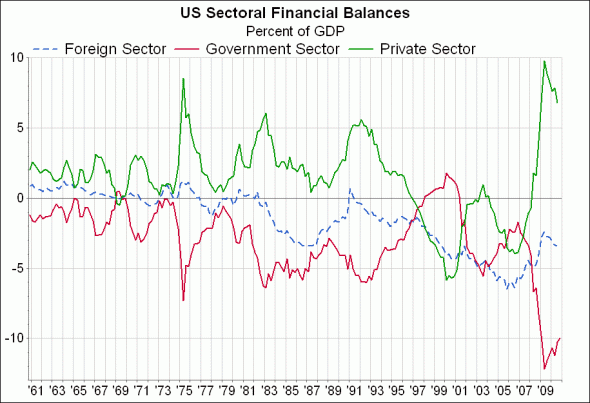
The current budget deficit is much needed at a time when unemployment is high and private sector debt burdens remain staggering. Make no mistake – this is not your average recession. If this were 1981 or 1991 I would not be so apologetic for the government’s largesse. But it really is different this time. As Richard Koo has so often reminded us, a balance sheet recession really does mean “it’s different this time”. And for those who don’t trust the math look no further than Europe where they are cutting budget deficits and their economies are sinking deeper and deeper into a hole. Is that really what we want for America?
By constantly comparing us to European nations (a sure sign that Mr. Ryan is a political fear mongerer and nothing more), the Chairman of the House Budget Committee has proven (without a shadow of a doubt) that he does not even come close to understanding the plight of the US economy. And because of that he continues to peddle the same neoliberal nonsense that helped get America into this mess in the first place. It is bad economics and it is even worse for the future of this country.
I apologize for the rant-like note, but the state of America is sad right now and the last thing we need is a politician posing as a financial guru telling Americans that they need to suffer more. Mr. Ryan clearly doesn’t understand that the government is a tool that is to be used by the private sector to further the prosperity of the private sector – NOT to benefit at its expense. Scaring a currency issuer into thinking that it might run out of money is like scaring yourself into thinking that the air might run out of oxygen. The entire idea is nonsensical. If Mr. Ryan knew what he was talking about he would at least be trying to scare us into believing that hyperinflation is right around the corner (of course, that would be nonsensical also, but at least it would prove he knew what he was talking about).
If Americans knew any better (why should they understand this stuff when people of such power clearly don’t?) they would kick Paul Ryan out of Congress so fast he wouldn’t know what hit him. But this is the state of US economics and politics today. While millions are unemployed our leaders are worried about debt ceilings that do not matter at all (that’s right, that whole debate is 100% politics as well) and the best way to incite anger in a population that knows less about economics than the people running the show. Our country has become dominated by ideologues and political sideshows. And we are all worse off because of it.


Amerika is monetarily bankrupt.
You are clearly morally bankrupt.
David Cameron is right.
See you at the soup kitchen USSA. (you first Warren, no after you Cullen, after all, we were both proved wrong)
When lacking cogent or intelligent argument – just insult people. You do realize this sort of comment makes you look silly, right? I mean, if you were debating someone would you expect to win by calling them names or would you attempt to defeat them thru use of your intellect? Name calling is what you do right after you lose the argument, throw a hissy fit and stom out of the room.
I’m all ears to those who can counter my comments with facts. Im quite open minded after all….Unfortunately for you, hissy fits don’t go over too well on this site. Now everyone thinks “jo” is an inferior thinker and of age between 6 & 10.
Redeem yourself or keep your tantrums to yourself. This isn’t a God damn joke to me. This is people’s lives we’re talking about so if you’re going to make an argument it better be pretty good.
And for the sake of you and your fellow countrymen – i hope i am wrong about Cameron. But it’s sure not looking good right now….
After all, Ireland took the “bold” and “courageous” step of austerity in the midst of a balance sheet recession almost three years ago. They’re on the brink of utter economic ruin
~~~~~~~~~~~~~~~~~~~
As always, our host ignores the reality, and twists facts to suit his arguments.
Ireland would be ABSOLUTELY FINE right now if it told the bankers/EU/IMF to get stuffed, and just defaulted on its debts, the vast majority of which arose trying to save its banks anyway. Let the banks fail, let the Euro project fail, let the people start again debt free.
As for the other points in the article, nothing to surprise us is there? Just another argument for a Keynesian spending splurge and damn the consequences. Our host, Koo, Krugman et al all seem to think there will never come a time to pay. Well, that time is now, and good for Paul Ryan and David Cameron for doing/suggesting the right thing.
And as for the MMT, when will you guys wake up to the fact that it’s just an intellectual plaything of yours, it means nothing in the real world.
Actually, MMT only describes the world we all live in. You appear to be trying to reject our economic reality instead of actually trying to learn about it.
Ireland would be better off if they had never joined the Euro project to begin with. Had they kept their own currency they’d have better options now.
Sorry Cullen, but…wrong!
Ireland joining the EUR meant such a huge boom for them that they became from a poorhouse to one of the most prosperous nations in Europe. Now it is time for payback, but they should clearly default to the banks (like Iceland) and keep a big chunk of that prosperity.
You would be better off if you stop seeing the world thru the MMT dogma lens only. Every school of economics has some valid points. MMT describes the reality alright, but also makes prescriptions, which are by no means clear to be superior to others over the long term.
I agree that the problem is that the top 1% gets a bigger and bigger chunk of the wealth. But the solution is not necessarily more deficit spending. You can increase their taxes, make them actually pay taxes (together with big corporations) etc.
InvestorX
InvestorX
Explain to me how increasing taxes on the wealthy do anything other than make people feel better about sticking it to the rich. This merely indludges a crusade rather than actually making fundamental changes that will enable people to be acheive their potential and be net contributors. It’s not like the government will take billions of additional dollars from the wealthy and then divide it up amongst the bottom 60% of wage earners (which, incidentally, pay zero net dollars in taxes after giving effect to the EIC). The extra money will be spent sub-optimally, as governmental spending decisions are so politicized as to be completely disconnected from any notion of return on investment. The money that is spent and the projects on which it is spent are distorted by unmotivated beauracracies that themselves have been skewed by political considerations. There will be no economic benefit to the masses by increasing taxation.
I agree that wealth is too concentrated and that a vibrant, motivated middle class is critical to the long term economic and social success of this country. Taxes won’t fix that, long term. The only way to solve that problem is to make fundamental changes (which can and should be catalyzed, at least in part, by the federal and state governments) to promote educational balance and success, effect cultural change in the specific communities that do not support excellence, and create a backdrop of growth and an increase in prodcutive capacity. That is how you both increase overall wealth and put it in the hands of more people. “Trying to tax your way to prosperity is like standing in a bucket and trying to lift yourself up by the handle.” – Winston Churchill.
Scott
Claiming to be responsible in balancing the budget via taxation is disingenuous and not about responsibility but about maintaining the same expenses and growing Government.
Some of those so call taxation lovers are living from family Trust money and will not be affected at all by any tax increase.
Like it or not, MMT is just a description of a fiat monetary system. You keep telling me that I see the world thru some weird lens. It is the lens that is real. You, on the other hand, prefer to view the world thru the gold standard lens. I am sorry, but that lens became defunct in 1971. MMT is not a prescription. IT IS A DESCRIPTION. You need to re-read this:
http://pragcap.com/resources/understanding-modern-monetary-system
Anonymous, the rich will never pay their share of taxes because along with wealth goes political power. Definition of a plutocracy.
Cullen,
You may be overlooking the fact that psy-ops strategies are now commonplace in the disinformation campaigns being wrought upon the good people of the US. Part of the bankers strategy is to hire people to troll websites and voice opposing opinions. I don’t know whether Jo is one of them or not but I always keep that in mind. This person is either moronically stupid or paid to act that way.
Trollers gonna Troll.
Ryan as head of budget committee is like Kadafi as head of human rights at the UN. The world has gone insane.
( Morons in Control )
looking at that graph, one thing stands out. The “foreign sector” has been steadily getting more negative for 50 years. This trade defecit is America’s real problem.
If we assume that the public can’t stomach big deficits, then the proper thing to do is to understand the entire accounting identity and then present policies to impact those behaviors. Which means we should deal with the trade deficit, because I assume we all agree private sector savings is not a bad thing. Oh, and then we have to deal with energy because $300B of the $500B trade deficit is imported oil!
It is the largest component of imports, $196 billion dollars or 10%….
Andrew P is absolutely correct! And don’t forget to mention how the plutocrats are using a two-party democracy to divide and conquer our country. Just reading the responses to this article, you know the plutocrats have no worries as the proles/peons/vulgar masses pointlessly fight among themselves.
Close trade deficit with tariffs, rebate revenue back into private sector via payroll tax cuts. Levy Institute paper three years ago estimated 15.3% FICA could be cut by 4.8 points. Call it the fair trade tax cut.
)
http://webcache.googleusercontent.com/search?q=cache:hJTJbMq3zt0J:www.levyinstitute.org/files/download.php?file%3Dwp_538.pd
Spot on, absolutely spot on.
Here’s the ridiculousness of Paul Ryan’s budget. He cuts entitlements, medicaid and other social safety nets by trillions, and then cuts taxes giving money to the richest by the same amount.
So how is he able to show that he will save the tax payer several trillion? His budget makes the assumption that by cutting taxes, they will spend more and produce the savings he believes he’ll make.
Utter nonsense. Paul Ryan; cutting tax revenues will cut deficits. We know that cutting taxes are one of the worst ways of stimulating the economy, makes far more sense for the government to take that money and do focus spending on various infrastucture projects, much like F. Roosevelt.
On a side note, why are entitlements called entitlements? Because the people are entitled to them, they have been paying for these entitlements and therefore are owed the money back.
MacroLux,
“We know that cutting taxes are one of the worst ways of stimulating the economy”. Really? Many studies have shown that tax cuts increase tax revenues. True it is contrary to liberal beliefs, because it doesn’t support a “distribution of income” ideology. JFK got tax rates lowered and tax revenues increased by more than 60% during the 60′s. Also Reagan’s tax cuts generated a more than 50% increase in tax revenues during the 80′s and many millions new jobs…
I have read that tax cuts have some stimulative effect, but inversely proportional to the income level. The claim was that for most effective stimulus, use food stamps. I believe only a fraction of each dollar given to the upper class gets spent, making it less effective. I really have no idea where I saw it, but it was some academic paper, I believe.
MacroLux, you have a very bright future in either the DNC or MSM….
I am torn. On one hand the accounting entities cannot lie: having the government show a ‘profit’ is dumb.
The US cannot be forced into bankruptcy the way Greece and Ireland have b/c the US issues its obligations in its own currency. At the same time, the EU’s attempt to wring crude out of Libya by force give both countries and more the incentive to endure the unendurable currency/euro burdens.
While the US is not Greece, issuing more and more debt is issuing more redundant claims on the same amount of output. At some point the issue becomes noticeable and the issuers look like goofballs. This is the point when confidence is lost in the issuers and deleveraging begins and runs out of assets take place.
This dynamic leaves monetary/fiscal stimulus as ultimately self- defeating. There is no substitute for output.
Unfortunately, output in America and in the industrialized West is dependent upon mispriced inputs. When inputs are repriced to represent their true worth (another set of accounting entities) the process of using the inputs falls underwater. Basically, the consumption — or ‘waste- based economy’ — has been too successful in ‘efficiently utilizing’ (wasting) irreplaceable capital resources. What left is for the establishment to attempt to substitute money/credit for the inputs.
This is as futile as austerity. Both austerity and stimulus reach the same endpoint without a constant expansion of available natural capital to waste. Ryan articulated badly and is an energy- company tool but he does capture the essential zeitgeist of the energy- deprived ‘now’.
While ordinary macro economics suggests that substitution is a natural part of economic development, facts suggest otherwise. There is no substitute for cheap (- $30/bbl.) crude oil. Not even expensive crude oil will do …
What to do? First is to jettison the waste- based economy even as it is in the process of jettisoning us. What is needed is a new form of economic thinking which considers input capital to be as real as money capital. Profits must be gained by conservation and husbandry rather than consumption. This will probably mean de- industrialization but the alternative is going to be de- industrialization, anyway. Repriced inputs are currently stranding greater parts of the waste- based economy. This stranding manifests as excess capacity.
The excess leads to deleveraging which leaves inputs as too expensive to have access to.
Add this to a loss of confidence in the economic managers and there is no room left to maneuver.
Ryan is intellectually dishonest. He does not offer any solutions other than to shift costs in an attempt to ‘hedge’ rising input costs. He’s the walking, talking mortgage credit bubble. But is is right about one thing: from an energy resource standpoint, the USA is bankrupt.
All very good points, especially stimulus leads to the same end result as austerity.
You are right – the financial manipulations have obscured the picture of the real economy and real input costs and efficiency. Exactly that it is why all these meddlings should stop before the USA becomes the USSA.
InvestorX
Kick Ryan out? You may be right. But who should we kick out along with him? Or let me phrase it differently. Who, according to his or her knowledge of economy and voting record that satisfies you, should stay in Congress and Senate after you kick out everyone you don’t like?
I would keep everyone that voted for the Kaufman amendment and kick everyone else out.
The wonderful thing about MMT is that as a society we can ask the question, “what do we want the government to provide for us” – and financing those plans in never a concern (though we may have to make some decisions if those needs push the country to full employment).
It’s just so sad to be screaming about something that isn’t even remotely a problem. Its just a distraction from the true question.
Ireland is in collapse because our huge trade surplus is being used to transfer wealth to the towering Spires of London , Paris and Brussels.
These centres of power cannot experience austerity.
Its amazing – they just produce bits of paper with no goverment backing before the crisis yet we are subjugated by forces both inside the country and outside to pay these debts.
We cannot default on the ECB (why can they not print Euros ?) which prevented rollover of this paper and we cannot default on the remaining private bond holders in the so called interests of stability.
This gigantic trade surplus is the mark of a colony.
Then again when we had more imports back in the late 90s and naughties we blew most of it on consumption ( ALTHOUGH WE REMAINED IN SURPLUS ALL THIS TIME) – its almost as if the banks did not want us to industrialise further.
External Trade Dec 2010 (Prov) jan 2011 (Prel)
Thanks for the rant, I needed that. It saved me from emailing and asking your opinion of it.
Pretty much what I thought as well based on my education from you and others.
I am doing my small part by emailing and calling talk radio shows but the fearmongering is entrenched and pervasive throught the whole system of politics and media.
And, it doesn’t help to futhur the MMT cause when regardless of what the monatary base and inflation numbers say, people are paying more for the basics.
It seems ingrained to tie it to Govt spending.
Isxcowpoke, so the taxslaves have more to fear from budget reduction than spending?????
There is little doubt that a lot of government spending is on bureaucracies that actually inhibit private sector progress (Dept of Education, Agriculture etc). In NYC, there is now a growing movement to cut back down on the endless red tape and harassment of small business by local agencies. I only hope that this deficit hysteria impacts those programs/agencies and leaves the essentials untouched (and throws in tax cuts for the middle class). In other words, the silver lining could be a less anti-growth government, lower taxes and just a slightly less out of control deficit, Cuts of the kind Ryan is talking about though would be disastrous.
No it would not, Carnahan….As the free enterprise system becomes more efficient and grows at a higher rate, this also results in higher tax revenues for the state…
I really question whether folks who are commenting have actually read Ryan’s report. Yes the report is a joke but not for any of reasons mentioned. Ryan cuts nothing–NOTHING. What it does is cut the projected increases from the absurd to the merely insane. If the world runs perfectly, it won’t, our budget would be in balance by 2040!
But no worries. Nothing will be done nor can it be. Critical mass was reached years ago when folks realized they could vote themselves the treasury. Kick back back, put your feet up and chill. You will be dead before the bill comes do. I have listening to this hokum for over 40 years with all the attendant monetary theories. Ahh for the simpler times of M1 and M2. :~))
Did you actually read the post yourself? You might learn something.
The federal deficit is NOT a by product of taxes and spending (they are inputs but not the only inputs); but an outcome determined by the savings and import behaviors of the private sector.
You can’t escape the accounting identity. If you think you can then I’m guessing you also still think the world is flat.
Adam, as I said I read the report. If you read it, you read it only through your MMT lens. Putting aside your theory, the intent of Ryan’s plan and the supposed Austeria that folks imagine would/will occur, my comments were directed at something that will never happen–meaningful deficit reduction. There will be no cuts of any substance for the reasons I mentioned.
In the meantime keep your ad hominem bullshit to yourself.
I’m sorry if I mis understood the intent of your post, but when you say, ” Critical mass was reached years ago when folks realized they could vote themselves the treasury.” I read – Congress and the people voted for the deficits and they wont give them up.
That is not the case. The deficits have to exist by identity given the desires of the private sector to net save and to buy lots of imports.
Amazing theory – please enlighten me how does the government know how much the private sector desires to net save, so that it adjusts the spending to that? Or does it happen automatically? (I would be curious to hear the exact mechanisms)
As I see it, accounting identities do not show you the way of causation. It is more likely that the govt spending forces the private sector to net save (sounds a bit like Ricardian equivalence, doesn’t it?)
InvestorX
InvestorX, basically, you should watch demand pull inflation and adjust the fiscal stance accordingly. Better yet, take this out of hands of the politicians entirely (or to the largest extent possible) and rely on automatic stabilizers, such as Job Guarantee and inflation-adjusted tax rate.
Sounds good, but if it is not automatic stabilizers, then it is exactly the same what Ben Bernanke is trying to do. I do not believe efficient central planning is possible after some degree of involvement. And the West has clearly went past this point, where state meddling in the economy is too much.
InvestorX
it is exactly the same what Ben Bernanke is trying to do.
No, because Bernanke can only use monetary policy, which MMT sees as distortive and ineffective. MMT has little use for monetary policy and would use fiscal policy, be it automatic or not.
We know for a fact, that the pvt sector cannot save ONE DIME if we run a CA deficit of -3.5% and don’t deficit spend to the tune of at least 3.5%. These are accounting identities that you dogmatically reject. Read this until you can recite it verbatim:
http://pragcap.com/resources/understanding-modern-monetary-system
Ok Cullen, I will assume that we need a budget deficit to offset the CA deficit (although I still do not see the way of causation here – all accounting identities only). So now let’s get back to the net saving of the private sector, adjusted for the CA deficit. My points still remain valid.
Further points:
1. Why does the private sector need to net save at all? This what all Keynsians and MMTers actually hate – saving.
2. Why does the net saving of the private sector need to be in financial assets? It seems to me it is mostly in hard assets and toys.
I am seeing the world thru all lenses. MMT is a good lens, but it makes a lot of assertions and prescriptions that are not proven to be the only correct ones. So it is not descriptive only.
I guess in future I will stay away from religious discussion on economic theories.
InvestorX
The point is, with CA deficits or even a balanced foreign sector, a govt that runs buget surpluses drains the pvt sector of the assets in which it needs to be productive.
“As I see it, accounting identities do not show you the way of causation. It is more likely that the govt spending forces the private sector to net save (sounds a bit like Ricardian equivalence, doesn’t it?)”
Correct it is not a cause and effect. But one can not exist without the other (or the math doesn’t add up). As for Ricardian it doesn’t exist. Just look at the chart. If the Ricardian equivalence existed how could you have the private sector going into debt with massive Bush deficits in the mid-2000′s? I can give you more examples that refute the Ricardian equivalence argument if you wish.
Adam, if federal spending is reduced to zero, would there is be a deficit??
Hans,
So you want a zero deficit. I would highly recommend you think through your desires before go about blabering about them.
Run the logic through the accounting Identity – remember it is a fact unless you feel that there is something wrong with 500 years of double entry book keeping…
Government Sector Net Spending/Savings MUST EQUAL Net Savings of the Private Sector PLUS the Net Savings of the Foreign Sector
Net Savings of the Foreign Sector = Balance of Trade.
In 2010 the US trade deficit was $497 Billion. $300 Billion of that was imported oil.
So for the Deficit to = 0, the private sector either has to add debt equal to the trade deficit OR you have to figure out how to get the trade deficit to 0 or into surplus. AND you need to do this without causing such a deep depression that the angry masses don’t hunt you down an put you to the guillotine or it wont matter what you want.
Sorry about my ignorance, which is plentiful…
Adam, thank you for your reply….What I am understanding, that nationally and as well on a global bases all economies books must balance out (no different than a business balance sheet)…
I am sorry to go off topic, but I always wondered why the old stand by GNP was replaced by GDP…
Now this from Dr W. Williams:
The related Gross National Product (GNP) is the broadest U.S. economic measure and includes the GDP plus the balance of international flows of interest and dividend payments. For net debtor nations such as Guinea-Bissau and the United States, GDP usually will show the stronger growth than GNP, since the outflow of interest payments does not get charged against economic activity. For this reason, the United States switched its primary reporting from the GNP to the GDP in 1991. Put in perspective as of the “final” estimate of second-quarter 2004, annualized real GDP growth was 3.3%, down from 4.5% in the first quarter, while GNP growth for the same period was 1.9%, down from 3.9%.
I should take this topic to the Discussion Forum, before I am reprimanded….
I just got all excited when I was reading it…
Hans,
Sorry if I sounded snippy. I sometimes confuse trollish questions for real questions. Anyhow, I with regards to GNP I think you’re missing a key item in the definition…
“GNP = Total value of Goods and Services produced by all nationals of a country (whether within or outside the country)”
The key missing item is NATIONALS. So many traditional US businesses are now owned by Foreigners (not US “nationals” anymore) and so many foreign nationals produce here that GNP is not very relevant to US production anymore.
Adam, I only troll when I go fishing…lol
Sorry, however, your definition of GNP is not correct…
How convenient not to deduct interest payment from production!
http://www.investopedia.com/terms/g/gnp.asp
I think we both might be off on the definition…
From the St. Louis FED http://www.bea.gov/national/pdf/nipaguid.pdf
see page 6.
Thank you for the link, Adam…I will read it; understanding it will be another matter….
Adam, I think I am getting this….The GP is a giant loop and it must all balance out at the end of the day…
Your excellent examples state, that when there is a surplus in one account it MUST be offset by an equal amount…
This involves three sectors, the private markets, government and foreign trade…
I forgot to ask why this recession is a Balance Sheet Recession and the others where not (I am assuming)…
Many thanks to you and Peter…
Balance sheet recession…
If you haven’t seen any of Koo’s video’s on Japan’s “balance sheet recession” I would highly recommend you watch at least one. He does a good job of explaining it.
Anyhow, my version…
The private sector is made-up of individual persons or businesses. They very much have to finance their expenses as USERS of the currency – including the cost of servicing their debt. Over the past 15 (or more) years the private sector has taken on a lot of debt. Since they must finance this debt it can not grow exponentially for long. Hence if it does grow exponentially, at some point it tops and the “bubble” bursts.
Since the private sector must fund its debt expansion it either must do it with future income (a return on its debt financed investment) or with future savings (reduced consumption). Since so much of the debt expansion was to finance consumption when the bubble burst it mean consumption had to decline & SPENDING = INCOME… so declining spending means a declining GDP.
In PAST FED induced recession, interest rates were raised and demand fell because the cost to borrow went up. In our balance sheet recession nobody can afford to borrow so the cost of borrowing (expensive or cheap) does not factor into funding private sector consumption via borrowing – hence the impotence of FED monetary policy.
On the government side we have a fiat currency which gives the federal government the flexibility to fill that spending gap, but even if we were still on the gold standard the government has a much greater ability to borrow because the government exists beyond a person (and has an entire economy to tax). No bank is going to allow a 99 year old individual to “roll-over” his debts because he is very likely to be dead soon. While all governments eventually end, over any short period of time that probability is far lower than any individual human hence a government normally has a far greater decree of capability to expand its debts.
Dear Sir,
Your argument here does not take into account the so called “anomalies” you neglect to include in this discussion. Namely…
What about all the countries (besides the UK and the USA) that run both private and public positive (+) current account balances?? How do you explain these situations? Canada, Taiwan, Germany, Luxembourg, Singapore, Korea and Hong Kong would not fit so neatly into your proposition above.
http://2.bp.blogspot.com/_Et4TQ-a0gGU/TLMPnRg3NiI/AAAAAAAADSM/PrVpHpmn5tM/s1600/FBM.JPG
P/S Please keep your personal politics out of future articles as they diminish your stature, cloud your judgement, and will turn 50% of your readers away.
News flash… It is mathematically impossible for every nation to run a current account surplus. If you add up every nations current account balance it must equal ZERO!
The ONLY way a nation can consistently run a Government surplus without indebting the private sector is to have a trade surplus – but NOT EVERY NATION CAN RUN A TRADE SURPLUS – it is mathematically impossible!
Adam
Assuming there is no trade deficit and Government spending is reduced wile taxation remain the same. We would get a reduction in the private sector savings. Is this not the same as paying your bills with savings ?
Obviously if we all pay out our debt in the near future there will be a temporary slowing down in consumption. That is more a consequence of past expansion that the cause of recession.
Like it or not only governments create net “financial” assets. But continuing to only use deficit spending “vertical money” to balance and fund the economy explains “the devaluation of money by the command of the state instead of the estimation of real business”. Record high and continued deficit created artificial demand that lead to what we just had and then the only answer is to increase the deficit to avoid a repeat. Not so sure about that.
Not ever reducing such a large deficit is like extending a infinite creation of currency that is never balanced by a government liability.
Even assuming it was more modest and more in line with the real economy’s money supply needs the Government should be a separate an accountable entity and the money supply should come from an totally independent and “non politicized entity” (a computer could probably do a better job than what we have now) and not have to be diluted and corrupted via government process and expenses.
Spending = Income.
Government Sector Deficit = Non-Government Sector Surplus.
Unless you can convince the private sector (non-government sector) to NOT net save you are going to end up with a deficit regardless of the government’s policy. Of course the government could reduce everyone’s income and saving to zero and force the equation to equal at 0, but I would suspect that a revolution would have occurred by then. There is a reason that the government has run a deficit for the most part of 200+ years.
Net exports.
TPC talked about it 100 times already.
Look at the graph. There are 3 items on it.
Some info on Singapore from a comment on neweconomicperspectives (emph mine):
Peter D,
How dare you publish data that might contradict someone’s well established delusion (hehehe).
It didn’t.
Scratch that. Sorry, misread your post. Nothing to see here.
Singapore, public debt consists largely of Singapore Government Securities (SGS) issued to assist the Central Provident Fund (CPF), which administers Singapore’s defined contribution pension fund; special issues of SGS are held by the CPF, and are non-tradeable; the government “has not borrowed to finance deficit expenditures since the 1980s”
Excellent data, Peter….Lets not for forget the Socialists Norwegians with a 160% debt of GNP….
I see you are very prominent on the net….http://heteconomist.com/?p=679
Stick around Al. I am an equal opportunity political hater. I’m a registered Republican just so you know (although I am really a moderate). But its not about politics to me. Its about good economics.
Cullen, your jealousy and envy of the wealthy suggest a typical American liberal’s contempt of individual rights, not a moderate.
That’s interesting considering I am in the tax bracket that Paul Ryan most wants to help out. Your assumption that I am some poor liberal is sad and pathetic. Your sort of thinking is what’s wrong with this country. The wealthy should not look down on the middle. We should recognize that it is the middle class that makes America great. That effort to move from the middle class to the upper class is what makes America so dominant. The fact that you don’t understand that is, in large part, why we’re in this mess to begin with. The rich can’t seem to look beyond their own wallets and recognize that if the middle class does well the economy does well and if the economy does well we all do well. I could care less if you cut or raise my taxes 10%. The extra money doesn’t impact my life too much. But it is having a dramatic impact on the middle class and our economy.
Cullen, your one insight regarding monetary operations does not mask your general stupidity.
I called you an “American liberal” and said nothing about your wealth status. Further, you are conflating income (a flow) and wealth (a stock). You may very well be in a high income tax bracket, but you are not particularly wealthy.
Then your 16 year old girl-like paean to the middle class is just idiotic. The middle class is so hard working they form the backbone of the country, yet they would perish without government handouts? Bit of a contradiction? Honestly, the American dream is going to die without the home mortgage interest deduction and if Medicare is changed one iota? Gives us a break… what years by the way were those policies put into law?
The facts are, to prevent an explosion of government debt in the future (since you agree that deficits do matter), we have a choice between cutting entitlements or broad based tax increases on all Americans. Even the most cursory knowledge of tax shares, you would know that a tax increase on high incomes doesn’t come close to preventing a debt explosion in the out years. The choice is cutting middle-class entitlements or a middle-class tax hike through a VAT.
Instead of writing substantively about the issue, you cut and paste from Mosler, beat your chest, call everyone a moron and make some half-baked assertions.
For example, you write,
“If Mr. Ryan had it his way we would be running a budget surplus currently and the private sector would be deeper in the red than we were leading up to the current crisis.”
This sentence illustrates your complete lack of familiarity with the proposal. Even by Ryan’s own estimates, his plan doesn’t run a surplus in any of the next ten years.
Pathetic.
The plan doesn’t have to run a surplus to be disastrous. If you could overcome your ideological beliefs you would actually understand my argument. Instead, you just throw around insults like we’re two children standing on a playground. The only thing pathetic here, is the fact that grow men behave the way you do.
So you were factually incorrect to write ” If Mr. Ryan had it his way we would be running a budget surplus currently”?
So you agree that the current trajectory of budget deficits in the out years would lead to a hyper-inflation?
The proposal doesn’t make any changes to Medicare for current recipients and near retirees. It’s a deal to address the out years, and, rhetorically at least, you appear to agree that projected deficits that would lead to net publicly held debt in 400 / 500 / 600% of GDP ranges, do matter.
Now you could say, Ryan/CBO projections of future deficits are BS, you’d rather see more tax increases in his plan and less changes to entitlements, OR you could take the logical conclusion from much of your writing and finally state that you simply don’t believe deficits matter. That would have been informative.
Instead, you write a sophomoric political rant calling for the workers of the world to unite and making every simplistic trope about Paul Ryan hating the middle class, etc., etc.
Who’s being childish?
No. His ultimate goal is persistent budget surpluses. Are you rejecting that? The plan clearly states that the country will be running consistent surpluses in the future. Sure, they’re way off, but who cares? If Ryan could wave his magic wand he’d eliminate the Federal debt today. It’s pretty obvious that that is his goal with this plan. Are you denying that fact? Yes, you are. And you’re making a semantic argument in an attempt to prove some nonsensical political point. We all know Ryan’s plan is to run surpluses.
I have never said deficits don’t matter. But again, you’re just putting words in my mouth to prove a semantic argument. It’s clear that you haven’t taken the time to understand my point of view. You wouldn’t say something so naive if you had. So, instead of trying to understand your opposition you have resorted to insults and childish behavior.
Go back and read you insult laced comments. You aren’t being objective at all. You’re just insulting me because your argument is weak. It sounds like a conversation I might have with a 6 year old on a playground. Pathetic? Look in the mirror. The only thing pathetic here is the fact that grown men come on the internet and act like children and force me to baby sit them and monitor their behavior. Learn to act and argue like an adult. You lost this argument the second you started throwing around the ad hominems….
Cullen you claim you have never said deficits don’t matter, but then attack a plan that purports to deal with the long term fiscal situation by claiming that the plan’s author wants to run a surplus now, even though the plan doesn’t run a surplus in the next 10 years. Nowhere in the post do you suggest that the intent of lowering long term deficits is a good one. In fact, you write childish,immature political tropes regarding Paul Ryan’s desire to steal from the middle class and give to the wealthy. Then, you focus on something (running a surplus currently) that isn’t in the plan, but you think would be in the plan if Ryan would write his “true” plan. If you are going to analyze imaginary plans that haven’t been proposed, do you honestly think Paul Ryan, Jr. in 2070 wouldn’t be arguing for tax cuts if debt to GDP had to stabilized at 50% and we were running surpluses as far as the eye can see? Give us a break.
People don’t believe you when you say you’ve never said deficits don’t matter because everything else you write leads to that logical implication. This post is a perfect example. If you are opposed to making changes in Medicare and opposed to broad based middle class tax increases, then, you are essentially saying deficits do not matter, ever.
If you don’t think your numerous posts along the lines of “everyone who doesn’t spout MMT on all occasions knows nothing about the economy and wants to stomp on the poor masses etc.” don’t border on self-righteousness and adolescent-”I just read Atlas Shrugged for the first time”-like-arrogance, well, they do.
At least you tried not to insult me in this comment. Until the very end….
You’re just rehashing the same nonsense that Krugman claimed about MMT – that we claim deficits don’t matter. If you were actually familiar with what you were criticizing you’d be familiar with my position on this. I clearly explained it in here: http://pragcap.com/dear-paul-krugman-you-do-not-understand-mmt
But you’re not familiar with my position so you’re resorting to name calling and sand kicking.
You can call me arrogant, self righteous or whatever you want. It doesn’t change the fact that I am working with accounting identities and operational realities and most other economists and pundits are working with fantasy land ideological beliefs.
Cullen calling somebody a moron? Where did you see that? The one insulting people here is you.
Yes, you are the one with the healthy intellectual perspective : “I work with mathematical truisms and accounting identities. People who disagree with me are in fantasy-land.” Well-adjusted adult, indeed…
And lets make it three times a charm you can’t address a straightforward point: Claiming you think deficits do matter yet refusing to acknowledge either, 1) we eventually need to change middle class entitlements or 2) we eventually need to raise taxes on the middle class, is logically inconsistent.
Let me ask you this: saying that speed with which you drive your car is dependent on the road conditions – is it the same as saying that “speed doesn’t matter”? No it isn’t.
Now, if you actually took time to understand the MMT perspective – something that people actually spend time thinking about and which of course addresses all the points that you’re making – then instead of insulting the host of this blog you’d be asking questions to clarify things. I’ve seen many, many people starting totally hostile to MMT based on knee jerk reaction to what they believe MMT says, and then starting to appreciate its insights once they actually dedicate some time and intellectual effort to learn about it.
Start with Cullen’s essay on MMT, Warren Mosler’s book etc, then come back and ask questions.
I guess if you just keep putting words in my mouth then it must be true! I have never said entitlements don’t require changes. And I have never said we will need to raise taxes at some point.
” I have never said entitlements don’t require changes”
Yet you equate a proposed to change to Medicare above to “stealing”.
Needless to say, we disagree as to whether the above sentiments at minimum need amplification or at worst, are incredibly incoherent.
Just say it – you’ve believed the USA is bankrupt for a long time (and been wrong). 6 months ago when you came here you were yapping about sovereign restructuring, soaring yields and the scary debt monetization. So, let’s just agree to reconvene when you’re right about a USA bk, okay? Until then, go peddle your fear mongering elsewhere.
Here you go Al:
http://www.nationmaster.com/graph/eco_imp_rat_of_gdp-economy-imports-ratio-of-gdp
Boston Al, I completely concur….This thread has lead the author from economic to political science…
We should direct spend into labor and bypass the horizontal banks. Labor will then pay down their upside down loans, unfreezing the credit mechanism. Spending into banks adds more debt (open market ops to maintain the interest window) and causes sector inflation and carry trade.
A direct spend approach would give the politicians political cover, fix the balance sheet, and prevent some of the distortions we see. In order to spend the money, the politicians could have a “deal” where they re-regulate the banks. In the current political climate, politicians cannot just ask for more money without something in return. The people think they are being ripped off, but I bet they would listen if a deal was made.
I believe FDR used the RFC (reconstruction finance corp) in this fashion. Also, WW2 spending was 3/8 of 1% and spent direct into industry. So, the great depression (balance sheet recession) was paid down by paying labor. I’m willing to be corrected if I’m wrong on this.
———-
L. Randall Wray, “Understanding Modern Money” page 82; “The private sector cannot create net nominal wealth – every private finanical asset if offset by a private financial liability.”
This is only true on a bank ledger with a double entry column. The asset and liabilty come down at the same rate. Ultimately, the principle of the loan falls off the balance sheet and disappears when loan is paid off. The interest portion does not fall off, and enters the supply as payment to bankers. Gov. must deficit spend to overcome the interest portion. This is an unfortunate reality of our system, and MMT does not describe it. (If it does, I cannot find it.) Payment to banking and finance is fuel for “financialization” of the markets.
Deficit spending into the private banks is causing too low of interest rates and hence speculation, which in turn causes a commodity bubble and a carry trade. A lot of money is spent into unemployment which is also wasted capacity. Unemployed folks should be put to work building infrastructure. MMT addresses this somewhat with Employer of Last Resort concept.
Exactly where the money flows is important, and we are not doing a good job of getting money to the homeowners. As an aside, I would add that Homeowners are voters, and they got gamed with GLB and CRA (Graham Leach Bliley and Community Reinvestment Act provisions). GLB and CRA ultimately caused the housing bubble. Government and FED created conditons for the bubble, they need to undo their mistake.
Ren said; “We should direct spend into labor and bypass the horizontal banks.”
DING,DING,DING! We have a winner! You’re exactly right, Ren. I was talking with a friend the other day about what is the smartest thing to do amongst 3 choices.
1) Everyone (society) will pay for people on welfare.
OR
2) Kick all the people off of welfare….which will lead to desperation and misery. 4 days without food will turn man into an animal. That’s means robbery and murder skyrockets. Some people will pay with their lives (the rich will absolutely be targeted) and the ones who are caught will go to prison….where everyone will pay to keep them there.
OR
3) Give everyone who wants to work a job fixing our broken infrastructure. You still have to pay but at least with this route we get something positive in return.
Pick your outcome- pay people to sit on their ass either in a slum or in prison or pay for them to make the US a better place. We already know we can “afford” it as MMR (Modern Monetary Reality) demonstrates as an accounting identity.
Robert M, your prescription is correct, but you know it will never happen, the days of FDR are gone.
L. Randall Wray, “Understanding Modern Money” page 82; “The private sector cannot create net nominal wealth – every private finanical asset if offset by a private financial liability.”
How do companies grow?
Why are they purchased and or merged if they have no net nominal wealth….?
Is this why there are never any CEO’s with an economic background because they can not produce net wealth…?
Is it the Wray way or the highway?
Hans, if you want to see the accounting of this, follow JKH’s comment quoted here.
Peter, thank you for the link….The information contained forthwith is beyond my comprehension….
It is actually pretty straight-forward. It explains what “net financial assets” means – how other assets created “horizontally” by the private sector cancel each other on the consolidated private sector’s balance sheet, while injections from the gubmint in the form of cash, reserves and bonds is what remains in the netting (plus your counterfeit dollars, of course
). I am sure with a little patience and sweat you can get it!
So, what this theory means, Peter, you must have a government ledger in order to advance (grow) assets…
So, any nation without any function able form of government will not see a rise in assets? Is that correct?
BTW, I read various parts of this theory and still find the notion artificial and nonsensical…
Is theory really practical ?
No, it just means that in if you want any one sector (say, non-govt sector) in aggregate to net-save, the compliment sector (say, the govt sector) has to net-spend. This is not theory but simple accounting. Now, of course we can achieve growth etc with private sector even under barter economy (though its hard), but IF you want non-govt sector to continue to be able to save (which is its natural tendency), the govt sector MUST accommodate with its dis-saving (spending in excess of taxation, a.k.a the dreaded, scary, horrible DEFICIT.)
Why is private sector dis-saving bad? It could actually be good when economy is at full capacity and the private sectors starts unloading its accum. savings and causes inflation – in which case reducing deficits or running surpluses is necessary. But under most circumstances private sectors indebtedness is a recipe for bubbles and financial instability. The work of Minsky – one of the precursors of MMT – was all about that.
Thank you again for your reply, Peter…
Within this economic lop, when one side spends, the other must save and vice versa…
What would happen without a government component…?
Spending is spending. The key is the balance of leakages (savings, taxes and imports) with injections (investment (borrowing), government spending and exports).
Thanks for all your replies, Adam…..
You are quite a taskmaster, as I have a lot of reading ahead…
Cullen, there are two things in MMT I don’t get. 1) The quote in this post: http://pragcap.com/deficit-hysteria-the-debt-ceiling
“If the government is (a) required by the deficit legislation to spend, and (b) precluded by the debt legislation from borrowing, the Treasury would be forced into default.”
In MMT for the U.S., we credit accounts to “spend”, but you say that the debt itself is just a tool for controlling interest rates, but does not “fund” the spending, right? How does a lack of debt issuance cause default? There’s some basic premise I’m missing.
2) Why can’t the private and public sectors run surplusses if the foreign sector runs a signifcant deficit?
1) There is an archaic law on the books that prevents the Treasury from “crediting” accounts if it would overdraw its account at the FED. It would be a political default.
2) It is quite possible to do that, however the US is a long way from running a trade surplus (a requirement for the foreign sector to be in deficit) and not every nation can run a trade surplus at the same time. For every surplus there must be an offsetting deficit somewhere.
Thanks for the info.
Peter D: If a country can exhaust its foreign currency reserves, then what is the appropriate action to prevent that?
Well, running trade surplus, like the Chinese. The question is why that would be the goal in the first place? See this but with the caveat that if running trade deficit is contingent on domestic unemployment then the cost-benefit analysis should be reconsidered.
As Adam said, it is of course possible to run public+private domestic surplus as long as the foreign sector run a deficit, but only for a time, till the foreign sector’s cumulative savings of your currency are depleted.
I really do not understand this post.
You do realize that no matter what crazy theories you ascribe to the system, that medicare will literally destroy the country, and in 10-15 years.
You say that you don’t believe a country can constantly run the deficits we are running.
But you have no specific criticisms here, no part of the plan that really bothers you.
ryan’s plan is a long term attempt at fiscal sanity.
Where were the rants against Obamacare, which not only clearly is unconstitutional but a god damn nightmare!
I am disappointed by this post. It’s fine to criticize Ryan, but there should be actual criticisms (apart from his misguided thought that we need to balance the budget every year).
Where were the rants against Healthcare? How about right here – http://pragcap.com/thoughts-on-healthcare-passage
I have slammed many of Obama’s plans due to his politics. Please don’t try to spin this as something political for me. Readers should know better. This has nothing to do with politics and everything to do with good economics. I have slammed Obama time and time again. As a regular, you should know that Prescient.
TPC, my apologies, I withdraw that part of the comment.
But for those of us who do not have time to read through the thing in great detail, what are your biggest problems with it?
Entitlement reform MUST happen.
I am a big fan of two things: short term stimulus in the form of direct injections of funds to main street (tax deal in Dec. was an ok attempt) and big infrastructure plans. But the other side of that coin is real, meaningful entitlement reform.
What does Ryan fail to do. What do you propose should be done on these kinds of issues.
Thanks
“What does Ryan fail to do[?]”
Reduce healthcare costs.
What is does?
Shifts part of the spending from the government to the individuals.
Vouchers that will provide be less and less adequate by design.
2.9T tax cuts for the rich.
I am not denying that healthcare needs reform. But I don’t think this is the time to be worrying about it. You know we’re in a balance sheet recession. You know the economy is fragile. We need to focus on the task at hand. And that is getting jobs back and using govt to support the pvt sector. We cannot go bankrupt and we are not even close to high inflation. So why are we all worked up over becoming Greece when we know it’s impossible?
What I don’t like about Ryan’s tactics is that it proves he is using fear mongering tactics to get a political message across. We don’t need to be cutting spending right now. Most certainly not. But he is jumping on the fear mongering bandwagon in an effort to make a name for himself. It’s really horrible economics.
It is so frustrating.
Why can’t one person in Washington just come out and frigging say the obvious – the government is carrying the water while the private sector is continuing its massive deleveraging.
Once that is over, or even right now, we also need to talk about meaningful, long-term structural reform. argh.
What I really don’t understand are all these people on here trashing Bernanke though. He is providing a great amount of stimulus, although indirectly and doing what he can to “juice” the economy.
You want a straight shot of adrenaline, have BB buy corporates directly. That’s what the Fed used to do before WWII. Watch the market and, more imporantly, business hum if he did that.
Structural reform of entitlements is the wrong approach. The only two relevant issues are (1) more productivity, so that when people retire, the slice of the pie available for everyone continues to grow, and (2) growth in private health care cost as relative to GDP stops at some points or even declines. Neither of these involve sacrifice; it’s the opposite, in fact. But if you reform entitlements thinking that is going to solve the “problem,” you will probably get neither.
I guess I’m just confused. Are you saying that the massive debt burden, not only here, but abroad, is a non-issue? At what point does the bond market choke on the debt and rates begin to rise?
My thoughts are simple: I believe NOTHING will change until all this debt is restructured, i.e. – a haircut. This is textbook debt-deflation being held off by massive monetary stimulus. It’s akin to keeping someone on life support hoping that they’ll wake up one day.
Half measures availed us nothing. Everyone must feel the pain. Certainly the banks.
Yes, haircuts would have been a more appropriate approach. I was in favor of that in 2008. I said we should focus less on bailing out banks and more on helping Main Street. But we’re well beyond that point by now. The point with regards to the “debt burden” is that there is no such thing as debt for a currency issuer who exists in a floating exchange rate system with no foreign denominated debt. All of the “debt” is denominated in a currency that we alone can produce. This is unlike the EMU. This doesn’t mean the “debt” doesn’t matter. But it cannot result in default like it can for a EMU nation (which are currency USERS) or a household or business. The only form of default we can suffer is hyperinflation and I just don’t see how anyone can be worried about hyperinflation when we’re barely struggling to get even average historical inflation right now….
You might be interested in reading the following. It’s a lot to take on, but it’s worth it:
http://pragcap.com/resources/understanding-modern-monetary-system
Thanks for the response. I understand where you’re coming from.
You know, it’s funny. Greenspan, Bernanke, Geithner, et al, have made one massive mistake after another. Then, we have Wall Street interests, which clearly don’t coinicide with making our country a better place. Throw in politicians who are funded by large corporations (clearly demonstrating that it’s no longer a country of “We The People”)! Also, as you’ve alluded to, there is Main Street America, which doesn’t have a clue as to the severity or complexity of this crisis AND who deserves the some blame by over-extending themselves via credit of ANY kind.
This leads to me believe one thing: that NO MATTER WHAT “the powers-that-be” will try to do to combat this horrific situation, the decision(s) will simply be wrong.
I guess what I’m saying is we are in a losing situation, unequivocally. And, until The People finally have had enough, things will only continue to get worse.
No one knows what they’re doing. No one. That tells me that markets will go down. Plain and simple. Safety is paramount.
I do appreciate you trying to make sense of it all. It’s one hell of a global chess game.
Mr Roche, government debt and the percent of GNP are at record levels: when do we begin to address these structural flaws…?
IMF, is suggesting urgency!
Ezra Klein doesn’t understand our monetary system too well, but he is right about Ryan’s plan being a joke:
“For one thing, Ryan’s savings all come from cuts, and at least two-thirds of them come from programs serving the poor. The wealthy, meanwhile, would see their taxes lowered, and the Defense Department would escape unscathed. It is not courageous to attack the weak while supporting your party’s most inane and damaging fiscal orthodoxies. But the problem isn’t just that Ryan’s budget is morally questionable. It also wouldn’t work.”
Peter, the same old and tired arguments from the Maoist class…..50 millions non-producers sucking on the tit of Medicaid…5% of all Americans (21 to 65) on SSDI…25% of all children….
Hans, the problem of our healthcare system is not the Medicare/Medicaid. To think that just by cutting those you’d lower the cost of healthcare in this country is absurd.
Peter, I would be inclined to agree with your assessment…
This is the best rant I have read since his plan was released.
(Top 10 on Bloomberg by the way)
Thanks.
The bigger question here is what is the optimal / most efficient balance between the public sector and the private sector? If the public sector continues to expand given the entitlement projections, will that have detrimental effects on the real private sector economy? The optimal balance may be different in America vs. Europe or Asia. Clearly we must spend now to offset the deleveraging taking place in the private sector, but if that gov. investment/spending does not yield productive long-term benefits for our country we will not be better off in the years ahead. The debate should be on how the government resources are spent, not if they should be spent.
10% of GNP….
The trade deficit problem in my opinion is best described by Triffin’s dilema. The balance equations work, but they don’t capture the political element.
http://en.wikipedia.org/wiki/Triffin_dilemma
We are the reserve currency issuer, so we have to run a trade deficit to funnel money to a world that needs dollars. Triffin’s dilema implies that we have to be importer of last resort. This hoses down main street (dollars are desired in the world, hence they are driven up in value), making U.S. products expensive. Finance ultimately wins in this game, as the issuer of currency gets rent values from their issuance.
Given today’s world, we have to spend to overcome twin deficits. One for the balance sheet in private sector, and the other for the trade deficit. (I’m not endorsing our current paradigm.)
Cullen/others – what do you espouse? Deficits create interest payments. Federal Reserve serves the banks with bailouts while the risks they took that then failed are added to deficits (creating more interest payments and inflation with M3 inflating). SHould we forget the deficit? WHy not take it a perpetually higher number annually? Isn’t there a consequence in your opinion? My understanding is that Ryan’s bill cuts Medicare at the Fed level but issues block grants to states. Do you really want government to grow in perpetuity as is envisioned by current liberals? I admit I’m confused as to the interaction of all the dozens of factors of our gov’t/economy/taxation/deficit, but it seems there must be a stop to the spending.
“Spending” is a boogeyman. Most of the govt spending is not “wasteful” and is supported by the electorate.
And here, for example, the conservative Heritage Foundation – the backers of Ryan’s plan – are shutting down pretty much the entire federal government (except for Department of Defense, naturally) and managing to cut only about $300bn or less than a quarter of the deficit (and less than our whole trade deficit, which must also be offset by the govt spending!). And this does not take into the account what would happen to the economy if all those cut were implemented. When Mike Norman went on Fox Business, the best Varney could do to indict the stimulus package was 72000 dead people and 17000 inmates receiving $250. This is what, 22 million out of 800 billion? 0.003%? Find me another program less wasteful than this.
There is some waste, especially having to do with wars and other defense spending. The healthcare is a separate issue facing the entire economy and is not driven by excessive govt. spending but by our broken system.
“SHould we forget the deficit?”
The deficit by itself is a meaningless nominal number that by itself tells you nothing.
First start with the accounting identity (which is graphically represented in Cullen’s chart, though it’s broken out between private and foreign sectors)…
Net Spending of Government Sector MUST EQUAL the Net Savings of the Non-Government Sector.
For every dollar that is SAVED there MUST BE an equal number of dollars borrowed. If the Non-Government Sector is NET SAVING more than it is spending then by identity the only other player in the equation MUST BE borrowing. The net savings can not exist without the equal amount of borrowing.
Do you think it is wise for the private sector to save? I do. Which means that the government sector MUST BE in deficit (unless we ran a trade surplus whereby foreigners would then net borrow; but not every nation can run a trade surplus).
Deficits by themselves, as you can see, are not bad however there are other things to take into consideration… Is the economy fully employed? If the Net Government Spending causing demand push inflation? Combining all three of these things allows you too really understand if you should be worried about the deficit or not.
In the Mid-2000’s, as you can see in Cullen’s chart above, the government was in deficit; however the deficit was too small compared to the trade deficit (the opposite side of foreigners saving in dollars) which mean that the private sector MUST be spending more than it is savings – going into debt – that is not good.
James, Let’s say two powers – Japan and the U.S., decide to build battleships. Each day we send battleships out to the Pacific and then we engage, sinking each. We then build more battleships. We can have full employment building battleships, but we have crowded out the private sector. All people do is build battleships, but not other things they want and need.
Government has a role to play, but if it gets too big, it consumes resources from the private sector. Government also has to deficit spend to overcome deficits that are systemic. Reserve status and interest servicing at the root of private banking both require deficits.
If we ever run an account surplus, we borrow from the private sector. Private money comes into being with large capital costs (on average 40%). We are in balance sheet recession now precisely because Clinton borrowed from the private sector.
If we run a trade surplus, then dollars are sucked out of the world.
5 numbers:
$3.2 trillion (amount of 2011 projected Federal spending)
$2.2 trillion (amount of 2011 projected Federal revenue)
$1.65 trillion (projected 2011 Federal revenue vs spend shortfall)
$61 billion (GOP proposed cuts = 1.6% of 2011 spending)
$33 billion (Democrats proposed cuts = 0.9% of 2011 spending)
Even a 4th grader knows a family cannot spend more than it takes in, forever. Why should the US be any different? Families across this country have lost jobs, sold possessions, and had to cut back. Why can’t the US government do the same? Both Dems and Republicans should be ashamed of themselves for these miniscule cuts in the face of absolutely disastrous spending levels. 1.6% and 0.9% cuts are not sufficient, not by a long shot. Roll back Federal spending to decade earlier levels, is more like it.
IMHO your comparisons to the PIGGS countries of Europe are not comparable. The level of banking sector debt to GDP in those countries is markedly higher than in the US (see: Ireland). Their bailouts of their banking systems were/are orders of magnitude greater than the US bailout (95% of which has been repaid sans GM, GMAC, FNM, FRE and the other Dem pet projects). So proclaiming that the PIIGS austerity plans would spell ruin for the US is not proper, in my own opinion.
Politicians will destroy this country. At least Rep Ryan has put something bold out there (as opposed to the five numbers contained in the “settlement” above).
My 2c.
Why can’t the US government do the same?
Because by doing the same the US government will deprive those same families of even more income. Because money that US govt spends doesn’t stay with the US govt but goes into the economy. Because your thinking that US govt is like a family is the root of your misunderstanding of our monetary system.
Peter, the “government” has no money but only transferred payments from the taxslaves….
Hans, I am so glad to get some of those counterfeit dollars you printed in your basement that the gubmint taxed from you and gave me, hahaha.
The Secret Service is knocking on my door as I type…
Come out now, with your hands and printing press in the air!!!!! lol, lol
“Even a 4th grader knows a family cannot spend more than it takes in, forever. Why should the US be any different? Families across this country have lost jobs, sold possessions, and had to cut back. Why can’t the US government do the same?”
It’s not wht can’t but why should it. Families across America are USERS of the currency. They must always fund their spending. The US government is the ISSUER of the currency and has no FUNDING constraints – just dumb politicians.
Additionally, go back the accounting idenity…
Net government spending MUST EQUAL Net Savings of the Non-Government Sector
If you TRY and cut $61 Billion then you must force the NON-GOVERNMENT sector to cut its savings by $61 Billion (or of course the Non-Government sector can just keep saving and the economy shrinks and the deficit remains mostly unchanged). Take your pick.
Adam, I get mmt but the $ the govt is “spending” is going abroad. I have learned much from Cullen (u) but wish more would be said about not crushing the dollar and reducing the oil part of the trade def.
Unfortunately as a nation we are not talking about what we need to talk about. We waste out time talking about irrelevant thinks like government funding and government debt. We need to be talking about what can the government do to HELP ensure a health economy.
before I get myself in trouble, government “deficits” are not irrelevant but in the current environment they are so far down the list of items to worry about.
The budget of the US gov is not comparable to a household budget. I understand the desire to simplify the matter, but it just isn’t applicable. My household does not issue currency.
A US state budget is somewhat comparable, or a municipal government.
It is true that we cannot demand limitless resources of our government, nor can taxation exceed the ability or willingness of US citizens to pay.
Most other developed nations pay more in taxes, and receive more in services from their government, but even those services are limited.
If the level of taxation and services provided needs adjusting, then let’s do so honestly, and not use falsehoods to achieve it.
In the post above there is a typo, Federal spending projected at 3.82 trillion, not 3.2 trillion. Sorry.
You are an idiot of epic proportions .
Go have a read of the latest IMF report released today .
http://www.bloomberg.com/news/2011-04-12/u-s-deficit-will-expand-to-largest-among-major-world-economies-imf-says.html
IMF is an institution long adored by you liberals in that it loves to come in and bail out countries and then exert full control of the country ( the liberal dream to have a small number of self described ‘ smart people ‘ call all the shots )
IMF says USA is at the breaking point and has to start slashing spending NOW …… wait , isn’t that what Paul Ryan is saying too ?
oh my , IMF and paul Ryan now one and the same ?
go cry on Krugman’s shoulder with your fiscal insanity
IMF and Ryan can say whatever they want. That does not make it true.
You obviously do not follow the blog or understand the content.
The insults are uncalled-for.
Bart,
For what it’s worth you could be a liberal or a conservative and still be an MMT’er. MMT is about how the monetary system works. How it is implemented is a political decision. And you did not mention a single person or entity that has a clue about MMT. From an MMT’ers perspective the worst thing any country could do is invite the IMF in, they are as clueless as they come.
MMT is about how the monetary system works.
But that does not mean we have to be MMT’ers. I hope it’s not a religion. Understanding a monetary system does not make it rational.
I’m not a liberal. And I am one of Krugman’s loudest critics. You might actually try to familiarize yourself with someone before you run around screaming and insulting people like you’re in grade school.
“IMF is an institution long adored by you liberals”
Total bullshit. Liberals like myself have been fighting the IMF for as long as I can remember.
“You are an idiot of epic proportions”
Total projection on your part. You sir, obviously know nothing and are a perfect example of the Dunning-Kruger effect. You are firmly stuck in the left-right blame game. This is not a left-right problem but an up-down problem. Your strident ignorance impairs your thinking. Cullen is a life-long conservative and I am a life-long liberal and yet we agree on MMR. I know that doesn’t fit into the limited FOXnews world view but you can ignore reality for only so long.
I am really a moderate, but I’ve definitely voted both ways. As always, it depends on the environment for me. There is no one size fits all for me…
And if you want to know what real liberals think about Ryan (as opposed to accusing Cullen of being one), here ya go:
paul-ryan-has-balls
Sorry…link code disabled here.
http://www.rollingstone.com/politics/blogs/taibblog/tax-cuts-for-the-rich-on-the-backs-of-the-middle-class-or-paul-ryan-has-balls-20110407?source=patrick.net
Canada is cutting deficit and roaring. So is Germany. So is Australia. Somehow it seems to be possible to have prosperity (relative) without relying on massive govt deficit spending. Perhaps the structural issues such as outsourcing majority of mfg base is core issue.
Net Exports. Look above.
If you plug all of those countries into the accounting identity you will discover that they all have a trade surplus which allows them to run a budget surplus. We all can’t run a trade surplus at the same time it is mathmatically impossible. That said, running such a large trade deficit for so long (and allowing our trading partners to fix their currencies to the dollar) leads to such problems which prompted you to say…
“Perhaps the structural issues such as outsourcing majority of mfg base is core issue.”
…which to me is not a good long term policy for any country.
Canada’s running a -4% budget deficit with a -1% CA deficit. Germany is running a CA SURPLUS and a budget deficit. Australia is running a small CA deficit and a budget deficit of -4%.
The facts don’t lie. There is a reason why these countries are doing better than others.
Yes, but Canada ha a trade surplus. Oil that is……..
Cullen learnt a lot from you, thank you for your posts.
If the US take the Euro cut path it will transfer the burden on to it’s tax payers, but is the burden not already on them through higher commod prices. Assets would fall in a cut, but they are failing now(apart from stocks), so either policy will achieve the same aim just one would achieve it slower than the other.
I guess point being that Infrastructuer spending is not going happen and this is possibly the only policy to help the tax payer.
The economic destruction that should have happened to the banking system but did not and if it had happened to the banking system it would have happen to the Tax payer therefore are we not back to were we started anyway.
Ben B’s current situation is slowly bleeding tax payers, Ryans will speed it up, are both policys has missed guided and both achieving the same results at different speeds?
If we truly slash the budget (not happening yet) we will go back into recession and likely a deflationary downturn. That will be very reminiscent of Japan. It’s not a good environment. We should have gutted the banks and focused our efforts on Main Street. But the time for that has passed. Now we are going to have to hope that they don’t cut and we muddle through until the BS recession ends.
We really botched this recovery. And QE2 is making it all that much worse through the commodity cost increases.
Canada had massive infrastructer spending and it also benefited in a big way from China’s infrastructer spending (same in OZ) Canada has not even started to cut it’s deficit, but will after the election.
If China slows Canada which seems to think it has a magical economy, will get hammered truely hammered. Look at the drops in the TSX with commods down in the last few days, 200+ each of the last two days alone.
If China slows dramtically and the cuts come in at the same time, watch the housing market in Canada evaporate. Vancouver 1mil average home prices right now, will be savage.
TPC,
Agree with Al…a little too much personal politics lately from the “pragmatic” capitalist.
I’ll say it again. There are no politics involved. It’s all economics.
I’ve trashed plenty of Democratic plans in the last few years. I could care less for the politics. If you want to skew it that way then that is your political biases influencing your reading comprehension. This is purely about the economics for me. And to reject the above identities in favor of politics is like rejecting that 1+1=2 just because you have some ideological belief.
If you want to see me rip a Democratic plan just look at my response on healthcare. I gave Obama the same treatment. People who claim I am being political are trying to inject their own politics into a fact based economics discussion. You do so at your own peril.
http://pragcap.com/thoughts-on-healthcare-passage
“The land of Austeria sounds like a fun place doesn’t it? It’s a land where the poor get poorer, the unemployed go homeless and the banks get a government bailout on taxpayer dime. That’s the America Paul Ryan wants for us all. He wants to crush the middle class, steal their Medicare payments and pass them along to his wealthy friends. All in the name of stopping a Federal bankruptcy that is monetarily IMPOSSIBLE!”
Do you really want to speak to the man’s character like this? You know what’t in his heart, I suppose? If you wish to speak to your belief in his ignorance, there are better ways to do it. Intelligent people can disagree, after all.
I don’t know what your politics are, and can’t say I really care. I think your statement above is garbage. I sure do hope that you are not one of those out there carping about a lack of civility in politics. I don’t believe statments like that do anything for your credibility. FWIW
I’m sure Ryan is a good man. That doesn’t mean he’s a good economist.
Everyone wants to make this political. That’s bull shit. I would have torn Clinton in 1999 with the same exact rant. And you would have come here and written some comment about how you agree with me. That’s just politics. And I don’t care about the politics.
Stick, we indeed, Mr Roche’ emotions ran a little wild…
Every budget is a policy statement, hence, ideological as well as economic. The depression budget that Rep. Ryan has put forward is a purely ideological statement of extreme economic liberalism. It is based on the unwarranted premise that government is the problem and should be removed from the economic equation other than to provision the military that protects US capital internationally. It also presumes that maximum ownership by the successful is the way to national prosperity, i.e., the old “trickle down” mantra of Art Laffer, Ryan’s economic guru.
Mr. Ryan professes that his inspiration is Ayn Rand, so it is no surprise that he would come up with this kind of a policy statement that rewards “the makers” and penalizes “the takers”. Even GOP fiscal conservative Bruce Barlett thinks it is bonkers, put forward to energize the Tea Party.
It is definitely going to energize the political debate, but so far, there is no indication that the economic debate will be any more cogent than it is now. MMT hasn’t broken through yet, and even Richard Koo, who does have a platform, is a minority of one.
On one hand, the budget that Mr. Ryan has proposed is a depression budget in this environment. In any environment is the expression of an ideology that would result in a privileged class and an underclass, and a double standard, creating an American aristocracy supported by debt peons. Rather than being the “path to prosperity,” it is the road to serfdom, as more and more income of the middle class goes to rentiers, while the poor are, to put it euphemistically, eliminated.
nice summary
Thank you, Tom. I believe that the road to even greater inequality is as dire as you say. Your sharp, to-the-point comments always make me think, but I’m curious, where will the poor be eliminated to? Prison, death, worse than serfdom?
Is there a level of dispossession and impoverishment that will mobilize US citizens against the truly elite, profit-at-any-cost bloodsuckers? Sometimes I think it could only come after near complete social breakdown. Then again, who knows? Some kind of flashpoint could put indebted, underemployed young adults in motion, right?
“Sometimes I think it could only come after near complete social breakdown.”
I’m really hoping not, but I no longer bet against it.
It’s not the government (part of the equation) that’s the problem but foolish politicians that abuse govt spending that wreck havoc. Reponsible trf payments coupled with pro small/mid size biz policy are ket ingredients.
Nothing but economics…
“Of course, that didn’t stop him from asking for a tax cut for the rich in December, but hey – what else is new? The little guy has been getting the short end of the stick (due in large part to the Paul Ryans of the world) for the better part of the last 20 years.”
“The land of Austeria sounds like a fun place doesn’t it? It’s a land where the poor get poorer, the unemployed go homeless and the banks get a government bailout on taxpayer dime. That’s the America Paul Ryan wants for us all.”
“I apologize for the rant-like note, but the state of America is sad right now and the last thing we need is a politician posing as a financial guru telling Americans that they need to suffer more”.
Name change to “The Hyperbolic capitalist”?
Would you prefer that I blame Bill Clinton for much of our current predicament? Because I’ve done that in the past. I presume you’d have a different conclusion about this post if I were writing it in 1999 (and yes, I would have written the exact same thing in 1999 when Clinton was proposing a surplus).
If you can’t see past your personal politics then fine, but please don’t accuse me of having some political bias when anyone who is familiar with my work knows that is not true.
Cullen,
It’s tough being in the middle or divorced from idols and idol worshippers and taking each issue on an issue by issue basis. Been there most of my life. Just like the song says, “clowns to the left of me and jokers to the right”
Ha! Hang in there.
The concern should not be on the deficits, per se, but rather on what the government deficit is funding. Were it for massive infrastructure upgrades, basic scientific and industrial research, education (that made a difference, not slop for the NEA), and other useful items, then one might feel “good” about it. The problem is that most of the govt spending is just consumptive crap for the uneducated, unemployed, and retired. Consumption by the unproductive has no return and no future benefits.
All you need to understand what is increasingly wrong with the USA is the proverb “better to teach a man to fish than give him a fish”
Some counterpoint:
http://seekingalpha.com/article/242669-the-trouble-with-modern-monetary-theory
Refuted here:
http://pragcap.com/discussion-forum?mingleforumaction=viewtopic&t=42
Savage, It’s painfully obvious that you’re trying to criticize me without even familiarizing yourself with my work.
Cullen, what do you recommend, in a nutshell? It seems that $14T on the books, adding $1.5T annually, with approx $75T off the books…….it seems we should start fixing this at some point! You say “Now is not the time to cut spending” but dad gum it, Congress NEVER cuts spending, and never will! Why not use the momentum of NOW and get started? WE’ll crash now, or crash later – what’s the difference? As you know, we aren’t going to organically grow out of this, with demographics failing and global corporations pitting US workers (from radiologist and attorneys whose jobs are being outsourced to India, on down the food chain) against world competition at $2-$10 per hour? We’re doomed, and there is no solution, so why not make a stand now? Devaluing the currency and raising inflation, while no jobs are created is the path we’re on.
We must distinguish austerity (and therefore spending).
In Ireland Cameron’s savings affect mainly retirement benefits, wages for police forces, civil servants, teachers and other government employees (these people are mostly better off than average Joe). So austerity does not affect the productive private sector. It affects the nonproductive government sector (mainly well-paid workforce). This is by far not the same and has no big consequences.
When Keyens argued governemnt has to increase spending during recession he meant to help the productive sector – mainly construction! But we had in the US (and Ireland) a construction bubble. Everyone who claims (like Keynesians) to boost infrastructre and therefore the construction sector does not understand that in this sector we find the root of the latest crisis.
I would argue that it is better to have austerity measures than to boost a sector in bubble mode. And it is in any case better then to boost nonproductive government sector.
I do certainly not believe in Keyens, but most people (it seems incl. Prof. Krugman) do not understand what Sir Keyens tried to say when he shaped his statement about government spending. Spending (according to Keyens) has to be thought out very well and it has to support productive sector. Otherwise it is a waste of money – even Keyens knew that.
So spending is not like spending and austerity is not like austerity!
Thats news to me – I guess the difference between a subject and a citizen is marginal at best in a world run by banks.
Ireland had a very simple balance sheet recession for the most part although I hear hints of derivatives from time to time.
Unlike German banks with hidden derivative losses the Irish Banks took right downs straight up with little messing after NAMA offloaded the loans
Unfortunetly the taxpayer paid for these sins in both a direct and indirect fashion and since the banks here operate now for the most part in Ireland they are exposed to these now poorer people and therefore have difficulty running a surplus in these times.
I hear that properties will now be offloaded after the most recent write downs so therefore we could see some commercial activity returning as not all property was badly situated.
The depression here is the result of both commercial banks not creating credit and a central bank not creating enough money to fill the credit hole.
I imagine we are a sort of lab rat for Europe – willing to do the core banks their bidding.
The huge trade surplus and now the current account surplus in the last quarter of 2010 is both a result of domestic austerity and also the fact we did not create a run on core banks facilitating a depression in the financial capitals of Europe – hence they continue to buy our drugs , computers , butter and beef.
construction or infrastructure does not equate to housing.
How about roads, rail, bridges, dams, etc
TPC,
I actually respect your work very much and am a regular reader of your blog. But I do take issue with the notion that deficits are irrelevant and can continue increasing indefinitely. But that is actually not why I posted what I did. You accuse Ryan and others of using fear tactics, but with all due respect this post seems to do exactly that, only in support of MMT, rather than in support of fiscal constraint.
And I don’t think anyone really deserves any “blame”, Democrat or Republican. I believe in advancing the debate, and leaving politics out of it to the extent that this is possible.
SS
You can’t possibly claim to be a regular reader when you say that deficits are irrelevant or can increase indefinitely. I have never said such a thing….
TPC, I think this could probably use its own post by you as many of your regulars are twisting your comments and MMT into just that.
Up above you said “Now is not the time to cut spending.” Yet, spending never gets cut, so that, to me, says you believe deficits don’t matter.
James, the math is rather simple as I stated in the piece above. If the household sector continues to deleverage then someone needs to fill the spending gap The govt sector is the only sector that can do so. If they cut the deficit to a level that is lower than the current account deficit we will sink back into recession. Now, if you want to argue about the merits of a recession then that’s a different debate, however, I know we can afford to run deficits for the next few years until households recover. Our worry is not default as Paul Ryan has you believe. Our worry is inflation and even with record high commodity prices we have 2-3% inflation….
I too, was put off my your comments about “tax cuts for the rich”. Since families making $250,000 a year are far from rich, it sounded like Democratic propaganda. But, I agree with the rest of your post.
I think if the Dems had their way, everyone in the world (because they’d let the whole world in) would have the same income. Now even if they use MMT principles to get the economy at maximum output, I and my family would be worse off. So, my point is I’d rather have a larger piece of a smaller pie, if in absolute terms I have more.
“Since families making $250,000 a year are far from rich”
Could you please classify families that make $25,000.
What are they?
Families that make $25,000 per year, economically speaking, are welfare recipients that pay no taxes.
That equitable enough for you???
Of course they pay taxes.
They might not pay income tax, but they pay all other taxes the same way as any other household.
But you deliberately are missing the point of course.
Charlie Rose interviewed Cory Booker the mayor of Newark, NJ the other day and I was extremely impressed. I think he is a Democrat, but he said that he was against gun ownership until he investigated the facts by doing a survey of his population. He was surprised to find that most gun owners were not extremists and that the gun deaths in his city were not commited by legal gun owners.
He went on to say that the reason why Washington has become so polarized is because of primary elections. Exclusive primaries exclude the other registered party citizens from voting and what we end up with is two extremists running against one another and finally one is elected.
I loved it when Joe Lieberman beat the extremist Democrats in his party by running as an Independent and winning.
These days it seems people just want a sound bite or a quick fix or a pill or they want to know what party you belong to and immediately agree or attack.
Call me a chartist or whatever, but I like the details. I want to decide for myself. Listening to financial planners in my early life cost me dearly. I suppose listening to politicians are going to cost us all dearly.
Cullen,
I understand the basic premise of MMT in the current private balance sheet deleveraging of the current environment and how an austerity budget will suck proverbial air out of the room and send us into a deflationary spiral. But, isn’t the point to decrease the budget imbalance somewhat while reforming the tax code and the regulatory environment simultaneously so as to provide an environment conducive to private investment and expansion? I know we can print all the money we want, but eventually won’t the deficit and by extension the interest on the deficit become onerous? Or at least appear onerus to the average investor and in doing so disincentivize domestic investment? The current expansion of the baseline budget did nothing to streamline the economy through tax or regulatory reform, so while the trillion dollar deficits can be racked up, they have not been created in an effort to promote future economic growth.
When you say deficits don’t matter, I probably agree with you mathematically, but shouldn’t the creation of a deficit be used in an effort to stimulate future economic activity and not just for the sake of spending money? When you say Paul Ryan’s plan is going to destroy middle class jobs, isn’t it also true that the current legal, regulatory, environmental and tax policy already doing that and aren’t they a major part of why we are here in the first place? And don’t we need a holistic strategy for budgetary, tax and regulatory reform in order to get on the right economic path? And don’t you think that is part of the plan for somebody like Ryan?
Or not?
Thanks.
“eventually won’t the deficit and by extension the interest on the deficit become onerous? Or at least appear onerus to the average investor and in doing so disincentivize domestic investment? ”
Nope.
GJGB10:IND Japan 10 Year – 1.34
re:”won’t…the interest on the deficit become onerous?”
Last time I checked all the interest is returned by the FED, less operating expenses. Another myth busted.
MMT and Cullen do NOT say that deficits do not matter.
To paraphrase, they say it is not the size of the deficits that matters, only the effect of the deficit.
Once the effect of the deficit becomes negative, (such as inflation becoming too high), then steps must be taken to reduce the effects (reduce the size, etc.)
I have never said deficits don’t matter. See the following:
http://pragcap.com/resources/understanding-modern-monetary-system
What percentage of the tax revenue does the $250,000 and up pay now, compared to say 10 years ago?
Since it is agreed by all that the accumulation of wealth, has been substantial for this group over the last ten years, Ryan’s philosophy would mean that their portion of the tax revenue should have gone up substantially also; as their tax rate was cut by Bush
cullen,
did it occur to you that a recession now, may lead to a period of great expansion in the economy later?
and tax rates were cut for everybody.
at least paul ryan has the balls to put a budget out there.
That occurred to Ireland about 3 years ago
If you’d like, perhaps you could quit your job, move over there, try to find a job, try to support your family and report back to us in a year when you can’t find gainful employment and can’t feed your kids. Then, let us know how the whole, we need to starve before we learn to eat, theory works….
God Bless sir!
Thank You for your patience and putting up with our ignorance. We all owe you a great debt. I had a website once (with no blog) and it was all I could do just to answer the emails. I had to shut it down lest I go crazy. If nothing else you are prolific. How do you keep it up when it seems we learn nothing?
TPC
This was actually a good post here.
While I consider myself a fiscal conservative wrt to HH, I am dropping back from that position @ the GOV level.
If you buy into sectoral balances, then to save the HHs, GOV must spend.
What really stirs the pot, is HOW GOV spends and for what reason.
And that is always a politically influenced operation (sadly). A dose of Abba Lerner works for me here. Also, checking out Article I, Section 8 of the Constitution is helpful. It may be a dilemma, but you won’t find Social Security in there… (could be a clue!)
And now that our prior (inefficient) spending has us at a high debt/deficit level, and we can’t argue to spend more (and you get called a Keynesian out of the deal too); seems like we’re in a real pickle.
Hence, why I have called for the cessation of all taxation for the short term (on HHs, a really good reply to the last time I said this tackled why not taxing CORPs might not be a good thing).
But what Ryan is about to do is going to really hurt us all. If we are to believe in the most basic aspects of MMT (money flows and accounting identities), then Ryan’s fiscal policy is going to send the HHs right down the tubes.
Haven’t enough people been hurt already, we need to hurt more?
The world really seems upside-down right now.
“The world really seems upside-down right now.” Insanely poetic, sadly.
“Stir the pot” :
Any time you have a dialogue on spending money the pot is definitely stirred.
Perhaps the really creative approaches are a better solution such as consuming or redirecting ‘over capacity’ in any area into creating more jobs and getting ‘people out of debt’ by using the tax code.
“why not taxing CORPs might not be a good thing” : (over capacity)
So why not punitive tax incentives for corporations that are working people overtime. On a sliding scale of course so that it doesn’t cause huge price increases. It could also be done with respect to corp profits.
Incentives for people to work abroad will help those who are truly deperate and willing to work. They will repatriate their incomes most likely as opposed to corporations.
In the seventies corporations produced less and were taxed more and the real profits were less while at the same time wage inflation drove prices up astronomically. It seems we have the opposite problem now to me.
Cont.
I hear the Stock Market is overvalued right now. That sounds like overcapacity in market net worth. Why do corporations need that money? They have over-capacity in production right now. Redirect it with a slight rate increase from the FED. That will help fixed income.
The Highest incomes in the country are as high as they were in 1929. That sounds like overcapacity in personal income. Redirect it to the tax coffers. That will reduce the deficit.
If the government threatens to sell gold to Americans to offset the deficit that will bring down at least one commodity price.
People get upset when some speak of redistribution of wealth, but on a temporary basis I see nothing wrong with it.
Thank you for that passionate and well-distilled dismantling of the lies, short-sighted political self interest and fear poltics that seems to be dominating this debate Cullen. I just can’t understand why so many people subscribe to this claptrap?
Wow! I read this piece and can’t believe anyone with a wit of sense can say what you just said. What you call fear mongering, I call common sense.
While you hold yourself to some higher intellectual place than others around you, I would suggest you might want to “lower” yourself to everyone else’s level so you can see what’s going on. You may actually learn something. Sometimes what seems apparently obvious doesn’t always turn out the way you would think.
For instance, most thought QE2 would lower rates. Did it? No, they are 100 basis points higher. Did Congress $600 per person tax credit do anything? No. The money ended up in China. But hey, they thank you! I can go on and on. At some point we have to start acting like adults instead of spoiled children who thinks that money grows on trees.
Isn’t it clear on the state level at this point which methodology works best? All of the big spending liberal states are in deep financial trouble. Only one conservative state is, and it will be out of it within a year. The writing is on the wall, the proof is in the puddin’. Only one country took on some serious austerity. That was England, and surprisingly, the economy didn’t collapse as you would have us believe. The rest of the countries you mention are teetering because they haven’t come close to closing any budgetary gaps. So put credit where credit belongs.
Your attack is disjointed and lacks focus, typical of a troll. Cullen does not support QE2 as you suggest at all. Read Cullen above at 1:42: “We really botched this recovery. And QE2 is making it all that much worse through the commodity cost increases.”
BTW, what do state finances have to do with the post? Also, by the “country” of England, do you mean the UK? The returns are hardly in yet, so don’t count your chickens just yet. Conservative’s austeria there is causing great ferment actually, supporting the gist of Cullen’s post quite well.
With all due respect, this post was not at all troll like.
I might have missed it in these 144 comments, but I have yet to see some alternative proposal, I just keep seeing self-aggrandazing statements that we are not balance sheet constrained, etc., etc.
Well let me put a news flash out there for you fine people. We WILL BE balance sheet constrained within a decade or so I would guess, if we continue to add debt (paper or whatever) at the current rate.
Balance sheets matter. Anyone that says anything different is a liar. No creditor nation is going to continue engage in this funding madness without some type of endgame planned that is not beneficial for the debtor nation.
The only thing huge in our favor is 1) our private sector; 2) our guns/nukes; and 3) we are the reserve currency.
Perhaps we can string it along for 20 more years, but trust me, steps are already being taken.
It’s sad really, perhaps we will finally see the end of that curse of socialism once and for all. How many people must it kill for it to be finally rejected??
GOVERNMENTS ALWAYS DEFAULT!!
Ah… “With all due respect”, the hackneyed phrase of a politician that means the opposite.
“To my good friend [the SOB] across the aisle”, c’s post was entirely toll-like or otherwise exhibits serious reading comprehension issues. Cullen has denounced QE2 repeated on this site and in comments to this post. He also addressed the UK issue at length, which c appears not to have read at all when referring to the “country” of England. Austeria is a developing disaster in the UK and Ryan’s version will be here as well…just as soon as Obama negotiates into the final budget.
“…Oh, and then we have to deal with energy because $300B of the $500B trade deficit is imported oil!…”
My foreigner friends explain to me why they don’t like USA.
USA have a lot of oil inside USA but don’t dig it.
More than that, USA not only buy oil from foreign country but also buy exta oil for strategic reserve.
USA doesn’t sell its resource/asset(for example, oil, Unical oil corp. , free way,…in name of National security),but use depreciate DOLLAR (which is a indirect way to STEAL/ROB their money)way to reduce trade deficit.
USA protest China reduce its rare earth mental export, but USA doesn’t dig his own rare earth mental and claim lourdly that it will pollute its environment.
Yes we buy oil from our friends around the world. It helps their economy as well as ours and yes to dig our own oil costs us more and yes we have laws that keep us from destroying God’s beautiful planet Earth and that makes us better stewards of His planet and yes we store away as a strategic reserve some of the oil we buy which makes for fewer bumps in the demand for oil and yes some think we have devalued our dollar stupidly and have run out and bought silver and gold, but to balance national accounts we must spend to counter act the large move to savings of Americans now as they try to get out of debt, but that situation is improving.
There will always be those who hate us even when we feed them and show them how to make things and die to free them from tyrants who want to steal their nations wealth and put the money in Swiss bank accounts. Yes we try to do the right thing and sometimes we don’t do so well, but nobody’s perfect. All any of us can do is the best we can.
We need a program to unemploy our political leaders.
Easy! Vote all incumbents out of office. Repeat until the toilet is completely flushed. Make it clear that we will keep doing this until the politicos start responding to their constituents.
“…Americans now as they try to get out of debt…”
Japanese and Chinese love to use DOLLAR(they hold) to buy oil digged inside USA even its price is higher to reduce the trade deficit.
“…There will always be those who hate us even when we feed them and show them how to make things and die to free them from tyrants who want to steal their nations wealth and put the money in Swiss bank accounts.”’”
Yes, USA envade Iuaq to free thier people from Hussan’s rule and yet USA Stays Silent As Bahrain Unleashes Brutal Crackdown,…
Why doesn’t USA envade China, Saudi Arabia, Cuba, North Korea,,,to free their people from tyrants who want to steal their nations wealth and put the money in Swiss bank accounts.
USA’s rule/standard is not a problem, its double(multiple) rule/standard is a problem.
How does devaluation or inflation help the middle class. It seems like the ultimate regressive tax.
Bret, actually I’ve argued that this devaluation is just the medicine needed, for everyone.
See the ridiculous wealth and upgraded standard of living for hundreds of millions of Chinese, that whole process really accelerated when the Chinese devalued the Yuan by 40% via fiat announcement.
I think BB has done what he can given his tool set. The worst case scenario is currency APPRECIATION during times like this, which is why I regard the Euro move as foolish in the extreme. It was our currency appreciation that led to the Great Depression.
The alternative is deflation. Enjoy your sinking wages, crushing debts and collapsing economy.
Cullen,
I run a small hedge fund and proprietary trading shop. I think you are right on in your article and have been thinking the same things about Ryan for a long time. What interests me is the epistemology of this. That is, why the critics of your post think the way they do. There seems to be such a blizzard of ignorance out there. It is like both Keynes and Friedman(true “serious thinkers” have both been completely thrown out in favor of gold bug Austrians in the media and public consciousness. Ryan is nothing more than a Mellon redux in the Republican party. Thank for speaking my mind! Where does this neo-mellonism come from?
Has anyone ever suggested a politician’s entrance exam? Perhaps one to identify individual strengths and weaknesses, and filter those excelling in certain areas toward their best suited committees and commissions? Or perhaps a different exam, a minimum qualification to serve on a finance or budgetary committee. It’s amusing (and also disheartening)when you see senators question Bernanke (or any Fed/Treasury official) with obviously pre-prepared questions from someone who knows more than them, who are unable to understand the answer and come up with meaningful questions on the fly. I know the above tests are completely impractical in today’s political world but perhaps in political Utopia.
Please, everyone allow Mr Roche his day of rage….What are you going to do, when Roche runs wild on you? (HHism) I thank you for your passion…Go to Robert “Mein” Reich and you will understand why the general public takes little interests in economic matters…
1) I loved the title to this thread
2) Mr Roche point that the government does not have a household budget is beyond dispute
3) Da, da, da, the central government is not broke….
4) Mr Ryan and I and millions of Americans know little of economics (I hope I learn with a little helf from my friends)
A sole question to the author, would you support the continuation of unemployment subsidizes to the jobless? Does such a program lead to market distortions and inefficiencies?
Please note, CPI for March was .5%….The first quarter results are 1.3%…(All Urban Consumer Index)