
About that “Housing Recovery”
I am beginning to see the term “housing recovery” all over the place these days. I googled “housing recovery” and narrowed the results down to the last 30 days and 3,900 results show up. It sure seems like the “housing recovery” has become a widely accepted fact. Now, I’m no longer some big housing bear like I was for so many years. I actually don’t think there’s much downside in US residential real estate, but I also think we’re getting a bit ahead of ourselves here. Let’s take a look at the data just for some broader perspective.
The most damning chart for the “housing recovery” is house prices themselves. What’s sparked all the recovery chatter? Strangely, it’s been that 2.5% spike off the bottom. The current bounce is actually much weaker than the 6%+ spike we saw in late 2009:
Okay, but prices aren’t everything. Surely, the underlying data is starting to look better also, right? I guess it’s all relative and in this bizarro Great Recession world where “good” would have once been considered “bad”. The next few charts are just big broad housing indicators. As you can see, they’ve certainly “recovered”. Recovered right back to some of the worst levels in US history:
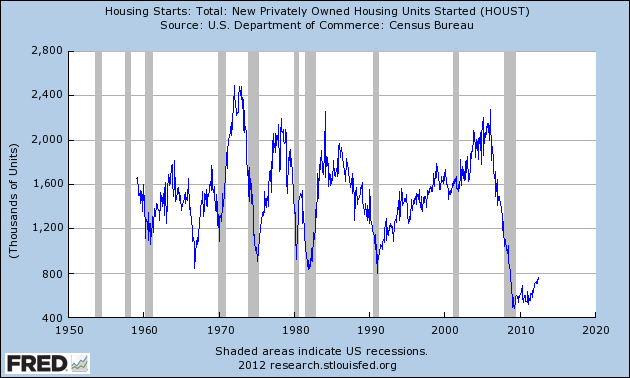
Housing Starts
Building Permits
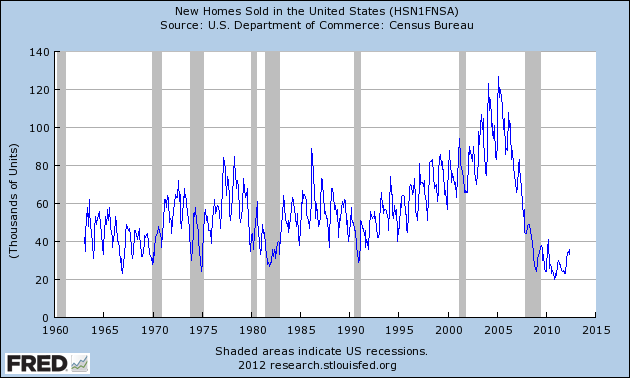
New Home Sales
I hate to rain on the parade here because housing stability has been a huge factor in my “no recession” call over the last year +, but I think we have to keep some perspective here as well. I don’t know what the technical definition of a “recovery” is in economics, but this is not a “recovery”. It might be a “stabilization”, but let’s not go all crazy abusing the english language here. I was a housing bear for years and years and I am infinitely more optimistic about the state of US housing here. But let’s be honest here. This is no “housing recovery”.


16 Comments
Housing seems to be one of the few bright spots right now.
So, our “…bright spot…” is “…back to some of the worst levels in U.S. history…”? (Or were you being facetious?)
Yes, facetious!
I have always wondered what “crawling up to reach the bottom” meant.
Well, after looking at these charts I think I “get the picture.”
I absolutely agree with everything you’re saying….but, the biggest propogators of all this “recovery” mythos are realtors, and in particular, the National Association of Realtors…luckily, though, they’re totally unbiased observers (sarcasm intended).
I’m guessing it does feel like a “recovery” from the perspective of your typically massively leveraged homeowner when their equity slice either reappears (from being underwater) or doubles etc. Is there a “law of small numbers”? If there is (or if I could call it in to being right now, as the opposite of the law of large numbers) – I think it’s that – and it covers enough of the population to be good link bait
This is like when a baseball team is down 10 runs and they drive in 2.
They aren’t in middle of a comeback, they’re attempting to mount a comeback.
Housing is recovering in the DC area. We have bidding wars again as supply shrinks below demand.
I’ve been a real estate investor for 30 years. I agree with what you say. I don’t see how we could possibly have a traditional recovery. Young people are cut off by student debt; old people are dying and downsizing. Serious damage has been done to market psychology. Real estate values are determined by incomes, which I suspect are still falling. Higher taxes, already baked in, will not help. I don’t see anything good to even mention.
Those 3 charts tracking New Homes and New Home Permits probably reflect developers who had serviced lots ready to build as we went into the pit of gloom (March 2009). Now that we no longer have extreme exuberance, developers are probably securing contracts to build as well as building on spec in areas where the finished product competes well with existing housing prices… but this mortgage application chart does not suggest a confirmed bottom is in place: http://www.calculatedriskblog.com/2012/08/mba-mortgage-applications-decrease-in.html
It looks more like a plateau without direction yet.
With the high Canadian Dollar, the tout was about Canadians snapping up U.S. real estate
http://www.theglobeandmail.com/report-on-business/canadians-outpace-all-other-foreign-buyers-in-us-real-estate-market/article4249321/ “Canadians made up the largest share of purchasers, accounting for 24 per cent of all international sales.”
The high CAD and crappy weather up here drove Snowbirds south, but the Canadian Real Estate market is peaking now in the classic Eiffel Tower speculative top: http://www.chpc.biz/canada_chart.html and as the Canadian market blows out (finally), fewer Canadians will be able to leverage sales in Canada for purchases in the U.S.
The bottom is a process not an event. Globally, wages are falling in developed economies leaving a trail of high household debt. There is still a lot of housing to be sold to turn debt into equity.
Bravo. As an attorney and former builder developer, your analysis is well-supported. We don’t know to what extent builders are building at no profit or even a loss to clear out old inventory and cut holding costs and/or save expiring approvals/permits.
Another critical factor ignored by most commentators is the extent to which foreclosures have been somewhat deferred during the 18 month atty gen’l investigation. That has reduced supply at the lower end, causing median prices (but not home prices, necessarily) to rise. But foreclosures are now resuming and predicted to rise by 25%.
With many other risk factors, the real issue becomes consumer confidence. If enough factors move negative, consumers will defer buying houses. So as you correctly point out, it is far too early to declare a housing recovery.
I agree that housing will continue to decline over the next 15 years or so. Baby boomers (80 million of them born between 1946 & 1962) started turning 65 last year (2011) and there will be 13,698 retiring every day for the next 15 years. I doubt they will be big buyers of homes or anything else, maybe smaller ones. If anything they will be sellers if their ownership is over one home like vacation homes.
I see more younger people living with parents or friends, and I conclude that there will be very little family formation going forward with student loans and such.
Good article.
Well I have always said until housing comes back down to the level where peoples wages are in proportion to the prices, people will not buy houses. Wages are way down but housing prices are not quite in line with them yet in my opinion, if banks require 20% down like they did in the past then prices will really have to come down, but I can see banks lending money out of thin air until this economy collapses which will mean a major deflationary time not a hyperinflationary time like seems to be conventional wisdom. load up and cash and you could create a dynasty soon!
At some point in time when the economy recovers, interest rates will rise making monthly mortgage payments higher. With interest rates at decade lows, I don’t see how there is going to be a long term recovery in housing. Rates will probably stay low for a while, but eventually they will go up as the economy improves. A house is only worth whatever a buyer is willing to pay for it (or can afford to borrow). Rates are low, but so are wages. When rates rise, wages better rise with them. Even with a housing recovery, houses will probably only rise at the rate of inflation anyway.
To what extent will there be a “paradigm shift,” to where people will, because of the housing bubble, NOT think in terms of their housing as a store of value, i.e. a societal falling-away from the greater-fool theory that it is worth it to buy up to the limit of one’s ability to swing the payments, in the belief that someone else will come along to do the same when the time comes to sell? I ask this because I do believe the “ownership society” principle is too ingrained for society as a whole to eschew buying housing. In much the same way people debate the term-vs-whole life insurance question, and decide that they will forgo an “equity” model for affordability in the here-and-now, won’t enough people just say “You know, if I wait for the housing prices to come down a little more and then not pay an exorbitant amount even then, relative to my ability to afford it, I will have more to show for it in terms of other investments I would have forgone otherwise,” more “wealth” will not be tied up in an illiquid asset like housing and turn out to have been illusory anyway when the feathers hit the fan, and people’s “investments” will perforce become more diversified? Am I missing something? Please advise.
Greetings from Tokyo!
Having witnessed the effects of 20 years of deflation and 0% interest rates on the Japanese economy, and in particular, the housing market – I can state with some certainty that no one knows where the bottom will be. The lack of inflationary expectations and uncertainty about future taxes and wages will be key to whether you will be able to claw your way up a very slippery slope.
Luckily, the US still has children being born. We do not even have that…