

ACHUTHAN: THE RECESSION IS STILL COMING
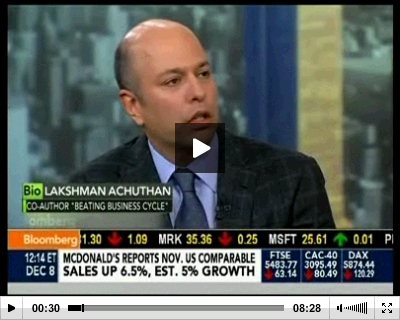
Lakshman Achuthan of the ECRI isn’t backing down from his recession call made several months ago. He was on Bloomberg this afternoon to discuss the economy with Tom Keene. Achuthan maintains that the recession won’t be acknowledged until well after it has started and that he might not be vindicated for a year.
Despite improvement in some indicators of late, he still thinks the recession is coming in 2012. Achuthan says the forward looking data is getting weaker and remains persistently negative.
His most interesting comment, from my perspective, is that the economy will not muddle through. He says we will either accelerate or decelerate and his indicators clearly point to deceleration. You can see the entire interview here.


He said Q3 would be negative. Now he knows Q4 won’t be negative. This guy is just going to keep repeating this call until he’s right.
Doesn’t the real value of forecasting come in the ‘when’? A weather man, for instance, can say ‘It’s going to rain’ but that really doesn’t tell you much. And he’s certain to be right, eventually.
What’s the old economist saying – if you want to be right then give a date and a prediction, but never give both at the same time. Something like that. Timing matters. In fact, in economics and markets it’s really all that matters. You can be totally wrong about your thesis, but if your timing is right then you’re a legend. Timing matters. A lot. And trust me, it’s not just the “amateurs” who are looking at timing. It’s primarily the pros managing billions of dollars….The real amateurs are the guys making forecasts with nothing on the line with nothing at risk except their reputation…..
Actually he said Q3 would be positive and in fact see in blip in growth due to the releasing of supply chain contraints from the Japan disaster. He has been consistent in saying that the recession wouldn’t start until 2012. I agree, and have for a while thought Q1 2012 is when it will begin. Some extension of stimulus (payroll tax cut, UI benefits) may soften the blow, but we will still have a recession, and if Europe implodes and China hard-lands it could be severe.
SS: When or where did he say that? Please share.
He should have referred to “amateurs” as “traders”. Of COURSE short-term macro traders are worried about the timing, whereas a long-term investor is worried about exactly that…the long term. ECRI’s call in January 2008 for an upcoming recession did nothing for those trading over the following six months – it DID work however, for those looking to reduce risk in order to protect against an overvalued market in the face of high recessionary risks.
A long-term investor doesn’t care about recessions.
“A long-term investor doesn’t care about recessions.”
In an OVERVALUED MARKET yes one does.
A long-term investor doesn’t care about valuations. Buy and hold is called buy and hold because you just buy and hold. It’s really very simple. Everyone else is a trader of some sort. And traders care about timing.
Even a long term investor must reevaluate his positions from time to time to see if anything has changed. Bad recessions could mean that dividends get stopped and firms go under. If you see a bad one coming down the pike it is a good idea to lighten up on risk, even if that risky stock is currently paying good dividends. And remember, virtually every stock eventually goes to zero. Some go quickly, some last for hundreds of years, some get bought out for pennies as they near the end, but most eventually become worthless.
“A long-term investor doesn’t care about valuations. Buy and hold is called buy and hold because you just buy and hold. It’s really very simple. Everyone else is a trader of some sort. And traders care about timing.”
What is wrong. Buy and hold is buy and hold. It is not long term investing. Investing is about buying with a reasonable belief in getting a return. Short term trading is one style of investing. Long term investing deploys capital when over the long term investing will likely achieve an adequate return, thus valuation is essential for long term investing. By and hold is only investing if that condition holds true (and thus implies selling when that condition does not hold true, even if that long term condition manifests itself over a short term time frame.) When it does not care about valuation it is not investing, but speculation based on bad reasoning, data and evidence.
Long term investors can care about recessions. Waiting to deploy capital at the most advantageous time (when valuations are low) is important for successful execution. Nothing provides such opportunities like having capital to deploy during and after recessions. It can come from cash, non correlating investments, etc., but an inability to deploy more capital when markets head lower wastes such an opportunity.
All investors trade, time frames and rationale determine the style of trading. Buy and hold being one strategy for executing a longer term strategy, but in itself is insufficient to become investing.
“A long-term investor doesn’t care about valuations. Buy and hold is called buy and hold because you just buy and hold. It’s really very simple.”
That is a horrifying statement. Come on guy.
To Cullen and you readers who are serious Economics students:
“His most interesting comment, from my perspective, is that the economy will not muddle through. He says we will either accelerate or decelerate and his indicators clearly point to deceleration.”
What does U.S. and world economic history have to say about Achuthan’s statement above? Have there, in fact, been long periods in economic history with “muddle through” growth in the range of 1% to 2.5%? How often has that occurred? Achuthan said that as soon as the US economy has decelerated from 3% growth down to a growth rate less than 2%, it rarely if ever re-accelerates. Most often it continues to decelerate, falling into recession. What does history say?
The early portion of this decade (with the exception of 2003) was basically one big muddle through…..
Even better, GDP adjusted for population:
http://research.stlouisfed.org/fred2/graph/?g=3KA
Whereas GDP total trended in the 1-4% range, pop adjusted it was in the 0-3% range.
Between the two recessions gdp population adjusted averaged 1.394%.
Let’s get a little crazy and adjust for the trade weighted value of the dollar too (yes, some of this is already factored into inflation and thus ‘real’, okay, but this also highlights the comparative difference to other country currency values, something not covered strictly by ‘real’ gdp):
Average of gdp between the recessions, population and trade weighted dollar adjusted, -0.928%. Ranges swing from 6.8% (at the beginning) and -6.4% (at the end).
Well, I think that just about settles the idea that there’s no such thing as a muddle through…..
With all respect the data you provide shows the US falling into recession within 12 months of growth falling from 3% to 2%. I would say this supports Achuthan’s claim.
Thanks, Cullen. No question that there has been a whole lot of history of “muddle through”.
The 2002 thru 2008 “muddle through” probably averaged 2.5% – my guess is that ECRI would not consider that a muddle through, but rather low growth.
Cullen, wouldn’t you say that your version of muddle through is more in the range of -1% to +1%? You’ve been arguing that that range is muddle through b/c what’s the difference between -1% and +1%…
IMO, ECRI is arguing that an economy is going to be +2% or -2% (or some range that historically the economy has grown at) versus the -1% to +1%.
It was also one big housing bubble during those muddle through years. Without the housing bubble it would have been one long recession.
Cullen,
I would call the last decade Muddle Through as well, but the chart actually does support Achuthan. When growth went below 2% it went negative not long after.
Also, they never said the recession would begin in the third quarter as claimed above. If the time frame of ECRI is to0 long to be useful for some styles of investing, that hardly seems a point of criticism. Not what some people want maybe.
Also, prior to every recession of the post war era data has shown a spike upward, including ECRI’s weekly index. I think that is generally a product of the fact that all data series tend to move in sawtooth fashion as opposed to a necessity, see your graph above for just such an example, but a pattern of “getting better” is unsurprising whether we go into a recession or not.
TED spreads are up 197% YTD so based on that he may be very well correct in his assumptions.
Achuthan of ECRI also said that GDI, or real gross domestic income (the flip side of GDP) is only growing at 0.8% average over the last two quarters in USA. In theory the growth rates of GDI and GDP should match, but in practice they don’t. Achuthan said that usually the GDP tends to be adjusted so it gets closer to the growth rate of GDI. So that positive 2% print for GDP in Q3 was not as good as it appears.
Sure hope he’s right, with all this press he’s doing.
What if ECRI’s ‘long leading indicators’ are just private sector credit growth? The private sector is deleveraging, so we would have recession if it were not for the 10% of GDP government deficit, which keeps the economy afloat.
Plausible?
Achuthan clearly said that if we aren’t in a recession by the second quarter he is wrong. Unfortunately from my experience it usually takes at least two quarters after a recession “officially” starts before the economists actually recognize that we are in a recession. By then the damage is mostly done in the equity markets and if your thinking of selling then, you’re just a little late to say the least. ironically, thats precisely when you probably should start building your shopping list. Given that most world markets are already trading well below their 200 day moving averages and appear to be in well entrenched declines so from where I sit the burden of proof is with the bulls.
He actually said Q3 GDP would surprise to the upside in an interview on July 8th which would be a head fake and then fall off after that.
So far his thesis is holding true to his form.
You have got to watch this interview from July 8th. It’s kind of spooky.
He says in responding to the question about the future:
“In October you are going to get a GDP number for the third quarter which is up.”
this is about 1:30 secs into the interview.
He goes on to say this is what will confuse the market into believing the second half revival is alive and well.
http://www.businesscycle.com/news_events/event_details/1434
Texas Instruments’ guidance seems to agree with Achuthan.
ECRI’s track record is the best out there. The fact that what Lak Acuthan is saying is unpleasant should not keep us from listening and factoring his points into our investment plans. Feel free to buy and hold, Dan H. I’ll happily eat your lunch for a few years. The present is a trading environment, pure and simple.
There will be a time to buy and hold again, but look at historical valuations (please, no quoting the fwd p/e) based on reliable metrics (Q ratio, Shiller P/E, Hussman methodology): we are not there yet. Timing IS important, stop listening to market pundits claiming otherwise. They all have an agenda, usually to keep their AUM as high as possible regardless of the cyclical outlook. No wonder they all try to discredit ECRI’s recession call.
VERY well said Mr. h…agree wholeheartedly. Be careful trading this market too.
In his famous “imminent” recession call in Sept:
-Aaron Task: “Are we in a recession today?” (Sept)
-Achuthan: “We may be in a recession already or it will start in the next month or two… once it gets revised, we’ll see did it start in the 3rd quarter or did it start in the 4th quarter.”
Clearly that hasn’t happened. And now he’s buying time well into 2012, and you can see how much more uncomfortable he is than he was back in September.