
Home » Chart Of The Day, Most Recent Stories

CREDIT SUISSE: WAIT FOR A CATALYST TO GET BULLISH

22 August 2011 by Cullen Roche 16 Comments

Credit Suisse says the recent action is nothing unusual in a post recession period.  They maintain that the markets are declining right in-line with past recovery ranges and will look for a catalyst to continue their rally from here.  They make the bull case:

“Now that the Q2 2011 earnings reporting season has ended, the equity market will focus on macroeconomic news, and sentiment is likely to remain the key driver for the next few weeks. While equity markets recovered somewhat last week and, we think that further catalysts will be needed for a more sustained and convincing recovery, either from policymakers or macroeconomic data, or ideally both. Specifically, from a macroeconomic standpoint, we would need to see macroeconomic data points to confirm that the recent weakening of economic indicators and growth numbers are indeed temporary in nature.

While the market correction over the past few weeks was quite intense and was caused by shocks such as the downgrading of the USA by S&P and the weaker-than expected ISM new orders figures, this correction should be considered in the context of an after-recession period, where corrections in generally upward trending equity markets are not unusual from a historical perspective. If we have seen the bottom, and assuming that we do not slip back into a recession (which is our scenario), and the historical analogy holds, we think that equities should perform well in the next 6 months.”
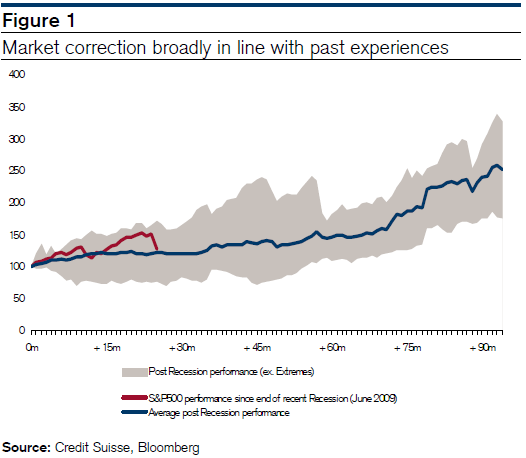
Source: Credit Suisse

Cullen Roche

Cullen Roche

Bio - Coming Soon.

More Posts - Website

Follow Me:
TwitterYouTube

Disclosures - Unless otherwise noted, authors have no positions in any securities mentioned and readers should never consider this to be investment advice. Always consult your financial advisor before acting on any ideas. Comments Guideline - Readers who denigrate authors or other readers will be banned without warning. This site does not tolerate any sort of reader abuse. The goal of this site is to create an environment that is conducive to learning and better understanding of the monetary system and the investment world. We expect readers to behave maturely and responsibly. We welcome and encourage intense and intelligent discourse, but the site adheres to a strict 1 strike policy. While it is your right to speak freely, it is not your right to behave childishly. Above all else, please enjoy the site. It is intended to be used as an educational tool and we hope the intelligent and mature debate will further that purpose. We hope readers will make an effort to respect that goal. Comments with excessive linking or foul language will be moderated before posting.
Comments
  • Tim

    I’m not wow-ed by Credit Suisse’s analysis here. It would almost be impossible not to fall somewhere within that gray area.

    • Exactly it looks like the cone of uncertainty for a hurricane. You can’t go below 100 in negative territory so its even more useless than it appears at first.

  • SS

    Jackson Hole could be the catalyst.

  • Derfem

    Assuming we are not in a bull case (aka secular bear), here is another chart. The good news is that they will soon diverge…
    http://advisorperspectives.com/dshort/charts/markets/mega-bear-2000-real.gif

    • zmt63

      Derfem-

      instead of overlaying the past 11 years performance of the S&P against Dow ’29 and Japan ’90 it’s even more impressive if one overlays the past 11 years of NASDAQ performance against the other two…

  • Anonymous

    “If we have seen the bottom, and assuming that we do not slip back into a recession (which is our scenario), and the historical analogy holds, we think that equities should perform well in the next 6 months.”

    The objective of analysis it seems to me isn’t merely to lay out assumptions and the inferences which result from these assumptions, but to identify which of any number of scenarios is most likely. If x, y, and z, then w is all fine and dandy, but how likely are x, y, and z and therefore w? Maybe we cannot determine that given current data, so the objective is to point out what to look for in what’s up and coming, in which case perhaps it is *I* who should better appreciate comments like the above. Lesson learned, thoughts shared.

    • Robert Rice

      My I-forgot-to-log-in membership was expiring; figured it was time to renew it.

  • QQQ

    It is not post recession anymore (like 2 years ago), it is pre recession like 2007… Wall Street Complex is always bullish, thats how they get fat.. Sorry guys but the 2-year cylical bull market is over, Bernank and his rabbits proved to be no panacea and there is nothing any human do amymore to keep the asset prices at elevated levels.

    Current crazy volatility and beheaded chicken like market moves are the pre-tremors of the big quake. Prepare for a major topping formation followed by a bear market.

    • Wantingtoretire

      QQQ,

      I think the humans are doing very well with the silver, platinum, and gold asset prices.

  • Willy2

    The spread between T-bonds and corporate bonds is widening and CS is bullish ??

  • jt26

    TPC, given your great call on Treasuries and Gold, do you think that call should be harvested (esp Tsys)?

    • Larry

      imho I would take 25%-30% of gold and Tsys off the table this week before BB on Friday. But keep the remaining 70-to-75% in both, since Ben might be out of bullets, OR one of the last remaining bullets he might use will be interest rate targeting on long treasuries, which would be bullish for Tsys, and probably good for gold as well.

  • Why is it so easy to find web sites with intelligent views but so hard to find the same in companies (who are actually paid to do it)? If I did work like this at my job I’d get fired.

  • Colin S.Toe

    The answer has to have something to do with institutional dynamics.To anyone with a strong vested interest in a given way of thinking, questioning/truth can be a threat.

    Where I find this most appalling is in the academic world, where free discussion of critical issues has been lacking since the seventies. Why have academic economists failed so miserably to educate their students and through them, the general public on how the monetary system works. (You may disagree with Paul Krugman on some issues, but he nailed academic economics in his piece in the NY Times magazine a while back.)

    Possibly those at the U of C, and to a lesser extent, Harvard, Princeton, Stanford deceived themselves on the Rational/Efficient/Self Regulating Markets Hypothesis (which they did not acknowledge as merely that). Interesting that economists at the U of Mo/KC not only have figured it out, but put it in terms a reasonably well-informed layperson can understand. Now if, instead of his Ivy Leaguers, Obama would start relying on advice from people like Sheila Baer, from places like Kansas…

  • VII VII

    Nice piece written by Credit Specious.

  • El Viejo

    I would like to see the current volatility compared to average volatility from previous recessions. 401ks, hedge funds and prior problems in Japan and delayed problems in Europe. We are in extraordinary times.