
DARDA: WE ARE AT A TURNING POINT
Michael Darda, Chief Economist at MKM Partners says we are at a “turning point in the economy”. Darda is one of the few economists who not only predicted the economic downturn leading up to the credit crisis, but also predicted the turnaround in 2009. Darda’s been pretty bullish up until a few months ago when his tone changed negative.
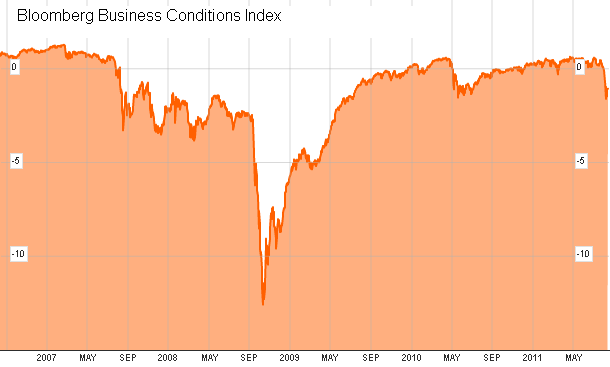
In these comments with Bloomberg on Friday Darda cited several sources of concern including the worsening situation in Europe and the Bloomberg Business Conditions Index which has turned down decisively in recent weeks. Darda says the index tends to lead the business cycle by a quarter and foreshadows weaker growth ahead.
You can see the full interview here:
Source: Bloomberg


Darda’s good. He focuses too much on liquidity though. He was very bullish on the banks early last year because he thought the yield curve was juicing the market. Big mistake.
He used the 10 year/2 year spread to back up his concerns. In an interview on CNBC about 6 months ago, Greenspan emphasized that people should watch the 10 year, it tells all.
http://www.doctorhousingbubble.com/heisei-boom-financial-trickery-central-bank-voodoo-debt-federal-reserve-central-banks-too-big-to-fail-japan-us-bubbles/
Predicted the economic downturn leading up to the credit crisis? Hardly. This guy was bullish (confidently so) throughout the first half of 2008, and only started to sound more cautious when the credit markets really started to freeze up in the Summer of 2008.
http://www.thestreet.com/story/10397389/1/recession-naysayers-hold-out.html
Jan 08, 2008
It is for MKM Partners’ economist Michael Darda, who believes all the recent hype in the markets about a recession is overblown. Darda, a frequent business television guest, appeared on CNBC Jan. 2 sporting a new beard. Darda told TheStreet.com that he will not shave the beard “until the recession talk ends or housing recovers, whichever comes first.”
http://video.cnbc.com/gallery/?video=766222355
June 10, 2008
“Well, I think, you know, anyone who is not predicting utter disaster, I guess, is considered bullish in this environment. I’m still constructive on the stock market. Obviously, we have significant headwinds from the credit strains and weak housing, but everybody knows that. And, I think looking forward, the worst of this economic situation, likely, is increasingly to be behind us. I think the last half of this year we’ll see better growth. It probably won’t be above trend, but this long and deep business and the worst downturn since the Great Depression, I think, is being proven to be utterly false. None of the data support that.”
I may be wrong, but I have a pretty good recollection of Darda turning very bearish before the collapse. Maybe he was more bullish than I recall….
Actually, John Hussman ripped into him last year in one of his weekly market comments (but doesn’t mention him by name) after a bull-bear CNBC segment on Larry Kudlow’s show (http://video.cnbc.com/gallery/?video=1534417211).
A couple of weeks ago, I was in a CNBC segment discussing economic conditions. I decline the vast majority of media requests, but I thought it was important to talk about the economic risks we’re observing. It was a debate-style format with another analyst who essentially recapped the same arguments that he made at the 2007 market peak. Indeed, just before the market plunged by more than half, he asserted “the fundamental underpinnings of stocks are superb.” He later appeared on CNBC in January 2008 sporting a beard, asserting that all of the recession talk was overblown, and telling a reporter at TheStreet that he would not shave the beard “until the recession talk ends or housing recovers, whichever comes first.” As of a couple of weeks ago, he had no beard, which was perplexing.
Now, while I have difficulty with analysts who repeatedly lead investors down the primrose path to abominable losses, my defensive approach has also left enough on the table from time to time that I don’t want to throw stones. Still, one feature of his analyst’s argument was different from 2007, and the more I’ve thought about it, the more I realize how damaging it could be to investors, so I think it’s important to discuss…
http://www.hussmanfunds.com/wmc/wmc100719.htm
July 19, 2010
I went through his CNBC appearances and Darda turned bearish in late July 2008 before the collapse. Hussman is cherry picking Darda’s calls. His outlook was actually pretty spot on:
http://video.cnbc.com/gallery/?video=812627340
He was early to call the recovery, but not by much:
http://video.cnbc.com/gallery/?video=1021240097
Bearish indicators are a dime a dozen. Try finding a bullish one. The economy is clearly in trouble.
Technically the ‘Bloomberg United States Financial Conditions Index’:
http://www.bloomberg.com/apps/quote?ticker=BFCIUS:IND
How about this for a negative indicator:
http://www.ritholtz.com/blog/2011/08/turning-japanese-spx-vs-nikkei-index-10-year-lag-2/
Whoever claims “liquidity” or “cash on the sidelines” as an argument to be bullish on stocks should be ignored.
Let’s say I have too much cash. I want to “put it to work”, and buy some stocks. Now the seller has the cash. Now he is “on the sidelines”.
Cash does NOT get destroyed when someone buys stocks. Same for number of stocks – apart from IPOs and share buy backs (limited since 2008) it remains stable.
I don’t know if anybody realized, but the stock market is basically completely inelastic to price. People WANT to buy when it’s high, they WANT to sell when it’s low. The demand side is practically inverse to price. The supply rises a bit when prices are high, but not significantly (now anyway).
Price inelastic markets, of course, are prone to huge price swings.
Gloeschi, re cash just switching sidelines, that’s an incomplete description of the process. Eventually that cash you part with will be destroyed as tax revenue, or in a Treasury security purchase, or in a security sale by the Fed. “Cash on the sidelines” may not be a great argument for stocks (especially since velocity is non-stationary), but technically it is “dry powder”. And there is some correlation between asset prices and trends in cash and credit (especially credit).