
DEJA VU ALL OVER AGAIN?
A little datamining never hurt anyone. And here’s a fine piece of it. The market has troughed during the summer in each of the last two years. And to be fair, summer is a notoriously poor market period on a historical basis with the end of the year being one of the better seasonal periods. But American Century Investments recently noted that the performance this year is eerily reminiscent of both 2009 and 2010. Will this year be the same? Should we prepare for both higher yields AND higher equity prices into year-end? Via ACI:
“The mid-year U.S. economic slumps of the past two years can be shown graphically, reflected in the declines of benchmark stock indices and Treasury yields over the period. The graph below shows the behavior of the S&P 500 index and the 10-year U.S. Treasury yield in 2010 and 2011 year to date through June 30. Note the similar dips in all four lines within the shaded second-quarter period for both years “:
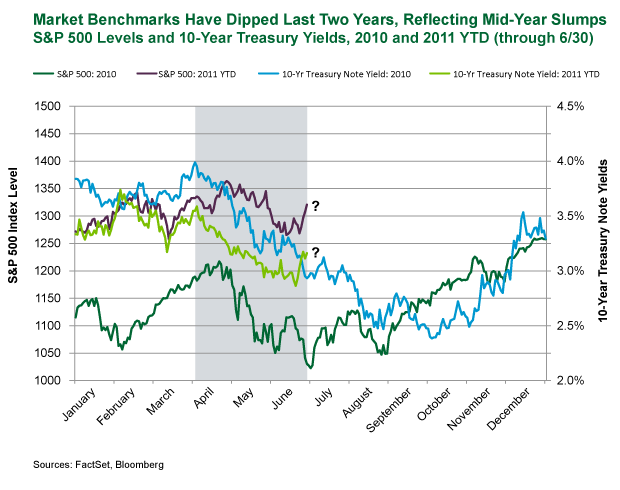
Source: American Century Investments


Well.. if by “last two years” you mean 2010 and 2011, I don’t think you can yet say that we’ve “troughed” this year. There’s no knowing where the bottom is except in hindsight.
And of course, the end of the 2010 trough seems to correlate pretty well with the announcement of QE2…
2008 looked a lot like 2010 and 2011 year-to-date, with a second quarter swoon as well. We all know how that turned out. I am surprised they didn’t consider that, since one could definitely argue that we are closer to 2008 than 2010 in other ways.
Graphs are like modern art. They mean whatever you want them to mean.
@MyTake
Perhaps one of the most astute things I’ve read in a long time.
Ditto that JLJ I like that my take. I’ll add my own color.. Accept when the artist is a mutual fund family then it’s being sold with one view.
I cannot beg you MMTers strongly enough to consider the possibility that what we have here in the US is a branding problem. If Joe mortgages his house to send his kids to college, he has debt. He owes money and to pay it back he has to earn money somehow. That debt is literally a claim on his future earnings and to sustain it he literally has to make a certain amount of money.
These conditions don’t apply to the US government. In reality the government “debt” isn’t debt. It is a courtesy provided by the government to allow its citizens to save in dollars (or financial assets in general), something its citizens are always going to be strongly interested in doing.
What would the “debt” be in 50 years if the US had experienced excellent growth over that 50 years, ala the last 50? $100 trillion or higher? We’re going to have economic problems and ongoing debt struggles and delusional bouts of people thinking we need austerity forever until people understand what is going on.
Call it what it is, here are some ideas
“money created to support economic activity in the US”
“dollars created”
“money created to allow savings”
“money supply” – because isn’t the debt abetter measure of money supply than traditional measures? And aren’t those dollars spend into existence by the gov’t beyond taxation literally the supply of dollars?
We have a branding problem. And, with total and complete politeness… I’d guess most of the people messing around in economic theory are academics, and while that is an important thing to be, it is also a profession that really doesn’t face the consequences of its actions. Its the only field I can think of where someone can be completely and harmfully wrong their whole career and still walk into the sunset to a glorious going away dinner and be remembered fondly in the history books. This is no time to be right and satisfied with that, this is a time to take the knowledge that you have here and shove it down the throats of the world. Force some people to think. Create some change, help some people.
You’ll make peace faster with the Austrians if you argue for tax cuts over more government spending, they seem to think MMT supports big gov’t. And right now among the general public, I think the Austrians are sort of winning the popularity contest. Those kind of anti-government, austerity ideas are heard at restaurants and bars and in conversations frequently. The idea that the government cannot default is not heard, at least by me.
Why don’t you guys get together and write a treatise on the economy and policy. Like the article TPC has here on this site, but signed off by each of you MMTers that possess meaningful credentials. Write it not as a statement, but as you would if you had to influence someone in a business deal. Acknowledge those points made by each school of economics that are viable and persons from those schools will be more likely to listen. In such a treatise you’d serve yourselves well to not reach too far, to stick to the most important facts (sectoral balances and the inability of the gov’t to go broke except by choice, and the folly of m1/m2/money multipliers, and a good discussion of what causes inflation, etc.) and not venture too far into theory and debatable points. What would the world look like today if Darwin had proposed the very simple and essentially mathematical idea of evolution by natural selection simply, and by itself, and let the world digest it separately from the controversial aspects? A treatise designed to have effect, to facilitate change.
I realize that isn’t related to the topic, but this is my effort to beg you MMTers to greater action. Humble as it is. Ignorance threatens the well being of all right now…
on topic: I have tended to think all year that this years chart will be similar to last years. some dips, some panic, ending the year roughly on its highs.
Brian,
These are really great thoughts. I can tell you that there have been many discussions amongst the main MMTers with regards to branding and future ventures that will help to promote and emphasize the right message. This is a major shift in economic thinking though. It will not happen overnight. At times I feel like MMT is like a penny stock that I know is worth $5. It’s just a matter of being patient enough to realize the gains….They will come.
Thanks again.
Cullen
@Brian
I like your branding ideas. I have been thinking about the same stuff. Your diatribe about academics was dead on. There they sit protected from the very market they spout bullshit theories about that have consequences to everyone but themselves. I would love to bounce more ideas around with you to see how we can facilitate a laymen’s explanation of MMT.Check out my site and let me know what you think. Shoot me off some comments if you get the chance also.
Here is the intro i put together that is very similar to yours:
The problem is that most economists don’t recognize the fact that government debt of a currency issuer is not remotely analogous to household debt. Why? For starters, no one in a household is the monopoly producer of money. What exactly is debt? Government “debt” of an issuer is the “savings” of the currency users as a matter of accounting. The issuers debt is simply a digital resource – a digital account corresponding to all the users’ savings in banknotes, deposits, and treasuries.In other words, the issuer’s debt creates the supply of currency, or savings, that people either spend or choose to save. A common misperception of our monetary system is that the issuer “borrows” from currency users, such as the US borrows from China. This is not only a fundamental misunderstanding of our monetary system but leads to catastrophic outcomes to our middle class like we are seeing today when the currency is not managed correctly. The only correct and factual interpretation of US debt is that the US Government produces the currency that China choses to save.The more China saves the more debt our Government takes on. A mutually beneficial relationship to both parties with little downsides as long as the currency supply is optimized under the conditions. Most of the academic community continues to trip over itself because of their complete failure to grasp the fundamental nature of our monetary system.
Point taken. I think it would be a good idea to emphasize tax cuts for the middle class and/or elimination of the payroll tax. That should be enough to hasten the end of the balance sheet recession and hopefully, bring about a turn in unemployment.
I would love to argue that taxes on the rich should go way up as I believe concentrated wealth destroys democracies but I take your point, it’s better to get the money into the hands of the people that need it now and worry about the other problems later.
Well said brian
“economic activity”
“productive”
Abstract and meaningless. I mean c’mon now, MMT is about a command economy taken to new heights because of the “cloud” info tech. Thats the FIAT gold rush so to speak. All these characters, Wray, Mosler, Mitchell, etc want to be part of Team Pink(o) thanks to the “fine” folks at Google, Apple, Facebook, etc. They want to tell you whats best for you. Analysts, experts, that sort of ilk. The same cons who know nothing but financial engineering. Insider profits, their own, and to hell with you.
I agree with the “branding problem” hypothesis across the board. Everyone needs to define things better and here is another example:
http://www.zerohedge.com/article/inflationistas-vs-deflationistas-what-does-cpi-and-ppi-tell-us
As a computer/controller programmer variable definition is important to me. I wish that I had a better grasp on the English language and punctuation. I highly recommend the humorous book: “Eats, Shoots, Leaves” to improve you punctuation.