
DO GOLD PRICES CORRELATE WITH U.S. INFLATION?
If you tell a hyperinflationist that their thesis has been entirely wrong over the last few years (which it has) they inevitably respond in one way: “look at a chart of gold”. This is a reasonable response. The only problem is, it hasn’t been entirely true over the course of the last 10 years.
Since the early 70′s US inflation and gold prices have actually maintained a fairly high correlation. Figure 1, which shows the year over year rates of change, shows that gold prices have tended to track the CPI:
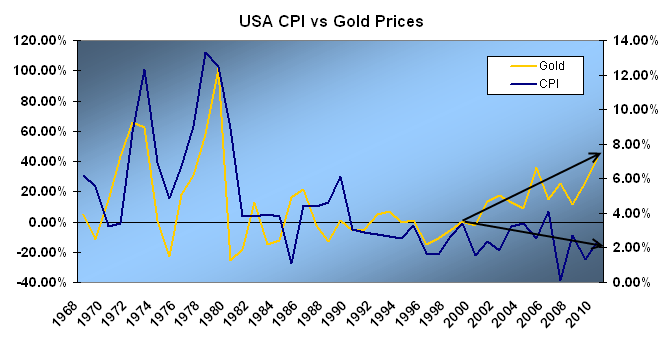
(Figure 1)
There has been a notable divergence over the last 10 years though. This is seen more clearly in figure 2 where we clearly see that gold prices have soared nearly every year during a period of stagnant economic growth in the USA that has generally been characterized by low inflation (the low inflation is easily confirmed by dozens of other independent variables including wages, bond yields, ISM price index data, ECRI Future Inflation Gauge, etc).
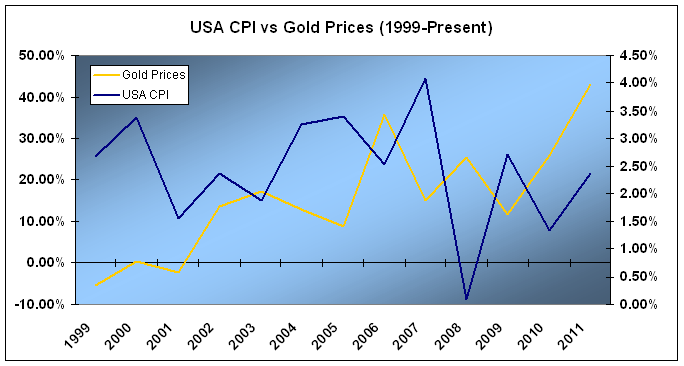
(Figure 2)
So what gives? Why do gold prices continue to soar as the USA continues to suffer through a period of low inflation and general economic malaise? The answer lies not in the “central planning” of the US government, but everyone else’s favorite “central planners” – China.
As we all know, China’s economy has roared to life over the last 10 years. Their government has increased the money supply at a 17% annualized rate as they try to sustain growth. Their inflation concerns are well documented.
Figure 3 shows the correlation between China’s CPI and gold prices over this period. As you can see, it tells a dramatically different story than the US CPI data does:
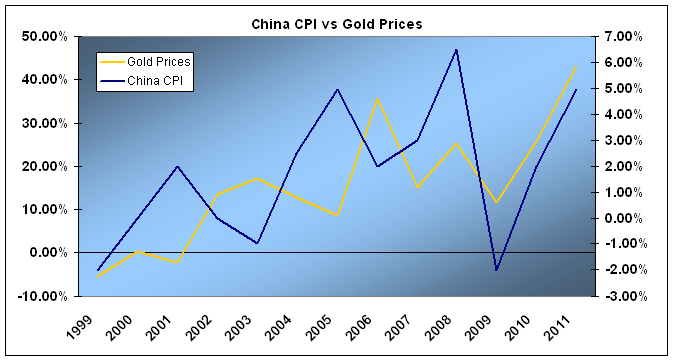
(Figure 3)
About a year ago I described three bullish trends in gold prices. The third trend was explained by UniCredit:
CR: I think the previous two trends are largely unfounded (though that doesn’t mean they won’t persist), however, the third trend is very real. UniCredit cites China’s surging demand for gold:
Unicredit: “The Chinese government has encouraged consumers to invest in gold, and with great success. In the last 12 months, demand for gold totaled 532 tons. While jewelry demand is merely stagnating, investors are increasingly discovering the gold market. While as recently as 2008 only 17 tons of gold were purchased, in 2009 the figure was already 73 tons. In the last 12 months, demand was even 143 tons! Although China has evolved into the world’s largest gold producer in recent years, the annual production of most recently 330 tons is by no means sufficient to satisfy this demand.
China announced important gold market reforms at the beginning of August. Foreign companies are now permitted to offer their gold coins at the Shanghai Exchange, more banks are permitted to import gold from abroad, and more domestic, gold-based investment products are to be developed. As a result, demand of Chinese investors will increasingly be felt on the global market. But the Chinese government also has an ever greater interest in gold imports. In April 2009, China had reported an increase in its gold reserves from 19.29mn to 33.89mn troy ounces. Nevertheless, they are still at a very low 1.7% of the entire foreign exchange reserves. If China is targeting a gold reserve of, for example, 10%, it would have to purchase 6,130 tons of gold or 2.4 times global annual production. If China were to meet the demand only from domestic producers, it would take 19 years to achieve this objective. Since the gold market is per se only a very small market, further increases in the price of gold are pre-programmed.”
This powerful trend can also be seen in the correlation between Chinese wages and gold prices:
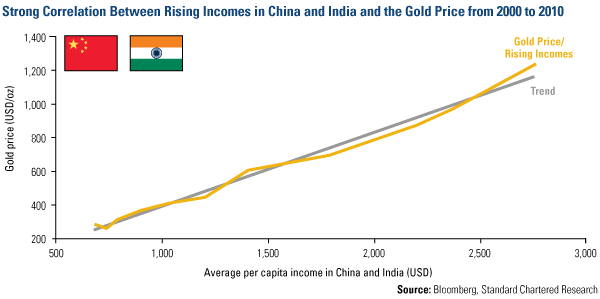
(Figure 4)
I’ve built all of this into my reasoning for thinking that gold is entering an irrational bubble. And I believe one of the primary drivers of this inevitable bubble is this misconception that the USA and the Federal Reserve are the primary causes of inflation and gold prices. The reason the hyperinflation theory in the USA has been so wrong (aside from misunderstanding how the modern monetary system works) is because the hyperinflationists have misunderstood the actual cause of their inflation worries. They’ve no doubt been right (in terms of gold), but they’ve been right for the wrong reasons. In my opinion, it is not the “central planning” of the USA that is causing this fear trade. Rather, the true fundamental driver is the Central Bank of China.
The key for investors will be understanding the point where the gold market reaches disequilibrium based on these misconceptions (the Euro crisis and the Fed contribute significantly to this misconception) and undergoes the inevitable collapse that always follows a bubble. I personally don’t think we’re there yet. In the meantime, when someone points to the Fed, the US government and their “central planning” or “money printing” as the primary cause of the surge in the price of gold and justification of their USA hyperinflation theory, you might do them a favor and let them know that they’re right about the flaws of “central planning” and excessive “money printing”. You just might want to also let them know that they’re focusing on the wrong central bank.


97 Comments
Poor China! Raping their environment to dig up money tokens that can be produced for nearly nothing. Maybe we should put them out of their misery by selling ours (sitting uselessly in vaults)? I guess we are waiting for a high enough price.
Cullen, I am not sure if you saw the Roubini vs Zero Hedge fight this morning, but it was along these lines. Roubini smashed his face in. Tyler is trying to rebrand himself as a “currency devaluer” and not a hyperinflationist. Unfortunately, there is more than ample evidence of how wrong Tyler has been over the years. Frankly, his hyperinflation theme has been so utterly wrong that I find it amazing he has any readers left. But fear sells, right?
http://zerohedge.blogspot.com/2009/01/whither-hyperinflation.html
Zero Hedge is a scam. He sells hyperinflation so he can go cash in a pay check in US dollars. Money that advertisers pay him because he has suckered enough people into believing his endless message of fear. He’s worse than a one trick pony.
That’s the worst part about that site. He is a hyperinflation doom and gloomer. No matter what happens he can’t be wrong. Except his readers don’t understand this. So when the economy is booming and his readers are losing money (as they have over the last few years during the greatest equity bull market ever) he blames central planning. When the economy tanks he says the world is going to shit.
It’s a great business model. I’d love to know how fat his bank account is. My guess is it’s overflowing with US dollars as he sells his scam to readers.
it’s worse than that – when gold goes up, the ZH minions think that it’s because of the hyperinflation meme! (that’s pretty much Cullen’s exact point (non-point?) in this post – well done, Cullen).
The thing that annoys me about this persistent hyperinflation meme is that this sort of environment has the ability to really cause a defeatist attitude. Anyone who is familiar with Japan knows that once Japan’s deflation became embedded in their thinking it became a nearly permanent drag on their economy. Now, I am not saying we need a “rah rah” cheerleader like Obama to come in and give us all “hope”, but we need to understand what our problems are so we can actually begin to overcome them. Referring to “central planning” and “money printing” is great for scoring political points, but it doesn’t help us actually understand what is going on and how we get out of this mess.
ZH together with CR are one of the best economic blogs out there.
Trashing ZH wont make PC better.
ZH is very informative and has been spot on on many reports way ahead of the mainstream media.
Whereas you have a blog like PC that keeps repeating the same old thing “deficits dont matter, we can print all we can” or Mish obsessed with his deflation theory, ZH has a much more balanced approach and a wider scope of reporting.
I guess when you have a completely distorted economic system like now, with people desperate and confused, the environment is ripe for all kind of crazy theories to flourish, each one pretending to know the solution.
One of them is chartalism with its staunch dogmatic defenders in this blog.
I expect it to die off once the economic crises start to taper off.
You can’t claim to understand my position or thinking when you claim that I have ever said “deficits don’t matter”. That is something I have absolutely never said.
I did see that. I wouldn’t say Nouriel “smashed his face in” though. There’s real merit to the thinking that our govt is failing us. I just don’t think it’s entirely based on the right reasons all the time.
First, let me say that certainly both PC and ZH are the best sources of information out there. I have been following both for two years.
I have never commented before but read most of the to and fro. I don’t know why I comment now.
The thing I find most confusing from you is your exact position on gold. You seem very gun shy of the topic. When you do raise it you seem quite hostile. I remember you once wrote that “in 500 years, gold will have no role in our system” (or something similar) and I understand neither the content nor intent of this statement.
I do not understand your personal distaste for it. I understand that it has no place within the current monetary system (MMT) but I do not understand your position on it? Could you please clarify
Nice Cullen. I hope you’ll keep us updated on the disequilibrium theory.
I have always had the impression that looking outside of the US for reasons that something is happening is not a common practice.
Scoreboard …. smart money is being made in the safety and fed hedge of gold and silver. Enough said. How are your returns in equities and cash doing for you by the way.
Cullen has a been a gold bull. And he’s actually gotten the macro picture dead right. How’s that for scoreboard?
I am not a gold bear….
People made money off “Cabbage Patch Dolls” too. But why?
The annoying part about gold bugs is that they have been right recently, but for the wrong reasons…. something you never hear from them though is how gold, longer term, has actually done worse than Treasuries. They think gold only, and guns and ammo to protect against the end of America, yet Treasuries did better than gold in this latest mini crash, and longer term – have done much better. Check these charts:
http://www.investorsfriend.com/asset_3.jpg
http://www.investorsfriend.com/asset_4.jpg
http://www.investorsfriend.com/asset_8.jpg
So much for this fear mongering rhetoric that Treasuries don’t keep up with inflation……. based on these charts, gold has done a worse job in that department.
Word.
Gold bugs are right to the extent that they take their gains before gold declines to its long term value: relatively constant against a basket of commodity staples. Those that bought gold as a long term investment at any time in the past few years (Austrians and Glenn Beck viewers?) under the impression that it was a good price…they’re going to lose money.
Even the former group will lose out if people finally realize that gold isn’t money and probably will never be again…then it will decline to its value as a decoration, a non-corrosive metal, and an outstanding conductor.
Those graphs make sense from a theoretical (and even Biblical!) viewpoint. Thanks!
Cullen,
Did you see Blodget’s piece on Fed policies? I hate BI, but I just popped over there for a laugh and to kill some brain cells and saw it, read a few lines and my jaw dropped.
Best
Link?
http://www.businessinsider.com/government-paying-banks-not-to-lend-2011-8
Yikes….
The Fed paying interest on the commercial bank’s excess reserves was part of the Economic Stabilization Act of 2008. It is described on the wiki:
http://en.wikipedia.org/wiki/Emergency_Economic_Stabilization_Act_of_2008#Interest_on_bank_deposits_held_by_the_Federal_Reserve
It seems ironic that the Fed did the QE as a great asset swap to increase the commercial bank’s excess reserves (with the erroneous intention to increase lending) and then effectively paid them to hold onto those reserves.
Banks don’t lend reserves so they’re not being paid to hold onto anything…..This is one of the central fallacies of the gold bug brigade. They don’t understand how modern banking works so they build these myths on totally inaccurate beliefs.
Your regular readers understand that banks don’t lend reserves. But if the Fed thought that increasing reserves would spur lending why would they then offer interest on what was not interest bearing before? Seems counterproductive.
Perhaps they were increasing reserves in anticipation of ‘runs’ on the banks. Extra reserves (plus interest) would help prevent liquidity problems. Perhaps the stated goal was to increase lending to encourage the economy but the real goal was to protect the banks. The Fed may understand banking better than we give them credit here.
The reserves serve as a de facto Fed Funds rate as they build up their balance sheet. If they didn’t pay IOR the rate would fall to 0%.
Good point, as always, CR.
Speaking of gold, in the 1800s in the US if a bank was under threat of a run the crafty bank manager would open the vault a crack so that the public could see the barrels of gold inside. In truth the barrels were filled nearly to the brim with nails and then topped off with a layer of gold coins. The public was reassured by the ‘transparency’ of the bankers. In the era of fiat money the QEs seem to me to be a similar slight of hand. Fill the bank vaults to reassure the public.
Cullen,
When you say “banks don’t lend reserves” can you please explain this point as i don’t understand it.
Banks lend against deposits and other sources of funds, and hold some regulated amount of capital against those assets (loans). So, I deposit $100 in the bank, the bank takes my $100 and makes a $1,000 loan using $900 of funds from other sources, e.g. debt.
I read the definition of “excess reserve” but can’t close the loop on the idea that banks don’t “lend” excess reserves. Isn’t a bank’s lending limit defined by the regulatory capital requirements? If so, doesn’t “excess reserves” imply more lending capacity? Am I confusing “excess reserves” with “available capital” (for lending against)? If so, what is the difference between “reserves” and “capital”? When I read the definition “excess reserves” seems to have something to do with “cash on hand”, which confuses me even more. What does “cash” have to do with it? When the bank makes that $1,000 loan I described, against my $100 deposit, there is no “cash” involved, just digits on a screen.
I am confused!
Pod:
I have found this .pdf to be helpful in understanding MMT.
http://www.actuaries.asn.au/Libraries/Events_Networking/FSF10_Paper_Frank_Ashe.sflb.ashx
Explaining MMT to a kidnergartner. Follow the story (you would be Frank) and you will see that banks do the lending first and then seek the deposits to finance the lending.
Mmm pretty interesting, but how does one explain the US 10 yr (2.17) price action, and the Chinese 10 yr (3.95) govt bond price action compared to gold.
The counterargument is that treasuries aren’t necessarily a perfect reflection of inflation either. The whole “Treasuries justify deflation” vs “gold justifies inflation” is missing a much bigger macro picture.
“The counterargument is that treasuries aren’t necessarily a perfect reflection of inflation either. The whole “Treasuries justify deflation” vs “gold justifies inflation” is missing a much bigger macro picture.”
Interesting Cullen, could you add to what you mean to the much bigger macro picture?
On this very subject, I thought David Goldman’s post was interesting:
http://blog.atimes.net/?p=1898
“The answer is simple: bonds are an option on the short-term interest rate, and gold is a perpetual put option on the dollar. Both rise with volatility.”
and David Goldman adding in the same post on his blog:
“It’s like the old joke about the thermos bottle: “How does it know if it’s hot or cold?” If the policy compass is spinning and there’s no way to predict how governments will react, you don’t know whether to hedge for inflation or deflation, so you hedge for both. By put-call parity, if there is huge volatility in the policy responses of governments, the option-value of both gold and bonds goes up.”
You made an interesting point here. I would also add that China was having a deflation problem in late 1990s and early 2000s, on-and-off for about 6 years, after the 1997 Asian Financial Crisis.
CR-
I had this discussion with Gonzolo Lira-Hyperinflationist. Now rebranding himself. His response to me was..yes but my investments have done well. I.E gold.
Rick Perry’s-money printing comment made me think of many of the readers here. I heard the collective..WTF.
I shared my gold thoughts before. But we have a bunch of clients and they are one of the best contrarian sign posts I’ve ever seen. They all want GOLD..they can’t see how they could lose. Most of our clients are also very conservative.(glenn beck types). So I have taken alot of flack going from 15% now down to 5%-8% and I will be closing this out in the next two months.
But the big signpost for me is all my friends in Newport Beach who were selling no doc loans from 2004-2007 ALL left the mortgage business and work for Monex in Irvince or Goldcorp in Santa Monica. I’m not kidding. Every mortgage broker is selling gold. I have no stats or data to show what that means but….let me give you a quick timeline.
These guys went from medicare scams(MRI trailer billings) busted…then to Mortgage….dried up…and now all work for Monex.
@VII,
Can I post the above at Max Keiser? Shouldn’t someone warn him and the lovely Stacy Herbert?
F. Beard…
Heavens No..when I say “my friends” they are. In fact he just called me know and I gulped thinking dios mio..he read my thread on the TPC. No lie.
I said too much which is why I’m now in the TPC witness protection program. New picture..new name.
You can take it as your own. But there are some professional standards I need to start following. I’ve become a little too comfortable in some areas.
Sorry about the image change but it’s part of the Fuzzs advice to go underground
OK, won’t do.
Lastly…I will be changing my name from VRBII to VII…I’ve said a little too much in my last piece.
Another factor in the rise in demand for gold is the introduction and popularity of the GLD fund, which has allowed many to purchase gold who would not otherwise have done so.
Has anyone mentioned negative real interest rates fueling the gold run?
See older chart and full explanation of real interest rates’ effect on gold here (from Jan. 2010, $1100/oz):
http://www.mcoscillator.com/learning_center/weekly_chart/the_one_real_fundamental_factor_driving_gold_prices/
Why not just look at TIP spreads ? This nullifies the flight to safety treasury move as they are treasuries vs treasuries?
DC-Beowulf-CR-F.Beard-Y, Dimm ..and my friends on the TPC.(and the 3 people I had to apologize to for being a knucklehead)
I’ve given F.Beard alot of flack for his image change but…I need to update my username and image to be less…well…traceable.
Here we go.
It was an honor to serve with you, sir.
Illuvator and y
I’m not going anywhere… I’m like Lindsey Lohan. Always going to change…front page in trouble.
I know of 10 guys who went from mortg. To monex. They helped each other get hired. Same with another co. I’d rather not name.
Y u are a bright young man. Keep your head down and keep on your studies…much further ahead now than I was at your age.
My theory is that when the global deflationist/stagnation picture is set straight and the situation over Europe and public debt non-issue (being payable) is clear gold prices will deflate.
Hyperinflationist at some point will have to get over their cognitive disonance, and MOST people sees gold as an speculative asset, not some sort of magic money-substance ala goldbugs.
But there is a fundamental demand on gold on Asia so I think prices won’t deflate extremely fast (maybe there will be strong corrections but won’t drop to a reasonable price when the bubble explodes, it would be similar to the real estate bubble I guess).
P.S: There is a lot of business on there is plenty of marketing on it.
Agree with your premise but those charts are wayyyyy too wonky to draw any clear conclusions.
Tangentally, what do you think of the MIT Billion Prices Project? I’m surprised at how little press this has gotten, I think it’s a pretty genius idea and tends to have remarkable CPI predictive power.
http://bpp.mit.edu/usa/
Great project and totally debunks the John William’s of the world.
Yes, BPP is good though I don’t think it’s publicly available any longer. And yes, it totally debunks Shadow Stats. As does the ECRI’s metric of inflation….
Great article, how can anyone think we’ve had any inflation in the last 10 years? It’s not like the prices of oil, copper, nickel, zinc, aluminum, corn, wheat, cotton, beef, sugar, and coffee have tripled or quadrupled over the last decade. If there was inflation, the CAD, AUD, CHF, and JPY probably would buy 50% more USD today than they did 10 years ago. What kind of fool could actually believe his currency has been debased?
CPI is one of the most manipulated numbers published. The government has a VERY vested interest in making that number as low as possible (COLA). Why not measure gold vs. M2/M3/MZM, or gold vs. a basket of essentials (food, energy, gasoline), etc? Both of those will be better proxies for true inflation, and you’ll probably be surprised at how good the correlation is, even over the last 10 years.
Pardon me but what the heck is gold but a shiny, obsolete money form? I rather trust the CPI than to measure prices via gold.
CPI data is corroborated by hundreds of other data points. The clearest one is personal incomes which are also soaring. So, as an inflationist, you have to make a pretty disastrous decision there. Is the govt lying about how rich we are? Or are they lying about inflation? Would they really do both? The answer is no.
Would the charts look any different is you used the 1980′s CPI formula or ShadowStats inflation data?
Of course it would, but why would you want to use data from someone who has been as consistently wrong as John Williams? He predicts hyperinflation of the USD while accepting payment in the USD… ridiculous.
Good debate and excellent insights as always.
The argument for/against inflation, or gold as any particular hedge, is so complicated because the world is WAY, WAY more complex (and random) than we all care to admit. Financial markets in particular because of the interplay between raw human emotion and various degrees of logic. The human brain is programmed: We need “A, therefore B, equals C” to make any decisions. That said, I just don’t believe in all the causality suggested between what are, in reality, very random, unrelated events.
That said, I am inclined to put some faith in the argument that many investors in the world today have a cultural bias towards gold ownership. There are many people in the world who have had their physical wealth and savings destroyed or confiscated in the past. History is long, as are memories, and those scars take a very long time to heal. We do know that gold has played a significant role as a medium of exchange for centuries, and it is almost universally accepted. In many places individual incomes are finally growing (China, Korea, India, Brazil, parts of Africa, etc) but these people are also same ones who have suffered those aforementioned wealth misappropriations. Thus, they may well be biased to always owning some gold regardless if they are witnessing inflation or deflation. But how does one measure that phenomenon within the price of gold today? Who knows.
Trent, currency was also being debased in the ’90s when oil hit an all-time low…so what does debasement have to do with the movements of commodities? Nothing.
No, not directly.
Cullen,
Have you ever followed Eric Janszen at itulip.com (he was buying gold in 2002!). I think he is a bit more rational than other blogs out there. His latest is a rant against Mish’s deflation argument.
I suggest reading him, he isn’t yet on the severe inflation bandwagon, but he suggests it is coming (you can read more of his view at the site).
http://www.itulip.com/forums/showthread.php/20102-You-re-not-going-to-believe-this-Eric-Janszen?p=205428#post205428
Good stuff Haris. Arguing with Mish is pointless. He just tries to scream louder than you. Sort of like Peter Schiff. Jantzen and Mish both have some misconceptions and good points. I see that some people in various places think I am on Mish’s side. I have no idea where this idea comes from. I called for deflation in 2008/2009, disinflation in 2010, and low inflation in 2011. All documented in real-time on the site. The only thing I said was nonsense was hyperinflation and that if anything, the risk of deflation was higher than hyperinflation.
Anyhow, what is Jantzen’s outlook now? Is he a hyperinflationist? I don’t have time to read half the blogs I wish I could….
Recent interview Janszen had on financial sense.
http://www.netcastdaily.com/broadcast/fsn2011-0817-1.asx
I still see some people referring to me as a deflationist. I am not sure where anyone gets this notion from????? I haven’t actually predicted deflation in years….
I believe people do not differentiate between
1. Deflation = GDP contraction (commodity deflation)
2. Balance Sheet Recession aka Debt Deflation (house and asset deflation).
These are two different occurences (30s deflation vs 2008 which had both 1 and 2) but I don’t think many people actually distinguish them (at least I did not till recently).
The fact you are a balance sheet recessionists leads people assume incorrectly you are a deflationist (as opposed to hyperinflationist).
It’s not just China, but the entire US trade deficit (but mostly China) and the Euro. Both started around the same time, after 97-98 Asian crisis (build up of USD by Asia) and intro of Euro (German’s diversification).
We all know the key to inflation is the velocity of money. Without increasing velocity the size of monetary base means very little. We had real inflation in the 70s and we could have it again. I consider gold a monetary insurance policy. With insurance you make payments and may never get paid back but you never know
Why aren’t private sector loans a legitimate origin of circulating money? Why only government spending?
When banks loan money and ‘create’ new money (FBR) there is a liability created at the same time. There are no new net financial assets created- only the Gov’t can create ‘new’ money.
FRB*
There’s always a fundamental reason behind any bubble. What distorts it is the irrational layer of pricing that gets built in. In this case, the fundamental floor is China and emerging markets. The irrational buyers are the ones crying wolf because of the Fed and the USA. The Shadowstats of the world. They’re the ones who are going to blow the lid on this thing.
I think some Austrian can be a bit dogmatic. But MMTers can improve their “debating” skills and quite being so pragmatic. For example, the occurrence of hyperinflation (is possible) but it is just as likely to occur as arguing that Austerity will lead to total economic collapse (i.e GDP = 0 from the deflationary cycle). Can this deflationary collapse occur, well yes it is possible. Is it likely outcome – well no? How come it doesn’t much interest as the hyper-inflationary case?
I’m sure Krugman or some MMTers can twist neo-Keynesian and make a few bad assumptions to show austerity “may” lead a deflationary collapse. And when corrected, don’t admit mistakes but continue to reinforce how strange these austere folks are believing that “surpluses matter”
And “worst thing” since following Cullen’s blog is I can’t read zerohedge, Schiff, Jim Rogers but I still have my guilty pleasure of listening to Marc Faber.
This is my view on the gold bull. Government deficit spending is inflationary (when beyond the productive output of the economy). But in the current deleveraging (balance sheet recession) environment, the deleveraging effects dominate any inefficient deficit spending effects on inflation. (This credit destruction is not the case in China as you have shown). High deficits and debt (.e. “printing money”) implies the need for a low interest rate policy choice by the Fed to minimize service interest payments. Thus it should be no surprise that bonds have largely rallied under a fiat currency. (Of course the stagflation episodes was a policy choice of high interest rates which hurt bonds and collapsed gold).
The other point of low interest rates, is that negative rates occur easily (difference in interest – inflation rate). Negative real interest rates make the present value of interest servicing payments on the debt lower. This represent a hidden “wealth transfer” of the difference in (interest – inflation rate) from treasury holder to the currency (USD). Hence we also see gold rises in a correlated fashion to negative real rates in part because of this (and the Euro default crisis as well). In China, they see higher inflation as you point out, and thus larger negative real yields that causes gold to rally (moderated by their peg and bolstered by big USD reserves).
Anyway I don’t see gold bull (and bond bull) ending until interest rates (and real rates rise). And this current euro-crisis is only the appetizer, so I hope there are a number of corrections in both along the way before the “bubble pops” in gold.
Mr. Roche,
So let me get this right. You are saying that increase in money supply in the US is indirectly responsible for rise in gold price. You see when US increases its money supply China has has to respond to it by increasing their money supply. This increase in money supply increases inflation in China. So, I suppose people like Peter Schiff and Marc Faber claim the same. So there is no correlation between the US CPI and Gold price but as you said their there is a correlation between China’s CPI and gold price. So, their must be a correlation between US money supply and Gold price with China Central Bank as an agent.