

Home » Market Indicators, Most Recent Stories

FINANCIAL OBLIGATIONS RATIO CONTINUES TO IMPROVE, LONG-TERM HURDLES REMAIN

21 June 2011 by Cullen Roche 6 Comments

The Fed released their data on household debt and obligation ratios last week.  The latest reading in the financial obligations ratio of homeowners shows a continued improvement to 14.84% in Q1 20111 from 15.13% in Q4 2010.  This is down dramatically from the cycle high of 17.48% in Q4 2007 as the debt  bubble was near its peak.  As incomes have improved and debt levels have declined the environment for de-leveraging has become increasingly stable.
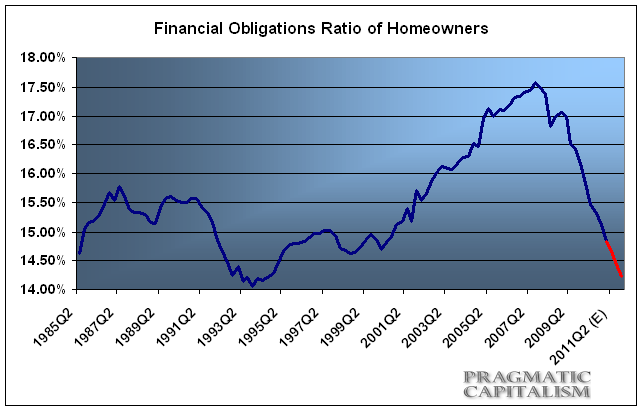
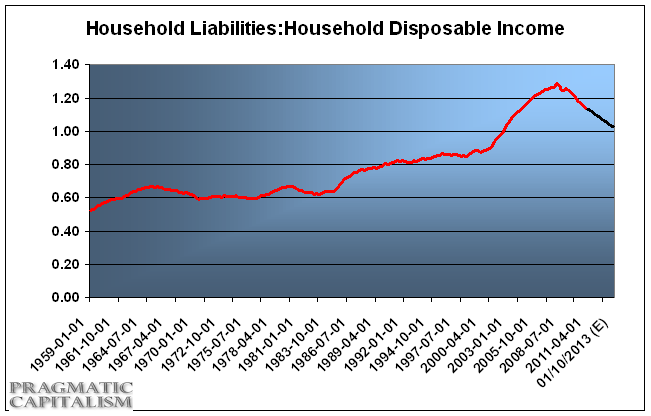
While the improvement in FOR shows that households are becoming increasingly creditworthy, the aggregate debt levels remain historically high when viewing disposable income to total outstanding household debt.  You could even make a worrisome case that at the current rate of improvement, households won’t be able to shoulder a heavy recovery via increased debt loads for quite some time.  In other words, the US economy could require persistent income growth and expansion in order to allow households to continue to expand their growth in aggregate debt levels.  Fortunately, the burden is easing, albeit at a slow pace.  Unfortunately, without substantial improvement (which could take years) we’re not yet close to a level where the private sector can substantially shoulder the burden of a debt boom (and a subsequent economic boom).
Cullen Roche

Cullen Roche

Bio - Coming Soon.

More Posts - Website

Follow Me:
TwitterYouTube

Disclosures - Unless otherwise noted, authors have no positions in any securities mentioned and readers should never consider this to be investment advice. Always consult your financial advisor before acting on any ideas. Comments Guideline - Readers who denigrate authors or other readers will be banned without warning. This site does not tolerate any sort of reader abuse. The goal of this site is to create an environment that is conducive to learning and better understanding of the monetary system and the investment world. We expect readers to behave maturely and responsibly. We welcome and encourage intense and intelligent discourse, but the site adheres to a strict 1 strike policy. While it is your right to speak freely, it is not your right to behave childishly. Above all else, please enjoy the site. It is intended to be used as an educational tool and we hope the intelligent and mature debate will further that purpose. We hope readers will make an effort to respect that goal. Comments with excessive linking or foul language will be moderated before posting.
Comments
  • Nathan

    Cullen–

    Intersting data. I couldn’t agree with you more regarding the balance sheet recession. It appears the FOR is at about the historic average (going back to 1980 and near the bottom of you go back to 1985). This is true whether or not you exclude the last decade and whether you look at homeowners, renters or both. The FOR data seems to suggest that we have a reasonable opportunity for household balance sheet expansion, assuming that people are borrowing at fixed rates or that rates reamain at these levels for the foreseeable future– i.e. people can cover more principle over time… It seems that the analysis is that if people are borrowing on variable rate ARMs, there will be more significant issues (as we see who is swimming without shorts)and that consumer spending will be more sensitive than normal to changes in interest rates… Thank you for the great data.

  • Chad Starliper

    Cullen

    Good post. This is something I have wrestled with for some time. From the perspective of the income statement (FOR), households are in decent shape because of extremely low interest rates. Historically there is a very tight relationship between the change in debt and interest rates such that low carrying costs predictably encourage debt accumulation over savings. However, from the perspective of balance sheets (Debt/DPI), households are still strained and highly leveraged in the aggregate–especially the middle class.

    So while I think the cash flow servicing of debt may be getting better, it may mask the underlying weakness of the household sector. Leverage is leverage. The low rates make it appear OK until it is not OK. Additionally, the negative equity issue is pervasive, and it does not get accounted for in any of the above measures.

  • Andrea Malagoli

    I also wonder how much of this improvement is due to bad loans being transferred from the individuals back to the bank, where they temporarily disappear by not being marked to market. The FED is trying very hard to show that all is going back to normal.

  • rhp

    Cullen,

    I question your conclusions from this graph. How much of household liability decrease has come from bankruptcy and foreclosure “eliminating” debt liabilities, which then have to be, at some point, accounted for in the banking system?

    Secondly, you speak of improving incomes. That would suggest wage stability or increases. Where is the data that backs this? All graphs have been pointing to a DECREASE in purchasing power and wages for the lower 4 quintiles. And you argue (rightly IMO) that there is no wage pressure to push inflation.

    I’m not sure that this graph is showing a wonderful deleveraging as much as it reflects bankruptcies and foreclosures. While those two entities may be necessary for the rebalancing to occur, I’m not sure of its rosy predictive value.

    OK, back to my “real” job!

    rhp

  • Roger Ingalls

    For those of us non-economists, a few definitions are helpful

    http://www.federalreserve.gov/releases/housedebt/

    So, the FOR accounts for homeowners = total mortgage payment PITI (principle, interest, taxes and insurances) and consumer debt payment.

    Consumer debt payment levels ratios are back to 1994 levels, and PITI is down to 2004 levels. This also could be reflective of folks refinancing to lower interest rates (and payments), buying less expensive homes (at low interest rates), and possibly lower balances for both home debt and consumer debt.

    A little curious as to how current the payments part of this ratio is.

    http://www.federalreserve.gov/pubs/oss/oss2/scfindex.html

    According to this site, the info is collected every 3 yrs? The last report was 2009, and the next one is due 2012.

    I could be confused, but that’s what I saw.