
GAS PRICES HIT HIGHEST LEVEL EVER FOR THIS TIME OF YEAR….
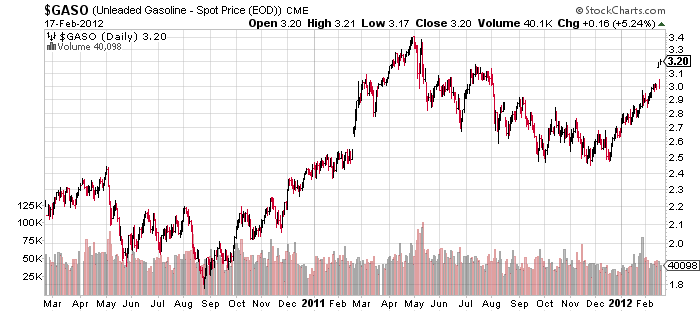
Here we go again…I’ll update the inflation outlook tomorrow, but this is the big risk I discussed to the disinflation outlook. Gas prices are surging again (via Huffington Post):
“At $3.53 a gallon, prices are already up 25 cents since Jan. 1. And experts say they could reach a record $4.25 a gallon by late April.
“You’re going to see a lot more staycations this year,” says Michael Lynch, president of Strategic Energy & Economic Research. “When the price gets anywhere near $4, you really see people react.”
…Higher gas prices could hurt consumer spending and curtail the recent improvement in the U.S. economy.
A 25-cent jump in gasoline prices, if sustained over a year, would cost the economy about $35 billion. That’s only 0.2 percent of the total U.S. economy, but economists say it’s a meaningful amount, especially at a time when growth is only so-so. The economy grew 2.8 percent in the fourth quarter, a rate considered modest following a recession.”
It’s a real shame that this country doesn’t have a substantial energy plan in place. The added volatility in the business cycle and the constant risk of cost push inflation suffocates policy options. But here we go again. If energy prices continue their push higher my theory of QE3 in June is dead in the water and the odds of a weaker second half economy will rise substantially….


Cullen,
What is primarily keeping (or pushing) prices upward? Is it stock market participants distorting the market? If so, do you have any regulation recommendations to prevent speculators from (overly) distorting the price of essential commodities that the “real” economy uses?
thanks.
Refinery closures from poor margins and tight credit, particularly in Europe. Iran headline risk premium also in there. The demand picture in the US is awful. It’s all export demand.
CR tell me the name of a country with an energy plan ! This is an unquestionable fact: big infrastructures have been always planned, financed and realized by the government. But we’re living in an horrendous time where a false ideology (like a church) shot to everything that’s public. Private interests prevail on everything. So here we are. Some countries are less bad (but far from optimal), and for sure the quality of the infrastructures in the USA is well below the average and a critical issue for the future of the country.
Dramatic drops in demand for gasoline along with higher prices for gasoline.
I guess this is just another datapoint that confirms the disinflationistas were correct.
Can someone explain to me how 2.8% GDP growth while creating deficit spending of 10% of GDP to achieve it is in anyway sustainable?
I mean I’ve been reading this MMT stuff and I do agree with much of it, however reality seems to be diverging from theory, given there is apparently no inflation and yet gas prices are closing in on highs despite a reasonably stagnant domestic economy.
V – we’re not the only consumer of oil. And we’re not the only printer of a sovereign currency. We can have imported inflation from other gas guzzling, growing, money printing economies.
As for 10% deficits but only 2+% growth – we ship a lot of dollars overseas in our trade deficit. We have households sending their paychecks to their past debts. And we have large private sector savers locking up money.
Central bankers running out of options. QE3 can’t happen. There is no single country which has plans to overcome the structural crisis. None, zero.
And as a poster above says, increasing deficits for decreasing ‘growth’ (and increasing income disparity, erosion of purchasing power, etc.) is not sustainable.
Disinflation, deflation & inflation cycles = decreasing living standards is what is happening right now. Out of ideas.
“Disinflation, deflation & inflation cycles = decreasing living standards is what is happening right now. Out of ideas.”
Meaning that the economy “is” and “has been” bad and getting worse for some time. These things do not happen overnight, and it does not correct in short order either. This is one “reality” that shows most all economists are wrong. An economy (country) needs to “produce” in order to have a healthy economy, and it cannot do so in the USA with the policies we have political, economic, and monetary. they are all “short term” views no more that a week sometimes and all tilted for the “stock market”. We all know it. Policies cannot be for Wall Street and the markets, it’s gotta be “for the people” and I have seen no leaders in thought on the topic. Lotsa blogs, lotsa opinions, but no working theory. WHY?
Because you would have to tear the whole thing down and “start over” and people with money do not want that. That is the current status quo.
High gas prices changes that status quo. We will have riots here.
Hey, Bad Moon,
This is the way that America wants it. No government, no regulation, every man for himself. America is getting what it set out to do, create a mess.
US demand for oil is down considerably. The figures on miles driven has dropped dramatically. My take on the reason oil is up is because of pure speculation in the commodities market. Given all the central bank liquidity distortions much of that money is ending up in commodities as well as the stock market (of course we all know this). As long as we have central bank intervention, a Federal Reserve that is truly out of control the distortions will continue and the result will be greater economic instability.
Correct. There are a lot of documents around. Try to read this for first:
http://www.nakedcapitalism.com/2012/01/chris-cook-naked-oil.html
Or the banking cartel will be dismantled or there will not be a future.
Global demand at an all-time high, Iran, Saudi output drop, instability in Nigeria and then of course US fiscal/monetary policy.
Price at the pump is going higher. And we haven’t even hit the driving season. Where I am in Los Angeles we are pretty much guaranteed to see $5 plus w/ our summer blend.
There is a solution if people finally demand it of the governments. The bulwarks that protected TRUE capitalism have been removed by parties that lobbied governments to remove them. With so much money at stake legalized corruption of the capitalist system has occurred. True capitalism and the laws of free markets and supply and demand are the only system which will really work. Laws must exist which protect free markets and supply and demand. These laws have been removed. Once these laws are reinstituted, TRUE capitalism can occur again. Some examples are:
Reinstitute the Glas-Steagle Act. This will break commercial FDIC banks, insurance companies, rating agencies, and high risk investment banks up again like before the act was repealed. This is because these four groups being part of the same company is an inherent conflict of interest. Repealling the act was like giving the wolves control of the cattle pen and foxes control of the chicken coup on the promise they wouldn’t eat the livestock.
Reinstitute and inforce the uptick rule. This will prevent parties with large amounts of cash from shorting companies and then driving them down into the ground to make money on their shorts, based solely on the profits of the short and not based on the companies true status or performance. It will also remove an unfair/coercive tool from parties to blackmail corporations to behave in ways that are antithetical to their own corporations or it’s shareholders interests. An example would be if finacial parties in Henry Ford’s time set targets for expected profit or risk being shorted, downgraded, and maligned to drive Ford’s stock price down to the ground because he reinvested money in paying his workers well to develop a highly skilled, motivated, and loyal workforce.
Reinact laws to force commodities traders to either take delivery of said commodities when the futures contract is due or have the capability to take delivery even if they intend to sell the futures contract before the due date. This will help remove speculators who are trying to distort the true supply and demand curve to obtain extra profit through price fixing. Monopolies were outlawed to prevent price fixing the same should be done for speculative futures price fixing. Both distort the true law of supply and demand.
Enforce the laws preventing naked short selling. If someone shorting a stock does not own that stock or take physical delivery of it in three days, they should go to jail. They are committing fraud.
There are other areas where laws or regulations probably should be enacted or enforced to provide a true level and equitable playing field for all participants in a true capitalist economic system. The economies of the world will not improve as long as corruption or unfair tactics are allowed.
Those who say it’s just business (survival of the fittest) overlook important factors such as the destruction of confidence amongst the populous in there institutions. This will result in people no longer trusting or using them or their services, (i.e. money in the matress). It can also lead to the rise of the strong man or women (i.e., revolution). History is repleat with it. Examples are Lennin, Hitler, the French revolution against Louis the XIV. All these were the result of or at least in part because of economic corruption, mismanagement, and failure which led to an angry populous.
We need minimal good laws and regulations not massive, bad, corrupt, and unfair laws and regulation. They also must be enforced rigorously. Otherwise the unethical, corrupt, or criminal elements of finance and business will destroy the system for all. It’s in the interest of the honest and moral members of the financial and business community to stand up and police themselves by helping develop good and honest laws and regulations before it or worse is foisted upon them by popular demand.
In full agreement with most of the above
Common sense is not part of the American scene. Sorry.
It looks like oil will keep its march up next week. Check the news wires. It looks like this ain’t gonna be peaceful Sunday. ..
Come on guys, we are all better than this. America’s energy plan, or lack thereof, has NOTHING to do with oil and gasoline prices. NONE. Both prices are determined by an enormously complex global market combined with enormously complex local and regional demand markets. Very, very, very simply, the geopolitical unrest is driving up the price of Brent, which we all know gas prices are based upon.
BJM nailed it perfectly. Enough already of those claiming speculative froth. Nonsense. period.
Malmo, I don’t think you read BJM correctly. Short term speculative “froth” is a real problem. Only in the long term do gas prices even out. But in the mean time Alberto’s link is a good place to start understanding the complexities BJM must have been writing about. You can make/lose a lot of moola very quickly here:
http://www.nakedcapitalism.com/2012/01/chris-cook-naked-oil.html
I was just making the point that global prices are set by a global market and that American energy policy is merely a cog in that wheel.
Regarding speculation – considering the marginal cost of production is around $85, $110 oil (average of Brent and WTI) is not that frothy. And one could even make the case oil was more “manipulated” or undervalued at $35 back in 2009 than it is manipulated or overvalued now. I don’t see a huge problem at levels that don’t promote rapid demand destruction such as back in 2008. Exxon Mobil has a $125 billion five-year CAPEX budget – my guess is that budget is NOT based on $55 long run oil…..
BJM
While speculation has some impact on global petroleum prices, there is a growing gap between petroleum discovery and production. Low cost sources are increasingly being depleted, and the use of oil in China and other developing countries is increasing competition for available supplies. US production has fallen from almost 10 million barrels per day to less than 6 million barrels per day. We use about 20 million barrels per day.
So what is the policy of our government to address our energy shortage? We cannot bring oil from Canada to the Gulf coast because of environmental concerns. We cannot drill for new wells in the continental shelf because we may get leaks. We cannot put in new nuclear plants because we may get releases of radiation. We must reduce our use of coal because it is too polluting.
In 2008, the following were the energy supply sources for the US: petroleum 37%, natural gas 24%, coal 22.5%, nuclear power 8.5%, and renewable energy (mostly hydroelectric) 7%.
DGC,
You nailed it right here: “Low cost sources are increasingly being depleted”. This is precisely why prices will continue to rise over time.
@BJM
“…the marginal cost of production is around $85, $110″
where did you read about this ? Because it’s false. Most of the oil from Middle East is extremely cheap to produce, less than $10 (and very cheap to refine also, because is sweet). Only oil from tar sands is close to the range you suggest (more likey about $55 to $75). Of course things will change in the future for the oil to be extracted from the arctic or from deep ocean, but even oil from the huge oil field in Kashagan (North Caspian Sea) will be below the price range you suggest (Source: ENI)
Alberto,
Precisely. The most expensive barrel to produce sets the price. It is like with electricity – nuclear is the cheapest, then coal etc…then natural gas is the most expensive, thus natural gas sets the price of electricity. So with oil, Canadian oil sands are the most expensive barrels, so the cost to produce sets the price. So OPEC can fiddle with supply and affect prices in the short term, but over time, it has very little to do with the price since, as you said, they have some of the cheapest barrels to produce.
The California prices per megawatt hour, for example, are the following:
Advanced nuclear $67/MWh
Coal $74-88/MWh
Hydro power $48-86/MWh
Wind power $60/MWh
Solar $116-312/MWh
Wave power $611/MWh
However, the situation with oil is pretty much as you described. There is currently a market for about 80 million barrels per day of oil production (including about 10 million barrels per day of “natural gas liquids”). If importing nations are willing to pay up to $105.00 for oil, then that becomes the international price, ignoring differences between crude oil types (e.g., West Texas Intermediate). Those sources who can produce oil for $20.00, for example, will sell their oil for close to $105, not $20.00, and enjoy the extra profits.
Several years ago I read a book, Hedge Hunters by Ketherine Burton (2007 http://www.amazon.com/Hedge-Hunters-Masters-Reckoning-Bloomberg/dp/1576602451 ) I read a chapter on a commodities manager Bruce Ritter, here is the chapter:
http://seekingalpha.com/article/55932-hedge-fund-manager-bruce-ritter-on-investing-in-commodities-hedge-hunters-book-excerpt
A nice quoted from the book and my two cents:
As Yannix started up, Ritter saw seismic shifts taking place in the commodities markets. “They’re dynamic markets, and if you look back ten years from now, you’re going to see some dramatic changes. We’re not all going to survive,” says Ritter. “To enter this field, either you have to be naïve or you’ve got to think your skills are well above average.”
…
The other major catalyst in the commodities markets is the entrance of institutional investors, who started buying commodities in about 2002 through index funds and other so-called long-only products, which wager exclusively on the rising price of commodities. As prices have steadily risen, more pension funds and other large investors have jumped in, buying into funds run by Goldman Sachs and other large financial services firms. The investors betting on commodities these days are doing so for the long haul because they foresee huge demand coming from China and emerging markets. These huge inflows make the market much less predictable in the short term, although in the longer term, the forces of supply and demand still apply. For example, a forecast for better-than-expected weather in the Great Plains would normally mean greater supply and lower prices. Nowadays that drop in price might be less severe than expected—at least initially—because of the money pouring into commodities funds from the likes of Goldman Sachs buying futures for their index fund investors and pushing prices higher. “The endgame is clear; how you get there is not always clear,” says Ritter.
From the link above by Dennis and Alberto we see that QE plays a twisted role in commodities, a role that at the end is DETRIMENTAL TO DEMAND AND ACTUALLY RESULTS IN DEFLATION INSTEAD OF INFLATION!!!
Here I show I think this happens. Even though Milton Friedman said
http://www.amazon.com/Hedge-Hunters-Masters-Reckoning-Bloomberg/dp/1576602451) Several years ago in the book Hedge Hunters by Ketherine Burton (2007 I read a chapter on a commodities manager Bruce Ritter, here is the chapter:
http://seekingalpha.com/article/55932-hedge-fund-manager-bruce-ritter-on-investing-in-commodities-hedge-hunters-book-excerpt
A nice quoted from the book and my two cents follow:
As Yannix started up, Ritter saw seismic shifts taking place in the commodities markets. “They’re dynamic markets, and if you look back ten years from now, you’re going to see some dramatic changes. We’re not all going to survive,” says Ritter. “To enter this field, either you have to be naïve or you’ve got to think your skills are well above average.”
…
The other major catalyst in the commodities markets is the entrance of institutional investors, who started buying commodities in about 2002 through index funds and other so-called long-only products, which wager exclusively on the rising price of commodities. As prices have steadily risen, more pension funds and other large investors have jumped in, buying into funds run by Goldman Sachs and other large financial services firms. The investors betting on commodities these days are doing so for the long haul because they foresee huge demand coming from China and emerging markets. These huge inflows make the market much less predictable in the short term, although in the longer term, the forces of supply and demand still apply. For example, a forecast for better-than-expected weather in the Great Plains would normally mean greater supply and lower prices. Nowadays that drop in price might be less severe than expected—at least initially—because of the money pouring into commodities funds from the likes of Goldman Sachs buying futures for their index fund investors and pushing prices higher. “The endgame is clear; how you get there is not always clear,” says Ritter.
Even though Milton Fridman said In 1963 “Inflation is always and everywhere ( http://en.wikipedia.org/wiki/Milton_Friedman ), from the link above by Dennis and Alberto we see that ZIRP/QE play a twisted role in commodities prices/inflation a role that at the end is DETRIMENTAL TO DEMAND AND ACTUALLY RESULTS IN DEFLATION. This is how:
The liquidity from ZIRP/QE doesn’t tricke down (remember trickle down economics?) to the little guy, but speculators use it to TEMPORARILY pump up commodity prices since in the long term prices are determined by consumption demand which is dictated by the little guy’s income.
Since liquidity at the little guy level takes a lot longer to manifest (e.g., wage increases), the result of this is a net decrease in prices due to lower demand of no commodity goods, and when QE is gone also a decrease in the price of commodities!
I am not about to go back to school to write a second dissertation in a new field but i think this thought has legs….
The statement is true of “local” Ag commodities–not true of “International Oil”
The liquidity from ZIRP/QE doesn’t tricke down (remember trickle down economics?) to the little guy, but speculators use it to TEMPORARILY pump up commodity prices since in the long term prices are determined by consumption demand which is dictated by the little guy’s income.
Since liquidity at the little guy level takes a lot longer to manifest (e.g., wage increases), the result of this is a net decrease in prices due to lower demand of no commodity goods, and when QE is gone also a decrease in the price of commodities!
http://www.cnbc.com/id/46445698
WTI above $104 is also going to affect the DJT –
DOW Theorist are wet over this prospect
The EWavers will be crowing
Time for a margin hike?
Absolutely time for a “margin hike”. The markets would be more efficient with more money on the table (the puts and calls contracts should cost a LOT more). The people that use commodity puts and calls to protect their business will still be able to do that, and the gamblers would be removed from the system. Day trading gamblers are adding nothing to the world’s economy, but taking a lot for themselves. There is no reason why producers and user of oil products need puts and calls that can control so much product for so little $ on the table. I say 50% instead of 10 cents per $ or what ever it is these days. That will greatly reduce the extreme ups and downs to the benefit of all. I really thought this was a great article and very good discussion so I’m posting the link again. http://www.nakedcapitalism.com/2012/01/chris-cook-naked-oil.html The price of oil is going through the roof in the short term because of the hype engineered by the producers (including IRAN), and then the bubble is going to pop again just like 2008.
This country does have an energy plan in-place; it’s called Obama-Energy. He has said many times that the price of fossil fuels must be “necessarily higher” in order to ensure that alternative or so called “green” energy is cost competitive.
Here’s an idea that would solve the nation’s unemployment problem, the “energy problem”, global warming, obesity (and in turn the “health care problem”).
Obama could mandate that all US electrical power must come from human-generated muscle power, e.g. stationary bicycles with generators attached. What’s more, he could mandate that 10% of all electrical power consumed by US houselholds must be produced within the home from said method.
Voila – full employment, dramatic reduction in CO2, dramatic reduction in obesity (and healthcare costs), etc.
Sort of reminds me of Milton Freidman’s comment to the Chinese foreman: “why don’t you give them all spoons?”
The “private interests always prevail” comment certainly struck a chord with me. I just spent part of the weekend watching the Ken Burns’ series on the political wrangling that went into the development of the National Parks and how private interests so frequently prolonged the process for personal gain – sometimes even in the face of supreme court judgements.
Bernanke and Draghi are pumping incredible amounts of liquidity into the markets…….. add tensions with Iran and you have a catalyst for that liquidity to find a home. At some point the central banks will have to cut back on the pump…… until then, nothing wrong with ringing the register.
This book has been out for a while, but it is always a gem to reread every time OIL begins to move in the markets……….
http://www.hooverpress.org/productdetails.cfm?PC=486
The Doomsday Myth: 10,000 Years of Economic Crises
Authors: Charles Maurice, Charles W. Smithson