
GDP Declines -0.1% in Q4
I am kind of out of the loop here due to travel so my apologies on such a brief post.
As you likely know by now, Q4 GDP fell by -0.1%. A decline in the rate was expected, but worse than analyst expectations of 1% growth. The decline was primarily driven by declines in government spending and private investment. We can get a bit more granular by focusing on the specific components by contribution. Remember, GDP = C + I + G + (X-M) where C is personal consumption, I is private Investment, G is government expenditure and (X-M) is net exports. The math here is pretty simple. The quarterly the breakdown was as follows:
GDP = C + I + G + (X-M)
or
-0.1% = 1.52% + -0.08% + -1.33% + -0.25%
See figure 1 below for the visual breakdown. Obviously, the big drag is due to the fastest pace of decline in defense spending (oart of the G component) in 40 years which dragged down the government component to -1.33%. In a balance sheet recession, the government component is crucial as it helps provide the income that the de-leveraging consumer can spend while paying down debt.
All in all, the economy remains incredibly fragile. The good news is that the deficit isn’t expected to decline to a large degree in 2013. BUT, the debt ceiling debates linger and the risk is a large cuts that would drive this data deeper into the red and into a certain recessionary environment. I don’t think the headline figure is worth panicking over, but it highlights the importance of the government component in this economic environment. And it shows why the debt ceiling debates will likely steer the economy in 2013.
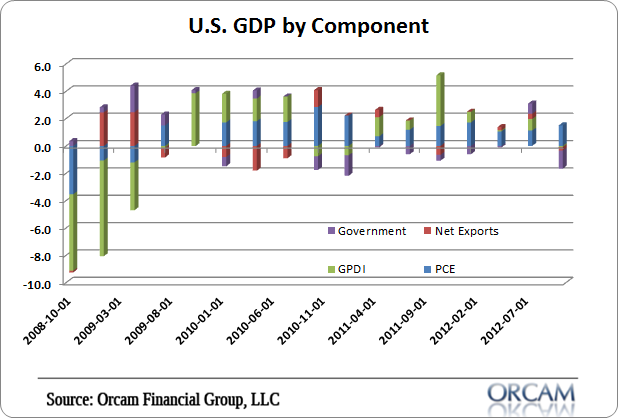
(Figure 1 – GDP by component contribution via Orcam Group)


35 Comments
“Deficit spending didn’t work because you fools didn’t spend enough!” – Keynes, circa 2015.
We’ve been hearing about “green shoots” and “recovery summers” for 4 years now.
What’s been happening during that lengthy period of time?
The government has been printing copious amounts of debt paper in the form of treasury notes(copious to the extent that it has printed $1.45 USD worth of debt for every $1.00 USD of revenue the government has taken in over the same period, resulting in a staggering additional 5 trillion USD of additional debt since 2009), and the Federal Reserve has purchased approximately 50% to 60% of this treasury note debt in the secondary markets (as it is forbidden to do so directly from the Treasury Department), with the result that the Federal Reserve’s balance sheet has risen from approximately 300 billion dollars in 2009 to 3 trillion dollars today.
In the interim, the government has spent $1.45 for each $1.00 of treasury note revenue it has received from these debt actions, and the economy is flailing badly.
The government has loaded up on debt (the U.S. now has an actual debt to GDP ratio of 103% regardless of Krugman’s claims of a lower debt ratio), and in fact, this has not only NOT helped the economy heal, it has broken markets, made price discovery impossible, and crowded out private economic activity, further breaking any mechanism even remotely resembling free market capitalism.
The equity AND bond bubbles that Federal Reserve monetary policy has now created are absolutely massive, and as history instructs us, the damage that will occur to the real economy when these bubbles “pop” (and they will; it’s inevitable) will be extreme.
Ben Bernanke is just like Greenspan in that he tried the old “inflate bubbles and get capital to chase them” approach,” yet his bubbles are more numerous, larger and inherently more dangerous than those Greenspan inflated.
Are you just brand new to this site? Are you completely unfamiliar with MMT and MMR?
“it shows why the debt ceiling debates will likely steer the economy in 2013.”. The debt ceiling debates have barely started, and yet investors have rushed into equities in January, presuming that all will be well, when the jury is still out. Seems like the “risk-on” investors who have gone “all in” have taken on a lot of risk indeed. What will be the percentage drop in G, gov’t spending, if we go into sequestration in the second half of this year?
Sequestration is $85 billion out of a government expenditure of over $3T. It will hit on March 1. The DOD will implement by imposing furloughs on all its civilian workers, which will cut their take home pay in the last half of the year by 20%. They will also have layoffs and cancel contracts.
” In a balance sheet recession, the government component is crucial as it helps provide the income that the de-leveraging consumer can spend while paying down debt.”
Are we to believe that increased defense spending is a precision tool? I can’t imagine that those who benefit from govt spending in the defense sector are the same people who need to delever in order to get us out of the recession.
We need to invade another Middle Eastern country.
no need, just pay $600 dollars for each hammer would suffice.
most of the time the government is not spending, the government is wasting.
There was a large drop in defense spending in Q4 because there was a large increase in Q3. The financial cliff debate pulled government spending forward and boosted performance in Q3 at the expense of Q4.
The fiscal cliff tax increases seem to have boosted PCE in Q4 by, likely, pulling spending forward. FY2013 will have to pay that price in Q1. On top of that the tax increases will bite in to spending. Savings is already low.
GDP Contributions from manufacturing and inventory were way below expectations. Were the regional reports right after all or will these numbers get revised higher?
Employment is a lagging indicator. We will see the effects this slowdown in the coming week/months.
Good points… very rational explanation and warning.
I see that the chain deflator was -0.6% (http://www.finviz.com/calendar.ashx). What is the significance of this?
The deflator was running at 1.95% through Sep so the final quarter saw a significant drop in prices. The economy is running at very low inflation if measured by the deflator or any other price measure, way less than 3% which has been the historical norm. More cowbell is on the way from Uncle Ben. He’s determined to get inflation anchored well above 2%.
It means that if the deflator had stayed the same as the Q3 factor then we would have have had a decline greater than 1.5%.
Doug Short discusses it here:
http://advisorperspectives.com/dshort/updates/GDP-Deflators.php
I have a hard time believing that inflation declined that much from quarter to quarter but that’s what they say happened. If that were true then to me that is a very ominous sign.
The hole is the formula is the idea that deficit spending is always positive that boosts GDP.
In a similar way, consumer debt would also always be a positive, except when it leads to a recession when the consumer goes broke.
Even MR would concede that excessive deficit spending can lead to problems, but it can’t be measured here.
According to the logic of the formula, then, to grow the economy everybody needs to borrow more money. We’ve built our economy around a formula that leaves out productivity and education and saving and innovation and the rule of law and healthy families and all the other factors that lead some nations to grow and others to stagnate.
@Johnny, Haven’t you heard the 4th Law of Economics: Things that cannot easily be quantified don’t count? But Einstein once said: Not everything that counts can be counted, and not everything that can be counted counts”. So things like education, innovation, the rule of law and healthy families – how do these fit into a computerized mathematical model of the economy?
Can answer that question on a micro level, tougher on a macro level.
The individual can always take advantage of his opportunities and raise his own C, so how does society best encourage that?
One thing that has failed — whether it was in 1970s Great Britain or present-day inner city America — is trying to replace C with G.
Johnny – that isn’t a hole in the formula. 2 + 2 always equals 4. But 2 rotten apples plus two rotten oranges lead to an empty stomach whereas 2 apple seeds and 2 orange seeds lead to trees that produce a ton of fruit. So MR agrees with you that productivity and wise investment matter. But since our leaders don’t understand the math or the monetary system they fight over the math and other nonsense. If they accepted the math and “realism” they would then be forced to move onto what MR really wants them to fight over…. what is productive spending and taxes, and what isn’t.
If I make a dollar and borrow a dollar, that doesn’t add up to 2.
Because next year, I have to subtract the dollar.
So we get GDP growth when the consumer is borrowing against his house, but lose GDP growth when the consumer has to delever.
In that sense, this is a formula that only describes the present quarter but is dangerous when used as a way to make long-term policy.
…
Joe, I will look at those articles.
the trick is that most people or gorverments do not lan on subtracting a dollar tomorrow. the assumption is they roll the debt forever
Johnny,
MR is based on the economic observations of Wynne Godley and Stock-flow consistent accounting. Ramanan has some excellent posts on his blog that dig into this equation deeper, and in my opinion, illustrates what is debt sustainability..
http://www.concertedaction.com/2013/01/05/wynne-godley-and-the-dynamics-of-deficits-and-debts/
http://www.concertedaction.com/2013/01/30/trade-elasticities-floating-exchanges-and-debt-sustainability/
http://www.concertedaction.com/2013/01/19/the-beggar-my-neighbour-game/
Joe! Great to see you back. I’d posted question to you here some time ago regarding capital vs equity, but shortly after “Ask Cullen” melted down. Any thoughts?:
http://pragcap.com/ask-cullen/comment-page-13#comment-136132
The hole is the formula is the idea that deficit spending is always positive that boosts GDP.
In a similar way, consumer debt would also always be a positive, except when it leads to a recession when the consumer goes broke.
There is no hole. It is simply an accounting identity which must hold when all is said and done.
I can invent behavioral equations that will make unfunded government spending increase or decrease GDP. I can invent behavioral equations that make raising the interest rate increase or decrease consumption, investment, and GDP.
MMT and – AFAIK – MR simply assume a more or less old Keynesian behavioral response.
This is not the whole story and it’s where MMT and Keynesians often go wrong. There is definitely no guarantee that deficit spending will increase living standards. It might increase GDP, but that doesn’t mean much. It’s completely plausible and even historically accurate to say that deficit spending can cause output to decline and leave the private sector entirely dependent on public spending. See just about any South American country from the last 25 years for evidence of socialist policy at work wrecking the economy.
MMT is quick to claim that spending is only a problem when it outstrips output, but what if it actually causes productive output to decline? Then what? Then the spending causes the output decline AND causes the inflation that reduces living standards.
Yeah yeah, I know that’s not the case in the USA today, but it’s been the case in the past in many different nations. There’s no guarantee that deficit spending will result in a better world tomorrow. And even MMT would say that deficit spending during full employment could be harmful.
“Just as the U.S. gross domestic product is taking a hit from lower defense budgets, federal spending cuts viewed as unthinkable a few months ago — $1.2 trillion falling heavily on the Pentagon — are seen as likely to happen starting March 1.” see http://www.bloomberg.com/news/2013-01-30/automatic-u-s-budget-cuts-more-likely-as-stances-harden.html
If full sequestration really hits us in March and Congress fails to stop it, this is something that has not been priced into equities, IMO.
1937 here we come
Could not agree more hangemhi! Private sector just too weak to deal with payroll tax hike and possible spending cuts.
For now, keep cool. Technicals look OK, and so far, not much in the way of selling. It’s a good time to be cautious, have some stops in place. I bought a few puts and may add but will also be looking for discounts on pullbacks. If the market turns so be it, selling because of what might happen gets expensive. Fwiw, I think with opinion polls ranking the GOP below head lice they won’t put up much of a fight in the debt wars. Anyway, for some time to come this bull may not care about fundamentals.
So when does the “stimulus,” you know…”stimulate?”
Hello,
everyone talking headline better than it looks beacause of huge negative impact of inventories and government. But also looks like deflator used is much lower than was expected(0,6 vs 1.5) – another sign of deflation?
I see some coverage of consumer weakness, due to payroll taxes and pump prices, but not many. It would be interesting to see one chart that covers credit card debt, savings rate, discretionary income, and pump price.
Lets cut government spending to cut the deficit….lets cut it by 0%, immediately and we’ll see if the private sector can pick up the slack.
There is no question where the economy and incomes followed by spending will go…in the tank.
It is not as much a question about how much the government is spending while relevant, it is more a question of how it is spending the money. If the gov’t spent in money in investments such as infrasture we’ll get a boost immediately, if the government spends money in health care and education with demands on efficiency the economy will benefit in the long run.
The above is fact with 1 caveat…no chrony capitalism. That isn’t possible in our current gov’t in bed with business society…it’s fascism.
Everyone is willing to sacrifice future generations for their own greed.
The 60′s, 70′s, 80′s, 90′s, 00′s and and now the 10′s generation took/take drugs to escape reality and while they may have stopped taking drugs they are still trying to escape reality via the convenience of cognitive dissonance via mass Q of fiat money.
correction on my last comment…should have read “cut it by 30%.”
It is also a question of what is a sustainable level of output. If unsustainable debt contributed 2% annual output to a “natural” level of 2%, attempting to maintain a 4% level of output through increased govt support is foolish. At some point markets need to clear.
You shoud understand that
1. GDP growth is not equal to wealth creation, so please do not obsess with GDP growth going negative or staying positive
2. GDP growth could be maintained but the median citizen gets poorer, so GDP growth is not lifting all boats
3. A recession is a natural process that the economy demands. Not having a recession is like refusing to sleep – how long can you hold out even using coca cola or drugs in increased doses?
4. A lot of poor stewards of capital / crony capitalists will suffer losses in a recession / market clearance, but so what? Let the true capitalists take over.
http://www.thedailybeast.com/articles/2013/01/31/what-if-stimulus-works-but-only-in-theory.html
‘In short, I’m wondering if rather than being tried and found wanting, Keynesianism hasn’t been found impossible and left untried.’
