
GRANTHAM: THIS TIME IS DIFFERENT
Jeremy Grantham is convinced that this time really is different when it comes to the commodity bubble. His latest narrative covers the decline in natural resources and why we have moved from a period of low prices to a period of rising prices. This is fairly shocking commentary from one of the great bubble spotters in history and the king of mean reversion. He writes:
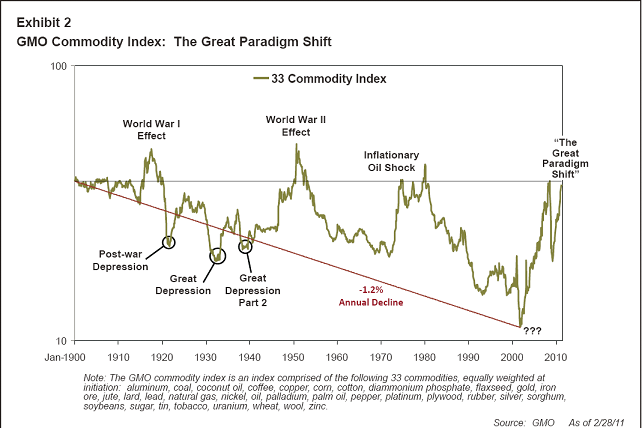
“The history of pricing for commodities has been an incredibly helpful one for the economic progress of our species: in general, prices have declined steadily for all of the last century. We have created an equal weighted index of the most important 33 commodities. This is not designed to show their importance to the economy, but simply to show the average price trend of important commodities as a class. The index shown in Exhibit 2 starts 110 years ago and trends steadily downward, in apparent defiance of the ultimately limited nature of these resources. The average price falls by 1.2% a year after inflation adjustment to its low point in 2002. Just imagine what this 102-year decline of 1.2% compounded has done to our increased wealth and well-being. Despite digging deeper holes to mine lower grade ores, and despite using the best land first, and the best of everything else for that matter, the prices fell by an average of over 70% in real terms. The undeniable law of diminishing returns was overcome by technological progress – a real testimonial to human inventiveness and ingenuity.
But the decline in price was not a natural law. It simply reflected that in this particular period, with our particular balance of supply and demand, the increasing marginal cost of, say, 2.0% a year was overcome by even larger increases in annual productivity of 3.2%. But this was just a historical accident. Marginal rates could have risen faster; productivity could have risen more slowly. In those relationships we have been lucky. Above all, demand could have risen faster, and it is here, recently, that our luck has begun to run out.
…Just as we began to see at least the potential for peak oil and a rapid decline in the quality of some of our resources, we had the explosion of demand from China and India and the rest of the developing world. Here, the key differences from the past were, as mentioned, the sheer scale of China and India and the unprecedented growth rates of developing countries in total. This acceleration of growth affected global demand quite suddenly. Prior to 1995, there was (remarkably, seen through today’s eyes) no difference in aggregate growth between the developing world and the developed world. And, for the last several years now, growth has been 3 to 1 in their favor!
The 102 years to 2002 saw almost each individual commodity – both metals and agricultural – hit all-time lows. Only oil had clearly peeled off in 1974, a precursor of things to come. But since 2002, we have the most remarkable price rise, in real terms, ever recorded, and this, I believe, will go down in the history books. Exhibit 2 shows this watershed event. Until 20 years ago, there were no surprises at all in the sense that great unexpected events like World War I, World War II, and the double inflationary oil crises of 1974 and 1979 would cause prices to generally surge; and setbacks like the post-World War I depression and the Great Depression would cause prices to generally collapse. Much as you might expect, except that it all took place around a downward trend. But in the 1990s, things started to act oddly. First, there was a remarkable decline for the 15 or so years to 2002. What description should be added to our exhibit? “The 1990’s Surge in Resource Productivity” might be one. Perhaps it was encouraged by the fall of the Soviet bloc. It was a very important but rather stealthy move, and certainly not one that was much remarked on in investment circles. It was as if lower prices were our divine right. And more to the point, what description do we put on the surge from 2002 until now? It is far bigger than the one caused by World War II, happily without World War III. My own suggestion would be “The Great Paradigm Shift.”
The primary cause of this change is not just the accelerated size and growth of China, but also its astonishingly high percentage of capital spending, which is over 50% of GDP, a level never before reached by any economy in history, and by a wide margin. Yes, it was aided and abetted by India and most other emerging countries, but still it is remarkable how large a percentage of some commodities China was taking by 2009. Exhibit 3 shows that among important non-agricultural commodities, China takes a relatively small fraction of the world’s oil, using a little over 10%, which is about in line with its share of GDP (adjusted for purchasing parity). The next lowest is nickel at 36%. The other eight, including cement, coal, and iron ore, rise to around an astonishing 50%! In agricultural commodities, the numbers are more varied and generally lower: 17% of the world’s wheat, 25% of the soybeans (thank Heaven for Brazil!) 28% of the rice, and 46% of the pigs. That’s a lot of pigs!
…This is an amazing picture and it is absolutely not a reflection of general investment euphoria. Global stocks are pricey but well within normal ranges, and housing is mixed. But commodities are collectively worse than equities (S&P 500) were in the U.S. in the tech bubble of 2000! If you believe that commodities are indeed on their old 100-year downward trend, then their current pricing is collectively vastly improbable. It is far more likely that for most commodities the trend has changed, just as it did for oil back in 1974, as we’ll see later.
…I believe that we are in the midst of one of the giant inflection points in economic history. This is likely the beginning of the end for the heroic growth spurt in population and wealth caused by what I think of as the Hydrocarbon Revolution rather than the Industrial Revolution. The unprecedented broad price rise would seem to confi rm this. Three years ago I warned of “chain-linked” crises in commodities, which have come to pass, and all without a fullyfledged oil crisis. Yet there is so little panicking, so little analysis even. I think this paradox exists because of some unusual human traits.”
Is it really different this time? I am not so certain. I am still a believer in the idea that a permanent bet on higher commodity prices is a bet against human ingenuity and if there is one great long-term bet over the course of human existence it has been on ingenuity….
You can read the entire Grantham letter here.


To be fair to Mr Grantham, he does appear to be advocating a “buy on dips” approach (which I always view as a cop-out). This probably intuitively appeals to any of us with a Malthusian bent (Boatman?!).
I think its an interesting read because he appears very aware of the fact that he is doing a “this time it’s different” piece and this is the kind of brave call that could ruin his reputation.
Cullen – as a thought experiment, what would it take for you to come round to his view on this? If anything?
I think it might be. Consider “Revisiting the Limits of Growth After Peak Oil” by Charles A. S. Hall and John W. Day, Jr.:
http://www.esf.edu/efb/hall/2009-05Hall0327.pdf
higher commodity prices lead to cost inflation and finally cyclical recessions. this time is not different. if he says that depleting resources and increasing demand from china and india will result in “this time is different”, mother nature says NO (because cycles are natural), instead it means we will see greater recessionary periods in especially in the developing world(re: china india etc)due to the supply-demand imbalances
I read Grantham more generally here. I agree that the world is passing into a new stage in which we finally get it that resources are not infinite and that the present economic paradigm that presumes unlimited growth based on infinite resources must be changed to reflect reality.
However, I do not read him as saying that there will be no more commodity bubbles ever again because of this general trend. The reason that trading is possible is due to different estimations of price versus value (the general trend line around which price fluctuates), the power of momentum to depart from the trend line and the corresponding tendency to overshoot in both directions during corrections, and the amplifying effect of leverage. In fact, the realization that the general trend is up may actually generate bubble behavior as people pile on in expectation of easy money. Exponential gains are unsustainable, regardless of the general trend.
human ingenuity so far rose on the cost of polluting our environment and some kind of slavery.
For sure there is a wall to be hit, and it does not seem to be that people learn from history, thats another thing one can be sure about.
Hey there is so much pollution on the way that we likely hit already the point of no return, i.e oxygen zones in the oceans is a really dramatic one, but not reported by our media. Instead we get brainwashed on problems, where there are no problems (CO2 science fraud). One time we will be demanded to collect and burry our faarts, that will have deeper impact on our environment than that whole CO2 hype.
Whole science is becoming a tool of profit maximization, leading us right into genozide under these absurd dimensions.
Thus we will hit the wall. And then the outcome from Jeremy becomes very likely.
Cullen, looks to me like you have a bit naive view on human so called gains and what is called science though its only backed by a consensus -> believes.
Thats how crazy human ingenuity looks like atm. Creating more profitable problems on claimed problems where there are no problems (forced by our money system)
“Human ingenuity drives us right into genozide.”
-Ivan Illich “The nemesis of medicine” -1976
http://imperialeconomics.blogspot.com/2011/04/peak-oil-population-overshoot-and.html
Right, Bruce. Thanks. And don’t forget the “Olduvai Theory” (world industrial civilization is a 125- to 150-year, one-shot affair owing to abundant supplies of cheap liquid fossil fuels).
http://imperialeconomics.blogspot.com/2011/04/pictures-of-peak-oil-and-greatest.html
The post-Oil Age Greatest Depression is quite probably already underway (see the link above), only we have yet to reach the point of mass-social recognition, which tends to take 3-5 years from the onset of a secular phenomenon. By this standard of social diffusion, a large plurality, or a majority, of Americans will begin to internalize the emerging permanent structural effects of Peak Oil and population overshoot and implications by ’11-’13.
“Z.P.G.”: http://www.imdb.com/title/tt0069530/
“Logan’s Run”: http://www.imdb.com/title/tt0074812/
“Soylent Green”: http://www.imdb.com/title/tt0070723/
Depending upon your age, you might recall the 1970s films at the links above; if not, these films were produced around the time of the Club of Rome’s “Limits to Growth” (LTG), reflecting the themes of pollution, population overshoot, climate change, and resource constraints.
The LTG findings and projections were largely ridiculed, dismissed, misrepresented, and worse for being too gloomy and lacking in faith in human ingenuity; however, a great many of the models’ projections proved to be quite sound (and continue to be today), and it was not a coincidence that the evidence was emerging for such outcomes to occur just as the US reached domestic crude oil production in 1970 (a near 50% decline since, and 60-65% in per capita terms), the US$ was removed from gold, and the deindustrialization and financialization regime had begun.
E.M. Forster’s “The Machine Stops” (1909): http://archive.ncsa.illinois.edu/prajlich/forster.html
Forster’s short story above was quite prescient a century ago in imagining a world that had become vulnerable to dependence upon “the machine”.
The peak Oil Age epoch of abundant supplies of cheap crude oil from the 1920s-30s to 1990s at an inflation-adjusted price well below $20 (2008$US) until the mid- to late 2000s is over. The US became the global industrial and military hegemon, i.e., empire, with the avg. inflation-adjusted price of oil at ~$10-$14, and Japan became the second-largest economy in the world with an avg. inflation-adjusted price of oil of $15-$16 to $20-$24.
Now China and India think (with help of US supranational corporations’ investments in their subsidiaries in Asia) they can replicate the peak-Oil Age, auto- and oil-based economic development model since the 1920s-30s with the price of oil since the 1990s-2000s at $46-$72 and $106-$122 today; it ain’t gonna happen, especially not in real per capita terms with a population of 2.5 billion (35% of world population).
Most of us don’t yet know it, but what we have known most of our lives as “normal” or a permanent way of living is over, and the overwhelming majority of us are utterly unprepared for what comes next; and politicians, CEOs, Wall St., and the mass-media influentials don’t want you to know for obvious reasons.
Bravo, Alfred! The great irony of “human ingenuity”, i.e., technological innovation made possible by cheap liquid fossil fuels of the peak Oil Age epoch since the mid- to late 19th century, has created a massive population/ecological overshoot condition and diminishing returns to net energy and complexity that there is virtually a zero probability that there is sufficient net energy returns to provide a western style of material consumption for even a tiny fraction of the existing human ape population.
I read this entire piece.
I wholeheartedly agree. There could be some rough sledding sure, but as I see it’s where one will want to be the next 10 years. Especially since the fiasco known as politicians and fiat money collide and implode.
I read Mish’s take on Ryan’s budget cuts, so-called. So Obama would have us at $27T debt by the 2020s whereas Ryan would have us around $23T.
And this is a serious discussion towards getting the debt or “paper obligations” under control???????????????????
Any wonder the PMs are flashing a big middle finger??
Tom and Kenzo, well said. The frequency of equity bear markets and cyclical recessions increase during secular bear market eras, and “this time is different” in that peak global oil production and oil exports, population/ecological overshoot, and falling net energy returns imply that real private per capita GDP is hereafter impossible.
Capitalism (as we know it) has created massively unsustainable claims on future labor product and production via compounding interest, unprecedented scale of ecological destruction and drawdown of vital resources, and a religious-like belief in perpetual growth of population, consumption, and ecological destruction and waste on a finite, spherical planet.
IOW, what we think of today as capitalism, “growth”, “globalization”, technological innovation, and “progress” is an “ecocidal” mass delusion of unprecedented global proportions in human ape history.
Yet, to listen to politicians, CEOs, and financial media influentials, all we need to do is “Drill, baby, drill!”, cut taxes, frack more (and buy bottled water from Nestle and Coca Cola), print more fiat digital debt-money, run up more credit card debt we cannot pay back, buy $40,000 electric cars with a range of 32-100 miles and a charging time of 4-6 hours, and buy more cheap junk from US subsidiaries’ contract producers in China-Asia.
We are eating ourselves while pi@@ing and shi@@ing in our water supply.
As a species, we’re insane.
prescient, acute resource constraints, rising prices, falling real growth of consumption, and eventual permanent shortages of resources will likely mean that the gov’t will take over arable land, water supplies, utilities, energy companies, ports, transportation, etc.; however, “the gov’t” is already now a de facto militarist-imperialist corporate-state, therefore, privately held mega-corporations will become a kind of feudal private corporate-state, and no one on this list will possess the wealth and connections to buy into that club.
There is said to be limitless Hydrogen contained within the oceans of our Earth. More than enough to supply energy for all without barely denting the supply. The problem as I know it is that it currently takes more energy to convert sea water to hydrogen and oxygen than the energy that is obtained.
So I believe this is the primary crux of the problem to producing Hydrogen in mass quantity to replace fossil fuels. (That and an industry that does not want to be displaced quite yet.)
I personally agree with Cullen here… ” I am still a believer in the idea that a permanent bet on higher commodity prices is a bet against human ingenuity and if there is one great long-term bet over the course of human existence it has been on ingenuity…”
The only caveat I would add to this is that in the short-term the “time” factor for achieving the necessary ingenuity result (technology jump) may be delayed long enough to cause great (or greater) harm to human kind before resolving the problem.
@Boston_AI
If you are implying that all we need to do is split the water into H2 and O2 so we can burn it again, that isn’t realistic. This is the chemical equivalent to a perpetual motion machine. After one considers the inevitable losses due to various inefficiencies — keeping hydrogen cold so we can store it under reasonable pressures, Carnot inefficiencies, loss due to leakage, etc. — Hydrogen is not the fuel source of the future. The only way hydrogen will come into common use is if some other power source (solar, wind, nuclear, petrochemical, etc.) is used to split the water apart to make hydrogen. Then we get /some/ of the energy back when we burn the hydrogen. To believe this scenario would evolve, we’d have to believe that hydrogen is one of the better energy storage media out there, which, if you’ll recall the Hindenburg, seems doubtful. It is also notoriously difficult to store. Thus, nuclear fusion aside, hydrogen is not likely to be in our future and certainly is not going to be our primary source of energy. (For that you’d need a large supply of elemental hydrogen or equivalent that could be mined somewhere, and there is no such thing on Earth. The sun on the other hand has lots and it is already being used to make lots and lots of energy.) On Earth, Hydrogen is destined to be merely a energy storage medium, and it is not really that easy to store hydrogen.
If you are implying we are going to use the hydrogen in a fusion reactor, well then that is more reasonable, if highly improbable. We at least aren’t talking about perpetual motion machines anymore. Alas, nuclear fusion reactors aren’t good enough yet. We would need a breakthrough in that area and whatever it is doesn’t seem to be right around the corner or even the proverbial “ten years out”.
Yes, but how much cash has the markets allocated to fusion research?I would say a pittance compared to what ‘the market’ is willing to throw at Groupon should it do an IPO. Hence this tech has made steady even if slow progress, mostly funded by govt.
Thankfully we also have lots of natural gas (at least in the USA). Significantly more supplies since Frac’ing technique was uncovered. But there may be unacceptable consequences of this if not properly regulated (polluted drinking water supplies?).
Another source with a great promise of supply is Gas (Methane) Hydrates. Frozen methane that occurs naturally in the depths of the ocean under great pressure and low temperature. http://marine.usgs.gov/fact-sheets/gas-hydrates/title.html
Not to mention relatively unlimited Wind and Solar energy.
Here again we have other problems. For one, methane is still a hydrocarbon, like gasoline. Like gasoline, it produces CO2 when it burns. It is better than gasoline in this respect, producing about half as much CO2 vs. water, but still will produce lots and lots of CO2.
The other problem with methane is that it itself is a greenhouse gas. It is actually many times worse than CO2. Right now, there is lots and lots of methane trapped under the sea, in the arctic, underground, etc. Some of that will be released naturally as the arctic warms due to global warming, which is bad. If we start mining it, I can only imagine that the releases of raw methane will be even higher.
Methane might be a stopgap, but if we exploit it at all, it should be a temporary one. We really need to bulk up on real renewables, even though they aren’t entirely practical or the most efficient sources of energy at the moment. That is where we need to be eventually, and the sooner we get there, the better.
And many of the renewable energy sources also give off greenhouse gases. The ones that don’t will not run 24/7 to provide efficient energy (power) needs. Wind and Solar are not 99% reliable.
So all you have done is traded renewable energy (bio-fuels?) for non-renewable ones?
Otherwise you are are talking nuclear energy. Today all we have is fusion. As you point out, fission is not possible (yet).
Correction: I mixed up Fusion and Fission in my statement above. It should have said:
“Today all we have is fission. As you point out, fusion is not possible (yet).”
The issue that Grantham brought up is not pollution or greenhouse gases. It is one of energy sources to run and maintain our modern day economic engine. There are alternatives, and yes, solar and wind could be used to split water into hydrogen.
Brazil has done a great job of switching to bio-fuels and compressed natural gas (CNG) and away from oil. But even they still use and need oil. I believe Brazil has only replaced 40% of their energy needs with renewable energy sources like bio-fuel.
So unless fusion can be made controllable, or cold fusion is even possible, we are not left with else that is non-polluting and reliable.
I noticed there is no mention to the low dollar as having an impact on current commodity prices in Grantham’s piece – any observation on why this may have been ignored, or how much of the current pricing is attributable to the fed? In reading much of your comments in QE2 I’ve taken to heart that we dont quite know what prices would be if Ben would leave well enough alone…
Grantham is a brilliant investor but his credentials as a scientist are questionable. He is a believer in AGW despite the “correlation is causation” fallacy at its core, and peak oil is a thesis I first heard in a freshman geology class in 1969. It’s an old chestnut that might be right sometime, but technological advances keep resetting the clock on the prediction.
When the Fed was growing its balance sheet in the 1970′s under Arthur Burns and William Miller (it was “monetizing the debt” back then also), we had rapid inflation and a blow off in PMs and commodities, just like we are starting to have now. Silver is probably in a developing short squeeze currently, but the government/Fed will come up with something to cool the fever if it threatens the system; the Hunt brothers experienced this first hand in the 70s. Trees don’t grow to the sky and this trend will end.
And by AGW, you mean Anthropogenic Global Warming?
There is no correlation is causation fallacy at its core. There would be if there was no mechanism to suggest a tie between rising CO2 levels and rising temperatures. However, there is.
Look, temperature is just a measure of energy density. Global temperature is therefore just a measure of how much energy is in the atmosphere. Given that physics tells us that energy is neither created nor destroyed (E=mc2, notwithstanding, depending on your definitions…) it should be fairly obvious that the amount of energy in the atmosphere at any given time is some starting level of energy plus the energy added in over time less the energy that radiates out into space over time. It is not unlike the basic rules of MMT, except here we have PHYSICAL LAWS guaranteeing zero sum heat laws rather than say a bunch of G-men from the Treasury department.
Now, when we burn fossil fuels, we do two things:
1) We release a bunch of heat directly into the atmosphere — burning fossil fuels makes fire… heat.. should be obvious.
2) We consume some oxygen from the air and make CO2 and water with it. Again basic chemistry, rather indisputable.
The fact that ties correlation to causation here is that the CO2 we made is much, much, much better at absorbing sunlight converting it into heat than the oxygen it replaced. As you add more and more CO2 to the atmosphere, the atmosphere gets better and better at converting the sunlight that hits the Earth into heat, and less of it is left to bounce off into space. Energy added to the atmosphere every year due to sunlight goes up. Energy lost due to radiation out into space goes down. At the end of the day, sure as basic addition and subtraction, the total amount of energy in the atmosphere rises and we feel that as the various problems associated with global warming. The connection between CO2 and warming is very clear.
In the face of that, to continue to be a denier, you have to either believe that we aren’t actually burning fossil fuels, or that the CO2 we make is somehow absorbed magically but other CO2 (e.g. from volcanos) isn’t, or the vast bulk of CO2 was introduced from somewhere else (space aliens) or there isn’t actually global warming going on at all. None of these alternative hypotheses are supported by evidence.
Even if we suppose the majority of CO2 came from somewhere else (but for whatever reason we can’t find that source now which apparently dwarfs all of human endeavor) we still have to contend with the issue of whether or not we are going to continue to make it worse with our own emissions.
The link between CO2 concentrations and atmospheric heat absorption is clear. The only dissent comes from folks who just don’t want it to be true, because it means they have to actually stop doing something, or at least feel guilty about doing it.
Seems to me he cherrypicked the lowest point on the graph. An honest look draws the trend line about in the middle between his line and the baseline. It ends up right about the trough of the current market bottom in early ’09.
Clearly he is trying to blow the bubble bigger.
I totally agree, Dave. He could have just as easily drawn a horizontal line thru the lows in the ’30s and ’70s. This would show a range instead of a trend. Then you would be talking about the mean-reversion tendencies for commodities. Furthernmore, it would seem that the outliers would happen more frequently on the downside.
I have a lot of respect for Grantham. But I do think he has officially gone Fisheresque here.
“Stock prices have reached what looks like a permanently high plateau.”
-Irving Fisher, Oct 1929
All I can say is “wow!” What a letter.
I think we will have an incredibly positive supply shock within 15-20 years. The hardest part may be getting there first though.
Resource wars are unfolding right before our eyes…. Africa is getting carved up between the West and China…
And the techno-utopians are too busy with their iPads to notice.
The thing with commodities is it is easy to get sucked into the ‘we are running out of everything’ meme, which throughout history has always been the case.
Most predictions from the 50′s, 60′s and 70′s have turned out horrendous – just look at the predictions from the first earth day.
http://www.ihatethemedia.com/earth-day-predictions-of-1970-the-reason-you-should-not-believe-earth-day-predictions-of-2009
Many of these commodities are more abundant than we perceive, it’s just a matter of building the extractive capacity. Once China completes it’s build out, things could get interesting, but predicting the timeline is naturally difficult.
Also nothing is really destroyed, just look at what is lying around in our garbage dumps.
Malthus lives…it’s the hip persona that’s crops up every thirty years or so. Last time was during the last years of the Carter debacle.
Commodities will be the place to be over the very long run. We have dominated consumption throughout the world for a long time. I think the entire economic issues the US is facing is how to deal with globalization and the billions of people wanting to improve their lifestyles. I’m not sure this time is really different. I wonder if the last 30-40 years were really the anomoly.
actually duncan i differ w/malthus…the next economic convulsion (take your pick of the reason-they are all out there hanging) turns us farther down the road of population plateau and fall….demographics point out this in industrialized nations and in the next downturn on an over-leveraged china and already teetering mainstreet US n euro– even most of the un-industrialized world will not grow in population-tho it will be from attrition….not pretty
commodities do fall(but don’t get to his down baseline) in the next and worse big bada paper-toothpicks n popsiclestick propped up bust.
but gold is not a commodity at this point…..the 1/2 of silver that IS a commodity(the ‘copper’ part) will initially take a hit…..but only temporarily.
Sorry Boatman!
I was only joking, but didn’t mean to misrepresent you!
believe me, if there’s anyone here that can take a joke, its me
To understand what is going on here, China is a big part. Look at what has happened over the years. They rape their country and plunder their natural resources, for what??? Paper dollars… They have used this low cost producer model to take millions of manufacturing jobs from the US, but now have a problem, they need these resources for their own vast and rising consumer class.
But guess what??? They don’t have enough copper or iron ore. China used to be the largest exporter of iron ore, and now they are the largest importer. And they are getting jammed with price hikes.
They will not allow that to happen with all their natural resources. Which is why I am bullish on the rare earth space for a while. China is pissed that America just sits their, acts like everywhere else should get destroyed with mining, and yet is saving their natural resources for future generations.
China is mistaking America’s refusal to develop its vast resource wealth as far-sighted and intentional. And they are pissed about it. They no longer want to be the “strip-mine” for the world and be subject to cartel pricing for key raw materials they desperately need.
That is exactly what happened with iron ore. This thinking is a big part in what has caused the paradigm shift, imho.
The other aspect which supports Mr. G is the flattening of global income distributions, which is very bullish for commodities.
On the other hand, the continued success in terms of trade, for Japan, Germany, Switzerland, countries with relatively poor natural resources, tells me I wouldn’t short ingenuity yet.
Didier Sornette’s log-periodic model predicts a gold crash beginning any day:
http://tinyurl.com/3sr8oxg
The commodities bubble is a classic hoarding scenario in which participants seek out proxies to maintain purchasing power against negative real yields for cash or liquidity preference. Eventually participants lose sight of (never realized in the first place) the rationale for the hoarding response and begin to internalize rising prices as self-validation of “investment returns” instead of a hedge or insurance against the loss of purchasing power.
The bubble price diverges far from the differential returns to hoarding of “money” proxies vs. cash, increasing the costs to liquidity of further hoarding well beyond future gains to hoarding vs. liquidity.
Liquidity becomes cheap, i.e., cost of holding cash bottoms, and the hoarding value crashes back to the long-term trend of liquidity, or back to the exchange/production value of the hoarding proxy (approx. rate of growth of money supply and GDP, generally speaking).
Part of the liquidity preference with the acceleration of price inflation peaking later this year and the hoarding value peaking well before will manifest in a shift to safety back into US Treasuries.
At the inverse hoarding-liquidity preference ratio as implied by the faster-than-exponential (hyperbolic) bubble trajectory of gold, the implied anti-bubble trajectory for gold will be a crash of 50-65% and the 10- and 30-yr. Treasury yields falling to the mid-1% and mid-2% range respectively, with the prospect for 0% to negative reported price inflation along the way.
Net returns to Treasuries and cash vs. stocks, junk, PMs, and commodities over the next 24-30 months will be HUGE.
Sell PMs, commodities, stocks, and junk bonds, and buy Treasuries before PIMCO’s Gross does.
Here is my retort.
Emerging economies have real money.
They need commodities.
Buy commodities.
There is my model and I have been banking it for 2 years. Good luck.
46% of pigs??? Clearly I should sell everything and go into pig farming…
The problem is the combination of a scarcity of resources, QE 1, 2, …. (and counting) and further down the road the next phase of credit contraction (=deflation). in other words: We’re ridng a roller coaster ride and we don’t have a clue where the ride will take us. We know what’s up ahead but we don’t know in which sequence those events will unfold. Then it’s not surprising that even Jeremy Grantham thinks that “This time it’s different”".
I would quote Mark Twain: “”History doesn’t repeat itself but it rhymes”".
Gregor Macdonald took a pot shot at you here Cullen:
http://gregor.us/economics/jeremy-has-spoken-but-rest-assured-pro-money-management-isnt-listening/
Never heard of him. Worth reading? I can handle criticism
In my opinion, we are fast approaching a point where the only source left, from which the debt addicts in DC can get their next fix (which they MUST have), is from some kind of overt or covert nationalization of retirement savings. Most likely that would come in the form of mandating that some percentage be moved into “safe” U.S. Treasuries (to protect the retiree’s savings, of course). But, since those funds have to come from somewhere, it will likely crush all other asset classes (giving cover to allow the debt addicts to mandate an ever higher percentage of retirement savings be in “safe” U.S. Treasuries) and temporarily “save” the U.S. Dollar (at least until there are no more retirement savings to loot). That will probably take a year or two or three but, once all asset classes are crushed (so that the looters and scammers running the show can buy them up for a song) and all retirement savings are locked up in U.S. Treasuries, the debt addicts will start demanding a massive return to quantitative easing (because they MUST have their next fix), thus kicking off the final hyper-inflationary collapse that many are (in my opinion, prematurely) currently predicting. So hold onto your wallet and make sure you know where the crowd is going (so you can stay out of its way) because you can be fairly certain that this time is NOT different.
You could be right, but I think it is more realistic that the confiscation of retirement assets will take place AFTER the next market crash. The last serious proposal to do this was floated by Rep. George Miller (D-CA) during the 2008 crash. His proposal was to take all 401K’s and put them into Social Security, with their former owners being given a lifetime Social Security benefit in compensation for the Eminent Domain seizure. If the market had not recovered in early 2009, such a plan might even had been popular. But the market did recover, and the talk of this largely went away. The Obama Admin has been floating the idea of mandatory T-bill investments for retirement plans, but with a GOP House, this plan is going nowhere, at least not if Congress has anything to say about it. If the market should crash to new lows, especially with a fully Democratic government, the Miller plan might just be quickly revived.
Of course, if Obama gets reelected, he could impose a mandatory T-bill investment plan by executive order and IRS regulation, and the Republicans won’t have the 2/3 of both houses required to overturn him. (He wouldn’t dare do such a thing before the Nov 2012 elections, even though he has the clear legal authority to do it tomorrow.) It would be very unpopular if the markets hold up, though, and it could cause further damage to his party in Congress.
I’m not sure debt is such an unstoppable force, nor am I particularly concerned by it. Debt has its own reward — insolvency or inflation, depending on who you are — and will be sorted out on its own in due time. All told, Americans have already gotten the message and they are sensibly paring down their own debt, even if this is largely through default. At least they aren’t incurring new private debts at the same clip as they were. A few might begin to believe in controversial theories like the necessity of a rain day fund, etc. This is all good. The rest of it, in the end, it is just numbers in an arbitrarily valued currency.
Far more worrisome to me is the continued over consumption of real wealth. The Boomer retirement demographic time-bomb is looking to be an inescapable fact. Without plausibility-stretching increases in productivity, living standards *must* decline for the nation as a whole to support so many non-workers on the backs of comparatively fewer workers. If we do not spend our last few years of Boomer productivity investing in infrastructure to enable substantial productivity improvements to carry us through that time, we risk septuagenarian backlash at the polls which may cause our nation to do rash and destructive things in a vain attempt to support the increasingly submerged and desperate elderly. That is the trauma I’d like to avoid.
Most people of my parents’ generation don’t want to become a burden on their children. The problem is that once you stop working, you are a burden on your children no matter what you do. Any assets you plan to liquidate to pay for your daily bread still cost the young that daily bread. It would be better if we taught pensioners to live inexpensively. Moving back in with your children is not in the end a terrible thing. You get to reconnect, and I am sure that they will /greatly/ appreciate the child care. If you are lucky, you may get to leave them something when you go. In either case, they will have memories of you.
I believe this is what you are talking about when you say human ingenuity. Can this be the game changer but not before a massive bout of deflation and capital destruction:).
http://www.livescience.com/13745-newest-cold-fusion-machine-impossible.html
I wouldn’t believe anything hawked by Rossi and his ilk. Researchers at NRL have tried to reproduce his results to no avail, and Rossi is a known felon. He is not a scientist. He has not allowed others to study his device in a manner that would allow it to be truly verified, and the whole history of those who make claims of reproducible “cold fusion” is one of scam artists who are out to bilk a desperate and gullible public.
There is a big difference between energy commodities (oil, gas, coal), ag commodities, and other commodities like metals. Energy commodities are used up and gone forever. They cannot be recovered. Ag commodities are also used up, but are renewable as long as solar energy and fertilizer are available. Metals can in principle be recycled almost forever. So, I would expect the huge run-ups in metals prices to eventually reverse once China and India are fully developed. Peak Oil is reality, and the biggest unknown is the true state of the reserves in the Middle East. Modern horizontal drilling technology allows Saudi Arabia to suck the oil off the top of its oilfields while pumping seawater into the bottom, thus maintaining almost constant extraction rates until the end. There may be very little warning before the end comes.
There may be a reason that the Kings of SA are all the brothers, and not the sons. There may not be much left for the next generation of rulers in that great medieval kingdom.
Any chance that those hundreds of billions we’ve spent on two wars plus 8 years of runaway spending and tax cuts to the wealthy by the Bush administration have played a role in this? This 2002 “Paradigm Shift” begins mere months after 9/11 and barely a year into Bush’s first year. All of the big spikes on this chart –including the “inflationary oil shock” of the 1970′s– seem to follow costly, protracted American wars. So how does our current military quagmire compare to others in it’s effect on prices? I’m certainly no economist or financial expert.. but why is it that OUR wars –including Viet Nam– seem to have had such a devastating effect on WORLD commodity prices for those 102 years? If we pulled out of the middle east and reigned in our paranoia and hysteria and put some teeth into financial reform, might prices come back down?
When choosing between Grantham and human ingenuity, I take Grantham. It’s not that I doubt human ingenuity but this collective strength tends to manifest itself only after human dumbness has messed up things to the point of no return. Whilst this wave pattern develops, you’ll be better off following Grantham.