

Home » Most Recent Stories

INFLATION UPDATE

23 February 2012 by Cullen Roche 48 Comments

Apologies for being a week late on the inflation update, but I’ve been swamped with other things.  The latest readings on CPI showed a continued trend in disinflation at the headline level but a small rise in the core level.  All in all the headline figure of 2.9% and core reading of 2.3% are still low although the 2% core level is above the Fed’s comfort zone.  Food, transportation and apparel all posted close to 5% gains on a year over year basis.   Clearly, the fuel issue is emerging again this year as it tends to do during this seasonal period.  Gasoline prices are already up 24% this year and will continue to pressure the headline reading.

My prediction of disinflation turned out to be right, but now has very little downside and we’re likely to see sideways to higher inflation readings given recent trends.  I think this puts the kabosh on QE3 as I had previously expected it to come in June.  With core over 2% and headline likely to creep higher in the coming months there’s no way the Fed can be expected to be even more accommodative.

The fuel issue is a real concern as this will likely dampen economic growth later in the year.  Fuel prices are at records for this time of year and we generally see steady fuel prices through the winter and into the summer driving season.  It would be highly unusual for fuel prices to put in a top before the July 4th holiday.  Given all of the above I am beginning to think that inflation is a bigger issue than the Fed is currently expecting.  Consumer credit has picked up, the deficit remains large, and we’re beginning to see some signs of stability in the labor market.  We’re by no means going to see soaring inflation in the near-term (unless oil prices really kick into high gear), but it’s becoming clear that the risk to inflation is now on the upside.

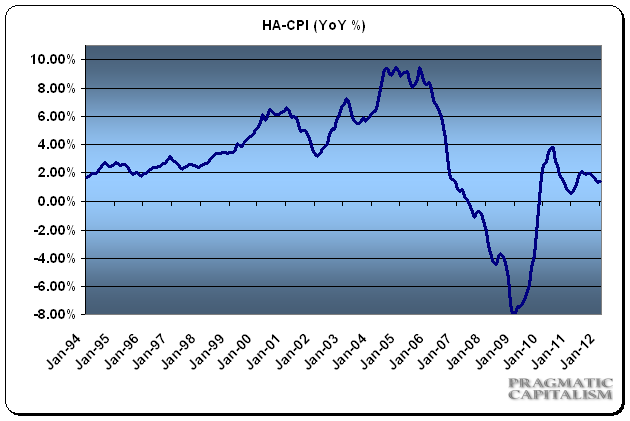
As for my housing adjusted CPI – prices remain muted on the whole as the housing market has continued to soften.  But this too is likely to bottom out given the recent improvement in housing data.  The latest reading was just 1.6% on a year over year basis, but I would expect that to scoot higher into year-end.  All of this makes me wonder – is the Fed behind the curve?
Cullen Roche

Cullen Roche

Bio - Coming Soon.

More Posts - Website

Follow Me:
TwitterYouTube

Disclosures - Unless otherwise noted, authors have no positions in any securities mentioned and readers should never consider this to be investment advice. Always consult your financial advisor before acting on any ideas. Comments Guideline - Readers who denigrate authors or other readers will be banned without warning. This site does not tolerate any sort of reader abuse. The goal of this site is to create an environment that is conducive to learning and better understanding of the monetary system and the investment world. We expect readers to behave maturely and responsibly. We welcome and encourage intense and intelligent discourse, but the site adheres to a strict 1 strike policy. While it is your right to speak freely, it is not your right to behave childishly. Above all else, please enjoy the site. It is intended to be used as an educational tool and we hope the intelligent and mature debate will further that purpose. We hope readers will make an effort to respect that goal. Comments with excessive linking or foul language will be moderated before posting.
Comments
  • Different Chris Dunce Cap Aficionado

    Is the Feds M.O, scratch that, historically preferred position ‘behind the curve’?

  • Anthony T

    The Fed likes PCE core, which is at 1.85%. That’s slightly below the 2% target. I’m not sure that Bernanke or Bullard or whoever runs the FOMC would put the kibosh on inflation if it went above target a bit. But you’re probably right about no QE3 coming. If you look at the breakeven rates for the month of February, you’ll see higher inflation being priced in.

  • Jay

    30 Year Mortgage Rates fell around 78% relative to the very top in 1981, but the Federal Funds Rate fell around 99.5% or more from the very top in 1981. This is a blatant bailout of banks happening at the expense of savers! Thanks Uncle Ben!

    • Anthony T

      With unemployment above 8% for 4 years, should we really be that concerned about savers?

      • fin

        Why not?no saving, how you are going to support your children education?

        • Anthony T

          Recessions are caused by an excess of savings. That’s why the Fed tries to make saving as unattractive as possible and borrowing/spending more attractive during a slump. They will reverse course in due time but not while the economy is depressed. Meanwhile, output is far below potential output, which costs our country trillions of dollars in wasted resources, not to mention that many individuals blame themselves and lose hope. I agree with the Fed to keep real interest rates (the true cost of borrowing) as low as possible. To heck with savers, for now.

          • dgc

            A liquidity trap is a situation where monetary policy is unable to stimulate the economy. This occurs when the expectations of adverse events make consumers and industry unwilling to increase their economic activity. You can hardly say that consumers currently have an excess of savings. Likewise, you can hardly blame consumers for the relatively poor economy.

            Perhaps we could assign some blame to the governmental policies which are making it difficult for industry to forecast increases in sales or increases to their customer base.

            • Anthony T

              I agree that many consumers have to repair balance sheets, but not everybody is broke. A person’s debt is someone else’s asset. Plenty of people have savings. Maybe it’s more concentrated in fewer hands than before, but it’s still there.

              A liquidity trap is where conventional monetary policy loses traction. You can’t lower the Fed funds rate below zero because no one would save money in a bank. However, unconventional monetary policy, such as the Fed’s asset buying programs, does have traction. The Fed is just too timid right now because it prizes its independence above everything else, and there is no political support for more QE. But the Fed can raise the price of any asset it chooses or is not restricted by law to buy.

              • wildebeest

                “A person’s debt is someone else’s asset”

                That is just whacky mainstream economics thinking. think about it:

                Joe sixpack borrows $200K from a bank. The bank creates a 200K deposit for Joe. At this stage one persons debt is another persons asset. Joe now takes the $200K and buys a house. A year later, shall we say for the purposes of illustration, the house is only worth $100K. So one persons debt is another persons asset? That mantra ignores unrecoverable destruction in demand for the asset.

                • Anthony T

                  The mortgage is still $200k. It doesn’t change with the value of the house. The homeowner’s debt is the bank’s asset.

                  • wildebeest

                    the banks asset, the mortgage, might be 200K, but the home owners asset is only $100K (in this example). So what is the actual book value of the mortgage? If we use mark-to-fantasy accounting then what you are asserting is true. If loans always equaled assets in real life why did we have a banking crisis in 2008/2009 and why did the Fed have to buy billions in MBS?

          • Anonymous

            “Recessions are caused by an excess of savings.”
            Aren’t most of the Americans in loans?
            Could you please answer the question that was asked?
            “How do I save for kids to go to college?”
            There is something wrong with an economic model in which responsible behavior by individuals causes recessions.

            • Anthony T

              There is a difference between what is right on a micro level and a macro. I agree that you need to save for your kids’ college. I save money too. But some people have enough savings and need to spend.

      • Anonymous

        Concerned about savers? are you nuts? YES- stop all taxes for people earning under $250,000 would cost less and do more for unemployement and the REAL economy than what has been spent on the Bank/AIG and other TBTF. Oh, wait- if real humans have any money it is inflationary, so let’s keep real peopel in caves while the GS master of the universe get us to be serfs for their service.

  • Larry

    See: http://seekingalpha.com/article/389681-model-vs-reality-reality-wins
    The inflation trader is calling for increasing inflation in 2012, heading up towards 2.5% rate. Similar to yours, Cullen. Goldman calls for decreasing inflation, down to about 1.5%. Who has been more accurate in the past?

  • Alberto

    After LTRO 1 in december oil is up 16%

    After QE2 (august 2010) in 8 months oil went up 45%

    No speculative forces at work ? Free market where ? Please tell me.

    How much longer do we tolerate this scam ?

    • Alberto

      Yo’re wrong. I’m european and the gasoline prices are growing fast. I’m also a frequent traveller and I can ensure you that in many so called poor or semi poor countries the situation is dramatic. A very high oil price has as a side effect a higher food price. I want to be clear. This is not a standard speculation, this is a crime and hundreds of millions of people are suffering. There are not enough words to describe the abysmal immorality of this play.

  • Johnny Evers

    ‘Food, transportation and apparel up 5 percent’ … plus now rising energy costs — sounds like inflation to me.
    It does seem to me that the prevailing idea that inflation comes with growth is a misguided one and probably leads to policy mistakes. What I see among my clients are continued recession *and* inflation.

  • Obsvr-1

    no/low inflation from the core CPI, FED enabled to continue ZIRP policy.

    ouch, this environment continues to put pressure on the personal Balance Sheet Recession; Asset deflation on what you own, price inflation on what you need and stagnate wages. The FED & Gov’t spend still fighting the recession (which statistically ended, but in reality still dragging on any recovery). Just flooding the system with new money in the $Ts is fraught with mal-investment and a transfer of wealth that continues to drive the wealth gap.

    Just have to feel for retired and nearly retired fix income group, almost looks like the “wealth incumbency” has pasted a target on the huge multi-trillion dollar savings pool that that boomers have amassed; And they do not have the ability to earn their way out of the situation, so they are sitting ducks.

  • juan

    The Forbes columnist may be wrong, but when you price Oil in ounces of gold instead of dollars it has about 22% higher to go yet.

    Countries in Africa and the middle east subsidize the price of gasoline so it’s not as expensive to the consumer, but drives up debt and inflation.

    America actually has a surplus of oil right now. A mild winter, and a huge drop in gasoline purchases recently has resulted in a surplus. That in turn has resulted in the American Oil/Gas companies selling oil and gas to the Chinese.

    Can’t blame them. Why should they sell it here for $4 when they can get $8 overseas. A large drop in demand is supposed to result in a drop in price.
    Why hasn’t it? Improbable answers can be correct when all the ‘probable’ ones have been eliminated. Ergo, oil hasn’t risen. The dollar has fallen. Of course, the Euro has fallen too, and about 1/2 the price you pay for a gallon is in taxes anyway. If Europe didn’t tax gasoline so much it would be about the same as it is here.

    Juan

    • VII VII

      @ Juan

      Is this an SNL skit?

      I’m just trying to wrap my head around the fact that the dollar in May of 2011 was 72 and has gone up to 78(up 8%) and Crude in May of 2011 was at 114 and has gone down to 108(down 05%).

      Oil is a complex market with financial incentives to keep it complex. But…I can tell you I have to agree with @ Alberto…the price of gas at the pump has gone up. Why, how, who subsidizes who, who taxes what..it’s all great. But the dollar is heading higher…and so is gasoline. Gasoline prices are up. You have gasoline dislexia…good for the spirit but terrible for you budget.

  • juan

    whoops, left a sentence out.
    after ‘supposed to result in a drop in price.” add: It hasn’t, therefore there hasn’t really been a drop in demand (except locally… but we live in a world wide economy.)

  • Gary_UK

    ‘We’re by no means going to see soaring inflation in the near-term (unless oil prices really kick into high gear), but it’s becoming clear that the risk to inflation is now on the upside.’

    Well well, is the first time Mr Roche is showing signs of panic? Still no risk of hyperinflation buddy? Ready to wriggle on that one yet?

    No mention (of course) of WHY the costs of fuel, food etc are starting to take off. Nothing to do with the huge injections of base money by the Fed (and other CBs) over the past few years.

    Yes folks, the genie is out of the bottle, and yes, oil will continue to head higher because oil producers see that fiat currencies have been, still are, and will continue to be debased. And the Govts of the world want that by design, to inflate away their debts.

    Trouble is: rising fuel costs, rising costs generally cause fresh deep recessions, more debt, more QE, higher prices…you see the viscious circle this world of socialism has caused. Only one way it ends, outright debt deflation and depression, or (in a pointless fight to avoid that) currency collapses/hyperinflations, followed by the depressions.

    I’m off to bed, to dream sweet dreams of my lovely shiny golden bars.

      • dgc

        Alberto, Free Marketeer, Juan, Gary,

        Low supplies and high demand are the primary causes of higher oil prices; not QE and not speculation.

        Why should CR panic while core inflation is tame? Gradually higher oil and gas prices would not be expected to cause runaway inflation.

        • Alberto

          I’ve posted several links to documents that in someway prove my arguments. You just wrote your statement without anything else. I’m continously trying to learn more about the complexity of this world in general and I change my ideas when fact prove that I’m wrong. You on the contrary prefer to stick to an idea without thinking. Good luck.

          • dgc

            OK. The site below states the following:

            “In 2010, world energy consumption of refined products increased 3.8%;[1] this is the first increase since 2004, the last year with prices below US$50/bbl.”

            “According to Enerdata, this trend was supported by fast-growing demand for road and air transport, particularly in developing countries. In China, demand for refined products surged by 12% due to increasing needs. Asia accounted for more than 40% of the overall increase in consumption.”

            http://en.wikipedia.org/wiki/List_of_countries_by_oil_consumption

            So production is relatively flat and Asia, in particular, is increasing demand.

            Here’s another link to an article which states “Predictions for the future? Here’s one based on the available pointers: Tighter oil supplies in 2012. In fact, brace yourself, a potential demand surge … And with it higher price for oil. Last month, the IEA announced release of strategic oil reserves to the market through August. Historically, such a measure is taken during desperate times like war. Well, goes to show how tight supply really is.”

            http://www.oil-price.net/en/articles/tighter-oil-supply-in-2012.php

            • Alberto

              Thanks for the confirmation that I’m very probably right. Quoted from the link you posted:

              “…Goldman Sachs Group Inc. has, in a recent report, said that oil supplies would become “critically tight” in 2012. Analysts of the bank predict that oil prices could go even higher as spare production capacity and inventories are “effectively exhausted.”

              GS the biggest financial trader in the world (and the biggest criminal organistaion), the same one who predicted oil at 200$ before the price imploded to 35$. If you believe in GS good luck.

    • I'llHaveADouble

      This doesn’t make any more sense now:

      No mention (of course) of WHY the costs of fuel, food etc are starting to take off. Nothing to do with the huge injections of base money by the Fed (and other CBs) over the past few years.

      …than it did yesterday, last week or last year. That only makes sense if increased reserves increases lending, e.g. the creation of money. The private sector credit data doesn’t bear this story out.

      It’s like there’s a crazy broken record in a bunker somewhere that’s controlling minds and trying to destroy America. Or, in your case, the UK.

  • quark

    Disagree, we’re still in deflation and we wil be until the death grip of debt deleveraging ends. There are no legs undertneath the economy of the US and we are have not decoupled from Europe. The market is biased to expect the best which was a forgiving approach during the debt crazed appreciation of prices era which ended in a bang in 2007. I agree with Schiller that the slow grinding down of debt levels is inevitable.

    Bad debt is lurking in the darkest areas of bank assets. Until this zombie debt is dragged out into the light and shot iit will come for equitie in the night.

  • auresdemulo

    What is the forecast for inflation if Congress fails to pass an infrastructure/jobs bill, as defense spending falls
    with withdrawals from Iraq, and downsizing of military. Even though imports have fallen from China, with
    manufacturing downsizing in China, there was still sufficient imports to help balance the costs of defense and
    avoid inflation. Now, with that gone, will we have deflation without a comparable spending bill being passed
    by Congress?

  • Sergio

    Keep it simple, nature will always show you the way no matter how much man tries to complicate things. Nature always strikes a balance….it takes time. Time is the great equalizer. Nature abhores a vacium…water always finds its own level. One cannot escape the inevitable trueth….it can at best only be postponed. The preable states… I believe accurately what our govts. job is and should have stuck to that. Provide for the common defense,promote the general welfare and secure liberty. Done through enforcing laws that help society by making sure all play by the same rules. Collecting taxes for defense. Treasures and bonds are for society to invest in the country so that govt. can provide things like roads and sewers so society can function better in free market. Govt. should not be there to creat jobs or dispurse the wealth between the rich and the poor. The fed should be there to make sure the banks are playing by the rules…fairness without excess risk. If both parties had not caused these problems we wouldn’t be having this converstion. The conversation that should be going on all over America is how do we get govt. out of the free market outside of the laws that need to be present to protect society from all special interest. (public & private) We don’t need special interest or Dems or Repubs…..We need Americans for America. You know… people who do the right thing for the right reason. (integrity) We don’t need people of interest. Then bust/boom and inflation/deflations will be a mute matter.
    Business is pretty simple….by the numbers. Once I have elliminated all the waste from my business then the price I charge will be relevent to my cost of doing business and a margin of what I need to stay in business. If I regularly charge $1 for the sale of 1000 units, then if in a bad economy I can only sell 100 then they have to cost $10 each (peroid) end of dicussion. By now some of you may have figured out the broblem (competion). The less of it you have, the less chance there is of price stability. If exxon charges more for gas why wouldn’t BP. If OPEC can get away with $100/barrel why sell for $80. I don’t think deflation of the US dollar is why gas prices are up. It continues to trade at $1US=3.75SAUDI over the last 3 years. Never let a crissis go unwasted. Many people are making more money now in this economy….it gives them an excuse. I have personally witnessed it and I have made more now than in good times. I’m in housing.
    Housing…you can expect further decline. More than 50% has yet to clear the market some say as high as 70% yet to come. Incomes are what support home prices. Lets see how America does over the long haul with all the jobs we have exported. I am starting to see a trend of jobs comming back and think that this will continue over the next 30 years. We will need it to right this ship. Americans have raised Asian economies. In the future american corps are going to need to start paying attention to our economy and americans will need to start buying mainly american products. (I do) In 1982 I didn’t understand it ….but I do now. It takes time and water always finds its own level. Remember no one is going to care more about you than you. No one is going to care more about America than Americans. It will start with a better education at home and in school. Right now we are pitiful at best. Not sure the generations to come will have the fortitude of our forefathers to right this ship.
    Good Luck To All

    • Sergio

      I hope that Mr. Roche and some of the regular commentors here don’t mind me posting this off of Ritholtz site. I thought it was an interesting read that tided in well with my comment above.

      Readers Respond to Moral Hazard-CAC
      By David Kotok – February 25th, 2012, 8:00AM Readers Respond to Moral Hazard-CAC
      David R. Kotok
      February 24, 2012

      ~~~

      Many thanks to readers for their notes about moral hazard and the collective action clause (CAC). Some of the emails are of particular interest. A few follow, as we continue our discussion of moral hazard. We will add comments to some.

      When reviewing these comments, readers may want to think deeply about this question of moral hazard. Most of the comments posted are from skilled professionals. So here is the question: is it moral, amoral, immoral? Remember that most moral hazard is legal, since it is created by government, and government writes the laws. Remember, we are defining moral hazard as the risk that develops when a government action distorts market’s risk-reward symmetry. The price for that shifting of risk is ultimately paid by the government (taxpayers) or the government is dishonored. Maybe both!

      Dana wrote: “CAC has been used to great success very recently in Ireland to crush the sub bondholders of Anglo Irish and Allied Irish banks. Our fund owned some of the AIB sub bonds. The Irish pension fund had put a large portion of their assets into preferreds and equity of AIB. In order to allow the pension not to take a loss and get money out of the sub bondholders (who were senior to the pension holdings) Mr Noonan changed Irish law to allow for CACs, then used it to force bondholders to accept his “voluntary” exchange offers. I believe the Anglo sub bonds were the first to go. They offered 20c for the bonds, then put in a coercive clause whereby they could ‘vote’ to have the remaining bonds called at .01c for the holdouts. Then he moved on to AIB, offering the subs 30c ‘voluntary’ with no coercive clause. When that didn’t work to his satisfaction, he used the new law to make the remaining bonds zero coupon for 40 years. Then he finished off the AIB subs with a 20c bid (no accrued, since they were not officially zero coupon) with 0.01c coercive hammer. I suggest you give Mr. Noonan a ring and congratulate him.”

      Hal noted that the use of the term, as searched in Google, is at an all-time high. The search spanned two centuries.

      Ramiro offered: “I couldn’t agree more with you on this issue. Furthermore, I believe this could have significant implications for the rest of the European sovereign debt market.”

      Paul wrote: “I agree CACs are as ugly as they sound. But, their sole purpose is for foreign-currency sovereign debt. You don’t need them for private debt, since there are bankruptcy laws and procedures. You don’t need them for own-currency sovereign debt, because they can always print. And that’s the real issue in Europe. They took a perfectly good own-currency sovereign market and turned it into an unstable foreign-currency sovereign market. They need CACs because they cannot come up with a robust mechanism to support and restructure Euro-area sovereign debt. Another issue for Paris.”

      Readers will note that Paul’s reference to Paris is the GIC meeting at the end of March. CAC, moral hazard, European debt issues, and monetary policy are the agenda. See: http://www.interdependence.org, if interested in attending.

      Mary Ann asked: “What if they pre-determine the terms of the CAC? Could you then price risk?” Our thoughts, Mary Ann, are maybe so. You would need to know that the terms cannot change. The presently discussed structure is not resolved. A key point is the adjudication of disputes. Greece is currently tantamount to a bargain with the devil. Using this metaphor, the judge in a lawsuit against the devil is the devil.

      Don brought the issue to America: “The problem is there are no morals, trust has completely disappeared. Quite sad when government portrays half-truths as acceptable. Anyone who thinks this so-called Greece bailout is going to work is a nut cake, as you call it. This is only the beginning and the USA will not escape unscathed.” Don, we regret that America is the champion of moral hazard. Lehman-AIG caused the world to lose trillions. Lehman was a primary dealer with the Federal Reserve. Its chairman sat on the NY Fed board while our present Treasury Secretary was the NY Fed president. Even after Lehman and MF Global and others, the Fed has not discussed (in public) the restoration of surveillance units in primary dealers. They were removed in the early 1990s. So the price of moral hazard in the LEH case was about 2 trillion dollars. Then Dodd-Frank, etc. was enacted. We do not yet know the final price tag of moral hazard related to the Fed’s primary dealer supervisory failure and the post-Lehman aftermath. Enough said.

      Andy sent this: “I happened to catch you on Tom Keene’s show and was as floored with the implications of this move. The most frightening thing is that our current (hopefully not for much longer) administration seems to be rapidly moving in that direction. Nothing they propose is what it seems. I am very impressed with the work of your firm and your high regard in the financial community (in addition to your fishing skills) and wish you much success in helping to get things back to a sanctity of contract and rule of law. Without it the whole world becomes chaos.” Thanks Andy. I’m working on the fishing skills and hope to keep you posted.

      The last one is from Jay: “The Troika is guessing that this may be a one-off, and bless this ‘retroactive’ application. And will CDS’s be triggered with this chicanery? Your point about suing them is obvious and another point I’m glad you made. Once they set precedents, it comes down to reputation. And we are short of this right now.

      “As we embark on yet another year of monetizing debt, printing money, manipulating the yield curve in multiple (Twist, QE2) ways, issuing moratoriums on debt foreclosures, I’d say the leaders have just pissed away any reputations their forefathers fought so hard for, and the courts established after years of judicial prudence, to instead engage in ‘volatility suppressions’ {See Nassim Taleb, ‘Black Swan of Cairo’} to avoid taking the required medicine. In short, you should be arguing, why can’t Greece take their required medicine? Because the world will come to an end? If the troika and Fed don’t like the way things are going … they WILL change the rules.

      “And if a retroactive CAC is issued by Greece, you may find arguing that it couldn’t happen anywhere else very difficult in light of our leaders, policymakers most recent actions and reputations. Your list of eligible sovereign debt investments may quickly get smaller if it is retroactively introduced, and no CDS trigger happens.”

      We again thank the many readers who emailed. Moral hazard is here. The issue for investors is to identify the forms and to try to manage the risk.

      ~~~

      David R. Kotok, Chairman and Chief Investment Officer

      http://www.cumber.com/

  • KB

    I find this hilarious.

    I thought the U.S. was heading for years of deflation?

    • Who ever said that? Certainly no one here….

      • KB

        So you’ve forgotton about the countless times you’ve suggested deflation was more likely than inflation over the last few years?

        • I would remember it except that’s not what I said at all.

          In my 2010 inflation outlook I specifically say that we’re likely in for an environment of disinflation with a higher risk of deflation than hyperinflation:

          Let me begin by saying that after having been a deflationista for several years I have substantially pared back my deflationist position to a more neutral position. I no longer have skin in the game per my market bets so consider me an innocent bystander. While I still believe there is much de-leveraging to be done we have likely thwarted the deflationary spiral that I feared was developing in late 2008. Nonetheless, inflation remains a minor concern in the United States for several reasons.

          All of this adds up to one thing. The money multiplier remains near its all-time lows. In other words, we’re not getting any iced tea and that’s why inflation readings continue to come in well below what the inflationistas are betting on. I would describe the current environment as disinflationary with a greater risk of deflation than hyperinflation.

          My 2011 inflation outlook called for 2.5% inflation:

          This all adds up to an environment in which we’re likely to continue seeing below average levels (3.5%) of inflation in the USA. Although I do expect inflation to approach ~2.5%+ by the end of 2011 we remain in an environment where downside risks remain more prevalent than the risk of high levels of inflation.

          So yeah, if you haven’t been paying attention then I’ve been a deflationist….Back in the real world, my inflation calls have been pretty much dead right.

          • KB

            So you’ve been completely wrong, yet somehow you can justify that you are completely right? I find it unbelievable that you call 2.5% inflation as “disinflation” given the Fed has a core inflation target of 2%.

            Sounds like warming up inflation to me. And it appears as if your downside risk thesis has been blown up and now you’re admitting that you’ve actaully been wrong?

  • JWG

    I know that this is purely anecdotal, but I hadn’t been supermarket shopping in about six months (agreed division of family labor), and I was shocked at the recent price increases in real food (meat; cheese; milk; eggs; fresh veggies). And then it cost me $59 to fill the tank on my Toyota sedan. My personal sense of the inflation situation is that the genie is out of the bottle if this keeps up, regardless of what numbers BLS and the Fed are offering. The 1970′s proved stagflation was possible, regardless of Keynesians dogma.

    • No doubt the energy thing is becoming a huge issue….I went golfing this weekend and my 3 buddies spent half the ride talking about gasoline prices. It’s really influencing psychology….