
Home » Market Indicators

INFLATION UPDATE – SIGNS OF DISINFLATION GROW

19 December 2011 by Cullen Roche 7 Comments

Last week’s CPI report showed increasing signs of a disinflationary trend.  After several months of fairly uncomfortable headline readings and a core rate that is bumping up against the top of the Fed’s 2% target, it finally appears as though the Fed’s much expected temporary inflation could be coming to fruition.  Headline came in at 3.4% on a YoY basis while the core came in at 2.2%.  The headline is down from a recent high of 3.8%.

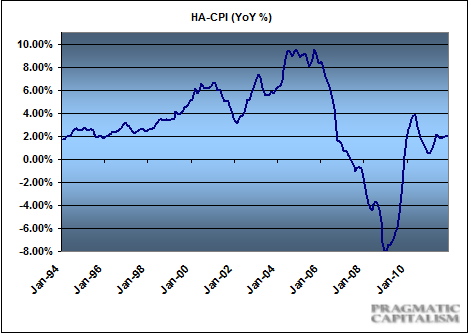
My Housing Adjusted CPI came in unchanged at 1.99% on a year over year basis.  This is consistent with the core rate and continues to show very low levels of inflation:
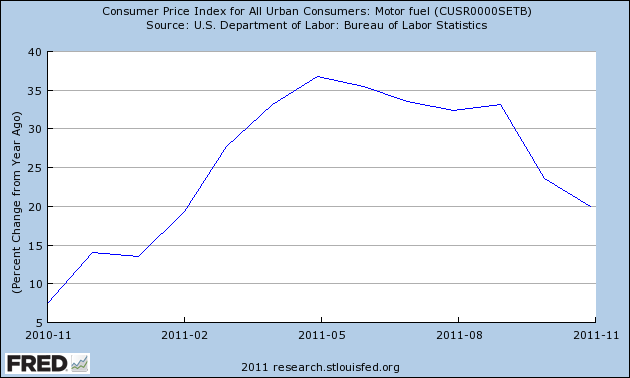
As I noted last week, the dominant driver in the CPI data has been motor fuel which has been on an absolute tear.  And as commodity prices decline substantially and the year over year comps become increasingly difficult we’re likely to see the impact from motor fuel lessen as we move into 2012.   The updated motor fuel data shows continuing declines in the YoY data and should continue to trend lower as we head into April which was the peak in the big spike from the mess in Libya last year.  This should keep a lid on the rate of inflation and if another large spike in fuel does not materialize in 2012 it could become a significant sign of deflation.
This could just give the Fed its opening for further policy action next year, but we’ll be monitoring the situation closely.  Fuel prices remain uncomfortably high heading into the new year, but anything close to last year’s surge certainly looks like an outside risk.  At this point, I continue to think disinflation is the likely trend moving into Q1 2012.

Cullen Roche

Cullen Roche

Bio - Coming Soon.

More Posts - Website

Follow Me:
TwitterYouTube

Disclosures - Unless otherwise noted, authors have no positions in any securities mentioned and readers should never consider this to be investment advice. Always consult your financial advisor before acting on any ideas. Comments Guideline - Readers who denigrate authors or other readers will be banned without warning. This site does not tolerate any sort of reader abuse. The goal of this site is to create an environment that is conducive to learning and better understanding of the monetary system and the investment world. We expect readers to behave maturely and responsibly. We welcome and encourage intense and intelligent discourse, but the site adheres to a strict 1 strike policy. While it is your right to speak freely, it is not your right to behave childishly. Above all else, please enjoy the site. It is intended to be used as an educational tool and we hope the intelligent and mature debate will further that purpose. We hope readers will make an effort to respect that goal. Comments with excessive linking or foul language will be moderated before posting.
Comments
  • John

    Whats the difference between disinflation and deflation? Are they interchangable?

    • nichole

      I’m glad I wasn’t the only one wondering that…

      • Different Chris Dunce Cap Aficionado

        Disinflation is a decrease in the rate of inflation. This is to say, when comparing more recent inflation data to ‘older’ data, inflation is still present (ie growing, positive) but at a slower rate.

        I like a car analogy for this one- If I was going 90 MPH (inital rate) and now I’m going 60 MPH (current rate) I’ve decreased my rate (disinflation), but its still a positive rate. In this analogy, deflation is traveling in reverse.

  • Jay

    Disinflation is falling inflation (but still a positive value)…deflation is negative inflation.

  • Nils Nils

    What does housing adjusted mean? How is the housing component calculated anyways, by what actual families pay or by what they could pay if they were to move?

  • Deflation is what you have witnessed in single family home prices and household incomes. Deflation is the Japanese economic trend since 1989 where a whole generation has never seen real estate appreciate in value. Guess what that does for the demand side of home ownership? Not pretty.