
IS QE3 ON THE WAY?

Despite the weakening global economy the Fed showed no signs at the most recent FOMC meeting of planning QE3.  Markets didn’t take kindly to the news and promptly sold off.  But that doesn’t mean QE3 isn’t in the cards.  In fact, I think it’s likely to become a topic of debate in the first quarter of next year and becomes a high probability event by the end of Q2.

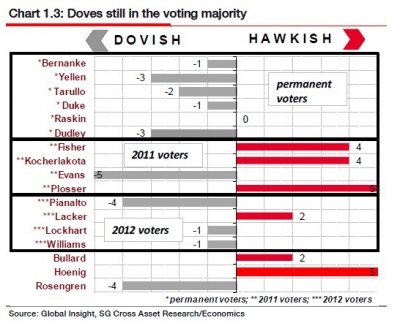
In a story last week FT Alphaville highlighted the fact that the Fed is increasingly dovish and likely to move towards an accommodative stance early next year:

“But there will be much talk about what might be done in the first quarter of next year, possibly as soon as the next meeting in January — and by then, Bernanke will find the company more amenable to looser policy, should he choose to pursue it. Non-voting hawkish Fed presidents can still make a lot of noise, of course, but on the FOMC itself the composition will clearly shift the other way.

A chart from SocGen, which mostly reflects our understanding of the members’ positions, though the bank doesn’t share its methodology:”
The more important element here is the status of inflation.  The Fed has been quite clear that they’re not entirely comfortable with 2% core inflation.  This is at the higher end of their targeted range and leaves them unlikely to take further action if they believe it could contribute to higher inflation.  But the kicker in the story is that we’re beginning to see signs that inflation could be peaking and if commodity prices continue their downward trajectory it would not be surprising to see the Fed feel more comfortable taking action.

The key to the inflation story in recent years has been the motor fuel component.  As the St. Louis fed noted early this year (see here), motor fuel is contributing unusually to the higher than comfortable inflation.  As you can see in the charts below the comps become increasingly difficult in April of 2012:
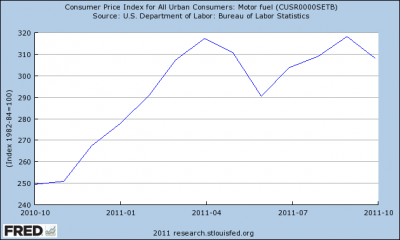
Motor Fuel CPI
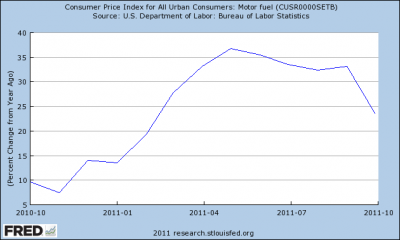
Motor Fuel YoY% Change

With the comps becoming increasingly difficult in April 2012 we’re likely to see disinflationary trends in core CPI around this time and perhaps before.  The FOMC meets early next year at the following dates:
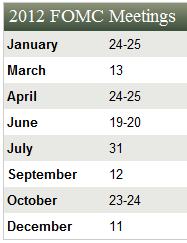
The March and April meetings probably won’t occur in time for the Fed (a notoriously reactive entity) to become comfortable with core CPI rates.  But the discussions will almost certainly be on the table in Q1.  There’s some chance the Fed is proactive at the April meeting, but it’s not something I’d bet on.  Instead, if you’re looking for QE3 the odds likely point to the June 2012 meeting.   Of course, there are a lot of moving parts here, but if you’re a betting man or woman the likelihood of QE3 in Q1 next year looks low to me.   The odds are substantially higher in April and June of 2012 when the FOMC meets.

Cullen Roche

Mr. Roche is the Founder of Orcam Financial Group, LLC. Orcam is a financial services firm offering research, private advisory, institutional consulting and educational services.

More Posts - Website

Follow Me:
TwitterLinkedIn

30 Comments

  1. Very Serious Sam says:

    As the incomes of the main street people don’t increase, they can’t care about whatever CPI reduction as long as the inflated prices are sticky. Which seems to be the case for isntance with motor fuel.

    As for QE1…n, what exactly does it achieve apart from shovelling over even more heaps of money to the haves?

  2. Agree QE3 is highly likely coming – At least Bill Gross is expecting it. ZH had a recent post howibg how he is short cash 60 billion. I.e, he has borrowed 60 billion ( at virtually 0% shorting 3mo. T bills I would guess) to position himself accordingly (operation twist + RMBS QE3). The key, as with most forecasting is when (I.e., the difficult part is forecasting the timing, not the event ?- think tech/housing bubble burst, many knew the event virtually everyone seen them missed the timing forecasting too early) If the FED is now behind the curve and things slow sharper than expected in Q1, and the European mess gets a lot worse than it already is (is this possible-;); IMO, the FED may sh*t on its pants and come out with QE3 a lot earlier than June 2012.

  3. Cowpoke says:

    “The key to the inflation story in recent years has been the motor fuel component. As the St. Louis fed noted early this year (see here), motor fuel is contributing unusually to the higher than comfortable inflation. ”

    EXACTLY, Thanks to the finacilzation of commodities, Especially Oil.
    This is what we get. A do nothing democrat Congress that blocks pipelines.

    “The reason, the economists argue, is that commodities have become increasingly “financialized” by the creation of exchange-traded funds that allow investors to easily trade in and out of them. So when investors get worried by things like what’s going on in Europe, commodity prices can fall sharply even though actual demand for commodities may be running higher.”
    http://blogs.wsj.com/economics/2010/05/28/the-financialization-of-commodities/

    When the common man is spending 50 to 75 bucks a week to gas up his car and then has to pay fuel surcharges on his bread, whiskey and pipe tobacco, OF course it affects the economy. So pumping up Banks reserves does little IMO.

    • Leverage says:

      “The reason, the economists argue, is that commodities have become increasingly “financialized” by the creation of exchange-traded funds that allow investors to easily trade in and out of them. So when investors get worried by things like what’s going on in Europe, commodity prices can fall sharply even though actual demand for commodities may be running higher.”

      This is ridiculous, ETF’s are a minor part of the whole market, financialization has been done thought futures market and bankers and funds taking over producers and consumers (market based on supply and demand rather than outright speculation).

      However, while this may create an inflationary feedback loop based on expectations of money printing, ultimately supply & demand (reality) triumph over perception. And increasing prices are not that bad because they are pushing to solve a problem of scarcity that REALLY exists, even if many fail to admit it, making other alternatives development possible or at least trying to invest in efficiency and production.

      If oil was easily accessible it wouldn’t skyrocket, just like you can’t speculate on the price of water.

  4. Leverage says:

    The two questions are:
    - With everyone and his mother expecting this, is already priced into the market? I could see a short lived relief rally depending on the price level the markets are when is announced (very probably lower than now), but the macro picture will still push the market in the right direction (up or down, presumably down if changes don’t happen fast and austerity and rising taxes are the common policy) and high correlation market will still be common theme.
    - Will this do something beyond strengthen the banks and easy liquidity issues, and push commodities up (again)?

    QE3 will be, IMO, when implemented, the demonstration of how powerless CB’s are under the current policy (and maybe institutional) framework and the final death of monetarist rabble (and hopefully the situation will push the rest of the theoclassical thinking through the cliff) and CB “independence”. While more buying of MBS could help a bit with refinancing this won’t solve problems by itself, with demand destruction and world deflation pushing its natural path after decades of diminishing return debt and money expansion.

    The other big question is how far will things have to go before the world ends in a deep depression and probably political and social turmoil and unrest which will shake the social fabric in a likely way that hasn’t been since a century ago.

  5. ReturnFreeRisk says:

    The next step in the Bernanke Fed’s transformation into a banana republic bank full of corruption will be to relax inflation targets to 3%. This is what is coming with the more dovish committee and Evans throwing tantrums whether or not he is a voting member. They are becoming increasingly irrelevant to the economy. And they hate it.

    • Ted says:

      Actually a few economists have pushed for a slightly higher inflation target (i.e. 4% rather than 2%) to help with our debt overhang. As long as wages could keep up (skeptical), I’d be all for it. Not sure why that’d mean banana republic status.

      That said, I’m no QE fan. I’d rather see Congress address this by spending on infrastructure and employment initiatives.

      • ReturnFreeRisk says:

        As you highlight,
        if the Fed is able to raise the inflation rate to 4%, does it, NET, help or hurt the economy.
        It helps the government’s debt burden. It hurts the households, because they will not be able to cope with the higher cost of living becuase their wages will not keep up in this economy. So the Fed might kill the economy by raising the inflation rate (a preview of this was seen earlier this year).
        If the debt load is purely government, they can inflate it away. How does the private debt load get better in absence of wage growth?

  6. quark says:

    Everyone expected qe1 and 2. It took a financial crisis for quasi.govt entities like the fed to act.

    Were in a period of DEFLATION over the past 10 years. Not sure why this has been so difficult for people
    to comprehend this facr. In such an environment assets are destroyed…it appears to everyones suprise, even the fed. So people are reactionary.like soldiers on the maginont line, they hunker down and pray that the next explosion doesnt kill them as they try to forget where they live.

    There will be Q^n’s for a very long time.

  7. chris says:

    i wonder if iran’s little idiot realizes that he controls fed policy…(fed policy <— inflation <– oil prices <— iran's little idiot)

    • InvestorX says:

      Aren’t you biased a bit by Western MSM propganda? As far as I can see, Iran has done nothing to the US, whereas the US+UK are doing everything possible to sabotage Iran and lure them into their next war of choice.

  8. RA says:

    QE3 will only happen if S&P drops below 1150. That’s the Fed target.

  9. Mike Sax says:

    “The Fed has been quite clear that they’re not entirely comfortable with 2% core inflation. This is at the higher end of their targeted range and leaves them unlikely to take further action if they believe it could contribute to higher inflation.”

    I understand that maybe they’ll take action if it continues to lower but philosphically I think they’re wrong about feeling incomfortable at a mere 2% level.”

    I mean juding by history the U.S. has seldom had any meaningful inlation-the only extended peace time inflation was the 70s which is the only war the hawks every remember.

    Yet even during the Great Moderation the average inlfation rate was considerably above 2%. I think 0-2% is too low. I’d prefer 2-4% myself not that I have a vote.

    Judging by ths then I guess the idea by the Chicago Fed President to either raise the inflation target even to 3% or to make the 2% rate conditional on geting the unemployment rate even beneath 7% is a nonstater I presume.

  10. Bond Vigilante/Willy2 says:

    It simply doesn’t matter as long as markets are selling off and a USD rising. Because then any QE won’t help the markets. Besides, the FED can’t control events unfolding in Europe. And “”Europe”" makes – IMO – the Eur/USD tank. And in the current situation a rising USD(X) is the worst thing for ther global economy. QE 3 or no QE3. MMT or no MMT.

    • VII VII says:

      From Ritholtz—speaking of the QE master himself

      All of our problems explained in one paragraph:

      “Ben Bernanke, Homeowner: After refinancing his mortgage twice, the Federal Reserve chairman owes $672,000 on his roughly $850,000 home, The Wall Street Journal reports. The second refinancing was after the Fed announced its “Operation Twist” program, designed to lower long-term borrowing rates.”

      -WSJ

      What more need I say . . .

    • Pierce Inverarity Pierce Inverarity says:

      A rising USD is a double-edged sword. It would cut back on exports but decrease our import costs. I think it’s far-fetched to say a strong dollar is necessarily bad for the US economy.

      • Bond Vigilante/Willy2 says:

        A rising USD leads to a shrinking US Trade Deficit and perhaps to a Trade Surplus. And a shrinking Trade Deficit is – contrary to popular belief – the worst thing that can happen to the country (US) that’s using the world’s reserve currency (USD).

        But then you need to understand how commodities priced in USD benefit the US. Never heard of the socalled PETRODOLLAR ?

        • Pierce Inverarity Pierce Inverarity says:

          Don’t be condescending. You’re reiterating exactly what I just said, but you aren’t considering that a dynamic capitalist economy can deal with trade surpluses as well as deficits. A stronger dollar means cheaper oil. That would ostensibly help the U.S. consumer, who drives most of our economic output anyhow.

          • Bond Vigilante/Willy2 says:

            Agree. A rising USD pushes price inflation down for the US economy and its consumers.

            What the US (and the rest of the world) needs to get the money of QE3 out of the door and to have an impact on the markets/consumers needs is rising prices for one or more asset classes. But with the USD rising and/or Europe and China “”going down the drain”" the chance of one or more asset classes rising in price are getting smaller and smaller.
            And a shrinking US Trade Deficit is toxic for foreign demand for US T-bonds. (Rising US interest rates any one ?).

  11. VII VII says:

    This piece may appear as just another posting but it is a valuable timeline investors should remember.
    If June is QE.. Thus around Q1 look to take on risk assets in advance. The price action and negative sentiment will be easy to spot to go long.
    This is a great piece…cullen just offered up. A good timeline of monetary policy if you ask me.

  12. Larry says:

    If the S&P500 is down near 1000 by March 12, and if the Europe crisis is worse, and Asia is slowing down, it is possible that the Fed may act on QE, or just verbally hint at QE, at the March 13 Fed meeting, just in order to try to goose risk assets and fight recession with the wealth effect. Politically they won’t act before 3/13 because Repub prez candidates are giving BB and the Fed too much flak.

    • Ted says:

      Shhhh! :) This is the exact scenario I’m looking for after a potentially disastrous Q1 2012 and a Fed that is forced to act. Now everyone hush up and we’ll all meet back here in 3 months to start looking for buying opportunities…

  13. Coolidge Low says:

    Next year is Bernanke’s last year as Chairman……… it is a political year. Do not count on another QE program.

    • Beethoven says:

      funny… that’s EXACTLY why I’m expecting something around March 2012.

  14. chris says:

    the euro denouement is set to begin: http://www.ft.com/intl/cms/s/0/94e6388c-2652-11e1-85fb-00144feabdc0.html#axzz1gLmSE6YD

    ben is saying no $ for you european banks…which means QE3 is no more than one meeting away

  15. I'llHaveADouble says:

    Maybe they do it by…buying up the European exposure in the financial system?

  16. I’m a bond guy but there are very clues in the multi trillion dollar Agency TBA mortgage market.

    1.Mortgages have tightened tremendously versus both swaps and USTs.
    2. Fed begins to engage in Dollar rolls.
    3. Fed is reinvesting proceeds now in Agency MBS again
    4. PIMCO’s allocation to MBS is up to 43%.

    Look all signs point to some significant buying of Agency MBS via a QE3.

Contact Us:

Name:

Email:

Verification Image

Enter number from above: