
Home » Featured, Most Recent Stories, Myth Busting

IS THE BALANCE SHEET RECESSION VIEW “INADEQUATE”?

20 July 2011 by Cullen Roche 110 Comments

In a recent story David Beckworth described the balance sheet recession view as “inadequate”. He’s not the first one to do it. In fact, most of mainstream economics rejects the idea of the balance sheet recession (although Richard Koo and I are two of the only people who were calling this a household crisis in 2008 when Bernanke and other monetarists were pushing for bank focused rescue plans). Paul Krugman made similar comments a few weeks ago (right after Yves Smith and Bill Mitchell debunked his long standing “liquidity trap” theory). I believe this rejection of the balance sheet recession is based on several misconceptions.

Beckworth begins by arguing that the aggregate level of debt in the private sector doesn’t matter because there is a creditor for every debtor. He says:

“For every household debtor deleveraging there is a creditor getting more payments. Yes, household debtors have cut back on spending, but so have creditors. The creditors could in principle provide an increase in spending to offset the decrease in debtors’ spending. They aren’t and thus the economic recovery is stalled. In other words, the problem is as much or more about the build up of liquid assets by creditors as it is the deleveraging of debtors. The balance sheet recession view, however, sees the debtors deleveraging as the main problem. It completely ignores the creditors buildup of liquid assets and its implications for spending.”

Beckworth makes an egregious error in making these comments. He falsely assumes that all economic agents are somehow similar and that creditors necessarily contribute to economic growth in the same manner that debtors might.

What’s really happened in the US economy is that the driving engine of growth (household debtors – does anyone contest that households are the primary driver of US economic growth?) took on excessive amounts of debt. When the real estate bubble popped these consumers became savers as they were forced to pay down bubble era debts with post-bubble era cash flows. Bank transactions, however, net to zero. So, where did the money go that has been used to pay down these debts? Well, it went to the banks of course!*

Beckworth is right to note that there is a creditor for every debtor, but this implies that all creditors have an equally positive effect on the economy (the truth is that banks are not in any way equal to all other productive economic agents and instead serve as middlemen in the capitalist process). So, the real question that David Beckworth should be asking himself is whether banks are the engine of the economy (I have argued, emphatically, that they are not)? Are they truly productive economic agents or are they middlemen who “grease the engine of capitalism” (as I like to say). More importantly, Beckworth might want to research whether this growth in the financial sector has actually DETRACTED from US economic growth?

I think our Federal Reserve would agree with Beckworth that a healthy banking system is absolutely vital if we are to have a healthy economy. After all, this is why Fed policy has been mainly focused on saving the banking system. And they’ve largely succeeded. Banks are reporting an incredible v-shaped recovery (see figure 1). Profits are at all-time highs for these “creditors”. So why aren’t they ploughing all of this money back into the economy as any good capitalist entity should? The answer is quite obvious. First of all, banks don’t “plough” money back into the economy unless there is demand for loans. The Fed has bolstered bank balance sheets and injected the banks full of reserves with the assumption that this might lead to increased lending. But anyone who understands how a modern banking system works knows that banks are never reserve constrained. So, the only way that a bank could “plough” money back into the economy is if there is demand for loans (outside of their less productive normal business operations). Clearly, with low aggregate demand there remains very weak demand for loans. The weak demand for loans is a direct result of the fact that consumers have become savers, which has resulted in reduced domestic revenues for corporations and ultimately a reduction in lending.
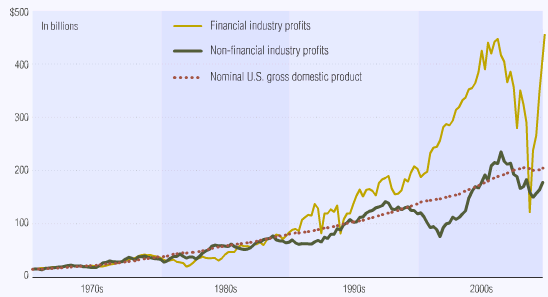
(Image 1 – Financial Industry Profits)

Beckworth then goes onto claim that QE worked during the Great Depression and if implemented properly today, could work here:

“The balance sheet recession view cannot easily reconcile the large deleveraging by households and the rapid real economic growth that occurred between 1933 and 1936. What can explain it is a more nuanced view that acknowledges creditors with excess money demand were confronted by FDR’s original quantitative easing program. This QE program was far better than recent ones in that FDR clearly signaled a price level target and backed it up by devaluing the gold content of the dollar and allowing unsterilized gold inflows. In otherwords, FDR signaled that he was going to allow a significant and permanent increase in the monetary base and followed through on it. This change nominal expectations and caused creditors to start spending their money balances. The same could be done today with something like a nominal GDP level target.”

First of all, it’s widely agreed upon that the Great Depression did not end in 1936. It lasted a full 5 more years. Were there spurts of growth throughout the decade long malaise? Yes. Just as there are spurts of growth today. Datamining a period of growth, attributing it to a specific Fed policy and then concluding that it “worked” is misleading to say the least. The truth is that reserves did expand after 1933, deposits increased steadily, lending remained stagnant, the economy viciously double dipped in 1937 (something Beckworth conveniently doesn’t mention) and the Depression continued until the early 40′s. Can we really conclude that QE “worked” during this brief period of the Great Depression? That’s like claiming that QE worked in Japan in the early 2000′s because they had a spurt in growth, but not even the BOJ agrees with that idea. **
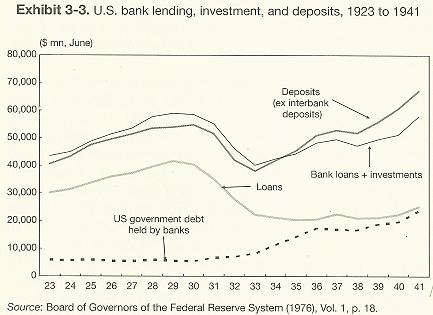
Beckworth is also on record stating that QE2 would “work” before it was implemented and was quick to cheerlead the program after inflation expectations showed some signs of spiking in late 2010 (see here and here). He now states that it wasn’t implemented properly as it’s become pretty obvious that the program did not result in real growth. I have consistently pointed to the exact specified transmission mechanisms that were supposed to result in recovery and debunked all of them in real-time. The David Beckworth’s of the world rely on this idea of altering expectations but cannot explain exactly how it works and have zero evidence proving that it has worked before (aside from the weak case of the Great Depression). The fact is, there is no transmission mechanism through which QE “works” during a time when demand for borrowing is weak. Of course, we’ve seen this in Japan and in the UK, but Beckworth doesn’t touch on those QE failures.

The broader flaw in this thinking is based on the common misconception that banks lend their reserves. That is simply not how modern banking works. As I’ve already stated, banks are never reserve constrained. When the Fed supplies banks with more reserves they are not giving them more fuel with which they can lend. Banks are capital constrained. They are never reserve constrained. So, the notion that more QE could “work” is simply not true in this sense. Giving banks more reserves isn’t going to force them to start building factories, lending more money, hiring more workers or generally “spending” (as Beckworth says). Just as their remarkable recovery in profits hasn’t resulted in any of the latter….

Furthermore, Mr. Beckworth’s colleague, Scott Sumner admits that QE is unlikely to be inflationary when the Fed is paying interest on reserve balances:

“If the new base money is interest-bearing reserves, I fully agree that OMOs may not be inflationary. That’s exchanging one type of debt for another.”

Could these operations alter expectations? Yes. I’ve consistently maintained that QE would result in altered expectations as people fear this idea of “money printing” and “debt monetization” (both of which are entirely wrong). After all, if nothing else, Fed policy is poorly understood by most people and known to cause severe economic disequilibrium. The evidence from QE2 shows that real GDP peaked as soon as the program began. All it did was contribute to commodity price speculation and cause a broad economic squeeze as cost push inflation increased and growth remained stagnant. The implication that we need more of this is misguided to say the least.

But most importantly, there are few people who have actually run a business who would contest the simple fact that they increase capital expenditures when they have more clients walking in the doors. And unfortunately, those clients aren’t walking in the door today because they are bogged down by bubble era debt levels. So, the recovery in bank profits and corporate profits in general might continue, but that doesn’t even begin to explain why aggregate demand is so low today. The answer, in my opinion, is simple – the US economy is suffering a balance sheet recession that is primarily caused by a collapse in household balance sheets. And while it is extreme to imply that monetary policy is entirely ineffective (I in fact said that QE1 would help stabilize the banks and market at the time it was implemented) during a balance sheet recession, it should be clear to most observers by now that the Fed’s policies have not done a great deal to help the US economy and cannot be relied upon as the balance sheet recession continues.

In sum, it’s clear that the mainstream continues to misdiagnose the true cause of this recession. The implication that banks and other creditors are somehow the engine of growth is just not an accurate portrayal of the US economy. And this idea that more bank reserves and altering expectations is a recipe for growth should be obviously inaccurate by now.

* Update – To clarify this comment, when banks create money by extending credit (loans create deposits), this occurs completely within the banking system and results in a liability for the bank (the deposit) and a corresponding asset (the loan). The customer has an asset (the deposit) and a corresponding liability (the loan). This nets to zero. The banks do however, accumulate wealth via interest payments.

** Richard Koo’s Holy Grail of Macroeconomics has an ENTIRE chapter debunking the Great Depression ideas espoused by David Beckworth

Cullen Roche

Cullen Roche

Bio - Coming Soon.

More Posts - Website

Follow Me:
TwitterYouTube

Disclosures - Unless otherwise noted, authors have no positions in any securities mentioned and readers should never consider this to be investment advice. Always consult your financial advisor before acting on any ideas. Comments Guideline - Readers who denigrate authors or other readers will be banned without warning. This site does not tolerate any sort of reader abuse. The goal of this site is to create an environment that is conducive to learning and better understanding of the monetary system and the investment world. We expect readers to behave maturely and responsibly. We welcome and encourage intense and intelligent discourse, but the site adheres to a strict 1 strike policy. While it is your right to speak freely, it is not your right to behave childishly. Above all else, please enjoy the site. It is intended to be used as an educational tool and we hope the intelligent and mature debate will further that purpose. We hope readers will make an effort to respect that goal. Comments with excessive linking or foul language will be moderated before posting.
Comments
  • JohnnyBravo

    Excellent piece, Mr. Roche.

  • theppel

    I would totally agree that it is household debt that is the problem today. I have seen aggregate numbers on household debt to disposable income and have wondered whether these numbers really tell the whole story. It seems that there is a group of households that have large disposable incomes and little or no debt. They probably have little incentive to consume more today since they have everything they want and they view other large purchases as investments. Then there are the rest who have varying ratios of household debt to disposable income where there would be a desire to consume more if they could lower their dept to disposable income. I would guess the mean debt/disposable income ratio is much higher than the average debt/disposable income ratio and would shine more light on how bad things are for many households.

    • Andrew P

      The real problem is that the value of the collateral collapsed when the house bubble popped, but the debt is still there.

  • FDO15

    I read the Krugman piece a few weeks ago when he said there was a creditor for every debtor. I was floored. How could a Nobel Laureate say something so simplistic and so fantastically wrong?

  • Quaternion

    For a while, I was somewhat skeptical about the notion of a “Balance Sheet Recession” for reasons similar to Becworth’s; viz, I thought that creditors would spend the money that got paid to them. But upon further reflection, i realized that the multiplier for debt payments would likely be far lower than for consumer spending — as Cullen noted, banks recycle only a small part of the moneys they take in, for a whole host of reasons. However, I haven’t had much success in quantifying just how big the difference would be between the multipliers for consumer spending vis-a-vis debt repayments — is there a reference somewhere containing that info?

  • DanH

    Great piece Cullen. What chapter is the Koo GD argument?

  • BT

    “So, where did the money go that has been used to pay down these debts? Well, it went to the banks of course!”

    Repayment of debts extinguishes both the loan and the deposits, shrinking a bank’s balance sheet. So mass private sector deleveraging destroys money.

    Now, if part of the private sector pays down debt but this is out-done by the rest of the private sector taking on new debt, then the total size of bank balance sheets can still grow happily and there is no recession.

    But right now the whole private sector is tending to pay down more debt than it borrows – hence the government needs to step in to issue bonds and thereby create credit/debt to maintain the stock of money and aggregate demand.

    • I added an amendment at the end. It is more accurate to say that the net result of these debt repayments results in increased interest income to the banks and a netting of financial assets. Sorry for not being clear on that.

  • SS

    Beckworth’s argument is the same neoclassic BS that has been ruining this country for years. He doesn’t view the debt as a problem and he does’t view the banking system’s accumulation of this wealth as an issue. I have a question for Beckworth: what public purpose do the banks serve other than to help companies expand their businesses? When did they become wealth accumulators and why is it so widely believed that that is a good thing?

  • Kostas Kalevras

    Cullen, could you explain from a monetary view what exactly happens when someone pays back his loan? Is there any part that gets destroyed?

    • I was unfortunately unclear about this in the original post so I added an update at the end:

      To clarify this comment, when banks create money by extending credit (loans create deposits), this occurs completely within the banking system and results in a liability for the bank (the deposit) and a corresponding asset (the loan). The customer has an asset (the deposit) and a corresponding liability (the loan). This nets to zero. The banks do however, accumulate wealth via interest payments.

      Sorry about the confusion.

    • Kostas Kalevras, When a private sector bank lends, it creates a debt, and that debt is then effectively passed from hand to hand as “money”. When the debt is repaid to the bank, the debt, i.e. the “money” vanishes. Thus Beckworth is not correct to say that “For every household debtor deleveraging there is a creditor getting more payments.”

      Where the repayment is to a non-bank entity, Beckworth’s statement is true. But where the repayment is to a bank, it is not true.

      The above wheeze (passing a debt from hand to hand as “money”) has been going on for thousands of years, but the way it is done has changed over the centuries. There is even evidence it was going on 30,000 year ago: that was a tally stick which archeologists dug up which was dated at 30,000 years old.

      • F. Beard

        There is even evidence it was going on 30,000 year ago: that was a tally stick which archeologists dug up which was dated at 30,000 years old. Ralph Musgrave

        Link, please? I am sick to death of hearing how gold has been money for 5000 years and would like to beat those folks with a 30,000 year old tally stick. :)

      • F. Beard

        When a private sector bank lends, it creates a debt, and that debt is then effectively passed from hand to hand as “money”. When the debt is repaid to the bank, the debt, i.e. the “money” vanishes. Thus Beckworth is not correct to say that “For every household debtor deleveraging there is a creditor getting more payments.” Ralph Musgrave

        That is my understanding too. Furthermore, I think folks are a bit suckered by “assets = equity + liabilities”. The liabilities are real (assuming many independent banks or an exogenous drain for reserves such as Federal taxes) but the assets can easily be bogus since in aggregate the interests for them does not even exist.

        So I do not agree that horizontal money necessarily nets to zero except on mark-to-fantasy balance sheets. I think it often nets to negative equity in reality.

      • Andrew

        If the payment is made to a non-bank, it still doesn’t buy you anything if the non-bank entity hoards and doesn’t spend, right?

  • VII VRB II

    Well done again CR

  • VII VRB II

    Enjoyed this alot. Good Stuff

  • MMTer

    Beckworth won’t understand your point that all bank transactions net to zero. He likely views it as most neoclassical economists view it as though there is a loanable funds market out there with money just sloshing back and forth.

    But the point on interest is really important. The banks are just leaches sucking from the US consumer. As you like to say, the only purpose they now serve is to help separate the middle class from their savings. More lending and more banking is not the answer to this crisis. We don’t need more QE. We need less QE. Less banking. Less debt.

    • BT

      If banks stopped creating credit and debt we would have permanent recession/deflation until there was almost no money left.

      We need banks to create credit and lend it for productive purposes – things that generate sustainable jobs and incomes – rather than for speculation on house prices or stocks.

      • F. Beard

        If banks stopped creating credit and debt we would have permanent recession/deflation until there was almost no money left. BT

        Not necessarily. Here’s a way to ban further credit creation without either deflation or inflation:

        1) Forbid the banks from creating any more credit. The would cause massive deflation as existing credit was paid off. Genuine lending with matching maturities between bank debts and loans or from bank capital could still be done.

        2) Send monthly and equal bailout checks to every US citizen equal in total to the amount of credit paid off the previous month. Continue till all mortgage debt was paid off.

    • rhp

      you and cullen could use a primer on the difference between “leach” and “leech”. If you continue to use the word “leach”, I’ll begin to think you two are gold bugs !!! (heap leaching with cyanide is a common extraction technique) lol

  • CP

    You blame QE for increased commodity prices, but your evidence for this is very weak. Firstly, there are a lot of weak links in the BOJ study (e.g. links between futures buying and increased spot prices would have to be driven by contango trades – and there is very little evidence of that).

    Secondly, how do you know that growth induced by govt spending/deficits would not produce the same result? A big value of G-T is going to increase the money supply, so if loose monetary conditions are to blame (as your evidence claims), then your solutions will produce the same result.

    Either way, we don’t really need to look at QE or the money supply to understand the price increases in commodities. Real factors like extensive drought, Asian consumption, harder-to-produce oil and middle east revolutions tell us why commodities have been on the rise.

    • I admit that the empirical evidence for QE causing higher commodity prices is weak. Then again, I work in the financial industry and all I do all day is talk to portfolio managers and traders who tell me that they’re buying commodities because the “Fed is printing money” so to me, the evidence might be weak, but the reality is crystal clear. I think Beckworth suffers from a serious case of not experiencing the real world. You have to be in the trenches to be able to see all of this stuff. You can’t just pick up a textbook and start opining about what it means to run a business or understand market price movements.

      On the other hand, the evidence showing that QE2 did not “work” is fairly strong. All one needs to do is look at the current state of the US economy. Now, granted, one could say that it would have been worse, but we know for a fact that the economy was MUCH stronger than anyone suspected BEFORE QE2 even started. Just look at RGDP, ISM reports, etc from before the program started or was even announced. What we can prove without a shadow of a doubt is that almost all economic indicators point to a slowing in economic activity by the end of QE2.

      To MMTers, the point of fixing the balance sheet is not about increasing spending per se. It is about fixing the balance sheets. Fiscal policy directly impacts the balance sheets of those households who are causing the crisis. More monetary policy can only work via the banking sector. Clearly, that’s misguided for reasons that should be obvious upon reading this.

      • MMTer

        It’s amazing to me how so many of the people influencing policy have almost no real experience in banking, finance or running businesses. Ben Bernanke runs the most important bank in the world and this guy has zero actual banking experience. Why does anyone listen to these “economists”?

      • CP

        Cullen, I also speak to people who tell me they’re buying commodities. But what these poeple are buying is either physical precious metals (which are largely irrelevant to this debate) or commodity futures – which they sell before expiry. Futures are different to physcial. Unless someone is executing a contango trade to profit from these futures buyers, then it makes damn all difference to the spot price.

        You did a paper once that mentioned stock piling (Copper or cotton, can’t remember which). In that case, speculation does drive the spot price, but those instances are relatively rare – and have little to do with QE.

        I agree with your general argument that trying to fix this via the banks is the wrong way to go (while disagreeing on specifics) – and so I agree that QE2 did not “work” in terms of end results. But as I said on the previous post, there’s nothing that says “QE” has to be executed via banks. There’s nothing to say that a CB can’t buy non-bank assets.

        Such a non-bank version of QE would indeed work. The example I gave on the previous post is one of those, and as I said there, TALF shows the mechanics of how this could be done. Executing that plan would do exactly what you say is needed – it would fix the household balance sheets.

        • MMTer

          This argument that spot prices are not influenced by speculators is not right. Yes, all commodities settle at a spot price, but that doesn’t mean the price hasn’t been influenced in the intermediate term by speculators. Would you claim that the housing market in 2006 was not influenced by speculators just because everyone took delivery of their homes at the time?

          TALF was a Fed program. The Federal Reserve is only permitted to purchase federally insured paper. That means they can only buy treasuries, fannie, Freddie backed paper and municipal bonds. Can you explain to us how more of that is going to help consumers?

      • S. Jacobs

        Nice job Cullen. I’m relatively new to the whole MMT thing but it really answers a lot of questions I’ve had about how our monetary system works.

        I am one of those guys in the trenches you mentioned. I work with banks and small businesses every day trying to match need with sources. Just had a call from one of my lenders telling how his bank President was ripping their heads off because they weren’t doing enough loans. Demand for loans from “qualified” borrowers is way down. Banks have money to lend but nobody feels comfortable enough to want to borrow it, be it a business or individual. Beckworth shows he hasn’t go a clue as to how the real world of banking and lending works.

    • ThinkTank

      Cullen,

      CP says:
      “You blame QE for increased commodity prices, but your evidence for this is very weak.”

      Quite contrary, I think the evidence is very strong. Please, check The Commitments of Traders in Commodity Futures(COT) reports, which are published by the Commodity Futures and Trading Commission (CFTC). Everyone can see rapid growth of open positions in main commodity markets starting in 2010 (and longer data are even more shocking.

      BTW good article.

      • CP

        Thinktank

        The CFTC data you are looking at concerns futures.

        MMTer

        The housing market had all kinds of speculation, but not the kind of speculation that happens via futures markets. If you think commodities futures trading can impact the spot price except via contango trades, then tell me how. What’s the mechanism?

        You are wrong to say that the Fed “is only permitted to purchase federally insured paper”. It can also, for example, make loans directly to businesses. That’s exactly what happened with TALF. Under TALF, the Fed has an SPV that owns student loans, small business loans, credit card debt and other wonderful things.

        • MMTer

          CP,

          Spot prices are influenced by futures prices. This is from the CFTC website:

          “PRICE DISCOVERY OR PRICE BASING

          Futures contracts are often relied on for price discovery as well as for hedging. In many physical commodities (especially agricultural commodities), cash market participants base spot and forward prices on the futures prices that are “discovered” in the competitive, open auction market of a futures exchange.”

          As for the Fed, we are talking about two different things. A lending facility is not QE. If the Fed were to do what you say through a program like TALF they would have to have the banks give them federally insured paper (or something near its equal) as collateral. TALF required AAA paper.

          Are you saying the Fed would lend the banks money so they could go out into the housing market and buy homes? That’s the only way your plan would work, it would not be deemed QE, and the public would think it was completely ridiculous.

          • CP

            MMTer

            What you quote from the CFTC is just PR guff to show they have a social value. It means nothing. If you were buying any physical goods, would you pay more just because the futures price was higher? I think not. If you did, I’d be happy to sell to you. Again, if you think commodities futures trading can impact the spot price except via contango trades, then tell me how. What’s the mechanism?

            No, I’m not saying the Fed would lend the banks anything. I’m saying the Fed would lend to an SPV which would buy homes. There is no requirement for any AAA paper. Even if there were, the SPV debt could be passed AAA no problem.

            Anyway, it’s not relevant, because the point is to show that in terms of economics, there is a form of QE that would stop the balance sheet recession. Contrary to the MMT dogma, relying on the govt to increase G-T is not the only way to do it.

            • MMTer

              You’ve never heard of spot future parity have you? Are you claiming that futures prices have no link to spot prices? Or do the daily futures prices help determine the spot price? People who are that all commodities settle at the spot price are ignoring the fact that futures traders can influence the spot price thru spot future arbitrage. The two markets are not independent.

              This fictitious Fed program would most certainly require AAA collateral. That’s why QE is limited to federally insured paper. Could the Fed do it? Probably. Should they buy every house in the country. I think most MMTers would argue that there are more effective ways to do things. Why don’t we just pay contractors to knock down homes, let businesses fail, let capitalism work instead of pumping money into the system to manipulate the market?

              • MMTer

                “People who say that”

                • CP

                  I guess you’ve never heard of contango trades, because that’s how spot futures parity is delivered in a market with steep contango e.g. one in which there are plenty of futures buyers. The point is that, if that’s what’s going on, it shows up in the inventory figures. The inventory figures show that isn’t happening. It was in 2007/8, but not now to any great extent.

                  Well, at least you agree that the home buying plan would work. I agree with you that it isn’t the most effective plan, but when govt deficits are effectively ruled out, it makes sense to go with plan B. For me it’s a better plan than your suggestion of paying contractors to demolish homes. For a start, you won’t get the budget to demolish homes, and secondly you’re destroying assets that have real value.

                  You say “let capitalism work”, but the whole point is that capitalism isn’t in a place right now to work without some help from somewhere else. I thought MMT followers recognized that.

                  • MMTer

                    Contango doesn’t matter. This is what you don’t get. The speculation and price manipulation all happens in the front month contract. If a big pension fund is buying oil contracts they’re buying the front month contract and just rolling all of their contracts over in perpetuity. This is where the upward price bias comes from.

                    I didn’t say your housing plan would “work”. I said they could do it. Is it good for the government to come in and set the price of an entire market like housing. They tried with the housing tax credit in 2009/2010 and it failed miserably. Rather than manipulate prices in the marketplace, why not just credit people’s bank accounts through fiscal policy? A tax cut would be way more politically acceptable than your plan.

                    • CP

                      “The speculation and price manipulation all happens in the front month contract”

                      Flat wrong there I’m afraid.

                      “why not just credit people’s bank accounts through fiscal policy?”

                      Because there won’t be big enough deficits, and any tax cuts that may be achieved are less effective than spending – which definitely won’t be achieved.

  • Hillbilly

    The MMT’ers can’t understand that there is no engine of growth now because we sat on our butts thinking cheap oil would last forever. Its not as if the banking thugs had to do much marketing to convince the feminists that those dirty men-dominated plants and factories were the stuff of little minds while properly educated high society sit behind computahs all day. Even a 2-bit conman like George Gilder said today that Mericas economy is trivia (Google, FAcebook, Twitter). Does the trivia outrage the MMT’ers? Apparently, not.

    • Oil is obviously a strain on the economy, but this recession is much bigger than just oil prices….

    • MMTer

      MMTers do not deny that an oil price shock could be a disastrous outcome for the US economy. But it’s more likely to result in a deeper recession than anything else. Certainly not hyperinflation.

    • Quaternion

      A further complication is that the USA’s industrial base has degraded so badly. The American consumer is bankrupt, but emerging-world economies are holding up quite well, and if our industrial base were stronger, we could put the unemployed construction workers to work in factories making goods for emerging-world citizens. This is another reason why I believe that “balance-sheet recession” explains a lot of our current situation, but it doesn’t explain all of it.

      • F. Beard

        A further complication is that the USA’s industrial base has degraded so badly. Quaternion

        The workers’ jobs were outsourced and automated away with their own stolen purchasing power via loans from the government backed counterfeiting cartel (the banking system) to the corporations.

        The implicit social contract between banks and the rest of the US was forgotten or ignored.

  • b_b

    Great Post CR,

    I would further add that creditors are not liquidity constrained as implied by Beckworth. Depositors can always chose to hold their money in short term deposits. The bank then take some mis-match risk which is mitigated via the banks access to the Fed’s liquidity.

    When a loan is “pay down” the credit money is destroyed and bank balance sheets reduce marginally. This of course requires either
    - someone else to give up a deposit, which can occur when a creditor spends money via acquiring goods or services from a debtor or
    - Government spending allowing a debtor to reduce loans, reducing bank assets, offset by the the issuance of Treasuries to make the bank whole again.

    The bottom line is creditors to not “get cash” as loans are repaid. They actually get goods and services – but only if the debtor is allowed to provide such goods and services (ie: have a job!).

  • rfr

    Can someone explain this sentence? “Banks are capital constrained. They are never reserve constrained.” What is a bank’s capital?

    Also, why isn’t it true that for every debtor there is a creditor?

    • LVG

      Capital is essentially the net worth of a bank. Assets-liabilities. Reserves do not make a bank more liquid. For instance, swapping treasury bonds for reserves (as QE does) does not necessarily mean that the bank’s capital position is improved. It just means the composition of the balance sheet has changed.

      There is a creditor for ever debtor. Cullen says that. Where Beckworth gets it wrong is by assuming that creditors are somehow collecting money from the debtors and sitting on it. And yes, the banks are sitting on this cash they collect from creditors because there is no demand for loans and because banks don’t do anything productive for the real economy outside of loan creation. So, if JP Morgan makes record profits this year they might end up sitting on most of their retained earnings because there is no demand for loans or because they don’t build anything. They might go out and hire a bunch of people to trade things for their bank, but again, where is the real output here?

    • F. Beard

      Also, why isn’t it true that for every debtor there is a creditor? rfr

      Imagine an extreme case where all the deposits in a bank were created by loans by that bank. Now imagine that all those loans are paid back. The bank gets the interest for the loans but the money goes back to where it came from – nowhere. So who were the matching creditors? There were none.

      Anybody, am I wrong?

      • F. Beard

        Actually, the bank is the sole creditor but the net result is a shrinkage of the money supply outside the bank because of the interest paid.

      • LVG

        Are you pretending that banks lend money to themselves? Banks lend money to outside entities. They might have their loans and deposits at the same bank, but that doesn’t make a difference. There is still a borrower and a lender. At least that’s how it works in the real world, but I’ve been reading Sumner and Beckworth long enough to know that they love to make up examples that don’t apply to the real world.

        • F. Beard

          Are you pretending that banks lend money to themselves? LVG

          No, except in the case of reserves.

          Banks lend money to outside entities. LVG

          Banks create temporary money, so-called “credit”, and lend it to outside entities. The bank is thus the sole creditor for those loans.

  • gf

    We have clowns on here blaming this on feminists now?

    Thats a good one, pass me what ever you are smoking.

  • Prudent_Southerner

    This is a strange argument from Beckworth. He has the causation all backwards. He thinks there is high demand for money and that there is not enough spending because of this. So, if we can reduce the demand for money then we can increase economic activity. But there is high demand for money because there is low demand for goods and services. Businesses don’t spend more money if you reduce their need for cash. They spend more when they have demand. Isn’t that why anyone starts a business? They have a product that there is demand for?

    Am I missing something in the Beckworth argument?

  • HankB

    DB writes:

    “The key issue, then, is to satiate creditors’ demand for money and get them to start spending some of their money assets. This insight is ignored by the balance sheet view of recessions.”

    So why don’t we just send the banks a few trillion dollars and the problem is solved! Oh wait, we already did that and the economy is still in a hole.

  • FXTrader

    It’s hard to take anyone serious when they say that banks do not have enough “money assets”. This man is teaching students this crap? Yea yea, all we need is for banks to get more money so they can start spending it. Who believes this sort of stuff. Better yet, Cullen, why do you waste your time responding?

  • Carl

    Beckworth seems to ignore that much of the de-leveraging is happening via default. I can’t imagine anything more likely to make a creditor sit on his cash.

  • “for every debtor there is a creditor” is about as good a critique of the idea of a balance sheet recession as Alan Greenspan’s famous quip that “mortgages aren’t a problem because households also have houses on the asset side of their balance sheets to offset” (or something like that).

    Absolutely asinine, but if they didn’t see the housing bubble and buildup of household debt on the way up, it makes sense they don’t see the balance sheet recession on the way down and blame it on a confused understanding of the liquidity trap. I suppose we should expect that from the same economists that model the macroeconomy without a banking system or financial sector.

    • MarkS

      Scott, it’s always nice to see you around here. I have been trying (unsuccessfully) to defend your honor at Sumner’s website. I work in the credit dept of a relatively big bank and I am aghast at the fact that Sumner says he doesn’t understand banking very well, but feels qualified to discuss this stuff. He said:

      “It’s true I know little about banking”

      http://www.themoneyillusion.com/?p=9494#comment-66856

      Is that what economics has come to these days? Anyone can practice this stuff and influence the public sphere while proclaiming that they are not an expert?

      • Thanks, Mark! Much appreciated.

      • studentee

        bravo to you for going in there and fighting the good fight. his commentators are terribly smug

        i just don’t think sumner cares at all about how the inflation comes about. he just assumes that the fed can set any level of price changes is wishes. bam. and that some how this will eventually result in growth, and provide a healthier economy, or something

        he’s also pretty rude to competing schools of thought (i remember him writing ‘post-keynesianism is worthless”. which is funny, because it’s 2011, and he’s a monetarist

        • MarkS

          I’ve been pretty rude myself over there. But with good reason. I started commenting on his site out of sheer curiosity, but then I quickly realized he had a totally flawed view of the banking system. I work in the credit dept of a major bank so I have a pretty sophisticated understanding of how this all works. Sumner’s ideas are just flat out wrong. What really floored me though is when he admitted to me that he doesn’t understand modern banking. It would be like Cullen saying he doesn’t understand how to place a limit order as he lectures us all on the investment world. That’s really absurd. I mean, it should entirely discredit anything the man has done in his life with regards to monetary work. I hate to be so harsh, but as you said, he’s incredibly smug and to admit that you don’t understand banking while pretending to be an expert in monetary policy (which requires extensive banking understanding) is totally unacceptable. This is a widely respected economist and someone who gets s huge amount of fanfare. To call that ridiculous is a huge understatement. It’s a really poor reflection of the state of American economics.

          • “It would be like Cullen saying he doesn’t understand how to place a limit order as he lectures us all on the investment world.”

            Perfect.

    • F. Beard

      I suppose we should expect that from the same economists that model the macroeconomy without a banking system or financial sector. Scott Fullwiler

      Ouch! From my point of view, it’s the banks against the rest of US with a lot of help from the Federal Government.

      • I agree with that assessment. Because neoclassical economists don’t know what a bank does, they can disagree with you while keeping straight faces.

        • Prudent_Southerner

          Scott,

          What does Beckworth mean when he says there is too much demand for money? Is he just saying that companies aren’t spending their retained earnings? Thanks for all your work on this.

          • My guess is it’s a reference to precautionary holdings of liquid balances, instead of spending them. Haven’t read carefully, though. But the view that Beckworth is espousing here with more and better QE is an attempt to get people to spend more out of existing income, which means reducing precautionary balances. If it really is a balance sheet recession, then getting people to spend more out of existing income (which I doubt QE could do anyway) is precisely the wrong policy.

  • chris

    fed should stop paying interest on excess reserves; even charge a fee for reserves in excess of a certain % of the banks assets. then the banks might find some demand…

  • Doesn’t this all just boil down to the fact that they don’t realise that money is endogenously created and destroyed as required according to demand at the current price of money.

    And that reserves are just there to grease the wheels – the less independent banks there are the less reserves the system needs to allow clearing to function.

    • MarkS

      I’ve been hanging out at Sumner’s website for a few weeks and he has admitted to me that he doesn’t understand banking all that well. My guess is that Beckworth is the same (if he understood it he wouldn’t write stuff like creditors = debtors). So yes, I think it’s safe to say that this argument really just boils down to the fact that one side of the argument understands banking and the other side doesn’t. And that explains why MMTers have predicted so much of the current environment and monetarists (or quasi – whatever they are trying to call themselves these days) have failed at just about everything over the last 30 years.

    • Ding ding ding. Their eyes will glaze over as soon as they read that horizontal transactions net to zero. They think MMTers are a bunch of loons and the truth is that they don’t even understand very basic banking. It’s utterly ridiculous.

  • MarkS

    Cullen,

    I just re-read this article and I think you’re making a big mistake by not honing is on his misunderstanding of the banking system. Anyone who understands banking knows that banks don’t “get” money when the term of a loan ends. They simply mark down the asset and liability. David is making an even more egregious error than you claim. He’s entirely misinterpreting the way that banking works by assuming that banks “get” money when loan terms end. He says:

    “For example, if a bank loan is paid down both loans and deposits fall. If those deposits were checkable, saving, small time, or money market accounts–assets used as money–the money supply falls too. For a given demand for money, this drop in the money supply now means there is–if not already–an excess money demand problem.”

    This assumes that money banks use their own money to make loans. He has it completely wrong. Banks aren’t using the money they loan. It is created endogenously. This basically another way of describing the money multiplier theory even though DB would probably say I am misinterpreting him (which I definitely am not).

    • I was thinking this same thing, but didn’t want to put words in his mouth. I think Beckworth left enough wriggle room in his commentary to claim that he didn’t mean that. Either way the argument is nonsense because it assumes that banks are productive economic agents who we all rely on to spend more money. As if we need bankers to get more money so they can spend more of it…..

  • TimmyGG

    The excess money demand argument is nothing new. These guys claim that everyone wants to get their hands on money and won’t spend it because the economy is so uncertain. Beckworth explains his solution here:

    “In order to fix this AD externality one needs an entity powerful enough to incentivize all the creditor households and firms to start spending their money simultaneously. Enter the Federal Reserve. It alone can change inflation expectations and thus motivate these creditors to start spending. Note that by changing inflation expectations the Fed is really changing expectations of future aggregate spending, the source of expected inflation. And by changing expectations of future aggregate spending it is changing the economic outlook for the better too. The Fed, then, is the one entity that can kick-start this virtuous aggregate spending cycle. However, in the absence of an explicit nominal target to shape inflation expectations it is not clear to me the Fed will be successful in fixing this aggregate demand externality.”

    http://macromarketmusings.blogspot.com/2010/11/memo-to-fed-fix-aggregate-demand.html

    This dude has clearly never run a business. Companies don’t just spend money when the Fed tells them to jump through a hoop. They spend money when they have paying customers. Anyone who has ever run a business should know this.

    The QM guys are interesting, but once you get past their mangled terminology and try to plug their work into the real economy you recognize that it’s a bunch of bull.

  • MarkS

    I should also note that most of the de-leveraging of the last few years has been the result of defaults. So the creditors aren’t even “getting” this money half the time. Another nail in the Beckworth coffin.

    I think it’s about time MMTers most past the quasi monetarists. These guys have just about debunked themselves entirely with this line of crap.

    • Completely agree on all counts.

    • Mark,

      You’re brutal :-)

    • Adam

      If we look at the Long Depression, the Great Depresssion, Japan in the 90′s and now – all balance sheet recessions – you will discover that the bulk of the debt is defaulted on. How someone can ignore those facts is beyond me.

      • I’ve noticed Sumner actually remove the banking system from many of his examples. Kind of like removing the brain when studying human anatomy. It’s sort of a crucial part of the equation :-)

        • studentee

          these new monetarists will say they don’t care about banking, and that the fed saying ‘it’s 7% ngdp this year, boys!’ is good enough to get everyone to jump high enough. it’s probably macroeconomics at its most extreme

          • It’s like my blind archer analogy. “C’mon Jimmy, you can do it! You can be the best archer in the whole wide world if I just keep saying this to you!” It’s amazing that this passes for economics these days. Dismal science indeed.

  • baychev

    In Beckworth’s pet theory default does not exist and this significant fact makes it unworkable in the real world.

  • JH

    HELLO, anyone out there live in the real world? Household debt has fallen very little since 2006, what has changed is that our greedy banker buddies have changed the game.
    In 2006 the balances most people were carrying on their charge cards was being financed at extremely low interest or in many cases rolled over continuously at 0%.
    Now the majority of people are paying somewhere north of 24% on those balances. It has been a windfall for the banks and a burden that has strapped the publics ability to purchase.
    Just another example of government by the banks, and for the banks. The trap is sprung and the public is drowning in debt.
    Balance sheet recession is just a euphemism for banker engineered wage slave economy.

  • TPC
    Great post, thank-you.

    2 additional points:

    Plosser just stated that the issues of the slowdown were supply interruptions and oil. Never mentioned the HH b/s issue. (Sarcasm on) Terrific!

    Banks are indeed an engine of economic growth! Just look how many warehouses they own/rent to store the commodities they recently bought! (Sarcasm off)

    Geez-louise, I wish these guys would get this. Then the austerity debate would take a back seat for now…

  • jt26

    Monetary/economic ideology is nice, but ask yourself this, and ask whether we know the answer:

    (a) has the US been creating significant wealth in the last 20 years; + can we measure the ROI as a measure of this wealth creation rate? (Sorry, definition of “wealth” is vague … heh, but this is an open book exam!)
    (b) why hasn’t wages kept up with GDP and productivity growth?

    I don’t think economic ideology has the answer, but it is nice to debate economics because it alleviates us from the responsibilities to ask the deeper questions.

    • F. Beard

      (b) why hasn’t wages kept up with GDP and productivity growth? jt26

      Because the workers’ jobs were automated and outsourced away with their own stolen purchasing power via loans from the counterfeiting cartel to the corporations.

      Banks are a parasite on the economy. They lend the so-called “credit-worthy” stolen purchasing power from the rest of the population.

      Why do we even have banks? The government certainly does not need them since it can spend and tax its own fiat. As for the private sector, why should usury and counterfeiting be privileged by government?

      • El Viejo

        Excellent!
        And with lost wages comes more debt: (besides self employment tax)

        What the he11 happened in 1982?
        (Scroll down to Debt 1950-2003, Inflation adjusted)
        http://www.marktaw.com/culture_and_media/TheNationalDebt.html

        • El Viejo

          Sorry about the missing Carriage Return above. Site updates recently been messin with me. But let me ask an honest MMT equation question:

          What sector do all the government contractors fit into?? I am told there are millions and they are not really accounted for very well. Is this horizontal, vertical or diagonal money???

          • F. Beard

            What sector do all the government contractors fit into?? El Viejo

            They are vertical money recipients as are SS recipients and the military.

            • El Viejo

              Thanx,
              Did you see that graph? It is quite impressive. It’s like someone just threw a switch in 1982. I have no idea what it is. Was it Reaganomics??
              However, concerning automation in your comment above. I have worked as an autmation engineer for 35 years. Only twice in that time did I see someone put out of work because of the automation. Once in the middle 80s when 5 extra welders were layed off because they were doing rework and the robot we installed made perfect units and rework was no longer required. Then in 2001 a project I was working on that was meant to reduce employees was completed, but not in time. It didn’t save enough money for the plant in time and the entire plant was layed off and bull dozed to the ground. With the unlevel playing field that Americans compete on Automation at least gave a few of them a chance. Pick a line somewhere between higly automated Japan and India which has no automation and where do you think we should be? Automation is very expensive. It usually is not ‘employed’ unless there is a belief that there will be future demand in which case few employees are layed off. The one person I have consistently put out of work has been me.

              • F. Beard

                I am in favour of automation and even outsourcing. But the workers’ jobs should not have been automated or outsourced away with their own stolen purchasing power. Without the counterfeiting cartel to borrow from then I reckon that corporations would have had to pay honest interest rates for their employees’ savings and/or pay them with common stock. In either case, the employees would have shared in the productivity increases.

                As for that chart, I reckon the US discovered the benefit of deficit spending. However (in retrospect) NO debt was required; the US Government should have just spent and taxed.

                • El Viejo

                  Ha! (I’m not offended) It seems I made a similar comment a few weeks ago about H2B visas and immigrants and then had to explain my position in great detail.
                  However, who do you say should have been taxed? I proposed on another website that taxation and even interest rates might could be split differently between employers and employees. This might help with the business cycle oscillation. In the 70′s (I’m sure someone here will straighten me out) individual taxes possibly should have been raised, whereas today there should be more corporate taxes (especially on stockpiled cash) But the big difference in taxation (a change that has taken place) is the reduction in the 90% tax bracket. And where do the rich put their money? Where did all those hedge funds come from? And didn’t Minsky suggest that too much money in the market is destabilizing??

                  • F. Beard

                    However, who do you say should have been taxed? El Viejo

                    As long as we have a government backed counterfeiting cartel, then the so-called “credit-worthy” and the banks should pay ALL taxes.

                    However, a certain amount of deficit spending is obviously good too.

                    • El Viejo

                      Yeah, I used to believe in a balanced budget, but not anymore. I too believe that a little deficit spending might be good also. I have no idea how much, but I do have an idea as to why. The govt institutes taxes sometimes for control and not so much for the money it brings in. A deficit and also tax rebates (for control) might also be a good thing. Say that there is a general rebate and depending on employment and inventories the rebate is split differently between corporations and employees. Now some would say that unemployment income is that rebate of sorts and maybe they are right. I’m just off the cuff brain storming here with generalized tools and minimum time and space here, but having gone through many business cycles and paying a horrible price for it I would dearly like for it to be stabilized.

                • baychev

                  I think you should not be scared of automation, it is very beneficial to both employees and employers and customers alike. Your real concern shall be the commoditization of labor, the forceful adoption of techniques and methods that produce sub optimal results, increase input costs and their only benefit is the easy replacement of workforce and putting a lid on wages. This is something different from the conveyor line, and very prevalent in high wage positions like IT at corporations. Adopting suboptimal MSFT technologies that increase the cost of doing business, but lower the cost of labor input through outsourcing and ultimately bring to users and clients technologies that are not as secure, as reliable and as fast as others offer. They stiffle creativity and innovation as well.

                  • F. Beard

                    I think you should not be scared of automation, … baychev

                    That’s good because I am not afraid of automation. What I oppose is an unjust, exploitive money model that basically makes us all work for counterfeiting usurers.

        • Y

          We had high interest rates in the 80s, which buoyed the dollar, which crushed exports and led to trade deficits, which meant that we could only have growth and private saving if the government ran budget deficits. At about the same time interest rates declined in the 1990s, we stopped pressuring other countries to not manipulate their currencies and the dollar, which contributed to persistent trade deficits, and persistent budget deficits…

          That’s one way of looking at it, at least.

          • F. Beard

            I believe in alternative private currencies. That way individual companies could strengthen or weaken their currencies as they desired to remain competitive.

            • baychev

              no, companies should strive to improve their competitiveness though their products, not the unit of account and medium of exchange. but i guess henry ford was 100% correct when he sad ‘thinking is the hardest job there is, this is why so few engage in it’ and they are resorting to ‘infuencing’ politicians to play with the currency in order to improve their own competitiveness.

              • F. Beard

                and they are resorting to ‘infuencing’ politicians to play with the currency in order to improve their own competitiveness. baychev

                You missed my point. With alternative private currencies, it would be the business of each private money issuer how strong or weak his currency was. Politicians would have nothing to do with it.

          • El Viejo

            Y,

            I like your explaination. Interest rates started falling in the middle 80s I thought, but persistent massive trade deficits have always given me a sick feeling in the pit of my stomach because they are huge sums of money. The WTO really should do something about them, but don’t hold your breath in our case. They all(from Russia and China to Europe) would love to knock us off our perch. We have become fair game. They just don’t realize that when the US sneezes the rest of the world catches a cold. Our so called leaders have sold this country into slavery.

  • Scott J. Faley

    Someone in the MMT camp (Cullen, Scott Fullwiler, etc.) should write a response to John Taylor’s op-ed in the WSJ today.

  • F. Beard

    but having gone through many business cycles and paying a horrible price for it I would dearly like for it to be stabilized. El Viejo

    According to Karl Denninger, usury itself is the cause of the business cycle since the debt normally compounds faster than the real economy grows.

    However, common stock is a private money form that requires no debt. It “shares” capital while at the same time consolidating it for economies of scale.

  • Sure, we need to find ways to address household debt. But what could be done without screams of “socialism”?

    • F. Beard

      But what could be done without screams of “socialism”? michael schofield

      The concern about socialism is mute. We already have it for the rich. However, the savers would howl (with justification) if only the borrowers were bailed out so the entire population should be bailed out equally. Who then could complain? As for price inflation risk that could muted by:

      1) Forbidding any more bank credit creation.
      2) Metering the bailout checks so as to just replace existing credit as it is paid off.

  • Winston

    New at this, but I get that money is destroyed when loans are paid back, just as money is created when the loan is made.

    My hang up what happens when the loan is NOT paid back. Say the borrower just defaults completely and has no assets.

    Obviously the bank writes down the loan as a loss, and it’s balance sheet shrinks, and so I guess money has been destroyed.

    But since the loan was created out of thin air in the first place, what entity actually incurs a loss? Not the depositors. Not the investors who put up the capital to fund the bank. Who?

    I feel this is a critical point, since it suggests that bank while loan defaults including mortgage defaults may cause the bank to become technically insolvent, no depositor or investor actually lost actual savings. The bank simply lost artificially created money, and if it has to be merged or taken over, so be it.

    • F. Beard

      My hang up what happens when the loan is NOT paid back. Say the borrower just defaults completely and has no assets.

      Obviously the bank writes down the loan as a loss, and it’s balance sheet shrinks, and so I guess money has been destroyed. Winston

      Nope. That money remains in circulation and is NOT destroyed. The bank however takes a hit to its Equity since Equity = Assets – Liabilities.

      But since the loan was created out of thin air in the first place, what entity actually incurs a loss? Winston

      The bank as described above.

      Not the depositors. Winston

      True, they are insured to $250,000 last time I checked by the FDIC.

      Not the investors who put up the capital to fund the bank. Who? Winston

      The investors do lose. What makes you think they don’t? Besides government bailouts?

  • JWG

    “For every household debtor deleveraging there is a creditor getting more payments.”

    Has the author heard of debtor’s excessive leverage and the writing down of financial assets as the result? Has he heard of Minsky and the concept of Ponzi borrowing? Does he know that a bank’s loans are assets on its balance sheet that can be impaired? That bank lending is not reserve dependent?

    TPC is shooting fish in a barrel.

  • Anon

    Here’s Howard Marks’ Take on the whole debt ceiling debate – http://bit.ly/q3Fgx8

  • JZW

    @F.Beard
    >>Nope. That money remains in circulation and is NOT destroyed.

    So the quantity of base money will increase by the amount of the defaulted loan?

    >>The bank however takes a hit to its Equity since
    >> Equity = Assets – Liabilities.

    But who enforces this? Can’t the bank just ignore the fact that the loan defaulted as they haven’t lost anything of real value since they just created to credit out of thin air.

  • LB

    As a small business owner, I assure you, that there is great fear of debt right now. Business owners do not borrow money because they fear increased taxes, increased insurance cost, increased costs of materials/supplies. It is difficult for small companies to remain competitive if they pass this cost on to the consumer. The easiest way to survive is to cut your payroll and control your expenses. I do not think people will feel like expanding until this current administration is out of power. They are creating too much fear in the business world so the bankers have no-one to lend money to.