
ITALIAN BOND YIELDS: THIS CRISIS ISN’T OVER
At this point in the Euro saga, it’s clear that all roads lead to Rome. That is, Italy has become the true endgame. If the contagion in Greece and Portugal spreads then the larger countries like Spain and most importantly, Italy, have the potential to cause massive turmoil in the region. Italy alone carries more sovereign debt than Portugal, Ireland and Greece combined.
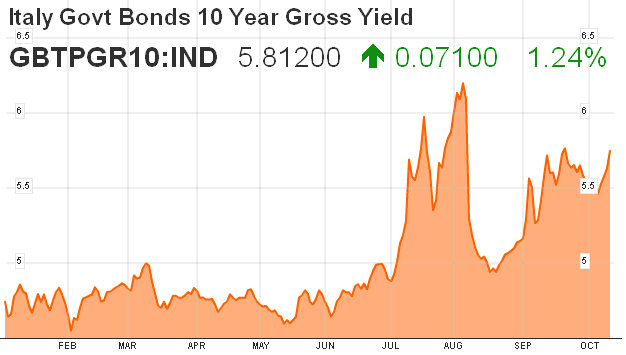
I think the bogey here is still the sovereign bond markets. As our friend Martin noted this morning, credit is not improving in Europe and if Italian bond yields are any sign it’s clear that they’re calling BS on this latest fix. As long as the Euro crisis remains unresolved the bond vigilantes in Italy (yes, unlike the USA, they have real bond vigilantes because of their status as a currency user) will push the envelope as budgets deteriorate and austerity fails to generate a sustainable recovery. Remember, fixing the banks does not fix the currency crisis….
The key for the EMU leaders is to somehow eliminate the solvency risk. As I’ve mentioned many times before, that is the only true long-term fix. We either move towards full fiscal union or we move towards a break-up of the EMU. I think the latter is off the table. That means we will slowly move towards full fiscal union. The big message the Italian bond market is sending is: “the current fix is not a fix at all and we know it”. It’s just more of the same. Europe needs a bazooka in the form of Eurobonds or full fiscal union. I think the bond vigilantes will push this story to its natural end – a panic ending in drastic EMU response involving some sort of long-term fix involving some form of fiscal transfers to the larger sovereigns (E-bonds?).


I think the muddle will be the ECB buying bonds below par ‘Ultra Vires’. And it will just keep doing that – probably with more gusto as time goes on.
It’ll be the same as Japan – insufficient political will to solve the problem properly.
Pray the US and UK find the political will somewhere, or we’re heading down the same path.
The ECB can’t stop this. They tried to stop the Greek yields from rising, but they couldn’t. Ultimately, the budget problems will decide the direction of yields and if we go over 7% the situation will become untenable and the crisis will reach its apex which will force Europe into bigger action.
The ECB can operationally buy every greek bond in existence. The constraints are political and they get looser the longer this goes on.
right — nothing can stop the ECB but political will. can peg all sov debt yields at 2% if it likes.
Yeah, but they won’t. Just like they wouldn’t in Greece.
So, they why do you say that breakup is off the table? I don’t see that it is. Sure, the political elites have a lot of personal financial incentives to keep the Eurozone intact, but if their voters are pushed to the boiling point the elites won’t be able to save their own personal wealth. They will be forced to go with the flow. Also, I don’t see any legitimate constitutional mechanism for full political union that will get the required popular majorities in France or Germany. Political union will require some kind of extra-constitutional coup.
“…We either move towards full fiscal union or we move towards a break-up of the EMU. I think the latter is off the table…”
Exactly.
the ecb has not acted like the fed as an aggressive lender of last resort. even when the ecb starting buying italy and spain debt at the margin, german minister stark has a fit and resigned. also, remember the new ecb chief is italian, and while wonders never cease, i wouldn’t imagine that he would throw the credibility of the ecb under the bus by having an italian-chaired ecb bailing out italy.
last i read, italy’s debt:gdp is over 100% and its growth rate is about 0%. this is a slow-motion train wreck. if the eu had trouble dealing with greece with 350B euros debt outstanding, imagine the fun when they address italy and spain with 2T euros debt outstanding.
But who would buy ECB bonds with a 2% yield??? There is nothing the ECB can do to stop the debt implosion. If there was, it would already have been done. And any effor to force the larger and more stable economies to bite the bullet and prop us the weaker countries will lead to another European war.
Below par? That suggests trending toward market rate, at least. On the contrary, purchase at par will be the disguised bail-out fraud.
I knew rising italian yields were about to rise again. Because US rates are rising as well. Rising US rates push german and dutch rates higher as well and then I wasn’t surprised to see italian yields rise as well.
I noticed that in e.g. the Netherlands and Germany rates can fall in the (european) morning but when trading starts in the US and US rates rise then dutch and german rates can but mostly will dragged/pushed higher as well. It will be interesting to see at what point dutch and german rates will start to diverge from US rates. And which rates will go through the roof first. TPC knows what my opinion on this matter. I won’t elaborate. My TPC alias speaks for itself
the 10 year is at around 2.25%…..ooooohhhhhhh scary. Mortgage Rates are at an all time low….if you think rates going back to a more normal level somewhow proves anything. then yes your alias does speak for itself. Your bond vigilante gang can not ride because you are three years early for your horses to arrive.
The U.S and Europe are very different…that somehow has been lost on you inspite of the myraid of articles to help you understand this. I can’t help to think if I had the softward my father in law uses to tell if a student at University has plagerized…he would find that your posts are merely an extenstion of someonw with Tea Pary Dogma. I’m sure beowulf could do this since he has finished the internet.
Even if your rates rise to 4% which I dont’ see happening it does not validate your view. However given Japan, and England embarking on QE I will revisit that yellow metal % of our portfolios.
“bonitas non est pessimis esse meliorem”
1. When one is up to one’s chin in debt then a rise of 50 or 100 basispoints can make the difference between “”treading water”" and “”drowing in that same water”" (read: debt).
2. I have read a significant amount of MMT articles on this website and I still have to read the first article that makes me a MMT believer.
For the time being I am short the 30 year T-bond future. Perhaps my chops will get burned. We’ll have to wait and see who’s wrong and hwo’s right, won’t we ?
“Because US rates are rising as well”
lol.
This is an interesting observation. I have also been watching Italian 10-YR rates closely. One thing to keep in mind, while the level or rates matters and has moved higher, the spread to the EU or German 10-YR also matters. This has been relatively stable within a band over the past two months. So part of the recent rise in Italian 10-YR yields simply reflects the yield pick up in 10-YR rates around the world (has happened in the US and across Europe as well).
Here is a related article I wrote on why a debt crisis in Europe can ultimately be avoided.
http://crackerjackfinance.com/2011/09/why-a-european-sovereign-debt-crisis-can-be-avoided/
CJ
In the end Germany is the final creditor…at some time their credit spread will widen. It should nonetheless occur once we know if some coutries are going to exit euro. If no exits, german spread will widen, other countries spreads vs germany will stay flat (or even reduce).
What’s interesting is the ECB seem so timid even after the conservative Swiss seem set on an unlimited peg! Gold has gone nowhere. The market doesn’t believe this is as serious as it is, they’re either right, or we’re all in for a very big surprise.
Gold only has value as an alternative currency. It’s time for it to take a breather from a meteoric rise. Pricing it is pretty hard. For one,it only makes sense in an inflationary environment, whereas we will have both sharp deflation and inflationary whiplashes – and one in which rates have failed to fully rise with inflation. It’s not like there is a USD # it can be benchmarked at if all fiat currencies fail. And it has to be discounted to a likely time horizon. But if 10K USD/ oz. w/ a particular, credible level of USD (and other currencies) failure, then the pricing could be said to be a future probability estimate. Massive deflation is a no-brainer except for unknown quantity of ongoing gvmnt intervention, making it all a wild bet.
Bear in mind, the market is not always right. Euro and EU have to crash and burn but few people, even investors, want to admit it. The last time banks failed in mass was 75 years ago and we imagine only because they were quaintly naive. Central banks are just too powerful today, right? Wrong.
“…I like it in the city when two worlds collide
You get the people and the government
Everybody taking different sides
Shows that we ain’t gonna stand s**t
Shows that we are united”
Adele…
Yeah well just listened to a influential old Irish economist on a poltical show – he is chief economist with the Irish E.S.R.I. – a semi – attached governmental economic think tank.
He seemed to be using his experience of the 70s & 80s when we had a glut of money & little credit to formulate his policies – of just one more cut & we will make it.
I was throwing stuff at the telly and screaming we have the exact fucking opposite problem.
Our debt is external now – before it was internal or our banks held Sterling bonds which was closely linked to our domestic economy.
Our credit money deposits is bleeding every month to service real external money interest obligations.
Something similar happened in the 19th century when absentee landlords collected rent and spent the Irish money supply in London.
I want to cry now.
The ESRI has been consistanly wrong in over a decade of predictions – I fear , no I hope it does not understand the euro system.
Fiscal union may or may not be the solution, but it should have political consequences. If fiscal union is achieved, then those participating fiscal-union nations should not also have individual-nation votes in the U.N..
North Carolina and Indiana have greater per capita GDP than many Eurozone countries, and they don’t have their own U.N. vote.
Cullen Roche: “That is, Italy has become the true endgame”
Hmm … IMHO before the italian end game happens we will have a default of Greece as a vociferous interlude. More and more european politicians advocate a hair cut of 40 to 60 percent where the loss has to be taken also by private bond owners.
And I think dealing with default risk is every day business for adult bond holders.
It’s those darned minors you have to worry about.
1) Greek default is inevitable. They don’t have the money. The austerity measures may be very necessary, but they also take away almost any chance for growth for some time. So they don’t have the money and they aren’t likely to have the money for some time.
2) The big question which is not being discussed publicly, but surely privately, is, “What do we do with Greece?” If it leaves the EU it is likely a failed state. I have bad visions of a Somalia in Europe. If it just leaves the monetary union, they can issue lots of drachmas, but who will buy their bonds? If they stay in the EU, should they continue to be self governing if they have no chance of being self financed? Yes, we have states in the US that fit that description, but the EU is not the US. If the EU takes over Greece politically, I would think there would be a lot more blood in the streets. Ultimately I think the question of what to do about Greece goes to the very structure of the EU. The answers could have very dramatic implications.
3) Italy is not Greece. Cullen, you pointed out very well, thank you, that essentially a fiat currency is backed by the productivity of a nation. These countries do not have their own currencies, but they do have their own bonds, which, in a way, serve as a currency for them. When I travel around the world, I see Coca Cola, KFC, McDonalds, Ford, Chevy, Google, Apple, etc, everywhere. I see BMW, Mercedes, Toyota, etc. I also see Fiat, Alfa, etc. Italy is home of one of the world’s largest oil companies, Eni; one of the world’s largest offshore drilling companies, Ensco. We import Italian wines and fine foods, especially cheese. Parmasean Cheese is one of our largest imported products. Milan remains one of the most important fashion centers in the world. Think Gucci and others.
What do we buy from Greece? Where are the Greek iconic brands? Greek shipping companies and Greek tourism are not enough to support this country, at least not in the style it is accustomed to.
What a pity. The birthplace of democracy is the penniless orphan in a world that thrives on freedom. Maybe we should adopt this waif, just this one, and let her eat at our table. As a memorial of thanks.
No, even proud Greece must be accountable. Democracy always requires responsibility. With opportunity comes accountability. Even for US.
It is very sad. The nation of Plato, Socretes, Aristotle, Pythagoras and the mother of democracy. But now the descendants of those great people are reduced to tourism, which is attractive because of its beautiful islands and coasts, but also because of its heritage. In other words, modern Greeks are living off the memory of their great ancestors. Very sad.
This, of course, is also true of Egypt, Babylonia and others. Is this the destiny of all once great empires? Are today’s Italy, Spain and England on a very slow gradual descent toward the fates of Greece and Egypt? Will the US join them on that sad slow road?
Or can nations rise, fall and rise again like China and India?
Or is civilization simply still too young to know if these are real trends or illusions?
This is what a common Euro treasury really means.
The decent into darkness begins.
http://www.golemxiv.co.uk/…/foreign-riot-police-now-operating-in-greece...
Exactly. I think Greece is the test case of “What does sovereignty mean for EU member states?”
cullen, you say “The key for the EMU leaders is to somehow eliminate the solvency risk.”
i have heard people say that greece faces a solvency problem, while italy and spain “only” face a liquidity problem.
the whole point with sovereigns is liquidity. if there is no liquidity problem, there is no solvency problem.
my point is that you are never going to liquidate a country when its liabilities exceed its assets, you are going to restructure (although i have found a sovereign restructuring in the 1800s where assets were leased to creditors to run for their profit). you will notice that greece is not making much headway in privatizations (although italy probably could raise some scratch selling off state assets).
so my takeaway point is that the manure is going to hit the fan when italy has a failed auction (liquidity), whether or not one may think that it has too much debt given its gdp).
not only won’t the ecb bail out eu, it may prevent the individual eu nations from bailing out their banks: http://www.businessweek.com/news/2011-10-14/ecb-tells-belgium-not-to-guarantee-dexia-s-interbank-deposits.html
can anybody believe this?
Exactly, Italy is a perfect example of how ineffective bailouts are. What Europe needs most is some kind of a fiscal union. That should be the main thing to occupy European leaders right now, not whether countries can agree another bailout package.
This entire problem is the result of banking deregulation in the late 90′s which turned previously solid, conservative bankers into compulsive gamblers. So banking needs to be re-regulated before you even think of trying to recapitalize the banks. Otherwise, you will just be putting more money into the hands of compulsive gamblers.
Derivatives should be banned. Buffet called them “financial weapons of mass destruction”, and bankers are currently using them to terrorize the Europeans into bailing them out.
Securitization should be banned, because it encourages banks to make unsound loans and pass them off to unsuspecting investors. Loan risk should stay with the bank that originated the loan.
Investment banking should be completely separated from consumer banking. Bad investment banking decisions should not be allowed to crash the consumer banking system.
Re-regulate the banks first. Then worry about how to recapitalize them.
I spoke to a German professional in the US on business; he knows German business very well. He was surprisingly matter of fact about the ultimate resolution of the crisis that the German business community expects to see: (i) the EFSF will be funded and leveraged up; (ii) European banks will be recapitalized to cover a big haircut on Greek debt; and (iii) the ECB will do whatever is necessary with keystroke Euros to fund whatever is needed beyond the EFSF to ringfence Spain and Italy.
His rationale: the EMU and Eurozone economies are inextricably linked; it is too late to unscramble that egg; and no one in German business wants a deflationary depression in the Eurozone. Spain and Italy are real economies that need some discipline and the ECB bazooka to stabilize; even Portugal has a fair business case (i.e., gateway to South America (Brazil) and Africa (Angola). Ireland is already stabilized. It is Greece that is seen by the Germans as the hopeless case. The Germans cannot tell Greece what to do in terms of restructuring their economy because of history and political realities; my thought is that the IMF and the ECB will inevitably have to do that job. Their hammer will be to cut off funding to Greece and let it stand on its own. The Greeks know that they cannot do it.
I came across a graph with CDS rates for the Netherlands, Germany and the UK. And they all are rising. No wonder when one guarantees money to the tune of tens and/or hundreds of billions of Euros.
What surprises me more is that the CDS rate of the UK is at about the same level of Germany and the Netherlands. AFAIK, the UK didn’t pledge billions to shore up the bail out fund. The best explanation I can come up with is that it’s related to the fact that the UK is running a Current Account Deficit and the fact that the british government has said they would buy/monetize UK guilts. Has anyone other thoughts ?
1. The ECB could/will(???) be recapitalized by going back to the some sort of gold standard. Remember what FDR did in 1932 ? He devalued the USD by repricing gold from about $20 to $32 (?) and made owning gold illegal. This simply meant a dramatic improvement of the balancesheet of the FED.
And the fact that central banks are buying gold (instead of selling) reinforces the credibility of this scenario.
2. There are rumours that Germany will leave the EURO zone.
http://www.pippamalmgren.com/77.html
Don’t know how credible this is. What to make of it. Anyone any thoughts ?