
KILLER WAVES AND DANGEROUS MACD’S
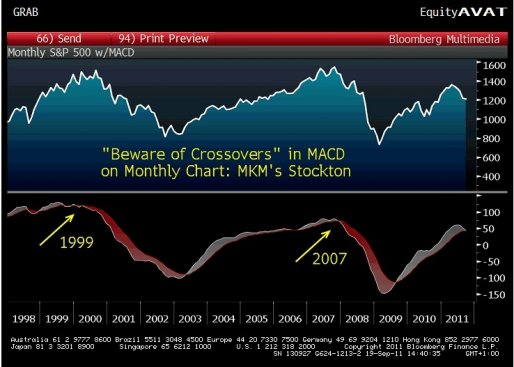
Albert Edwards has been hard at work in recent weeks studying the technical landscape and the uber bear has found what he claims is more evidence of the peak in the bull market within a secular bear market. In two separate research notes this week he described two popular long-term indicators which appear to be giving an early warning signal. The first signal is the monthly MACD which is giving just its third sell signal in the last 15 years (via Business Insider):
“The chart below shows the monthly S&P together with the MACD.
For those normal people who don’t know what the MACD is or even what it stands for, it is the Moving Average Convergence-Divergence. It is a momentum oscillator closely followed by many market participants. When the faster moving mav breaks the slower moving mav (up or down) we get a key buy or sell signal.
We may be about to break downwards on the monthly S&P chart which would give us a HUGE sell signal as was the case in Nov 2007 and the end of 1999 (also see attached note on The Killer Wave signal). If the S&P cracks we will be at 1.5% 10y US yields within a few days and probably heading to 1%. Watch this space.”
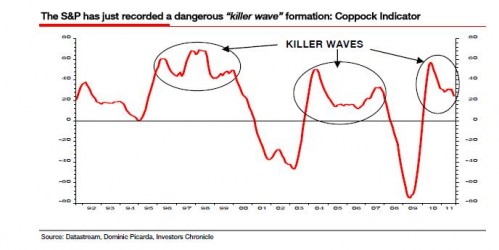
The second is the Coppock Curve or Coppock Guide. Edwards notes that this indicator is also sounding the early alarm (Via FT Alphaville):
“For those looking for a reason or a technical signal that the cyclical bull market has ended and that we are firmly back in the icy grip of the structural bear market, we would highlight the analysis of Dominic Picarda of the Investors Chronicle and the FT. He identified the S&P as having just made a killer wave. He has identified eight killer waves in the S&P 500 over the last 83 years. All have been followed by substantial losses. The average fall following a killer wave has been 40 per cent over 20 months.
As Dominic Picarda explains in his article, a killer wave is formed as follows. The Coppock indicator gives an initial sell signal (which it did last summer). However, the indicator subsequently turns up once more, without first having registered a reading of below zero. This happened in April 2011. The killer wave is then completed once a further sell-signal occurs, forming a sort of “double-top” pattern in the Coppock indicator (for Dominics article click here for a little video explaining the signal click here you might have to click more than once)”
What to make of all of this? Why are we seeing these rare technical patterns currently? I think the wave analogy by Edwards is probably appropriate. The market can be thought of as one gigantic system moving in cycles or waves. We’re all familiar with the standard business cycle and its peaks, troughs, expansions and contraction phases. Markets are no different. The interesting thing in the last 15 years is that this cycle appears to have picked up enormous volatility. The swings have become increasingly violent. I have attributed this to what I refer to as the “disequilibrium of misguided market intervention“. In our many policy fumbles over the last few decades, the Federal Reserve has helped to financialize and destabilize markets by embedding a “put” beneath them. This destructive “put” has given the market’s participants the impression that they can take outsized risk knowing that the downside is protected by a Federal Reserve that will intervene any time the markets appear fragile.
I described this process earlier this year as we saw this “put” in real-time during QE2:
“The result has been obvious – equity investors are eager to take excessive risk by buying every dip in the market with the knowledge that the market can no longer decline. It’s a lot like walking a tightrope knowing that there is a cushion just 5 feet beneath you. There is no need to be overly careful. The problem arises when too many people start jumping on the tightrope with you and create a disequilibrium in the system. At some point the rope becomes unstable and possibly snaps. Except this time your cushion isn’t a soft padding, but someone else’s head. People get hurt. You get the picture. What Bernanke has created is not all that different. It’s an environment of spoiled tightrope walkers who are conditioned to take risk and believe they will always receive their treat when they begin to cry. It might be “working” for speculators, but is it good for the US economy?
The problem for Mr. Bernanke is that he must take the pacifier out of the baby’s mouth without causing a temper tantrum. And yes, Wall Street will throw a temper tantrum when the pacifier is removed. If I had to venture a guess I’d guess that Mr. Bernanke will end QE2, continue reinvesting interest payments, thus slowly removing the pacifier. But that’s just a guess. Either way, he will tread carefully and likely remain close at hand with the pacifier at the ready just in case the baby begins to throw a temper tantrum.”
Unfortunately, this market volatility has also led to increased economic uncertainty as the price volatility influences the real economy. I believe the Fed is largely to blame for this predicament as their misguided approach is partially based on the belief that the markets are an accurate and fair indicator of the real economy. This is simply not true. The market is not the economy. And it is not the efficient pricing mechanism we have all come to believe it is.
As for killer waves and MACD rollovers – I don’t know. I tend to use technical analysis as a supplement to a sound macro fundamental outlook. Unfortunately, the fundamental picture doesn’t exactly look all bright and rosy right now. And while I tend to believe that no investor can predict the future of markets out more than about a quarter, I do think this general cautious perspective meshes with the secular outlook I’ve been using since ~2006 – as long as the balance sheet recession continues this will remain a market in which buy and hold investors will do poorly. So while I’d be wary of people calling for some sort of waterfall decline, I think it’s prudent to take note of the many fundamental and technical signals that seem to be sending one unanimous signal – buy and hold is dead – for now.


Cullen, do you have any short positions?
Failing miserably at fundamental market timing, Edwards has become a technician? You owe it to your readers to point out that he’s been bearish for the last 80% of the rally off the March ’09 lows. I believe he was bullish for a week sometime in April…
Albert does have a tendency to be a touch bearish at times and I think he has a problem with gauging policy response and market optimism. Those two factors have changed markets so that they become diassociated with fundamentals. Who has not been surprised by the last minute ramp in markets on bad news. He gets this wrong and miss times due to it but his analysis of the fundamentals is always worth taking note of. He did for instance suggest european banks were not particularly well capitalised and Southern europe may get into trouble.
Here I think he has gone down the wrong route with the technical analysis. He has assumed you can extrapolate from the markets of the past to the tweaked ones of today. ETF’S, shadow banking, CDS, CDO’s HFT’s and the like have all come into existence making this type of correlation fraught with risk. Where he may be right is if these kind of technical analysis criteria are built into HFT algorithms.
Now we know the market is not the real economy, but it would be good to clarify exactly what is the real economy. Here I think you can split the real economy into a number of groups, namely Global and export orientated firms, domestic only firms and the general population. Global and export firms by nature of their profits from abroad may equally be masking the lowest level of the real economy which is the general population and domestic firms. Equity markets in fact may reflect the Chinese economy much more than the US one. The real domestic economy may be really a little irrelevant back water for the markets. Its a shame that a lot of policy is focused on that market. Maybe Albert’s ice age scenario may have some merit after all.
Edwards has been bearish since March 2009!
If Lucifer Ben comes out with a massive qe program, stocks and commodities will rally. Heading into the election year and with banks in desperate need of capital, it is probable that the banksta will not disappoint.
Enjoy the ride!
Sentiment trader did an entire piece saying that this was not that good..
consider the results
http://content.screencast.com/users/wprosser/folders/Jing/media/d6f06982-1af1-4681-890d-06b73a5723c3/2011-09-20_0700.png
Jason is very unbiased, and good.
“If the dates are mostly the same, then I can’t confirm the dire prediction from the “killer wave”. The S&P’s performance going forward was sub-par, certainly, but I don’t see the “average -40% decline during the next 20 months”.
When we look at the next 20 months, the maximum decline in the S&P was a median -13.9%. That’s definitely higher than what we see during any random 20-month stretch, but way off from what was mentioned in the report.
Also, the maximum gain during the next 20 months was actually quite a bit higher than that, and in fact it was even higher than random. The last six “killer wave” signals, in fact, led to quite bullish outcomes, excepting the one from November 2007.
Overall, I don’t see much about the indicator that would have me overly worried about stocks’ long-term prospects.”
To the old school guys out there……. the S&P is forming a classic flag formation after a head and shoulders top. Looking at 950 on the S&P 500
And a fed meeting announcement tomorrow that disappoints the market could initiate the ride. But IMHO the ride will not go far below 1050 without real terrifying news. I mean facts and not fantasies about european debt
.
I am prepared to go short
.
These particular studies have so much wiggle room they are basically meaningless–especially the Coppock study which was designed as a buy side indicator. If we don’t go into a recession the market is probably a buy after having declined nearly 20%.
Do the MACD plots for S&P prices for 1 minute, 1 hour, 1 day, 1 week, and every quarter and then apply this reading tea leaves schemes.
I can’t tell you how many times I’ve been burned by technical indicators when I was gambling in the forex market (just small change, for fun). MACD and all others are lagging indicators symbolizing exactly nothing. They can work dozens of times and then completely stop working. That’s because they can’t predict human behavior. Congress *could* do the right thing at any moment and end this recession and no technical indicator can predict that. They are all based on the assumption that the market will react exactly as it has in the past.
As Cullen points out, the market is not the same as the economy. Demand drives the economy and generally, the market follows. That is unless the market has completely lost touch with reality, which lately seems to be the case….mark-to-fantasy, rampant control fraud, bailouts.
The best-paying technical indicators are typically winners only about one third of the time.
They work not by paying off over 50% of the time, but by paying off big enough when they do pay off to cover all the times they led to a stop-out plus a healthy profit.
The death cross, for example, earns 45% over any given 10-year period, even though it fails 84% of the time. Its losses are very frequent and small, its payoffs are few but huge.
Ever play pro blackjack?
You sound like a guy who knows to hit 16 not because you expect to beat the dealers face card over 50% of the time but because hitting loses less than a stand.
nice to see such skepticism about technical analysis.
better for the people who actually understand how to use it.
Me? I can never tell who’s responding to who on these comments.
Anyway, I wasn’t being “smart”, just recognizing Moe as someone who sees the reality behind the surface.
no, i was referring to the 50% win rate, stated above.
i suppose its true if the ta performed is not comprehensive.
Cullen,
I would be interested in you stating what you mean by “secular bear market”.
A secular market trend is a long-term trend that lasts 5 to 25 years
Edwards is entertaining to read but it’s hard to heed his advice based on the fact he is always bearish. I like Cullen’s approach taking a fundamental macro approach. The macro don’t look great at the present.
Speaking of bears, of all the bears I have to say Howard Davidowitz is the most fun to watch on TV, that guy kills me. I don’t care what the accuracy of his calls are, he’s just good entertainment.
Oh no it’s the Hindenberg. Oh the horror, the humanity.
I am confident the Fed will come out with *SOMETHING* tangible tomorrow, but what that is (likely Op Twist) and what impact that will have (none) will be unlikely to stir markets positive.
It’s misleading to say Edwards has been a bear since 2009. He was a bear long before that. Much more accurate to say that his thesis has consistently been that we are in the midst of a secular shake-out of which the bear market of 2007-2009 was only a part. He has remained bearish through the bull move from the March 2009 lows until the top in May of this year, it is true. But that view was always predicated on the belief that however strong the rally might be, it was a bear market rally and we would see a significant new bear move down before any sort of true secular bull market would begin. Do a search through FT Alphaville archives (he is their favorite uber-bear) if you really want a true understanding of the consistency and length of his bearish view.
Checked this MACD – on monthly scale looks like it is close to cross-over, but not there yet. On daily basis – divergence is actually increasing…. So we might be months away from the event, in the case the indicator is correct.
Don’t know where to start….
Good posts by all of you..enjoyed your comments. Very intelligent and thoughtful(good stuff BRICK).
SBG-seems to have a question alot of readers could use a thoughtful answer by you guys. (i’ll just digress into nonsense if I do it)
VII,
I see this term thrown around a lot. I believe that a secular bear market is a period of earnings multiple contraction and secular bull market is a period of earnings multiple expansion on the S&P 500.
I am just curious as to how others define it.
SBG-
“Guns offer no protection from the financial bear”- Russell Napier..Anotomy of the Bear
I have my view based on Russell Napier’s book and Vitally N. Katsenelson….book littl book of sideways Markets.
Yes Short Version..Markets go from expensive work off excess to cheap. I can’t answer for Cullen.
I will provide a paragraph from Russell Napiers book though.
“Can it be coincidence that the four years covered in this book -1921 1932, 1949, and 1982(bottom of the bear..start of Bull)-also mark momentous change in American society. There was the birth of consumer society(1921) the birth of big government(1932) the birth of the military industrial complex(1949) and the rebirth of free markets(1982) …..”
So these Secular bear markets last on average 14-16 years. I don’t know what the next momentous change is in this country…My Denist told me about how IBMs Watson is being designed so that client gets tested and the computer spits out treatment to doctor. lowering costs and providing better care…VERY SHORT Version. Maybe it’s a technological one that ignites our next move and applications are just the start of something bigger our youth will drive. I don’t have a clue. But looking back on our history..we always rise up and find away. 2013 could be it…or it could come later in 2016 at a 1982 type valuation.
Sorry SBG. You asked a simple question.- I always digress..
While this MACD is a lagging indicator it must be respected because it is based on monthly data. From the monthly perspective “Long Term Trends” don’t change on a dime.
The “Coppock Indicator” is based on “Rates of Change” consequently it is more forward based and has forcasting value. Its forcast record is about 80% correct historicaly
The ” Classic Coppock” was based on month ending closes–and was designed as a “Long Term Buying Guide”–Mr. Coppock’s exact words.
It has No Value as a sell side indicator !! Mr. Coppocks exact words
New subject:
Where has the ” Coppock ” failed.
In the “Depression Years” and in aftermath of 911
Why did it fail in the “Depression Years”
SIMILAR to “Today” we had Govrnment interventions
In the Depression we had FDR “Fiscal” stimulus which Failed
Today we have both “Monetary and Fiscal” stimulus which are Failing
The Obama Adm’s “Robin Hood” policy fails because the poor are Not Oppressed
The Poor do not pay any TAX–No King is taxing the Poor unfairly
Today-It is the opposite the “The King” (Obama Adm ) wants to TAX the Rich/ Corporations
This type of “Political” economy is never good for the “capitalist”
Remember: We live in a “Capitalist” economy and a “Political” economy.
Just a simple rehash with some history
BTW–just viewed CNBC–are the Romulans taking over–
Maria dressed for all hollows eve?
@ AWF
“The Poor do not pay any TAX–No King is taxing the Poor unfairly”
I think you might mean income tax. The poor pay sales taxes and if employed payroll taxes. Or if you mean any form of taxation at all you may mean on a net basis after taking into account all government benefits.
How much net tax should someone with no job who has been unemployed for 6 months, has lost their house and has no net assets pay?
The US has one of the lowest total tax to GDP ratios of any developed economy.
@Explorer
I think you might mean income tax. The poor pay sales taxes and if employed payroll taxes. Or if you mean any form of taxation at all you may mean on a net basis after taking into account all government benefits
You are correct sir!
“The Poor are not Oppressed” consequently we have NO use for “Robin Hood”
Do folks realize Edwards is a “hyperinflationist”?
http://www.reuters.com/article/2011/08/18/us-edwards-socgen-idUSTRE77H31320110818
He understand deleveraging but see’s a bond collapse likely starting in Japan (and admits that it is hard to pin point the cause of the collapse). His story can be quite convincing but like much of modern economics lacks the firmness of a specific date and cause. And will likely find yourself broke waiting for the event to happen.
@nikko
I don’t think he’s a “hyperinflationist” (though that word is used in the article). He suggests double digit UST yields, which may be dramatic, but that’s high inflation, nor hyperinflation.
Yes, he’s a perma-bear (but maybe over the past 10 years, people could have done well listening to him). Not someone to listen to for short-term views, of course. But always worth reading. (Except when he resorts to graphs, maybe.)
It’s pretty obvious that the big-shot bankers on Wall Street have been getting richer and richer during this economic crisis, while your friends and family members haven’t.
Well if you’re interested in cracking open the “black-box investing strategies” of the rich, so you can see how they’re doing it, you’ve gotta check out this video Mike Dillard just posted…
Despite the fact that he’s not an investor, trader, or financial guru of any kind, he’s made a 280% return since 2008, while the rest of the world has lost 30-40% of their portfolio.
How?
Get this… He found a “map” back in 2007 that’s allowed him to basically predict the future.
Like I said… VERY COOL…
Check out this video he just posted and you’ll see how he’s doing it…
http://www.TakeControlofYOurFutureNow.com
Jerry O –
Tell Vinny I said hello and tell him my sham wow is fantastic…heck it’s made in Germany.
Do I go thru for my tax relief? And how do I clean my juicer you sold me?
And yes…can y’all stop coming to this site to sell your black box of nonsense.
Killer Waves, Hindenburg Omens, Death Crosses etc. are all a lot of nonsense. The bottom drops out when you least expect it and the run ups start when it seems like we’re about to go over a cliff. Be greedy when others are fearful and fearful when others are greedy; good advice from Uncle Warren.
I follow pragcap regularly and whenever I see a post like this one, I just get reminded of the ole quantum physics principle..
“The act of observation creates the observed”
aka If you look for something hard enough, you will find it.
(to the technical analysts, yes you may kill me now!
)
macd is simply a momentum indicator, and is not a good indicator of underlying technical strength.
nonetheless, the market is technically weak.
Like the chart colors – it says Bloomberg multimedia and on top Equity AVAT – googled it but cannot find what chart company???
let’s imagine you use on monthly data a macd 26/12/9 (EMA) since jan 1950.
You take a short when signal is crossed down and enter on the exat month end price of the crossing down. Let’s image you cut on the best possible month end before the signal cross up. Some results
- 21 trades
- 9 are wining
- max 50% (08 crisis) / min -6.25% / avg 10% / median 4%
let’s look at the worth month end during the period
- max loss : -21.56%
- min loss: 34.25%
- avg:0.16%
- median : -1.9%
now let’s look at what was market action before the cross by looking at:
Price at month end when cross down / (max price of last 3 month end). Let’s call this “price action before”
Though there’s no crystal clear relation it seems that, as intuited, the higher the correction price before crossing down the less chance you have to make money. Converse not being truth.
max PL min PL “Price Action before”
8,51% -18,17% -23,67%
-6,24% -21,56% -15,57%
5,76% -13,80% -10,71%
11,56% 2,94% -8,41%
40,60% 22,07% -7,81%
-1,96% -1,96% -7,37%
16,08% 1,46% -6,75%
4,65% -10,61% -6,59%
-6,25% -8,28% -6,56%
-1,34% -8,90% -5,60%
4,14% -6,46% -5,60%
41,53% 34,25% -5,09%
50,30% 32,54% -5,03%
7,25% -3,96% -4,86%
2,69% -6,27% -3,81%
15,79% 5,45% -3,49%
4,91% -4,32% -2,99%
-1,98% -1,98% -2,45%
-0,91% -5,23% -2,40%
28,36% 14,10% -2,26%
16,07% 1,12% -1,79%
17,73% 8,04% -1,42%
-0,99% -0,99% -1,26%
-1,94% -1,94% -1,00%
-3,44% -3,44% -0,53%
that being said month end will surely end up with a cross down. “Price action efore”, based on 1122 is -15%.
correction:
25 trades, 16 winning on this strong assumption in terms of cutting
were you to cut when it recrosses upward :
- 7 wins. max 13.75%, min -21.5%, avg -1.9%, med -2.37%
were you to cut when signal decelerates:
- 9 wins. max 12%, min -15%, avg: -1.31%, med: -2%
fyi the 6.24% loss displayed below after a “price action before” of -15% is related to a shot entered end august 98 which was the bottom (based on month end data) of S&P during the russian/LTCM crisis.
Look at min PL versus “price actions before”…it just says the obvious: when monthly macd crosses down too late…the trades become too risky…too late to enter short rigth now for this crisis ? (based on those technicals it seems)
What will Obama package look like ?
will ECB pull out a big fat gun ?
sorry to flood: min PL is the worst possible PL during the period starting at crossing downward and ending at crossing upward.