
Home » Most Recent Stories

MACRO MINUTE

12 August 2011 by Cullen Roche 36 Comments

Sorry for the lack of updates this week. I don’t know if you’ve heard, but there has been some stuff going on in the stock market and that makes for busy times. Anyhow, let’s cut to the chase.

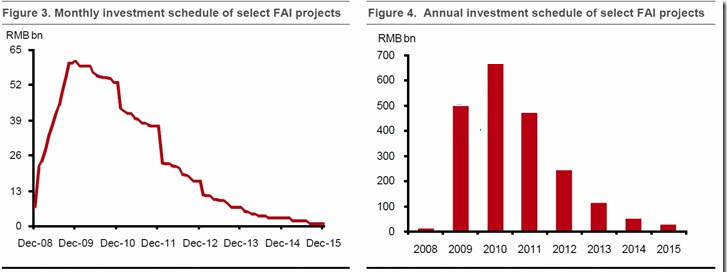
We are, in my opinion, in a balance sheet recession that is likely to persist for several more years.  This means we can expect the private sector in the USA to remain very weak.  Parts of Europe are also suffering from a balance sheet recession that is largely the result of an incomplete and flawed currency union.  Asia has boomed in recent years.  They remain the one strong leg of the global recovery.   I have maintained that the Chinese economy experienced booming growth in recent years in large part due to their stimulus.  It is my opinion that the stimulus was excessively large given their lack of real economic problems and is resulting in high and unstable inflation.  Historically, these bouts of inflation have tended to result in a recessionary correction.  As the stimulus winds down we should see downside risk in China.  Whether this is the beginning of a new economic downturn is in question still.
 

The riskiest region of the world remains Europe by a wide margin.  Austerity is now biting hard on the periphery and appears to be spreading.  Italy’s balanced budget amendment is likely to impose further pressure on their economy which will exacerbate their debt woes.  France’s recently announced austerity measures should also put downside pressure on their economy.  This all creates a highly combustible environment in the coming year.  As we know from this week’s market action, investors are very jittery about the potential for a banking crisis in Europe.  Europe’s leaders are clearly behind the curve here and implementing more can kicking strategies that are unlikely to work.  This means that there are extraordinary risks as the European economy weakens and the risk of a potential banking crisis increases.  If the Germans are serious about not bailing out Italy we could experience a very serious calamity in the coming year.  I would say that the risks in Europe are skewed heavily to the downside.

The U.S. economy is not nearly as bad as the media might have you believe (or even as bad as some of my recent commentary might make you think).  The budget debates did not result in massive austerity and the USA is still running sizable budget deficits that should be large enough to offset much of the effects of the balance sheet recession as the consumer continues to de-leverage.  Unfortunately, the stimulus from 2009 is winding down so there is downside risk as this works as a pseudo austerity.  Fortunately, the sizable budget deficit should continue to bolster the US economy and provide for a muddle through environment.  The major risks are exogenous although increased austerity would certainly hurt (we’ll see how this develops).  The double dip debate is missing the boat in my opinion.  We never left the last recession.  It’s just that most people don’t understand that this isn’t your average recession – its a balance sheet recession.
Cullen Roche

Cullen Roche

Bio - Coming Soon.

More Posts - Website

Follow Me:
TwitterYouTube

Disclosures - Unless otherwise noted, authors have no positions in any securities mentioned and readers should never consider this to be investment advice. Always consult your financial advisor before acting on any ideas. Comments Guideline - Readers who denigrate authors or other readers will be banned without warning. This site does not tolerate any sort of reader abuse. The goal of this site is to create an environment that is conducive to learning and better understanding of the monetary system and the investment world. We expect readers to behave maturely and responsibly. We welcome and encourage intense and intelligent discourse, but the site adheres to a strict 1 strike policy. While it is your right to speak freely, it is not your right to behave childishly. Above all else, please enjoy the site. It is intended to be used as an educational tool and we hope the intelligent and mature debate will further that purpose. We hope readers will make an effort to respect that goal. Comments with excessive linking or foul language will be moderated before posting.
Comments
  • confusedMMTer

    There are a number of factors you are considering in the monetary system.
    1 GDP growth/Full employment
    2 Price/Currency stability
    3 Fiscal responsibility (deficit spending/debt)
    4 Tax/interest policy

    MMT would imply 1 can be achieved, with little effect to 2, regardless of the levels of 3, provided the economy is not at full capacity. Further the Fed/Government under all conditions have full control over 4.

    Austerity would imply that excesses in 3 has an undesirable impact for both 2 and 4 (interest rates specifically), that produces a worse long run negative impact to the economy than the negative impact that austerity has on 1.

    To test the MMT (or austerity) hypothesis, one can speculate on the robustness of an economy by taking each of these factor to extremes. That is does MMT hold true and apply for all conditions of 1,2,3 and 4? Robustness does not mean the extremes are likely to occur, but rather the system is stable under all conditions. Alternatively, it may identify under what circumstances “black swan” events or practical limits exist and suggest further restrictions on 1, 2, 3 and 4 in these extreme cases.

    Thoughts?

    • Dimm

      In terms of policy options real time results provided by comparing Ireland(&Greece) and Iceland.
      Deficit vs rates and inflation – Italy vs Japan.

      • confusedMMTer

        Both parties (Austerity vs MMT deficit spending) seem to start from different set of base assumptions and reject the foundation of the other (my interpretation). Logically one can conclude that either of the fundamental statements I give for MMT deficit spending versus Austerity below maybe correct description but neither party has proven analytically that their thesis is robustful.

        “MMT would imply 1 can be achieved, with little effect to 2, regardless of the levels of 3, provided the economy is not at full capacity. Further the Fed/Government under all conditions have full control over 4.

        Austerity would imply that excesses in 3 has an undesirable impact for both 2 and 4 (interest rates specifically), that produces a worse long run negative impact to the economy than the negative impact that austerity has on 1″

        For example, the austerity camp under a fiat system have failed to prove that a country in the long run is economically better off limiting deficits (by how much?) than the short run ill effects to GDP/unemployment. And yes Iceland is a example that arguable supports their case, but their assertion is still unproven in general. In addition, as Cullen says they make a number of “fear mongering” statements about inflation, currency depreciation and interest rates but do not quantify this.

        On the other hand, I believe MMT is valid in a well functioning economy , however I am worried about the robustness of the system in the case of “black swan” events (CR calls these exogenous events). The answer cannot be, that you are fear mongering or that it is low probability. I think the financial crisis of 2008 should remind us to not underestimate these type of tail risks.

        As someone wrote elsewhere, economics is a dismal science, though I know of no better way to provide convincing argument with this analysis.

      • confusedMMTer

        And it interesting to note that of the countries you mention, only Iceland appears to be a growing and viable economy. They did go down the austerity path, but I think the success is even more subtle than that – they repudiated foreign debts (no bailouts for the banks). Debt repudiation is not even a realistic conversation in the US or Europe – be it Austerity or MMT camp.

        If anything could “reset” the balance sheet recession a debt jubilee would be the most direct.

        • rhp

          “Debt repudiation is not even a realistic conversation in the US or Europe –”

          There is no need for debt repudiation in the US if we are a currency supplier. We DID repudiate debt in 1971 in going off the gold standard…….

          • confusedMMTer

            Iceland did not default on it public debt. Rather, their central bank did not bail out the private banks and allowed individuals to default who were incapable of paying off their foreign denominated mortgages (yes they have risky mortgages their too). I’m suggesting, this may have been the more important reason for their current economic growth, and not necessarily the austerity measures they took in addition.

            An alternative way to deal with a balance sheet recession is to let/enforce private banking and individuals to fail in orderly manner. This is how free markets and capitalism works. Government policy that attempts to address the balance sheet recession via bailouts, austerity or deficit spending is not the most direct solution for a balance sheet recession. One exception is deficit spending that pays down private debts directly which I am not in support, but am noting because in some part the US has done for its domestic and some foreign banks.

            • rhp

              totally agree w/you regarding your Iceland comments, although it took a near revolt of the Icelandic population to stop their politicians from guaranteeing the debt a la Ireland. It is not the austerity which is helping Iceland, but repudiation of debts. Here in the US, we do not need to repudiate any debt as we are not dealing with a foreign denominated debt as was Iceland.

              One problem I see here in USA is the confusion of terms of “bailouts” versus “deficit spending”. The bailouts WERE the gov’t paying down private debt (of the TBTF banks), IOW “deficit spending”. I agree that they should have been allowed to fail, BUT……….

              The Tea Party republicans, with their emphasis on destroying the social safety net, are saying that all the non-”FIRE” industry people should simply “be allowed to fail” as well, equating the lower/middle class erosion of finances with irresponsibility and poor work ethics, and not recognizing that the FIRE industries contributed to the looting via massive accounting fraud.

              I agree with MMT’ers approach on gov’t deficit spending in a B/S recession, but question the allocation of deficit spending so far in terms of effectiveness. Unfortunately, I feel the entitlement programs are one of the reasons we are still “muddling along”.

              rhp

  • prescient11

    11th Cir. just ruled obamacare unconsitutional!!!!!

    Huge news is that this almost guarantees Supreme Court review!!!!

    excellent news for the country and business.

  • VII VRBII

    CR-
    I’m thinking the issue is confidence.
    Wall St., Cooporate America and policy makers understand when people are down the economy tends to suffer.
    We’ve been told for some time a recovery was taking place and so EPS on the market are stretched for 2011 and 2012 to justify 1350-1400 year end on the S&P.
    I agree with you.I have for some time on many issues and am new to the concept of MMT(12 months now)
    I would think even a mild contraction in the economy has taken valuations down but would still need to adjust not to what WE all are seeing but what Wall St. and Policy makers have tried to create in the markets.
    Trying to create confidence falsy like QEs etc. to me in a balance sheet recession ultimatley back fire and in the end actually do more damage to investors confidence. Now they can’t trust you.
    Better to be upfront, deal with the problem and pick up the can. I will vote for you if you tell me the disease and the solution. And I will trust you..that gives me confidence in you and my future. Maybe I cut back on spending but less so when I think you have no clue what your doing.
    Unlike the movie…I believe we can handle the truth. And we prefer it. I prefer it that way at least.

    Am I off base on this?

    • confusedMMTer

      If you run for office I’d vote for you.

      • VII VRB II

        Thank u!
        My checkered drug Years from 2000-2004 and the prostitute I wrote a check too make me in electable.
        But thank u

        • Mediocritas

          Are you kidding? With that kind of record you’re PERFECT for congress, you’d fit right in! :-p

          Although, with just hookers and crack you’re a little bit lightweight. Get a few priors for sexual assault and fraud to really have a shot at getting into the inner circle.

    • reslez

      Saying the issue is confidence is like saying a cancer patient’s problem is being depressed. People lack confidence for good reason (high levels of private sector debt versus income). Their confidence will return when conditions warrant. We got here by being overconfident (taking on undo levels of debt), confidence will not lead us out.

  • KB

    I am afraid the mere absence of austerity would not be enough to sustain balance sheet recession. To maintain decent growth in GDP and corporate/personal income, the government should have increased the deficits.
    Now, after recent debt ceiling debate, deficit increase in any form, especially new stimulus, would be next to impossible. I think we are facing another recession during next 12 months.

    • brianr820

      I fear the same. However, we have an election coming up and Obama will be motivated…

      We are at the mercy of politicians. MMT teaches that they can clean this up, but they are showing only faint signs of doing so. My basic plan is to buy meaningful “sea change” action from governments. Ecb setting rates perhaps, fiscal stimulus here, etc.

      I am still filled with awe and fear at the worlds direction, but hope exists.

  • prescient11

    If we had just printed this money, rather than rely on the archaic form of bond issuance, we would be in MUCH BETTER shape.

    There is no proof that purely printing, rather than bond issuance, is any more inflationary. Our debt burden would be reduced by 70% right now.

  • Wantingtoretire

    Technical and analytical assessments are not really any good for the human component going forward. Graphs are assumed to include the human component because the graphs reflect human decision making but they are all backwards looking. So confidence needs to be instilled in the humans and needs to be maintained on a regular basis. Stop trying to steer the economy as if it were a motor car…………..

  • John

    Anyone have an opinion on the 30yr treasury?

    Looks like slow growth for quite some time, the risk free yeild maybe respectable.

    Even the most skilled investor is going to struggle here possible.

    Any thoughts on the 30yr?

    • ocean

      John I asked myself same questions, this is my thinking.
      - Looking at the Japan experience of the balance sheet recession (and their 30 year yield) and the US ongoing economic softness one might expect the 30 year could drop lower.
      - Perhaps in the short term the stock market is a bit oversold (given by dividend yield) and bond market is a bit overvalued (30 yr bond yield)

      • John

        Ocean thks for reply.
        The JGB 30yr current @ 2%. If we are repeating Japan then US30yr at 3.7 could still be a possible buy.

  • Dee

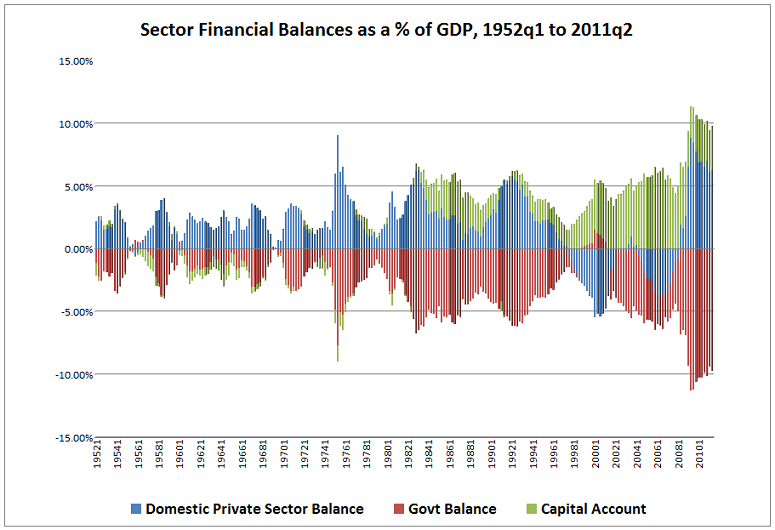
    Would someone please elaborate on the Sector Financial Balances chart? What does the Capital Account represent? The pattern doesn’t seem to correlate with ressesions. I’m guessing I’m missing something. Or is it just showing our shrinking balance sheet? Thanks!

    • Different Chris Different Chris

      Dee,

      Excellent question because Secotral Balances are an important part to understanding MMT. The capital account ‘represents’ the flow of money to the ‘foreign sector’. The important part of understanding this in terms of MMT has to do with government spending and the following-

      The Private Sector + Capital Account = -(Government Balance)

      This is an accounting identity, it absolutely true to the smallest increment. The reason it is important to understand is 2 fold. It helps illustrate that the Government must sepnd (hence the negative %) money into the private sector for that money to exist. Also, it shows that if you ‘reduce’ the negative Government balance (like cutting spending or raising taxes) you will reduce the positive Domestic Private sector balance (and Foreign Sector Balance, or Capital Account).

    • zmt63

      “The pattern doesn’t seem to correlate with ressesions”

      Recessions occur when the domestic private sector balances are forced to cut back. Maybe not immediately, as was the case with Clinton budget surpluses, but eventually. The three have to off-set each other. So, gov’t balance deficits will mean a private sector surplus (holding capital accounts constant). This is the whole point with the private sector balance sheet recession. If HH have to deleverage, then govt has to take up the slack, which means deficits.

      i think…

  • geniusnitwit

    “We are, in my opinion, in a balance sheet recession that is likely to persist for several more years.” CR

    Agreed, in fact it happened to Japan in 1990; Richard Koo wrote that Japan’s “Great Recession” that began in 1990 was a “balance sheet recession.” He argued that monetary policy was ineffective because there was limited demand for funds while firms paid down their liabilities. Despite zero interest rates and expansion of the money supply to encourage borrowing, corporations in aggregate opted to pay down their debts from their own business earnings rather than borrow to invest as firms typically do.

    Therefore, it is obvious for the American government to fix the monetary system as stated by confusedMMTer;

    1 GDP
    2 Pricing/Currency stability
    3 Fiscal
    4 Interest Rates

    Therefore, in a balance sheet recession, GDP declines by the amount of debt repayment and un-borrowed individual savings, leaving government stimulus spending as the primary remedy. Like Japan; America makes mistake, it will also makes America stronger.

    Cullen, the Chinese economy is unique due to the internal economic prosperity. The economic cycle is independent due to the high domestic demand and supply. And the Government is taking advantage of the budget surplus to invest internationally during crisis through Chinese corporation. These company are being funded by the government, and motivated to venture into sensitive sector such as commodity and financial which is relatively cheap.

  • Y

    the Chinese economy is unique due to the internal economic prosperity. The economic cycle is independent due to the high domestic demand and supply.

    Low capacity utilization, empty cities, and fixed investment an unbelievably high proportion of GDP suggest that this is not the case.

    • geniusnitwit

      Thanks Y, it’s superficial or artificial economy. I’m not going into details about China. I’ll just take what China economy want people to perceive.

  • Octavio Richetta

    Ac CR himself has mentioned in many occasions, the economy and the stock market are related but they are not perfectly correlated. The fact that the US economy is turning out weaker than expected does not necessarily mean we will have a significant market correction. It is highly likely that we will stay in a trading range with some kind of solid bottom from which we bounce back without coming anywhere close to the 2009 lows(no-one can guarantee this 100%; but it is reasonably likely this will be the case). There is, of course, the possibility that the European situation turns in a so-called black swan event; I myself have said I believe the European mess is bigger than our subprime-initiated housing crisis.

    Even though we are in the strangest of times (i.e., we cannot rely on history much), I would like to point out that The last two market crashes/corrections (the tech bubble and the housing bubble) where BOTH brought about by the FED hiking rates. Now we are at ZIRP with no rate hiking insight; and corporations, specially solid, consumer non-durable blue chips are doing very well. Some exposure to the US market appears reasonable. I bought the latest dip significantly but will sell (very probably too early as usual) if I get significant appreciation before year-end.

  • Anonymous

    I believe the issue is not what happens today or in the next year or two but where we are at in 10 years if government deficits are too large. Large government deficits are required to offset private sector savings and foreign savings. People save for a reason, they want to spend when they are no longer producing. If at some point in the future we have negative private sector and foreign savings we need to run government surpluses. Is there a good policy response if in the future we have a current account surplus (because other countries want to claim their IOU’s they have saved up), we have negative private sector savings (because the baby boom generation has retired and is now spending more than the younger generations are saving), and we have higher inflation (because we have demand that exceeds supply). It seems like the policy response would be to run government surpluses. But could we do that if the federal reserve is trying to fight inflation by raising interest rates? Isn’t it possible that the interest the Federal Government would have to pay on its debt would put them in the situation where they would not be able to run a surplus? That is if interest payments become a major line item in the federal budget, how do you tax enough to withdraw all of that interest from the economy?
    In round numbers we have about a $15T GDP and $15T Debt. Our current budget is about $3.75 trillion or 25% of GDP and interest payments of about $.5T, which leaves 3.25 for programs or 22% of GDP. Our current tax revenues are about 18% of GDP. Based on projections in 7-10 years we could have $22T in debt on an $18T GDP. If interest rates go up we could have interest payments of $2.2T. Keeping government programs at 22% of GDP we would have $4T in government programs. If we then needed to run a surplus of $1T to cool inflation, we would need tax revenues of $7.2T or taxes of 40% of GDP compared to 18% today. Who is going to accept that?

    • ocean

      I think you are saying, when the US escapes the balance sheet recession, they may have issue fighting inflation caused by increased domestic consumption and export demand. The reason is that taxing is never politically popular and raising interest rates creates exponentially rising interest servicing payments due in large to our recent and ongoing deficits and debt.

      From an MMT perspective, the US as monopoly issuer of its own currency can spend these servicing payments into existence (though they call for taxing to moderate inflation in theory which may not be possible). At any rate “printing” money to cover exponentially increasing interest service payments and raising interest rates in theory will continue to work as it has in the past. I’m ignoring any currency depreciation effects and loss of faith in the currency for the sake of this discussion.

      That said, there are are other policy choices to curb demand. For example in the 50′s the government countered high inflation by increasing the down purchase percentage for items bought on credit. In a plastic economy I’m not sure how this would work and if the Fed has the mandate to control credit in this manner.

      They could even begin to “monetize” the current deficits today and stop issuing treasuries for the time being to offset the problem of future coupon interest. At a later date they can begin reissuing treasuries to implement interest rate policy as they do today. In addition,they could purchase more treasuries via QE3 and even consider monetization of treasuries buy direct printing (instead of QE reserve swap). Debt monetization may even be stimulative to the economy (but will more likely lead to appreciation in other asset classes).

  • marparker

    CR,
    Can you tell me where you get the info for the sectoral balances from? I’ve been looking through the fed reports and have found some information but nothing that gives me the same output as your bar chart.

    Also, is there any way you can print the line graph for the sectoral balances as well as the bar chart. All of this has been a revelation for me and the few people I have been able to convince to pay attention to this overwhelming evidence of what a healthy spending plan should look like.

    Regards

  • marparker

    CR,

    One more question. What do you think hyperinflation would look like on the sector balances line graph?