
McCulley and Rosenberg: This Indicator Could be Pointing to Recession

I’m filing this one in the interesting, but obscure indicator file.   According to David Rosenberg, Paul McCulley likes to look at the 3 month moving average of core capex orders as one of his preferred economic indicators.  As Zero Hedge notes yesterday, it’s not looking good for this one:

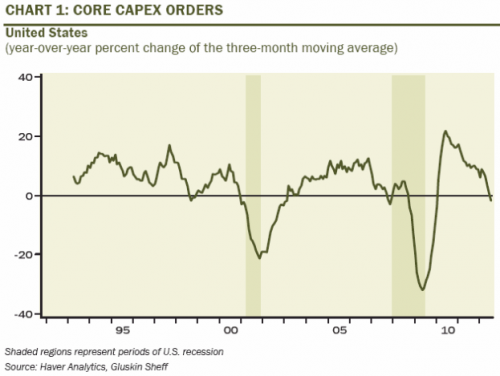
“Paul McCulley, the former legendary economist and fund manager at PIMCO, who was once being touted to join the Fed as a policymaker, told me last year at the Altegris-Mauldin conference, the YoY trend in the three-month moving average of core capex orders had for a long time been his preferred indicator of how the broader economy was going to fare a few quarters into the future. Well, if you are bullish on U.S. growth prospects over the near-term, I suggest you look at the chart below.

Notice how the YoY trend just sliced below the zero-line in July (to -1.7% from +1.1% in June).Only once in the past did this NOT tip the overall economy into recession and that was back in September 1998 when the Asian crisis was at its peak, LTCM had to be wound up and Russia defaulted … not exactly a pretty sign even if the recession was delayed for another two years.

In terms of sectors, it was order declines in machinery, electrical equipment and communications equipment that far outpaced gains in metals, autos, aircraft, and computers.”
Cullen Roche

Mr. Roche is the Founder of Orcam Financial Group, LLC. Orcam is a financial services firm offering research, private advisory, institutional consulting and educational services.

More Posts - Website

Follow Me:
TwitterLinkedIn

8 Comments

  1. adsanalytics says:

    Our three top recession indicators (after the jump below) aren’t flashing red quiet yet – economic activity is above the stall speed, markets-based pricing (barring Treasuries) are still relatively benign and the historical prob model is upbeat.

    http://www.adsanalytics.com/report.php?report=s-mrec

    J.S.

  2. Erik V says:

    Too bad the data set doesn’t go back further (I checked on FRED) but it does look like a nice indicator, clearing pointing to recession in the coming months.

  3. marparker says:

    What about early 90s recession? Or that recessionthat didnt happen around 2003? Thats 2 good signal and 3 misses.

  4. This paragraph from Rosenberg is a little statistically challenging to interpret but it gives a little more data for the above:

    http://thebagehotpost.blogspot.com/2012/08/why-paul-mcculley-would-be-shorting.html
    “The key leading indicator of business capital spending is the non-defense capital goods ex-aircraft (core capex) component, and it slid 3.4% in July on top of a 2.7% plunge in June for the worst back-to-back performance since December 2008-January 2009. These orders are down now in four of the past five months, and so far in Q3, the “build in” is a hugely negative -16.4% annualized tally and this follows on the heels of a -5.8% print in Q2. Now core capex shipments were flat in July, the softest reading in three months, but there is still enough statistical momentum being carried over from Q2 to keep the current trend running close to a +5.6% annual rate versus 5.4% in Q2″

  5. BHB says:

    Even worse is that consumer spending is turning negative, which drives capital spending. Another bad report at the end of the month will be even more evidence of a recession.

  6. Mountaineer Mountaineer says:

    I’ve used an excel version of this graph based on imported FRED data for awhile. If you have the slightest inclination to consider a Keynes/Kalecki investment-driven theory of the business cycle this chart should be a mainstay in your analysis. It alone could have kept many from making foolish recession calls in the summers of 2010 and 2011. Simply put, 10-15% yoy expansions in investment spending are not typically the stuff of recession.

  7. Rob says:

    A zero Hedge reference again?

    Can’t you find better sources of information????

  8. Andrew P says:

    If there is a recession, it probably won’t last long if Romney is President. Look who he is likely to appoint in Bernanke’s place.

    http://www.businessinsider.com/mitt-romney-greg-mankiw-2012-8

    He has advocated policies that would make Bernanke blush.

Contact Us:

Name:

Email:

Verification Image

Enter number from above: