
MORE ON ITALY’S IMPOSSIBLE DEBT REDUCTION….
Markets have been reassured in the last few weeks by big changes in Europe (mostly in leadership) that will do absolutely nothing to help fix the root cause of the Eurozone crisis. The truth is, the sovereign debt issue is here to stay. As I showed last week, the math just doesn’t work in Italy. The likelihood of growing out of this mess is virtually zero.
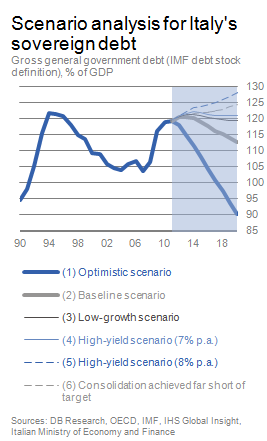
Over the weekend, Deutsche Bank published a brief note showing the potential paths of Italy’s debt. As you can see in the following analysis this is a problem that is not going away any time soon. In fact, in their baseline scenario the debt levels don’t improve from current levels for over 3 years! Via DB:
“But just how realistic are the chances of Italy’s being able to substantially and sustainably lower its chronically high debt level over the coming years? In the following we shall use a scenario approach to briefly analyse the sustainability of Italy’s sovereign debt. In doing so we shall project the potential curve of Italy’s gross general government debt in relation to GDP (according to the IMF definition of debt*) up to the year 2020 in six scenarios.
(1) In our optimistic scenario we build on the latest forecasts of the Italian finance minister up to 2014**, assuming that real GDP grows at an average of 1.1% p.a. over the next ten years. Furthermore, Italy succeeds in permanently raising its primary surplus (i.e. the budget balance before net interest payments) from -0.3% of GDP in 2010 to as much as +5.7% of GDP from 2014. Market interest rates, approximated in the following by the yield of 10Y Italian government bonds, come to hover at around 6% p.a. in the medium term. As a result of this, the nominal effective interest rate is assumed to rise gradually to roughly 5.6% by 2020 from around 3.5% in 2010.*** (2) In our more conservative baseline scenario, by contrast, the Italian economy only expands at an average of 0.9% p.a. over the next ten years. Similarly, we assume that the primary surplus inches up to merely 3.75% of GDP by 2016. Here, too, a market yield of 6% p.a. is assumed. In the next four scenarios we fundamentally adopt the same assumptions as in our baseline scenario; however, we vary the assumptions by altering individual variables, i.e. we perform a sensitivity analysis. (3) In our low-growth scenario we calculate the curve of government debt in the case when GDP growth falls appreciably short of expectations over the next ten years, averaging 0.4% per year. (4-5) In our two high-yield scenarios we analyse how a further increase in market rates to 7% and 8% p.a., respectively, would impact the sovereign debt. (6) Finally, we show the debt curve when the savings achieved fall far short of the target, i.e. the primary balance only increases to slightly over 2% of GDP by 2012 and remains at that level.****
Chart 1 shows the findings of our scenario analysis. While the debt ratio in the optimistic scenario noticeably declines to about 90% of GDP by 2020, it falls only slightly in our baseline scenario to just over 110% of GDP. In our low-growth scenario it would in fact remain unchanged at a high level. Whether Italy succeeds in substantially reducing its debt load (or whether this debt load perhaps even continues to increase) hinges largely on the assumptions made – this holds particularly for the future development of market interest rates. For example, on our assumption of an increase in the primary balance to +3.75% of GDP a medium-term reduction of debt falls out of reach from a market interest rate of around 7% per year. Given an even more significant increase in market rates, to say 8% p.a., the debt burden would climb to nearly 130% of GDP no less by 2020. In both cases there would cease to be any further grounds for long-term debt sustainability without additional measures (such as large-scale privatisations) and even more swingeing austerity programmes and/or the implementation of more decisive structural reforms that bolster potential growth.”


And with 10 years of contracting GDP?
exactly, and thats exactly what austerity will get them, esp when combined with a trade deficit…
6% on Italian debt is not any sort of equilibrium and cant stay here for a long time. I take issue with extending this assumption for 10 year. Either things spin out of control and the core decides to go its way (periphery can inflate away then) or ECB puts out a target on Italian yields subject to the government meeting certain criteria. ECB can issue a credible threat while letting markets do the work like Hildebrand. I think the latter is more likely.
That is the greates graph I’ve ever seen.
“Well folks on page 2 of my handout for the season in 2012 I’ve predicted the most likely scenerios for the upcoming season. We wil either go 0-10, 1-9, 2-8 , 3-7, 4-6…”(you get the idea)
That is the all time smartest graph. All I can say is when DB did layoffs they fired the wrong people.
This so called ‘analysis’ could have been created by almost anybody with some understanding of EXCEL, including reasonably bright high school pupils.
But the average salary of the ~70.000 DB employees worldwide is ~150.000€ per year. Unfortunately, this is no joke.
Brilliant and insightful!
And people pay money for this?
Debt is Good:
http://www.realnewspost.com/sa.php?a=53542
Hi Cullen,
One aspect about Italy which is rarely mentioned is household debt / GDP is relatively low (about 40% compared to USA of 100%). Check page 20 of the McKinsey report….
http://www.mckinsey.com/mgi/reports/freepass_pdfs/debt_and_deleveraging/debt_and_deleveraging_full_report.pdf
Is there an argument the private sector can increase net borrowings to compensate for the lower budget deficits / trade deficits.
Of course, the ECB has to get the interest rate right, and credit markets have to open up.
But from an MMT perspective, it’s a bit extreme to say the maths is “impossible”.
It all boils down to the accounting identity…
Net Government Spending MUST EQUAL Net Savings of Private Sector + Net Savings of Foreigners (inverse of balance of trade)
If Italians saved less and spent more (and on Italian goods and services) then government revenues will rise (and safety net payments will fall).
Of course if the private sector goes into negative net savings (increased indebtedness) it typically can sustain it. I don’t know of any historical episodes that didn’t end badly when the private sector net dis-saved for any length of time.
Pvt sector debt doesn’t really matter here. It’s the sovereign debt that matters. And Italy’s markets don’t particularly care about anything other than the fact that austerity and low growth will not help their debt crisis. If you think the math works in Italy then I am all ears. But even DB’s optimistic case is not very good. And that’s not even noting that it’s entirely unrealistic.
Cullen,
Thanks for your response.
By way of background, in Australia we ran budget surpluses from around 1999 to 2008. In fact, by 2008, net federal debt was almost zero (gross debt was less than 10% of GDP).
Yet Australia also runs significant external deficits too, and has done so since the 1970′s.
The sector balances tell us the private sector was dissaving. And that is exactly what happened. Household debt / GDP has increased significantly.
My point is, despite a fiscal surplus and an external deficit, the Australian economy has not had a recession for over 20 years. Simply because the private sector has increased debt (dissaved).
Of course this can not last forever – but Italian household debt is very low.
So the question is – Can the same dynamic occur in Italy? That is, higher household debt to compensate for external deficits and fiscal surplus balances?
Disclaimer: I am short Italian equities. But this one issue keeps me awake at night.
Italy averaged a 1% growth rate during the 2000s. I don’t see how anyone could possibly expect them to grow at rates much higher than that even if their pvt sector goes massively into debt (a long shot estimate in my opinion)…..
$ per annum growth? Yes – with zero population growth – equivalent to 3% for a Country like Australia or the US.
Is there perhaps an asset bubble in Australia at the same time, for example Real Estate? Given sound lending standards the capacity of the private sector to rack up debt without assets backing it should be quite limited.
Type “asset bubble” into google and you will find there is supposedly some type of bubble in every corner of the planet.
Australian housing is NOT experiencing a bubble because the factors of production are not earning excessive profits (for example, our listed builders / developers / land owners are trading way below book value and a barely make any profits).
This is where people who do not understand MMT get confused on Australia. We have huge household debt (90% of GDP), because until recently we had zero government debt and a large external deficit – even with the mining boom. It is not related to housing.
I’m not saying high household debt is sustainable – but it is a factor when you think about Italy and its relatively low household debt.