
Home » Most Recent Stories

NFP REPORT SAYS LOW INFLATION….

4 March 2011 by Cullen Roche 42 Comments

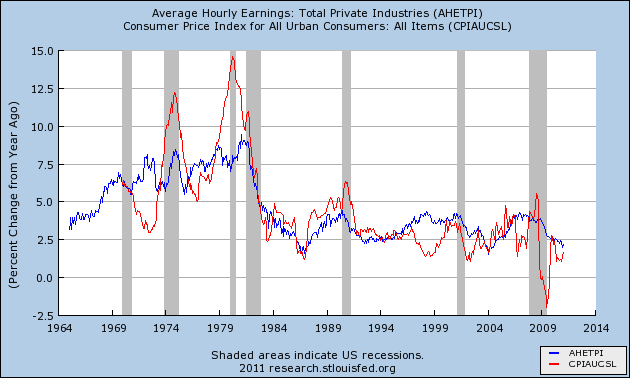
Average hourly earnings were flat in this morning’s non-farm payrolls report.  While we are seeing some sustained income growth it’s highly unlikely that we can see sustained high levels of inflation without a coinciding surge in wages.  Wages are at roughly 2.5% on a year over year basis.  You can see the very high correlation between inflation and hourly earnings in the following chart.  Despite surging commodities the ability to pass on costs remains weak at best.  Core inflation should remain below the historical average levels in 2011.  The more likely outcome from higher commodity costs is a reallocation of spending, slower economic growth and margin compression.
Disclosures - Unless otherwise noted, authors have no positions in any securities mentioned and readers should never consider this to be investment advice. Always consult your financial advisor before acting on any ideas. Comments Guideline - Readers who denigrate authors or other readers will be banned without warning. This site does not tolerate any sort of reader abuse. The goal of this site is to create an environment that is conducive to learning and better understanding of the monetary system and the investment world. We expect readers to behave maturely and responsibly. We welcome and encourage intense and intelligent discourse, but the site adheres to a strict 1 strike policy. While it is your right to speak freely, it is not your right to behave childishly. Above all else, please enjoy the site. It is intended to be used as an educational tool and we hope the intelligent and mature debate will further that purpose. We hope readers will make an effort to respect that goal. Comments with excessive linking or foul language will be moderated before posting.
Comments
  • JH

    Pay no attention to the man behind the curtain, or what you are paying for goods and services, or anything else that is real and tangible.
    Believe instead our statistics and charts, and lies.
    What we tell you is the truth.
    Keep repeating what we tell you is the truth, what you witness is a lie.

    • Look at a chart of incomes and CPI and then answer me this: is the govt lying about how much money we make just so they can lie about inflation? That’s the dumbest thing I have ever heard. This idea that govt data is lies is pure BS. You can’t have it both ways. They aren’t telling us we make no money just so they can tell us inflation is low….That would be beyond stupid…

      • JH

        People know what they are paying for the things they buy.
        It is costing them more to fill their gas tanks.
        It is costing them more to fill their shopping carts.
        It is costing them more to pay their utility bills.
        It is costing them more for insurance.
        It is costing them more for their Auto registrations.
        It is costing them more for traffic/parking tickets.
        To deny any of that is just stupid.
        Believe what ever floats your boat, but I know what I am paying.

        • People also know what they earn. If you earn less and have higher costs then you spend less on all items. That’s why the correlation between CPI and wages are so tight. So your theory posits that the govt is lying about both. I don’t see how that helps their supposed campaign to make us all feel better about our lives. The truth is, the US economy is in a rut. It’s not due to hyperinflation. And it’s not due to collapsing industry. It just is what it is. But one thing it’s not is a big conspiracy. As wages show, things stink. And that means the CPI is low. No conspiracy there. Just reality.

          • first

            Salaries don’t have to go up in order to have inflation just as they can go up with out inflation. If Productivity improves salary could go up with out inflation. If the government produced bombs that end up in the ocean this is negative production that no one will consumes but it will maintain the same pay roll to produce the bombs and those same salaries will be chasing only goods that can be consume therefore pushing prices upwards.

            Increase salaries does not change the money in circulation it displaces it. Actually it the opposite salary increase will generally come after inflation starts as pressure from labor to compensate inflation.

            • Sure, productivity and output can decline and result in inflation. I’ve never argued otherwise.

              • first

                Its like my chocolate bar. Same price less chocolate. But I appreciate it more.

                • Yeah, it’s not a great example, but chocolate bars were a lot more boring 50 years ago…they might have been the same size and cost less, but you get my point.

                  • first

                    Cullen.

                    During the recession I also have smoke sardines a noon $1,05 per box. Last week $1.25 and God knows they are just as boring as 50 years ago. Haaaaaaaaaa

                    • Let’s be honest though. You can I are probably the only people on the planet who enjoy smoked sardines!

                      Seriously though – there’s certainly some level of food inflation out there. I am not denying it.

          • JH

            For who, are wages are going up? Is it the common working people? NO, it is the people at the top of the food chain.
            This can easily be proven by the ever increasing spread in wages and wealth.
            Just because the wealthy are getting wealthier, and that is reflected in overall income stats, does not mean there is no inflation, or that the common person is keeping up.
            A banker or a stock broker getting a multi million dollar bonus does nothing for the unemployed carpenter who is now driving a taxi.

  • RB

    I agree that core will remain low, but does it really even matter? Now that oil has a fundamental story for speculators to run with look out. It’s the one commodity price that will always be passed on.

    • It matters enormously to policy. What the Fed should do is keep rates low, end QE and tell Congress to keep the fiscal policy coming. The high inflation fear mongering feeds into raising rates and bringing on austerity. That is the exact wrong policy response in a balance sheet recession.

      • B Ferro

        If, as you say, monetary policy is a blunt, largely ineffective tool in a balance sheet recession, why advocate the Fed keeping rates low, ostensibly through rate targeting instead of QE?

        The reality of the issue is that rates should be noticeably higher. I’m not talking Taylor Rule either, just common sense. In a post credit collapse economy, risk aversion by capital lenders renders the rate mechanism useless. My credit is great and I’m sure many other readers can say the same, yet over the past two years I’ve gotten countless letters from banks explaining rates on my credit cards are going higher.

        You know this, but I’ll just restate the obvious – we are here because of low, specifically, negative real rates over a decade. China is here now for the same reason.

        Either way – we need to get the Fed out of rate targeting and all things not related to containing inflation for once and all.

        How scary is this idea though???…the Fed, in response to the oil price surge, justifies the creation of an even bigger QE3 program or starts targeting even lower real rates on the longe end? What if this becomes a self-reinforcing death spiral. I don’t think such a response is beyond what their text books would tell them to do in that scenario…

        • The problem with raising rates is that it will put pressure on debtors. That doesn’t help when debts are too high. QE2 is not working. They are not controlling rates because the policy is implemented incorrectly. It’s entirely different from the way they control short rates. So it was flawed from the beginning. It’s clearly not having its targeted response of helping debtors. It’s helping speculators, but we don’t need to help speculators.

          I disagree that you can blame rates for the credit bubble. I think poor regulation and our financialized economy is to blame. An affordable house was not the cause. The cause was not forcing homeowners to place down payments. The cause was allowing anyone and everyone to get a no interest loan. The derivatives market is out of control because they don’t have to post collateral of OTC’s. Again, that’s a regulatory problem. That’s not about rates. That’s about regulation and sheer common sense. Don’t borrow what you can’t afford…..This model of allowing banks and markets to regulate themselves has broken down. It does not work. And the idea that anyone still believes it works is preposterous. Of course, the Fed has contributed to this all by being asleep at the wheel, advocating speculation, encouraging deregulation, allowing too bigger to fail, etc.

          I totally agree with you on getting the Fed out of the rate setting game. I advocate a permanent 0% rate. Let the market decide the true cost a a 30 year mortgage. And with proper regulation there is no reason to believe that low rates would lead to malfeasance.

          Either way, in the current environment we should continue to see relatively muted demand for credit. If fiscal policy falls off the cliff I guarantee you the economy will contract and we’ll venture back towards 2008….

          • In short, changing rates just shuffles interest payments. Savers get more, debtors get crunched. What’s the net effect? If it doesn’t influence levels of borrowing (unlikely during a balance sheet recession) then who really cares what they do with rates….The point is, it shouldn’t be the focus of policy.

          • B Ferro

            I view unsustainably low rates as the grease for the wheels of political stupidity (de-regulation and all the other things you list). So, we differ on that. What we don’t differ on most likely is the complete vacuum of leadership at nearly every level of gov’t and in every agency. No collective willpower to have vision and change policy for the better, not for ideological reasons.

            Also, I have real wage growth much lower than the 2.5% you have in the post – much closer to 1% on a YoY basis and falling given the recent oil price increase…not good for consumption.

            • Right. The biggest problem with the leadership is that they have no idea how things work. So the theories of Milton rule the day, the banks run wild, we deregulate everything, convince ourselves that the pvt sector never needs public sector help (even though they are, by definition, co-dependent), convince ourselves that our govt can go bankrupt, and what do you get? America 2011. We need a dramatic overhaul of just about everything…

          • TPC,

            I have been reading your site for a long time. So first let me say ‘Thank You’. The amount of work and dedication you put into the site and into answering questions and engaging in conversation in the comments is incredible.

            I wanted to say that that this is probably one of the smartest comments I have ever read. It’s nothing revolutionary (you have been saying parts comment for months/years) but I like how succinct it is.

            I have been reading Bill Mitchell’s work regarding the false thinking of ‘natural/neutral’ interest rates and that the natural rate of interest is 0. It took me a lot of thinking about it to accept the idea. But when you consider the argument against the traditional ‘crowding out’ idea based on government spending that is part of the common economic thinking, and you realize that Federal spending (money creation) in excess of Federal taxation (money destruction) is the private sector net saving of Federal Reserve Notes + the trade deficit (which is also the way that net bank reserves are added to the system, which drives down interest rates), then it becomes a logical extension based on how our monetary system works that short term interest rates want to go to zero all by themselves. We don’t need the Fed to set or manipulate them to do so.

            Ideally, what this would result in is the discontinuation of the Government Bond market. With interest rates naturally going to zero, there is no reason to issue bonds as a mechanism to drain reserves and to perform all of the unnecessary complexity with interest rate targeting, coordination with the PDs, Treasury desk, Fed Trading desk for the size of the auction, yadda, yadda. Everybody would be disabused of the false notion that Treasury bonds actually fund anything anymore. We could just have a much simpler system.

            …. But, I am not holding my breath. The Government bond market is an industry, and the banking system has not desire to get rid of it, even for the sake of transparency.

            But to your other point, I completely agree. The single primary cause of the credit and housing bubbles were not 0% rates, but lax lending standards. This has been documented many places (including here at Pragcap). With decent regulations and lending standards, that were actually enforced, there is no reason that the banking industry should have allowed a bubble to form even with 0% rates.

            So, as a wish list (that will likely never happen):
            - The Fed should abolish the overnight rate. Let it float to where it wants to go (which is zero)
            - The US Treasury should stop issuing bonds.
            - Lending standards should be tightened and enforced (especially with regard to down payments)
            - Remove reserve requirements (they are completely unnecessary) for banks
            - Enforce capital requirements for banks (this would have prevented so many problems)
            - Reinstate Glass-Steagall
            - Allow the market to determine the rates for mortgages / car loans / etc.
            - Stop supporting Too Big Too Fail Policies

            Others, to be sure, but that would be a good start. :)

          • Scott

            I think it’s a mistake to ignore low rates or “cheap money” in the formation of asset bubbles. I’m not sure that it’s possible for them to form or be sustained without “too much money chasing too few opportunities”, and cheap capital is usually part and parcel of too much money. I can tell you that in my business (private equity), cheap debt (cost and covenants) being made very available by lenders enabled buyers to apply huge debt to EBITDA multiples and drove purchase multiples p big time. The lenders disappeared in late 2008 and those that did lend charged a ton. Values crashed. Banks got back in the game in mid-2009, especially to the mega-fund guys. Big debt to EBITDA multiples, light covenants, low rates all over again…all made possible by rates being held artificially low, below market equilibrium. Lending ratios and purchase multiples are beginning to approach pre-crash levels. Valuations are headed up in lockstep on marginally better operating performance. Artificially low rates change the risk/reward equation and enable sub-optimal behavior. Why wouldn’t they? If KKR or Apollo can use someone else’s cheap dough to lever up an asset to high levels to juice returns, they will.

            I agree that smarter regulation is an important part of the fix, but I don’t think it’s right to ignore the availability of cheap capital as an important component of asset bubble formation.

      • RB

        How would low rates help tame the commodity bubble?

        • Ending QE2 would be a big help in taming the commodity bubble. I don’t see low rates as the direct cause of the commodity bubble. I think it’s more to do with China, their insane explosion in M2 and some level of speculation in financial markets.

          • RB

            I agree on all of your points, but you have to admit US interest rate policy is a not insignificant factor. When interest rates are as low as they are, for as long as they have been, capital will always seek higher returns elsewhere. It has always been this way. My fear is that with all other commodity prices having run so far already, that capital has moved on to chasing oil now that there is a nice fundamental backdrop to rally around.

          • JNH

            All your points I agree with and have been for a long time. However, low rates can lead to a lot of speculation, hasn’t there been a run on low rate credit by hedge funds, some estimate at 295B, who in turn plow it back into commodities and the equity markets.

            • Doesn’t provide a great economic benefit, but can that be stopped? If it’s not the US they borrow cheaply from then it’s some foreign bank. We can’t eliminate and we shouldn’t eliminate speculation. But it should be regulated in a manner that it can’t cause widespread economic turmoil. If some pvt hedge fund wants to lever up on copper futures then fine. If they implode, screw them. Who cares. What should never be allowed is having JPM levered up to the hilt in an attempt to maximize profits while also putting a systemically critical institution at risk of taking us all down with it.

              I don’t think low rates are the inherent problem. It’s sort of the old guns don’t kill people thinking. But if you let people misuse the system then it’s guaranteed to get ugly….

          • Mediocritas

            Regarding M2, here’s a nice chart that compares M2 for China, USA and Europe:

            http://static.seekingalpha.com/uploads/2011/2/10/268621-12973608109818-Erwan-Mahe_origin.png

            Shhhh, don’t tell ZeroHedge!

  • dimm Dimm

    TPC, I admire your patience with the tin foil cap crowd.

  • Miller

    What does the spike in oil prices mean for precious metals? I suppose that their price will drop once investors figure out that we’re not heading toward inflation.

  • bfuruta

    “Despite surging commodities the ability to pass on costs remains weak at best. Core inflation should remain below the historical average levels in 2011. The more likely outcome from higher commodity costs is a reallocation of spending, slower economic growth and margin compression.”

    Well said. I think some people are too focused on the most salient food and energy prices.

  • John

    This is a gross oversimplification, to be sure, but I tend to distill it all down to supply and demand. Today we have far more people on this planet competing for the resources that, in the past, were largely monopolized by the West. Given the explosive growth of emerging markets, it makes sense that supplies are increasing more slowly than demand. Wages and interest rates will have an effect on nominal prices, but if more people are trying to eat the same pie, whether prices go up due to inflation or prices go down due to deflation, the real cost of a piece of pie will go up and most people will be eating less. IMHO, of course.

  • AWF

    Cost-Push Inflation
    Inflation caused by rising costs of production. For example, if the price of a barrel of oil rises significantly, this could cause fuel prices to increase which, in turn, increases costs for transportation of food, tools, and other goods, which can cause some level of inflation across an economy.

  • Scott

    TPC

    Quick question…when you make statements regarding correlation on charts, is this based on running the math on the raw data or are you just eye-balling it? I’m not challenging you on the chart above (I happen to agree with the logic), I’m just trying to contextualize your statement.

    Thanks.

    • I have not run a regression or anything if that what you’re wondering, but it’s no big debate that inflation and wage growth would tend to correlate highly….

  • mad_dom

    Notice how the deflationists….. errr excuse me… anti-inflationists, always like to point out core inflation? Who cares? Poor people can’t even afford to buy gas and food so who cares if “core” inflation is low. The more gas and food rise, the more your cost of living goes up, especially for poor people who are screwed over. “Core” inflation being low is good for rich people who get to buy more discretionary stuff. But too bad for the rest of the population.

    • First of all, food prices in the USA are not rising that much. Check the facts. I don’t know where people get this idea that food inflation is anything like energy price inflation. That’s just flat out wrong.

      http://research.stlouisfed.org/fred2/graph/?chart_type=line&s1id=CPIUFDNS&s1transformation=pc1

      Energy costs are high. No doubt. It hurts. I am not arguing that. But for every price you cherry pick (such as gas) there are plenty of others that aren’t rising or are declining.

      • mad_dom

        The “facts” tells me there’s no inflation yet reality tells me there is.

        BTW, many companies are reducing the size of their products. Instead of raising prices, they reduce the size of the servings. Stealth inflation right there. Notice there’s a hedonic adjustment to lower prices when the quality of a product is better but there’s no adjustment upwards when the product is reduced in size?

        In terms of “cherry picking”, I only need to “cherry pick” important stuff that people need like energy, food, health insurance, and education and ignore everything else. Because quite frankly everything else is irrelevent unless you are rich and want to buy multiple cars and houses.

  • JNH

    It may just feel like inflation is rampant, because in the last 3 years when oil spiked down, so did a lot of related cost as well as demand for almost everything. 08 and 09 were great, cost of everything took a spike down,fixed income was paying a fairly decent rate, damn those were the good old days. We should have more recession.

  • first

    Inflation is not about looking at the past two years. Its about what those charts will look like in a year or so. Inflation in definitively increasing and loans have risen at a 6.1% annualized pace. The present M2 charts still reflect the zero growth in commercial and industrial loans of the last two year but this will change soon as banks are now expanding their balance sheets and businesses is finally starting to borrow. Let look at the same charts next year.