
Home » Most Recent Stories

ON THE PROSPECTS OF QE3

28 April 2011 by Cullen Roche 69 Comments

In a research report this morning Liz Ann Sonders of Charles Schwab discussed the prospects of QE3:

“… what about QE3?
Bernanke didn’t quite close the door on QE3, but made it seem much less likely, noting the “trade-offs” are getting “less attractive” and the need to keep “inflation under control.” This suggests that even if QE3′s not off the table, the bar is set pretty high for its initiation.

That’s great news to us, having believed for some time that the risks of another round of quantitative easing greatly outweigh the benefits.”

Ben Bernanke showed his cards yesterday and it looks like he’s leaning towards completing QE2 and is hesitant to consider QE3.  This is a welcome development for the US economy.  Despite persistent chatter about QE3 the evidence is beginning to show that QE2 was not the panacea that so many expected it to be.  In fact, I have yet to see one good argument proving that QE2 did anything positive.  The final nail in the coffin should be this morning’s GDP figures for Q1.  Real GDP, at just 1.8%, has been on the decline ever since the program started!
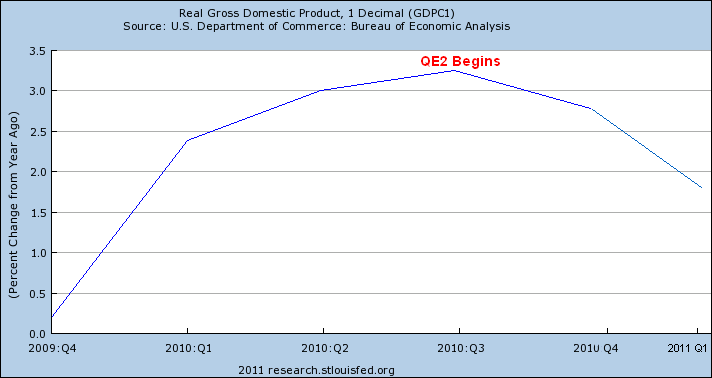
The Fed has attempted to deny that QE2 had any damaging impact on the US economy.  And while that might be up for debate, the mere fact that we are having a debate over it should be enough for the Fed to stop with “experimental” policies.  Sometimes, it’s best just to cut your losses.   The bottom line is that QE is not helping the US economy at this juncture according to the growth data.  In fact, this program cannot help the US economy at this juncture.  This is crystal clear to anyone who understands how a modern banking system works.  As I’ve previously discussed, this program was destined to fail from the beginning due to its focus on size and not price.  The very thought of QE3 should be absurd to anyone who is objectively studying the transmission mechanism through which QE works and its clear results from the last 8 months.

If the Fed were to attempt to correct its errors in implementation via QE3 (by targeting price) I fear the cries over “debt monetization” and “money printing” would be even worse than they were during QE2.  Despite their arguments to the contrary, it’s clear to anyone with a functioning set of eyes that the Fed has sparked a massive boom in speculative commodity bets.  This has been a direct contributor to the slow-down in real GDP.  Were the markets to begin pricing in QE3 I fear this would only exacerbate the current situation.  “Transitory” inflation could become something worse.  Because of that, I believe it is best that we simply step back from the operating table and accept the fact that this is not the time to be experimenting with the livelihoods of American citizens.

Cullen Roche

Cullen Roche

Bio - Coming Soon.

More Posts - Website

Follow Me:
TwitterYouTube

Disclosures - Unless otherwise noted, authors have no positions in any securities mentioned and readers should never consider this to be investment advice. Always consult your financial advisor before acting on any ideas. Comments Guideline - Readers who denigrate authors or other readers will be banned without warning. This site does not tolerate any sort of reader abuse. The goal of this site is to create an environment that is conducive to learning and better understanding of the monetary system and the investment world. We expect readers to behave maturely and responsibly. We welcome and encourage intense and intelligent discourse, but the site adheres to a strict 1 strike policy. While it is your right to speak freely, it is not your right to behave childishly. Above all else, please enjoy the site. It is intended to be used as an educational tool and we hope the intelligent and mature debate will further that purpose. We hope readers will make an effort to respect that goal. Comments with excessive linking or foul language will be moderated before posting.
Comments
  • Dennis

    I could not disagree more. Bernanke said that it was never intended to be a panacea for the economy, but to help support recovery. According to Ben:

    “I do believe that the second round of securities purchases was effective…We saw that first in the financial markets. The way monetary policy always works is by easing financial conditions. We saw increases in stock prices. We saw reduced spreads in credit markets. We saw reduced volatility. We saw all the changes in financial markets and quite significant changes one would expect if one were doing a normal easing of policy regarding the federal funds rate.”

    While the economic recovery continues, Bernanke wants to maintain the central bank’s record stimulus initiative, especially while unemployment is slow to improve. So far, the central bank has purchased more than $2 trillion of U.S. Treasury and mortgage bonds to pump money into the economy.

    Further Ben explained that this level of Fed “owned” treasuries was going to stay the same for the time being. In other words, as some of these bonds mature, he will use the funds to “buy” more. Becuase of this our interest payments on the “National Debt” will be less going forward. The long term effect is good for the tax payer because we have these stupid laws that say the Uncle Sam’s deficit spending must be covered by taxes or loans. He cannot add funds into the economy by law. MMT says that we are not using the full power of our monetary system because of this.

    So, as I see it this is a way around that law. Uncle Sam has added a lot of money into the system. $2 trillion is now not covered by Treasuries that Uncle Sam must pay interest on. (The Fed gives the US back the interest and when the bonds mature, Uncle Sam already “owns” those bonds and would, in effect, be buying them from itself.) Since 60% or more of the world’s money is US dollars, so far this is NOT the cause of the inflation we are seeing. Cullen, you have explained very well that the world’s supply of US dollars has not increased, thus the only mechanism of real inflation is not QE2. Your citation to the BOJ report supports my position more than yours. You cite the paragarph on QE2 and not the rest of the paper which says that we have a combination of factors at work here that are impacting inflation, not JUST QE2!

    What we are doing in my opinion is explained by Dr. Koo:
    Richard C. Koo: “Cherry-blossom-drinking economics” “This appellation came from the old tale of two brothers who brought a barrel of sake to sell to revelers drinking under the cherry trees, but ended up consuming the entire cask themselves, each on in turn charging his brother for a cup of rice wine, then using the proceeds to buy a cup for himself.”

    The brothers, the Fed and Uncle Sam, are enjoying a great afternoon, working the ideas that underlie MMT and putting needed funds into the economy without adding to the National Debt (http://en.wikipedia.org/wiki/Chartalism), and Congress can do nothing about it.

    • I didn’t say that Bernanke said it was going to be a panacea.

      QE doesn’t “pump money into the economy”. That’s just not how it works. Look at the money supply numbers. http://pragcap.com/the-exploding-u-s-money-supply-myth

      QE has NOTHING to do with govt deficit spending. http://pragcap.com/pomo-flip-matter

      I don’t think you’ve quite understood the transmission mechanism here Dennis.

    • George H

      You sounded like you were just out of “Dance with Benny”. We know who will quote what Bernanke said as the definite answer.

      “Cherry-blossom-drinking economics” between the Fed and the Treasury can’t possibly be something productive for the economy, can it?

    • Dan Dell

      The only thing I can say with certainty is that you got through the first 5 pages of Koos introduction

      • Dennis

        OK you’re right about that. I was just trying to make the point that the Fed and the Treasury have been doing what I think is the right thing at this time, adding funds to the economy. It seems to me they are doing it under Koo’s cherry trees. I don’t know if this is a good analogy or not.

  • prescient11

    The real question is whether the economy can handle the debt service come 2015 (whatever that is).

    I would say that is going to be difficult, and some type of default will eventually happen.

    Which is why the biggest bubble of them all is now in jeopardy.

    • Pierce Inverarity Somnolento

      What debt service? Private sector or public? ‘Cause if it’s the latter, you haven’t been paying attention to what Cullen explains very clearly everywhere on this site.

      • prescient11

        excuse me? tell me how i haven’t been paying attention.

        • Pierce Inverarity Somnolento

          That’s why I asked a question. There is no concern whatsoever about the Federal govn’t servicing its debt. Period. If you’re referring to corporations or municipalities, it’s a different story.

          • prescient11

            Are you frigging kidding me? Apply a 4-6% rate to the current debt service and see what happens there sparky.

            Yes, of course the government could just “print” that money and everything would be hunky dorey.

            If you think that I have a bridge to sell you. The “helicopter” will only work as a bargaining chip with our creditors until it doesn’t.

            • Pierce Inverarity Somnolento

              Cullen, can you step in here please.

              • Dennis

                This is exactly what I’m talking about. Our government can always pay for this, but the public is being told by Paul et al., that our kids are on the hook for this, not Uncle Sam. Uncle Sam is out of control and must be stopped. Hello?

            • What’s gonna cause the rate change? You can’t just say X+2=6 without telling us what X is and how you obtain it….

            • Adam

              I don’t even think you understand what you’re getting hysterical over. Let’s think this through…

              For easy math lets just assume that the outstanding debt is $10T. At 4% interest that’s $400B. Not a small number but it still doesn’t tell you much. Is $400B in interest payments too much stimulus for the economy in 2016? Don’t know. And considering this is $400B in bond interest is it getting spend, because that’s what really matters. If it’s just getting “saved” then its not fueling inflation. If it is getting spend, what’s the economic output gap? Or is there not one? You don’t know at this time. Even if it is inflationary, that’s not something that can’t be dealt with in 2016.

  • LVG

    Cullen, am I reading this wrong or am I getting a hint hyperinflation fear in that last sentence?

    • I am not remotely concerned about hyperinflation, but it’s clear that the Fed is having a damaging impact on the psychology of market participants. My fear is that they would exacerbate this impact.

  • Darren

    If speculative activity is fueled by the psychological results of QE2,wouldn’t a QE3 that targets price levels also have the same effect?

    • That would be my concern. The point is, had they truly wanted to pin rates the Fed could have done it during QE2 and it might have had a meaningful impact on the economy. The problem now is that inflation expectations have surged and we’re walking a rather fine line with regards to inflation. So yes, I think there could be a further damaging psychological impact should the Fed go on with QE3 (even if it were implemented properly).

      • Darren

        What would you suggest the Fed do then if say, Congress passed short term contractionary fiscal policy and oil prices continue to stay above 120 a barrel throughout 2011.

  • Jim

    This is not the graph I get when I go to FRED. How did you get what you got? I got:

    http://research.stlouisfed.org/fred2/graph/?s1id=GDPC1#

    Jim.

  • Dennis

    I do understand that what the Fed does is downstream from the deficit spending. Uncle Sam’s budget is about $1.3 trillion this year. The money was put into the economy by Uncle Sam; the Fed has professed no control over that. But they are soaking up the Treasuries and other governement “owned” junk bonds from Fanny and Fred, to the tune of $2 trillion so far.

    You are just holding tight to your semantics, I get it.

    • There’s nothing semantic about it. You just don’t understand it. The Fed is not enabling the deficit spending. They are not “soaking up” anything. Your argument is the same one many people make – that there wouldn’t have been buyers of those bonds without the Fed. That’s nonsense. Bond auctions are reserve drains that can always be executed by the PD’s because the reserves are simply tracked down and extracted from the economy.

      There’s absolutely nothing semantic about it. I would suggest you read the following link. It will dispel the myths you are propagating. http://pragcap.com/n-y-fed-explains-government-spends-issues-bonds

    • Dennis

      I also agree with this totally:
      “QE doesn’t “pump money into the economy”. That’s just not how it works. Look at the money supply numbers. http://pragcap.com/the-exploding-u-s-money-supply-myth
      I have read this many times. The reason for this is that the world lost a lot of US money in 2008. I’m so glad that the excess Uncle Sam spending is not exploding or even diluting the world’s money supply. Other folks are terrified by this:

      “Even though the central bank seemed unconcerned about inflation, investors acted otherwise and pushed up inflation-hedge investments gold and silver after Bernanke spoke. Gold rose $13.60 an ounce, and closed at $1,517.10. Silver climbed 90.8 cents and ended the day at $45.958 an ounce.

      Investors have flocked to gold and silver as the U.S. dollar continues slipping. After the Fed statement the U.S. Dollar Index fell to 73.284, its lowest level since August 2008.”

      The is no question about the “damaging psychological impact”. I’m not concerned about the psychos that don’t understand MMT. If they want to save their money in the form of gold and sliver, I don’t care. It is a kind of waste though, and dangerous because the price is totally controlled by computer controlled speculation. Those folks could be enjoying life and going a trip, buying a new car, but instead they get out their gold coins and foundle them. To each his own I guess.

  • Nard1

    I apologize for not taking the time to dig through older posts, but wasn’t your position that China and its policies were more the cause for the commodity boom than QE2? Now you pin the spark of boom in spec commodity bets on the Fed. Has something changed?

    On subject of inflation/deflation, does anyone else stay awake at night and kick around the variant notion that China is the mother of all Potemkin Villages? And if so, how such a development impacts the longer term view of things? Maybe it’s just me – pass the Ambien.

    Tremendous thanks for your efforts here Cullen.

    • My argument with regards to China has been that you can’t blame “money printing” on the fed. The money supply just hasn’t grown at a high pace in the USA. In China, however, it has. So, if you want to blame “money printing” blame China and not the USA. I’ve never denied that the Fed’s action would alter psychology and I think it’s now pretty clear that this policy is dramatically altering psychology….

      • Dimm

        Not really:
        http://pragcap.com/paul-krugman-confused
        Dimm:
        “Actually he is for QE DESPITE or even BECAUSE it does not do anything.
        He says the central bank can scare inflation if it credibly promises to be irresponsible, by committing to incremental expansion of the monetary base no matter the current and future state of the economy.”
        TPC: I get his argument. I just think it’s nonsense.

        • Krugman said QE could create demand pull inflation. That has been hysterically wrong. Instead, it’s creating margin compression and something more akin to stagflation. Has the overall leakage into core inflation been higher than I suspected? Sure, but not by much. You’re conflating sustainable inflation (due to real demand and real economic growth) with short-term psychological impacts similar to 2008 and the speculative boom caused by oil prices. That’s not demand pull inflation and it’s not sustainable. I heard the same stuff in 2008 about how the inflation was “real”. No it wasn’t. It was just an energy surge….The same thing is happening now and I’ve been talking about the likelihood of higher inflation since well before the beginning of this year. I’ve been pretty vocal about the likelihood of energy prices peaking this summer along with CPI due to QE2, speculation and seasonal trends in energy….

          If there is one thing I agree with BB about it is that much of the current inflation is transitory.

      • Dimm

        Same post:
        TPC:
        “As I mentioned above, operationally, he is making no sense. He says the actual operation of QE will not work, but that expectations of QE could work.
        []
        It’s sheer nonsense.

        • And that was 100% accurate. You’re saying that the commodity speculation is somehow beneficial to the economy. Please explain to me how real GDP of 1.8% proves your point….It proves Krugman wrong in my opinion. QE was not a good decision. It did not help growth and the impact on inflation expectations has been quite damaging. Krugman thought QE and its impact on expectations would cause a surge in spending and real economic activity. All its done is compress economic growth because the commodity impact has been substantially greater than the consumer impact….

        • Dimm,

          Do you honestly believe the expectations due to QE have been beneficial? Even PK says the expectations effect have been benign. http://krugman.blogs.nytimes.com/2011/04/24/qe2-disappointment-wonkish/

          The expectations effect I have focused on consistently has been with regards to destructive speculation and the likelihood of growth compression. That turned out to be spot on as the hit to CPI is dinging real GDP. You’re only right if you think 1.8% is higher than 3.5%….

          • Dimm

            I totally agree with you that QE2 is destructive.

            My point was that you did deny that the Fed actions can alter psychology.

            Pretty much all equate QE and printing money, therefore they alter their inflation expectations which alters the market.

            You saw QE for what it is – a monetary non-event, thus refusing to accept that it can alter expectations. I guess you did not think so many are so ignorant.

            • Come on Dimm. You know that hasn’t been my position at all. In September I specifcally stated that the Fed could alter psychology:

              If QE has had any impact in recent weeks it has been 100% psychological. How do we know? BECAUSE THE PROGRAM HASN’T EVEN STARTED YET! How can anyone say that QE2 is driving the market higher when we know for a fact that QE2 is only having a psychological impact? In other words, investors have been readjusting portfolios in recent weeks on better than expected news and EXPECTATIONS that QE2 is some sort of wonder drug. I’ve argued that this is misguided and based on misconceptions that QE is inflationary (a misconception that a sitting FOMC member has finally admitted).

              So, the impacts from QE have been mostly psychological and not fundamental. And the few psychological impacts (wealth effect and higher commodity prices) appear to be having a negative effect on the economy. Anyone who thinks that I believe Fed policy has no impact on markets is really missing a huge portion of the focus of my work. I did an entire case study in October on the effects of QE and the markets.

              I’ve covered these attacks here. http://pragcap.com/discussion-forum?mingleforumaction=viewtopic&t=45

              I know there are lots of nuances in this stuff, but I have been very consistent in my arguments about QE….QE has had no real fundamental impact on the markets or commodities. Instead, it has caused mass speculation and negative overall impacts on the economy….Did I underestimate the extent to which this policy would impact trading and the markets? Yes. Absolutely. But I never said it wouldn’t have any impact. I said it would have no real impact on the money supply and real economy and that actually turned out to be wrong. It had a negative impact on the economy….

    • Adam

      Nard, anyone who wants to understand what’s going on with China economically should be reading Michael Pettis (http://mpettis.com/). While he doesn’t speak MMT (I don’t think), he completely understand the flow of monies and sectoral balances.

      China is 1970′s 1980′s Japan on steroids. They subsidize their export industries under the fallacy that export surpluses are a good thing. In the mean time all that “savings” in US dollars (as reserves) is money they are depriving their citizens of as income. They are not likely to ever get it back – it’s dead weight loss in economic terms.

      Anyhow, spend some time on Mikes site and don’t use the Google links, they’ll only sell you Viagra. I’ve e-mailed him about this several times but nothing seems to get fixed.

  • I find it hilarious that guys of your mental caliber could witness the monetary inflation of the last 25 years and suddenly decry price increases as “speculative” did you know that producers in 1996 were recieving the same price in nominal dollars for cattle as in the 1970′s If those prices do not increase with monetary supply increases we will all starve. I wonder why we have been losing cattle operations for the last 15 years…..I wonder why the cattle numbers are lower than in the 1950′s …..I am using cattle because it is a market that I participate in and am familiar with but you could paste in any “commodity” and the same fundamentals are there…….this has been a long time coming but thank god its here maybe the producers of all our wealth will not go broke.

  • Dennis

    We are totally on the same page here: “THE N.Y. FED EXPLAINS HOW THE GOVERNMENT SPENDS FIRST AND ISSUES BONDS LATER”. China does the exact same thing, except the banks are part of the governement. They don’t have a “National Debt” — which is my point. The American people are terrified by the size of this debt because of the interest owed on this. Tell me that QE2, and the $2 trillion that the Fed put on its books, and the low funds rate on the Treasuries (also controlled by the Fed), did not lower our “interest payments” on the 2010 debt and now the 2011 debt. I know that you will say that our taxes do not have anything to do with paying the interest on the debt, but that is not was Uncle Sam says.

    • The lower int payments just mean lower govt spending. It means savers get less income. I don’t really see how that is a good thing? The govt doesn’t need to save money to spend it. So why are you concerned about the govt lowering their “funding” costs?

  • Dennis

    You know, this is one of your points that have never understood. I am very very concerned about the govt “funding costs”. And you are also! How many times have you raised the issue of the waste that goes on with govt spending? Lots — the war, homeland security, etc. etc., there is a lot of government wasted spending.

    The “savers” must be poeple that hold the treasuries? But these go first to the PD’s, then are sold worldwide. I’m not worried about these “savers” AT ALL, because these are the world’s banks. They use that asset to fund more loans. We have discussed the fact that the furious pace of loan selling was one of the main reasons for the 2008 collaspe.

    • I am guessing that you’re worried about the int on the debt? I am not at all worried about the funding costs. The int on the debt represents less than 1% of GDP. It has always been right in that range. There is nothing unusual going on right now.

  • Chad Starliper

    This sounds like a never-ending circle…

    QE2 is nothing more than normal open market operations conducted further out on the yield curve. It’s funny that you don’t hear people screaming about debt monetization and money printing when they lower the Fed Funds, whhich is the exact same thing.

    • Most people don’t get the difference. But look at the impact it has had on markets….talk about the greatest misconception of all time….I am pretty much convinced that there are only a handful of people who really understand what QE is….

  • “My argument with regards to China has been that you can’t blame “money printing” on the fed. The money supply just hasn’t grown at a high pace in the USA. In China, however, it has. So, if you want to blame “money printing” blame China and not the USA.”

    Prcisely.

    China’s money supply since ’05-’08 (Peak Oil) has been growing at a doubling time of 30-36 months and nearly double the rate of reported nominal GDP, itself growing at an impossibly unsustainable doubling time of 42-48 months.

    Get that. Money supply doubling every 3 years or less to double the economy every 4 years or less. This is INSANE!!! And the Fed is accused of being money printers!!!

    Moreover, it’s even more insane than that. To keep real GDP growing at the presumed rate of 8-10%, the Chinese will have to accelerate the growth of money supply to a doubling time of 22-24 months, every 16-18 months after that, and then every 6-7 months.

    Do the extrapolation. Were this Chinese hyperbolic money supply and GDP growth trajectory to continue for another 2 to 3 1/2 years, China’s money supply and GDP would exceed the US levels by 100% and 50% respectively during the period.

    China’s money supply and GDP reached terminal velocity in mid- to late ’10, and now they are into the anti-bubble regime phase in which price inflation is running out of control and a collapse of money supply, investment, and production is imminent.

    China is the greatest credit and fixed investment bubble in history, and the Chinese face a scale of economic collapse unprecedented in world history over the next 2-9 years.

    As for the Fed balance sheet, the Fed’s holdings of Treasuries and agency paper will run off in the amount of QE2 no later than ’14-’16; in the meantime, the Fed will merely take the cash redeemed from the Treasury and turn around and repurchase more Treasuries from PDs to replace them.

    But don’t rule out QE3+, as banks have yet to clear their balance sheets of bad paper and to ramp up their holdings of gov’t debt as is the tendency during debt deflation.

    Further, during the debt-deflationary eras of the 1830s-40s, 1890s, 1930s-40s, and Japan in the late ’90s to date, bank reserves/monetary base/gold reserves did not stop expanding until they reached ~1:1 with outstanding bank loans (an effective 100% reserve requirement by the time debt deflation runs its course), and bank cash assets and gov’t paper holdings converged with the level of reserves and with bank loans.

    Therefore, US banksters still have a long way to go to liquefy their balance sheets by writing off loans, accumulating cash, and lending to the US gov’t and/or selling to the Fed. And when China-Asia crashes in the months and years ahead, US banksters will be happy to lend even more to the gov’t at 0-3% nominal yields with their net interest margin shrinking and 10%+ of loans being continually charged off or delinquent.

    The stock market has not come close to discounting this likely outcome in the months and years ahead.

  • Cullen asked, “That implies that our standard of living has been on the decline for the last 25 years. Do you really believe that?”

    http://imperialeconomics.blogspot.com/2011/04/pictures-of-peak-oil-and-greatest.html

    If one examines per capita employment, wages, and the value-add goods-producing capital and labor stock of the US economy, the answer is, yes, the overall standard of living and capacity to maintain the current standard in the future for the vast majority of Americans has been declining since US peak crude oil production and the decline from plateau in the mid- to late ’80s.

    The 10-year avg. of real per capita private GDP has contracted, but one will not hear this in the mass media.

    The bottom 80-90% of Americans are at least indirectly aware of the results of the decline in the US standard of living from the peak in the ’60s-’70s, even though they might not be able to describe precisely accurately why and how.

    For those in the top 1-10% of US households, i.e., those who receive 50% of income and own 85% of financial wealth (and who lend to firms, gov’ts, and households), they arguably have it infinitely better than any human being in history; but their success and affluence is a consequence of capturing decades’ worth by now of future labor product and production from the bottom 80-90% of households in the form of compounding interest on private debt, which ensures little or no real per capita GDP growth hereafter.

    For the self-satisifed top 1-10%, it is understandable that they would dismiss the other 90% of the population who are struggling and who perceive their standard of living as having declined, and continuing to do so; both are correct in that the former are benefiting handsomely from deindustrialization and financialization while the latter are not. For the top 1-10%, everything is great, and there is no need to change anything or concern themselves with the plight of the “losers”.

    • GDP per capita has not fallen over the last 25 years….

      • Dennis

        “Per capita” is the key here. I’m lucky to be in the top 2% with tons of moola I can’t even figure out what to do with (except support 19 nephews and nieces, BTW- Only two have jobs, the ones in college can’t get into the classes they need.) The other 98%, I worry about them. We have had a huge transfer of wealth from the poor to the rich and this continues big time. So I don’t put much cotton into your “Per Capita” wealth calculations considering how one single overpaid CEO makes $100′s of millions. Do the math, this can mess up the “Per Capita” number a bit.

  • Gary-UK

    Real world stuff, rather than economic theory:

    QE2 was for the benefit of the big banks. They’ve been able to flip bonds back to the Fed within weeks, coining billions each week. The Fed is owned by these banks remember.

    QE3 will come (or TARP-esque equivalent), when the banks are faced with the cashflow catching up with their non-performing assets. It’s always to rescue the banks remember, not to help the economy (Bernanke does a good impression of appearing stupid, but he knows EXACTLY what he is doing).

    We’ll have a nice little(or large) deflationary event through the summer, then watch the govt/congress/media literally begging the Fed to do something. And of course they will, maybe $2trillion, maybe $5 trillion.

    Eventually, every penny of bad debts will be socialised, or printed away, and then watch out for hyperinflation.

    Your politicians are both crooked and weak, and the whole ruling class will be buying up hard assets before the dollar finally disappears. Confidence will just vanish, or will be taken away by the BIS or China/Russia. You guys are finished already, no where to go but 3rd world. What a waste.

    Mock me, or rant, but just watch it hapen over the next 5 years.

    Buy some physical gold, keep it out of the States, and hope.

  • Gary-UK

    Take 2 hrs to read this. It changed Rick Ackerman from a deflationist to believing hyperinflation is inevitable:

    http://fofoa.blogspot.com/2011/04/deflation-or-hyperinflation.html

  • “Most people don’t get the difference. But look at the impact it has had on markets….talk about the greatest misconception of all time….I am pretty much convinced that there are only a handful of people who really understand what QE is….”

    Cullen, given your perception, have you ever attempted to reconcile your assertions about gov’t spending money into existence by examining closely the Fed’s quarterly “Flow of Funds” report, the US Treasury’s FMS and daily statements, the weekly bank report of assets and liabilities, and the NY Fed’s SOMA?

    You will likely find the exercise instructive, if not challenging to your position in several respects, particularly how and through which transmission mechanisms gov’t funding and reserve balancing “actually” works.

  • “GDP per capita has not fallen over the last 25 years….”

    Who said it has?

    • You said the 10 year avg has contracted. That’s not true. It has been relatively flat for the last 10 years, but is up quite substantially over the last 25 years.

  • “You said the 10 year avg has contracted. That’s not true. It has been relatively flat for the last 10 years, but is up quite substantially over the last 25 years.”

    You read it incorrectly. I said that the 10-year avg. of “private” real per capita GDP is contracting.

    And this has occurred with real per capita gov’t spending growing at ~2.8%/yr. since ’00-’01.

    Were the private real per capita GDP trend to continue, and real per capita gov’t spending trend toward private real per capita GDP, as it eventually must, gov’t spending will have to be reduced by 30% in real per capita terms.

    At the trend rates of the GDP deflator and population, this means that gov’t spending effectively cannot grow for a decade or more hereafter.

    Further, at the ratio of total gov’t spending to nominal GDP, no growth of gov’t deficit spending for a decade, for example, would mean a net cumulative loss of annual growth for nominal GDP of ~20% for the decade ahead.

    But we know that elder transfer payments (one-third of federal spending) will be eventually growing at 8-10% rates, contributing 2.5-3%+ growth to federal spending and 1% to nominal GDP for 2-3 decades; therefore, if there is no growth permitted for the budget overall, this means that the rest of the budget will require cuts of a net cumulative ~4%/yr. for a decade without raising payroll or income taxes along the way.

    Yet, raising taxes to maintain no growth of gov’t spending will mean even less private sector growth over the period.

    The larger inference is that the US real private sector has not grown in per capita terms for a decade, and now gov’t cannot grow hereafter without dragging on the private sector, meaning that we will witness overall real per capita GDP contract sometime in this decade.

  • Gary-UK

    Cullen Roche
    I am not remotely concerned about hyperinflation,

    I’m saving this quote on my PC, it will haunt you in a few years…

  • Tom Hickey

    I think that QE3 will depend on the market reaction. If markets are relatively stable after QE2 ends, then probably no QE3. If not, most probably QE3. The Bernanke put is still in place, IMHO.

  • Anonymous

    Dear Cullen,
    Do you have the data that how much short time TB(within 3 years) and long time TB(longer than 9 years) were purchased by FED in QE1 and QE2?
    Thanks!

  • Anonymous, if you’re really interested, see the following:

    http://www.newyorkfed.org/markets/pomo_landing.html

    http://www.newyorkfed.org/markets/soma/sysopen_accholdings.html

    http://www.federalreserve.gov/releases/h41/hist/h41hist3.htm

    Cullen, here two more perspectives on the US economy:

    http://dshort.com/articles/guest/2011/0428-GDP-minus-the-federal-deficit.html

    http://imperialeconomics.blogspot.com/2011/03/us-sheconomy.html

    Note that the US gov’t by this summer will have borrowed and spent an equivalent amount of nearly 50% of today’s private GDP (nominal GDP less total gov’t spending, including personal transfers), which will reach 100% of GDP at the current rate of increasing public debt by ’14-’15. It will take the US 6-7 years to borrow 100% of private GDP from the onset of the debt-deflationary regime, whereas it took Japan 10-11 years and the US during the Great Depression until WW II.

    US fiscal deficits to federal receipts are at the highest levels since during WW II and during the worst contraction of the Great Depression, i.e., FDR’s New Deal giveaways, when the US had virtually no permanent federal debt (after FDR de facto defaulted when the US$ was devalued 40% when gold was confiscated and gold repriced from $20.67 to $35 in 1933) and the price of oil was $1.17-$1.40 nominal and $11-$13 in CPI terms in 1946$, approximately where it is in 2011$.

    US real private GDP did not return to the 1929 high until 1946-47, at which time real private per capita GDP averaged less than 1%. During the dark depths of full mobilization and mass destruction of WW II, the real US private GDP had contracted nearly 50% with deficits/GDP at nearly 70%, which is where we are today.

    It took the utter destruction of Japan, parts of coastal China, and a large part of continental Europe to bring the debt-deflationary depression to an end in the 1940s and early 1950s.

    And it took until 1955 before US real private GDP doubled from the 1929 high and for the nominal S&P 500 to return to the 1929 high.

    Can it happen again, one will surely ask? Well, it already is, only massive gov’t deficits to GDP and receipts and the fiat digital debt-money US$ depreciation are masking the ongoing decline of the real US per capita private GDP.

    But there is a finite limit as to how much the US$ can fall, commodities prices can rise, how large deficits/GDP and deficits/receipts can be, interest/receipts can rise, and gov’t spending to GDP can reach. We will reach that limit bound much sooner than most realize.

    Will it require another world war of global mass destruction of property, farmland, infrastructure, and human beings to end this debt-deflationary depression; don’t rule it out, friends.

  • —-That implies that our standard of living has been on the decline for the last 25 years. Do you really believe that?

    I think that is possible….I think that it might be “lower than it otherwise might have been” to borrow a phrase from the bernanke…debt levels are higher, stress levels are higher, govt is massively bigger, taxes are higher and paid by more people, civil liberties have been on the decline, freedom and liberty in general is declining in this country and has been for roughly the same time period. My grandpa is now 91 and he remembers the first time he ever filed income taxes …..it was in the 1960′s ….back then only the uber-rich, or gov’t employees were required to pay income taxes. Today it is expected that both parents work, back then it wasn’t……..The examples are many, however for the last 25-30 years the living standard for the top 5% of earners in this country has gone exponentially higher…..I am not one for class warfare I just want a level and fair playing field for all……I have learned alot reading this website and I want to learn more ….I appreciate your work ethic and love the dialogue
    -rancher from south dakota

  • the top 10% will find that they have little but fear when the bottom 90% finally go completely broke and have nothing to lose. Almost all real production needs the bottom 90% to exist I doubt very much that the military would stand up to the bottom 90% if that point comes. I think that our whole economy has now divided between the haves and the soon to be have nots…..I have an example, studies have shown that educated upper class people have discovered that natural organic food is good for them and they are willing to pay more for it……the bottom 90% buys what is cheapest period. Most commercial cattle operations (90-100 million head) produce for that market which translates right now to ranchers getting about $800 per 600lb calf ($1.33 per lb) which is then fed out to make meat…..on the other hand I raise all natural organic bison (total herd in the us of about 400,000 hd) which is for the upper class educated market and right now my 400lb calves are selling for $1300 per head ($3.25 per lb.) note the difference in price per lb…..people are starting to be bothered by this…..I am convinced that the top echelon will not see food shortages because of this price difference but there are segments of the bottom that will because our commercial cattle herd is still in decline….ie its still not profitable to be a cattle rancher……just a different perspective to consider….it won’t be long and we will start to have discussions about parity pricing comparing past periods with the current one…..fyi I blame the govt and the farm program subsidies that helped to misprice commodities I hate them and would be elated if they came under the chopping block…..Central planning never works in the long run

    • Adam

      People need to stop blaming the government. This is a democracy the government is only responding to its constituence. The problem is that the masses have allowed the “constituence” to become a small group of people with very deep pockets.

  • Much like everything in life, physical and metaphysical – surpressing or excentuating (manipulate) prices at the margin is against the natural law
    and will (must) have unintended consequenses.
    Or as they say “You don’t tug on Superman’s cape, don’t spit into the wind and you do not mess with Mother Nature”

  • constantnormal

    Cullen, you asked where a bump in interest rates would come from …

    There was this briefly popular PIMCO pie chart showing how the Fed was currently buying 70% of the Treasury’s debt, and wondering who was going to step in any buy it when the Fed quits at the end of June …

    http://www.pimco.com/EN/Insights/Pages/Two-Bits-Four-Bits-Six-Bits-a-Dollar.aspx

    Now, I am certain that somebody will step in to buy it, but if one subscribes to the notion of a relationship between supply, demand, and price, it certainly seems to me that if the Fed can beat out other buyers to acquire 70% of the debt being issued, then they are paying more for it. And when they stop buying, the price that the Treasury pays to sell its debt (rates) will rise.

    That seems a likely place to my way of thinking for a rise in rates to come from.

    While I do agree that we need not have rates ever increase, to go that route seems quite a bit like the path that Japan has taken over the past 2+ decades. And the Fed would almost certainly be the agent that would keep rates artificially low in perpetuity, whether via QE3 or some other means.

    Do you not believe that the Fed’s 70% share of Treasury debt purchases is related to QE, or perhaps that the PIMCO charts are somehow bogus? Because those are the one ways I can see to reconcile these items.