
PAUL KRUGMAN IS RIGHT ABOUT GREEK EXPORTS
Paul Krugman has been discussing a potential return of the Drachma in Greece and how it would influence the domestic economy. Today he showed a nice parallel in Argentina and how exports are a much bigger part of the Greek economy than many presume:
Mark Weisbrot points out, in reference to my earlier post, that when comparing Argentina’s exit from the convertibility law with a possible Greek exit from the euro, the relevant comparison is with Argentine exports before the exit, not after. He’s right; here’s what it looks like (data from UN and Eurostat):
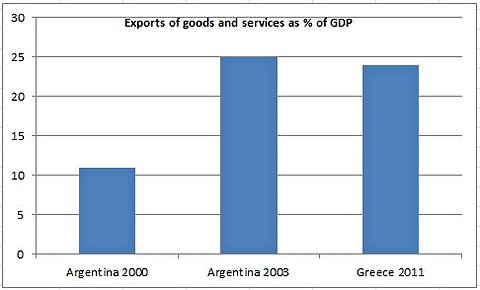
No one knows precisely how much the Drachma would fall compared to the Euro if it was reimplemented, but guesses are all over the place ranging from 20-80%. No matter what, the decline will be substantial. Substantial enough that that bar on the right-hand side of the above chart will spike higher. And if some of the more extreme guesses are right (like the 80% guess) then we’ll see something more than substantial on the export side as Greece becomes ultra competitive. And perhaps more importantly, Greece will start printing money again. And that means an end to the austerity and a double whammy on the growth side – domestic government spending stimulus AND a substantial boost in foreign trade. For a country in a depression that would almost certainly mean nothing but economic improvement from these levels. It would be nearly impossible NOT to see a growth boom – “boom” from current levels.
But the more interesting part to me is not Greece, but the other countries. Dr. Krugman is right about Greece and their export growth. But is he also right about the potential collapse of the Euro? If Greece leaves and begins to see economic improvement I think rumors will shortly begin about the other periphery countries also leaving. First Portugal, then Ireland, then Spain, then Italy. We’re talking about a big big mess there. It’s an every man for himself type of situation that is the exact opposite of why the Euro was created in the first place. The Euro would essentially become core Europe and something resembling the D-Mark. And a higher D-Mark on all these other countries is something that Germany doesn’t want because that means a big decline in their export driven growth (and maybe even a credit crisis for their banks).
So expect the line to hold here. Germany has the most to lose from a break-up. And my guess is they’ll start to do everything in their power to avoid a break-up because the worst case scenario will be a disaster for the one strong economy left using this currency. Greece might be able to leave at this point, but if that occurs the core needs to put up a firewall. If they don’t, this whole thing could blow-up in their faces….


44 Comments
I thought dissolution of the Euro was not and option?
Yes. And let me be very clear. I don’t think dissolution is the endgame. As I said in the article, Germany will try to hold the line here. They have to. If this thing unravels it will be a disaster for them. Eurobonds are the only logical move for Germany from here.
Are eurobonds even possible without full alignment of fiscal policy? I wouldn’t take that risk. I see Germany accepting a little bit more inflation and relaxing fiscal targets but the eurobonds should come last imo. Don’t forget the ECB is also there to help…
The ECB is just helping fund austere balance sheet moves. Remember, QE in Europe is like funding the states in the USA. BUT with the Federal govt FORCING them to balance their budgets. So, it’s not full blown deflation as a funding crisis would be, but it’s still not a NET POSITIVE on the spending side (which is what’s needed in BSR).
So they need a federal funding mechanism. They need E-bonds and somewhere where these countries can obtain permanent cheap funding. E-bonds don’t complete the fiscal union, but they’re a really good start.
Suppose dissolution is the endgame, even if big players don’t want that outcome. Even if the New Mark goes up, the Germans could always drive it down by printing more Marks. It is easy to make your currency go down by printing more of it, but it can be hard to make your currency appreciate or hold a value that is pegged too high.
Iceland is another example of letting their banks fail, a great drop in the currency and a real boom in exports.
One really wonders why in the world they want to adopte the Canadian $ as their currency then?
My understanding is that they are considering it as an alternative to the Euro, which they were possibly going to join.
Zanny Minton-Beddowes 0f ‘The Economist’. who has made sense in the past. expressed optimism about the Euro on NPR’s ‘Diane Rehm’:
The EZ countries – likely in response to a Greek exit – will move toward a Euro-bond and the ‘Euro-ization’ of the banking system.
Another commentator added that at some point, this will need to be supported by ‘democratization’ at the Euro-level.
She also compared what is already happening there to the US: federal/central stimulus combined with tightening by the states/periphery.
Agree. Eurobonds are going to become front and center here.
Colin
“She also compared what is already happening there to the US: federal/central stimulus combined with tightening by the states/periphery”
I was reading the budget shortfall in California last night and the propsed tax increased from 10.3-13.3% state and increase in sales tax in California. I started the discussion with my wife about leaving California. She said NO WAY.
Clearly we have some Greek unfunded liabilities to Which our Gov. has said the Fed and courts will not allow him to cut.
I read the Q and A from Cullen last night and I liked his comment re: Germany. Once the other countries see what would happen to those who left the Euro the whole thing would unravel. I wonder how much of Californias issues are similar.
Should the courts and Fed allow Gov. Brown to make the needed cuts(wether he is really pushing or prefers to use them as a scapegoat is another issue) would that not set off a massive deflationary enviornment for many state retirees?
After reading Bloomberg last night on this issue- I felt both German and my old Republican hairs had me moving to Nevada next to a strip club which is next to a church.
Other than a sister who has worked many years as a Special Ed teacher (some years ago, Richmond was going to furlough her and send the kids home, until the courts said if it couldn’t afford to keep the schools open, the state would have to) – I have limited knowledge here.
However, my sense is that Brown will do everything he can to avoid cutting services, including browbeating the public to accept tax increases – and CA is going to be a major ‘test case’: the extent to which the Fed will help him out; whether those who can afford to, bail out, etc.
Depending on how it plays, we may not maintain the luxury of tut-tutting over Europe’s woes.
(PS Re who’s at the top of the class: The greatest contribution of cognitive psychology may have been Howard Gardner’s theory of ‘multiple intelligences’, ie there is more than one kind of smart – he identified seven. On one or two of them, you likely would place on the right-hand tail here.)
‘Fed’ – Correction: I mean the federal government.
Ha..
And my wife thought I was sexy but stupid.
I’ll pass this along to her
Gardner would probably consider “Sexy” as corresponding to one of his ‘intelligences’.
I’m a Californian as well, and I just don’t see the tax increase happening, doesn’t it need 2/3 approval? I certainly wouldn’t vote for it. I can certainly see a lot of browbeating when the election comes around, and throwing things like education on the fire of what is to be cut, but I just don’t see people going for such a big tax hike. I don’t think people are happy enough with what our tax money is currently being spent on to be OK with increasing taxes.
I’ve thought about leaving the state as well, but can’t really find a place where taxes are better AND I would actually want to live there AND I could find a good job in my field, as well as for my wife.
It will be interesting to see how it all plays out for CA…
California could cut its budget an awful lot if it really wanted to. That state has an enormous number of expenditures that it could do without. Brown does not want to cut, and neither do the CA voters. They had an opportunity under the previous Governator to make cuts, and the voters rejected the ballot measures. The CA public has elected a legislature that is 2/3 Democratic, so it is no surprise that real cuts are not on the table. If the CA voters were willing to have cuts, they would have elected Meg Whitman instead of Brown. Perhaps the CA voters will get fed up with big expensive overregulating state government in some future election, but apparently things aren’t bad enough yet.
I get the impression that the elitist liberal majority in CA deliberately want a state government that crushes and impedes economic growth and development the way CA does. They want to keep the natural beauty of the state for themselves, and anything that discourages more people from moving to CA or even drives people away is a good thing in their view. It is the same motivation behind restrictive zoning laws everywhere, just on a grander scale.
Hhahaaa..
Greek is paying the May 15th maturity bond as well.
My investment in Greek bonds paid back big time.
Shorting the oil and the euro is starting to pay off as well.
Euro will go below parity if eurobonds will become a reality.
What is your reasoning behind: “Euro will go below parity if eurobonds will become a reality”?
The Euro will rally like crazy if E-bonds become a reality. It will be major risk on. Simple.
I just hope my baby boy will not have to live through 4 years of his life talking about Greece. It is painful to watch.
Only the Mexican Cartel can do what is needed to the HEADS of state in Greece.
I am now going to pray every night that this ends before June. please..I can’t take this anymore.
I swear I’ve read the same article on bloomberg every year just with different leaders names of Greece.
“I swear I’ve read the same article on bloomberg every year just with different leaders names of Greece.”
Ha. Yes, you have! You’ve probably been reading the same articles here just with different dates also….Kill me.
Reason is not your best guide to making money in this market.
In my opinion, the market has priced in a lot of easing from the Fed, that is why the dollar is so cheap compared to the Euro. With the crappy European economy alone the euro should be at parity.
When the money printing starts seriously at ECB, I expect the Euro to go below parity.
I know you might find this unreasonable, but I see what a dollar buys me in the US and what a Euro buys in Europe. Based on this alone, the Euro is about 30 to 40% overvalued.
I don’t really see Spain or Italy leaving Euro. These are huge countries in comparison to Greece with more or less diverse economies.
Greece should exit, there is no other options left. Their population won’t take anymore austerity.
As always, the austerity is only for those on the bottom of the totem pole, while the benefits from it go to those on the top. We’ve seen examples of that over and over. Good for greeks that they actually have a voice in making the choice.
I would expect the collapse of their currency after Euro exit to be no less than 50%.
My only surprise is that I don’t hear any reports of Greeks converting their bank holdings into hard goods, which I would personally do to preserve my savings in this situation.If it is not happening, then it would signify that greeks beleive they can stay in Eurozone.
I just heard that greeks are pulling money out of the banks big time. So, it is happening. Once the confidence in Euro preservation is gone and run on the banks starts, they are past the point of no return. This is exactly what I expected to happen.
The numbers I heard are not exactly “big time”. Over E 100B left in the last few years, and less than a billion left in 1 day. It is a large increase in the rate of capital flight, but still is not a true “panic”.
Greeks do not have many good options if you think about it. If Greece leaves the Euro, a Greek citizen’s account in Germany could suddenly become inaccessible, or even be confiscated by the Bundesbank to settle defaulted TARGET2 debts. Euro notes could become invalid unless they were stamped if the Euro gets disbanded, and conversion to gold has risks too. Any physical cash or gold could be confiscated by the Greek Government in the turmoil after a Euro exit. If I were a wealthy Greek, I would put some money in foreign banks as much as allowed by law and try to leave as few electronic trails as possible, some money into Euro cash, some into gold, and some into US Dollars, and some into buying a vacation home in another European country.
1. Those exports are almost entirely tourism, as Krugman himself concedes. So whearas now a German tourist might spend $1,000 Euro in a week, he may soon be paying only $500 Euro per week.
How does that help Greece, even assuming that tourism doubles?
2. How will printing drachma help? If they print drachma, then the exchange rate will continue to fall. Who will want these drachma? Most likely they will go to pensioners and those unable to get paid in Euros.
3. Greece is presently borrowing Euro at low rates to finance its standard of living. When Greece is no longer able to borrow Euro their standard of living is going to fall even further … correct?
As a result of those lower prices european tourists who would visit e.g. Spain, Turkey or Italy now will visit Greece. So, the amount of tourists will increase. And there’s the contagion. Tourism is a (very) significant part of Spain’s, Turkey’s and Italy’s GDP.
A better comparison would probably be Iceland vs Greece, or Iceland vs Ireland. After the bank collapse in Iceland, they told their creditors, “we will only pay you in proportion to our ability to pay.” If memory serves, some British politicians made threats to label Iceland a terrorist state. Since many Icelandic loans were held at British banks, then it makes sense, as the British did not want to loose out. But, mild mannered Icelandics being labeled as terrorists tells us something about the pervese effects of money power.
Today, Iceland using their own currency has recovered economically. Owning your own currency is fast feedback, and allows an economy to naturaly stabilize. A sovereign people should own their own sovereign currency.
The money power and political power are closely related forces. Absent the political power, the money power cannot work. In other words, fiscal policay and monetary policy are flip sides of the same “coin.” If a country gives away its money power, it should also give away a large measure of its political power.
Greece finds itself in a situation where it’s money power has been subordinated to private commercial interests. In effect, they have delivered themselves into other’s hands. That is a form of slavery, and it won’t last (if democracy has deep enough roots). Neo- Feudalism using the money power is at war with democracy. Caretaker governments in Europe are agents of bankers and are not representatives of democracy.
Either the private banking interests will win out. Or, central Government (Germany with the ECB) will change the rules, allowing debt cancellations. As some have mentioned, inflation is a way to wipe out debts, but it creates other problems.
If the pressure becomes intolerable, then Greeks can take matters into their own hands and recover their money power. It is the best solution, but it may not happen unless the people demand it.
Yes its strange that its considered fine when the general populous is debt slaves, but as soon as governments find themselves in the same position it suddenly becomes immoral.
Best to stand aside, take a suitable position and enjoy the spectacle.
I really can’t see an alternative to Greece exiting the EUR (and therefore defaulting). If not now, tomorrow.
I don’t think that this will result a run for the exit by the other states. It will result in them using their new-found negotiating power to ameliorate “austerity”, and I think they’ll succeed. Blackmail, if you like. The debtor owns the lender.
But Greece is different – it’s small, it’s dysfunctional – it is a basket case and unsolvable. Maybe the line can be drawn here ?
(If any Greeks read this, I’m referring to the government and the administration, not you.)
Remember there has already been a default sponsored by the ECB/Germans – the so-called haircut.
A greek exit would immediately boost tourism (whereas staying in the Euro would not). This would solve the employment problem, but in any case their standard of living will drop. The question is are the Greeks prepared to go back to 1980/90s Yugoslavia, Czechoslovakia or Hungary living standards, or will they themselves choose to hold on longer hoping for a miracle?
There is no doubt, the Euro will not hold, ask yourself:
(a) have young Greeks been allowed to migrate on mass to work elsewhere in Europe?
(b) if Germany had so much faith in the PIIGS why were they lending them money to buy Benz’s rather than building plants there to build them?
(c) has Germany spearheaded any method that would allow the PIIGS to repay their debts (e.g. higher German inflation; create a fund for European investment; incentives to purchase PIIGS products/assets?)
It would only spur tourism if the country was politically stable and free of violence. This is a very big if.
All tourism isn’t viewing historic relics and natural beauty either. There are seedier types of tourism in the world – and the Germans are well known to be big fans of the darker side. If Greece becomes desperate enough, they could lure all those rich German tourists away from Thailand and Africa.
eurobonds are “unthinkable” just completely forget about that.
Greek tourism will not boom, beyond their regular general and transportation strikes they massively offend their former largest customer, the Germans,
and now they beat up even a 78 year old dutch guy:
http://www.welt.de/politik/ausland/article106315000/Griechen-brechen-Hollaender-die-Nase.html
I see their tourism sector booming after that
these endless desires that Germany has to do this and that, and others just say what they think is impossible, this is just completely ridiculous.
There is a Maastricht treaty with “no money printing” and “no bail out”
and those folks will learn to live by the law. period. Criminals will be ejected from europe, I doubt it will benefit them.
Eurobonds are “unthinkable” just completely forget about that
Tell that to your beloved fin minister Schäuble who just recently stated that he would welcome higher inflation in Europe and is not entirely against Eurobonds. Off course he’s going to wait to be head of the Eurogroup to come out of the closet as a Eurobond supporter and sell the German sovereignty.
Who else could we put at the head of the eurogroup apart from this man who contributed to much of the despair in Europe?
I disagree on the tourism. I think it will benefit from cheaper currency. I remember all the Russians going to Cyprus in the 90s because of no-visa and cheap costs. Now they go to Turkey. If Greece can compete with Turkey on costs they’d rather go to Greece. I know, I would.
I think you are all too optimistic. A few flys in the ointment:
1) Argentina had a severe slowdown after 2000, not a boom. Why would Greece be any different?
2) Argentina’s exports as a % of GDP increased from 2000-2003, but GDP dropped a lot, so the actual increase was only about 10%, not a doubling as the chart implies.
3) What is the elasticity of Greek export demand? If the price of olive oil drops 30% will I buy more? (No.)
4) Greece still has to deal with a deficit, even if the debt is zeroed out.
My conclusion is Greece leaving the Euro results in a few years of considerable pain before a recovery and boom.
Greece is toast. In the last three days there has been a run on the greek banks.
Completely agree with Rich.
The Greek situation might probably not be different to Argentina in 2003… And compare the exports of both nations would make sense… But the world economy is certainly different to 2003 when it was at the start of the boom.
And remember Argentina could benefit from a starting long bull market in agricultural commodities and metals… what will Greece benefit from?
What does Greece’s import numbers look like? And what goods do Greeks import? Does Greece export commodities like Argentina or consumer goods? Could this make some necessities too expensive for Greeks? I understand that many are not doing too well financially, so how does a 50% increase in imports not equal a different form of Austerity?
“so how does a 50% increase in imports not equal a different form of Austerity?”
Well with currency sovereignty the govt. can start employing people again and you have a light at the end of the austerity tunnel.
Right now you have people with no jobs and no way of buying those imports anyway. They need to get the internal economy going again. Once they have no sovereign default problem they can easily run a deficit and get things going as MMR and MMT show.
It will be messy and painful but it will get them back up and going a lot faster. The Troika et al are talking about decades of austerity with no end in sight.
It makes no sense for Greece to leave the EU. Leave aside the social costs of such an exit, the economic costs are also probably not easy to calculate. But for sure, comparisons with Argentina, or with any other country that has devalued from a fixed exchange rate regime is not appropriate. Tobegin with, there is nothing to devalue. Greece does not have another currency but the EUR. Forget trying to figure the economic advantages/disadvantages of such a devaluaion, the mechanics of such a switch is mind boggling. This thing cannot happen overnight, nor over a weekend, nor a month. Argentina had the peso alongside the USD at least. But what Argentina did not have and sadly Greece does have is a lot of foreign debt. At the time of the breakdown of the currency board, Argentina’s external debt to GDP was around 50%, Greece’s is now around 180%. It is true that Greece’s exports to GDP compares favourably to Argentina’s at the time of devaluation, 10%, but the Greek external debt to exports at 850% is almost double that what Argentina’s was, 470%. You see exports only matter if you can reasonably expect them to help you pay off the debt. You can make a comparison with the former Asian tigers (S.Korea, Malaysia,Indonesia, Thailand) at the time of the Asian crisis in 1997-98. They also had a similar foreign debt to GDP as Greece now, however these countries were major exporters – their exports to GDP were on average at least 50%! As a result of that, despite their high foreign currency debt, their debt to exports ratio was a much more manageable 300%. The examples of Argentina and the former Asian tigers show that the only way for Greece to benefit by a devaluation is either if that exit from the EU is also followed by a massive debt moratorium or through somehow becoming a major exporter. None of these is very likely – Germany and debt moratoriums do not have a happy ending if history is any guide and Greece’s industrial base has been destroyed since the introduction of the EUR.
If the law is changed, where the ECB and Brussels can direct spend into Greece, then it makes sense for Greece to stay in the Euro. For example, the U.S. direct spends into states with grants. The depressed areas, like Michigan for example, receive grants and other monies keeping their governments running. During natural disasters, money is released to pay for repair e.g. the levies in Lousiana after Katrina. That cannot happen in the Euro system.
Absent the law change, then the sitation in Greece is untenable. It is a cardinal sin in economics to let your debt point outside of your legal system. The triangular flow of debts between allies and germany, led to World War 2 and all of its horrors. When debts point outside, they grow exponentially and the only way out is some sort of breakdown as there is no regularizing mechanism. Either the EU dismisses the debts with a Jubilee, or Greece forces the issue with an exit.
Vectoring your economic surplus outside of your economy in order to satisfy bond holders and exponentially growing numbers on a banking ledger will lead to Greek political suicide. Democracy may break down and Greece becomes a slave Feudal State servicing its debt masters. We’ll see how deep democratic roots go. But, banking masters should take heed: The law and politics always are the trump card. Debts that cannot be paid will not be. Good luck collecting when your victims are unable and unwilling.