
PUTTING PAST BUBBLES TO SHAME
And you probably thought the oil bubble in 2008 was a big deal? Well, the CRB Spot Index of 23 markets (which EXCLUDES oil) now dwarfs the 2008 move. This bubble is not only larger, but it is substantially broader in terms of the markets included. Few markets have been excluded from this price surge:
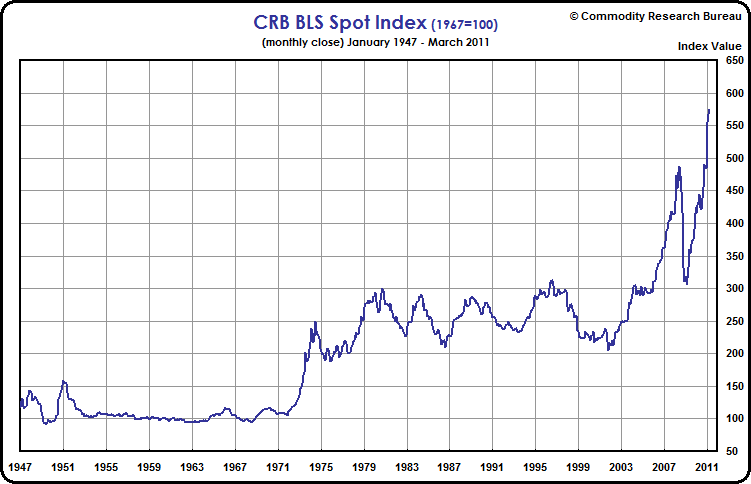
This is such an extreme disequilibrium that I think the Fed has to now very seriously consider that they have contributed to this rise in commodity prices. Several independent sources have come out to counter the propaganda out of the various Fed banks claiming no involvement in the commodity price increases. It would be nice if the Federal Reserve stopped playing doctor on the US economy and actually tried to objectively quantify the impact their actions have had. To anyone with a working set of eyes it is fairly clear that the Bernanke Put is working its magic in most destructive ways.


Cullen, there is a paragraph in Justin Fox’s book “The Myth of Rational Markets” where he reports how futures speculators have been blamed for commodities bubbles since the the beginning of time.
Guess what our President and Attorney General have been doing lately?
If the equity markets go down … blame the “short” speculators.
If commodities markets go up … blame the “long” speculators.
Just blame speculators any time the markets do not move in the direction the Government wants them to.
I am especially dismayed by the Fed academics who are willing to put their PhDs behind questionable research absolving the Fed.
I am not so concerned with the level of speculation. I am more concerned with the extent that the Fed exacerbates it. It’s only natural that speculators would respond to the Fed with these sorts of actions. So, we shouldn’t blame the traders. We should blame the source of the problem – the Fed.
Exactly. You take away the liquidity and the amount of money that can be used for speculation peaks. There’s a reason why hedge fund assets have topped ’07 highs and it’s not because high net worth investors or pensions have more money. It’s leverage created in the shadow banking system through the Fed’s QE policy as investors swap treasuries for cash that is then either invested or lent out to hedge funds. This whole thing is going to unravel putting in a long term secular top in the CRB if you ask me.
True. The Bill O’Reilly’s, Lou Dobb’s and President Obama’s all seem to miss that simple point…
another great excuse to regulate and tax.
It might be a little self-referential, but what would this chart look like inflation-adjusted?
When do you think the mainstream Economists (including Ben and Dudley from the FED) will wake up and see what is really going on? Or is it more that if they come out and admit what people like you know; it will discredit all of their economic work and theory they have spent most of their adult lives working to justify?
Right. They can’t reverse course now. It would be like the Pope having a revelation about Buddhism. He’ll reject that revelation to no end and if he can’t fully reject it he’ll take it to his grave. Anything else would be heresy.
I remember Bill Maher interviewing an old Vatican theologian about some of beliefs he considered absurd. The theologian smiled and said that no one around there believed that stuff, but that it had inertia because of traditional beliefs held by the masses. Institutions are inertial frames of reference, which is what makes them institutions. Institutions proceed on the path until a sufficient force deflects them from it. Change comes either very slowly from within or swiftly from without.
But… I thought… Aren’t economists supposed to treat their ‘science’ with neutral rationality and clarity, not the blind devotion of faith? If they don’t base their decisions on empirical data, but just what they ‘want’ to believe… they may as well have a shaman at the table to help them with their huna.
When did it become ok for economists to be overtaken with religious fervor, disguised as rational thought?
/confused.
Oh, I remember now… never mind.
Will the Fed never learn? The question is which bubble is going to be the last straw. As more and more leverage is abused and more and more debt is accumulated, each cycle sees the system becoming more and more fragile.
Will they learn? Congress expects so much from them that it seems as though they will continue down this misguided path trying to fix problems they aren’t equipped to deal with. I think it will likely take an act of Congress (probably after another big financial meltdown) to alter the Fed’s current course.
Any real bubble, once it has properly popped, cannot be reinflated. Tulip bulbs became tulip bulbs after all, Tech stocks did not reinflate, housing does not reinflate in spite of QE1,2 and so on…
Why do you guys think the “commodity bubble” not only reinflates big time but also reaches new highs in a very broad manner?
I do agree that there is some speculative froth in commodities, but I am quite sure that this commodity supercycle is going to stay with us for quite some time. Or at least until diminishing energy supplies finally choke it off…
I am wondering, whether or not global trading has played a large role in the growth and price of commodities in general?
Jeremy Grantham from GMO states that “Days of Abundant Resources and
Falling Prices Are Over Forever” that there is in fact a Paradigm Shift.
https://www.gmo.com/America/CMSAttachmentDownload.aspx?target=JUBRxi51IICi3XDk3kgSh6vLtzbPwJWv9j9b13l0dYjF9rvqA%2bOemQJnKCUtBlLDQGoZefVzk4SHgb7XFBPhF9TB5NDqRGhNovIh7Uv8y28%3d
Beat me too it.
*to
Statistically, most commodities are now so far away from their former downward trend that it makes it very probable that the old trend has changed – that there is in fact a Paradigm Shift – perhaps the most important economic event since the Industrial Revolution.
Why is margin squeeze still subdued?
Was QE responsible for the move going into 2007?
This has very little to do with QE, imho.
Technically, greater efficiencies should lead to lower prices, but due to Jevons paradox, the more efficient you make the production of that thing, the more it typically gets used. The cheaper you make something that is inherently wanted, the more people who want it are able to have it. Demand ultimately begetting more demand.
Assuming that the chart prices are not inflation adjusted would mean real prices effectively fell from the beginning of the chart to ’72, coincidentally rose around the time of the 1973 oil crisis, then fell in real terms (stayed within a range in unadjusted terms) from ’75 to ’07 or so, then started rising again, again coincidentally when oil production (but not global use) roughly maybe peaked.
An inflation adjusted chart of oil, for comparison:
http://en.wikipedia.org/wiki/File:Oil_Prices_1861_2007.svg
An inflation adjusted chart of the CRB would be handy, if anyone has a source.
Best I could find:
http://www.stockhouse.com/Columnists/2011/Jan/5/images/ss010511_6
from this article:
http://www.stockhouse.com/columnists/2011/jan/5/why-we-don-t-think-bernanke-is-lying-about-u-s–mo
If accurate, does seem to put the “horrible” 2008 spike of commodity prices into context. (Or silver’s recent rise, from the article, for that matter.)
Ah, here’s another chart, from a more familiar source:
http://pragcap.com/commodities-the-year-bear-market
Using the Real Commodity Prices chart, man had better hope the fall in real prices from roughly 1950 onwards was due to permanent human ingenuity and not abundant cheap energy, fertilizers, and petrochemicals. If commodity prices normalize back to even 1950 levels, let alone the wild variability of the 1800s, given the chaos current changing prices are creating in places like MENA, life is going to get a whole lot more interesting over the next couple years.
The problem with priced or planned for perfection is perfection seldom lasts. It’s not that much of human ingenuity won’t last and be of ‘permanent’ benefit, it’s that it’s not the whole story. It’s only part of the story. Cheap resources were also part of the story. There’s human ingenuity with the wind at your back, and with the wind in your face.
THIS HAS NOTHING TO DO WITH THE FED!!!!
Do the bubble callers have any other method of analysis???
This is a paradigm shift. Price movements are not always bubbles, nor should dips always be bought…
Don’t scream it. Show us some proof.
Show you some proof? First off, let’s deal with the assertion or implication that the Fed is causing this price movement.
Number 1 – a serious uptrend developed before the financial crisis, before any QE, and before any huge deficits were threatening our fiscal reality in the immediate term.
Answer how that’s possible, unless those damn bubble guys were just a bit too early.
Number 2 – did you read Grantham’s piece? How much more proof do you need? YOu say this is a bubble. I say why? What proof have YOU provided, other than a graph of prices going up very fast. That is not always a bubble. Will there be corrections and sometimes harsh, sure, as we saw during the crash of ’08-’09.
Does it not raise your eyebrows quite a bit to see a so-called bubble happen TWICE within several years and happen very fast?
No analysis of supply/demand. No analysis of any of the actual underlying factors. It is this thinking that will blow up the PM market. Do you know why? Because real buyers with real money are coming in and buying the crap out of it, not some financialized garbage NY swindlers who provide nothing of value to society except ride the coattails of those that actually do business. So while the monkeys create all the “instruments” to “short” the PMs hard, the real heavyweights are entering the arena on the buy side.
The cure for high prices is high prices. Will there be substitution and innovation, absolutely. Corrections, you bet. But I think a lot of commodities are being repriced before our very eyes. I am not waiting 10 years for them to invent a substitute for coffee, I will simply pay more. As with all else. Only when you can’t pay more does emergency innovation really kick in.
You want a bubble, go look at the bond market and fiat money. POst some of those charts (Marc Faber has them available). That bubble has been building for 30 some years and watch the f out when it collapses.
I await your reasoned reply.
Prescient11, I believe a closely reasoned reply awaits you courtesy of Nemesis below.
To which I would only add that, whilst emerging nations’ growth may perpetuate strong demand for raw materials over the ultra-long term, this does NOT of necessity imply permanently high prices. We should be more careful to disentangle arguments about intrinsic demand from arguments about price, especially when commodities have, as Nemesis clearly points out, become so ‘financialized’.
Price does indeed cure price. Your line ‘I am not waiting 10 years for them to invent a substitute for coffee, I will simply pay more’ is laugh-out-loud funny.
Sure, YOU might be able to shrug off a ramp up in the price of coffee (and gas and electricity and food and clothing) but just how much more do you think the developed world’s debt-saddled middle-classes will be able to pay for their necessities before they clamp up their wallets and pitch us straight back into a recession?
Whoops, there goes your commodity bubble.
Right now, any ‘new paradigm’ for commodity prices – and note that when people begin shrill talk of a new paradigm we are ALWAYS within sight of the top – depends squarely upon the continued hunger of China for raw materials.
But I would suggest that the assumed invulnerability of China is delusory – as delusory as Japan’s proved 20 years ago – and that their construction boom will shortly begin to stall out.
This will first be indicated by a major top in Hong Kong, Australian and Brazilian stock markets – probably within a month – and will be accompanied in due course by a series of dramatic burstings of bubbles in commodities, like the final explosions at the end of a glorious firework display.
Let the entertainment begin.
This neither responds to my points, nor does it rebut anything. Come on people.
You want to call a bubble, have the balls to come out and defend it.
Especially when I can eviscerate the entire argument after spending two minutes looking at the graph above which is supposed to serve as Exhibit A to this original post.
Oh no, let’s get this the right way around here:
In your post above, you have called this a ‘New Paradigm’ for commodity prices. It is not down to me or anyone else here to defend our position – those of us calling this a bubble have seen plenty before and see precisely the same characteristics appearing again today. It is down to you to prove that this time is different.
The more shrill your cries, the less weight they carry. Tellingly, you assert that my post neither responds to nor rebuts your points – since they plainly do, I suggest you have let yourself become deaf to argument.
Listen,
Answer this simple question. If QE supposedly caused the commodity bubble (as you call it), then why did you see the very strong price action – going into the similar territory we are now (which again you claim is a bubble) BEFORE QE EXISTED??? i.e., in 2007.
Answer that question, then perhaps we can move into your claims of knowing bubbles when you see them and the analysis, or lack thereof, that is behind that statement.
Sure.
First, check my posts: nowhere have I claimed that QE caused the commodity bubble. As all bubbles do, the commodity price boom began with strong fundamentals based on emerging market growth, dollar weakness and the numerous supply / demand factors we all know perfectly well and that you have often stated.
But that’s the beginning of the story, not the end of it.
Just like the two most recent and notorious sector booms in technology and housing, the basic assets then became ‘financialized’ and vehicles for broad-based speculation. In a low or ZIRP environment, all manner of financial institutions required, created and continue to create instruments to take advantage of these favourable fundamentals (and the increasing public realization of these fundamentals) in an effort to dramatically lever up returns. In the self-reinforcing (‘reflexive’ as Soros would call it) upwards spiral which then ensues, price eventually stops being a reflection of reality but of our *perception* of that reality – which has itself been distorted by the price.
From that point on, price needs only its own justification to continue higher: the internet revolution becomes ‘a new paradigm’; house prices ‘have never fallen before’, therefore cannot fall. Extremely intelligent and plausible commentators pop up to justifiy the public’s faith in these asset prices (who can forget Irving Fisher’s ‘stocks have reached a permanently high plateau’, or Bernanke’s “the subprime crisis remains contained”?) and their words are seized upon in an effort to keep the music playing. Greed, justified in this distorted reality, feeds itself.
Now this great wall of speculative cash – amplified massively since 2009 by QE – has moved wholesale into commodities and we see prices being rationalized in precisely the same ways.
Occasionally, genuine new paradigms do indeed open up before us – but this does NOT imply paradigm shifts in price! No one denies the internet is a true revolution for example, or that China’s rise is changing the world order. The question is solely about the price we gullible human beings attach to these events.
Currently, spot silver is about to become, on a monthly basis, a 3-standard deviation event. This is bubble territory, pure and simple. Once or twice in the last 20 years it has spiked to 4 st. dev. But any close above 3 is a heaven-sent signal to protect yourself or leave the stage with your gains intact. We’re almost there.
1981 – 1990: http://stockcharts.com/h-sc/ui?s=$SILVER&p=M&st=1981-01-01&en=1990-01-01&id=p14857532620&a=232562660&listNum=21
1990 – 2000: http://stockcharts.com/h-sc/ui?s=$SILVER&p=M&st=1990-01-01&en=2000-01-03&id=p41413112732&a=232562991
2000 – 2005: http://stockcharts.com/h-sc/ui?s=$SILVER&p=M&st=2000-01-03&en=2005-04-01&id=p29476312530&a=232563605
2005- : http://stockcharts.com/h-sc/ui?s=$SILVER&p=M&yr=6&mn=0&dy=0&id=p76406053350&a=232564407
QE II + ETF’s + theory of inflating debt away + commodities priced in $’s + zero interest rates + possible QE III + “China” combined with a dollar that has declined 40% over the last two years = commodity rocket ship. It will crash when the fuel runs out.
The 1970s commodity inflation was roughly the same. percentage-wise (a 200% increase) as the recent move in the CRB index. This bubble may be close to popping. Of course, it’s also possible that the dollar is a bubble that has already popped, accounting for the rise in the CRB. I’m going to go out on a limb and say that the dollar is going to be strengthened and that the CRB index is close to its zenith for a long, long time.
The CRB has recently achieved the critical cumulative differential rate of growth to GDP of an order of exponential magnitude, with the rate of acceleration since late ’08 turning asymptotic at a doubling time of 30 months.
The time projection for the terminal date of the faster-than-exponential bubble trajectory to end is essentially now, with the subsequent “anti-bubble” crash regime lasting approximately the terminal doubling time of 30-32 months (lows in summer-fall ’13).
This is classic textbook Didier Sornette-type log-periodic bubble trajectory and terminal blow-off price regime. All bubbles crash back to the level at which the faster-than-exponential growth began, which in this case is in the 200-300 range, or a 50-65% decline from the bubble top so far.
A crash for commodities prices, including gold and silver, in the months and years ahead is among the easiest high-probability forecasts one can make with high confidence; however, the question now is only from which level the crash will begin.
Speaking of gold and silver, gold’s doubling time has fallen to 25-26 months to silver’s doubling time of 7-8 months, and 3-4 months since Jan. By the log-periodic bubble and anti-bubble metrics, there is no question whatsoever that gold and silver are exhibiting classic bubble trajectories, with silver’s rate of acceleration exceeding that of gold by nearly an order of exponential magnitude since last summer.
By the time the PMs dust settles on the next global deflationary economic contraction and stock, real estate, and commodities crash, gold and silver will fall back to the lows of ’08-’09.
Oroboros and Cullen,
http://pragcap.com/commodities-the-year-bear-market
“. . . [C]ommodities are NOT investments.”
This is a demonstrable fact. Commodities are business inputs in the first instance, and they have been “financialized” as an “asset class”, i.e., abstracted symbolically for the purposes of financial speculation, which encourages MASSIVE financial leverage and causes MASSIVE distortions to price discovery, requiring producers and intermediaries to become commodities speculators further out the production/extraction temporal curve to secure affordable and profitable prices for their operations.
There was a time when commodities futures markets required participants to enter into actual delivery arrangements for physicals with much higher margins, reducing or eliminating the short-term speculative arbitrage associated with leveraged positions with never any intention of taking delivery.
Now the commodities markets have become so financialized and abstracted many times removed from the actual supply-demand and extraction/production operations that it is ridiculous and increasingly disruptive and costly to the real economy. We have 20- and 30-something speculators at Godmen Sucks and More-gain Stainly who don’t know the slightest thing about energy and agriculture, but they are dramatically influencing the prices at the margin via digital instruments for the entire world’s real economy.
And the same applies to HFT, dark pools, PTFs, offshore pass-through entities and front companies for the banks and large hedge funds, and the like. They all should be regulated or taxed out of existence; but the publicly traded exchanges are now making too much money from allowing these entities’ transactions to shut them down.
And the likes of Ben Shalom Zimbabwe are hired to run interference for the banksters, hedge funds, and parasitic rentier types to game the system into oblivion.
Therefore, nothing will be done until their collective activities and cumulative effects bring down the whole system and world economy.