
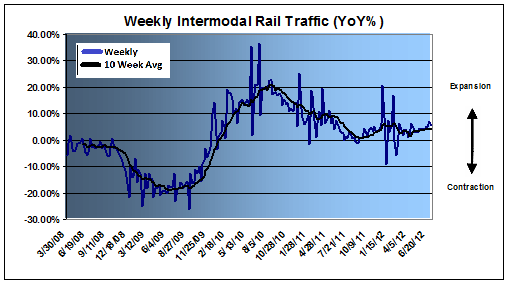
Rail traffic was mixed again this week although intermodal continues to point to a growing economy. Carloads were down 1% on a year over year basis while intermodal jumped 5.6%. This brings the 10 week moving average to 4.5% which is a healthy historical figure. AAR has the details on this week’s data:
“The Association of American Railroads (AAR) today reported mixed weekly rail traffic for the week ending July 7, 2012, with U.S. railroads originating 243,156 carloads, down 1 percent compared with the same week last year. Intermodal volume for the week totaled 203,362 trailers and containers, up 5.6 percent compared with the same week last year.
Seven of the 20 carload commodity groups posted increases compared with the same week in 2011, with petroleum products, up 54.8 percent; motor vehicles and equipment, up 52.7 percent, and food and kindred products, up 11.1 percent. The groups showing a decrease in weekly traffic included iron and steel scrap, down 29.6 percent; primary forest products, down 24.1 percent, and farm products excluding grain, down 23.6 percent.
Weekly carload volume on Eastern railroads was down 12.3 percent compared with the same week last year. In the West, weekly carload volume was up 5.3 percent compared with the same week in 2011.
For the first 27 weeks of 2012, U.S. railroads reported cumulative volume of 7,567,974 carloads, down 2.8 percent from the same point last year, and 6,253,092 trailers and containers, up 3.4 percent from last year.”

Mr. Roche is the Founder and Chief Investment Officer of Discipline Funds.Discipline Funds is a low fee financial advisory firm with a focus on helping people be more disciplined with their finances.
He is also the author of Pragmatic Capitalism: What Every Investor Needs to Understand About Money and Finance, Understanding the Modern Monetary System and Understanding Modern Portfolio Construction.
Comments are closed.