
Recession Index Still Says “No Recession”
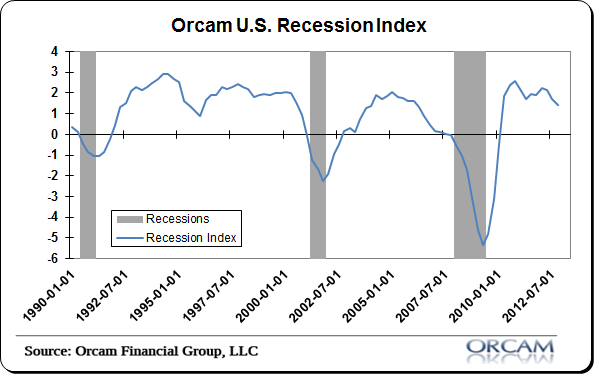
One of the main indicators I rely on for the cyclical view of the markets is the Orcam Recession Index (which I update in the research regularly). It’s helped me keep from bring bullish into each of the last two recessions (though a bit early in the last one) and has kept me from being too bearish in the last few years despite working under the understanding of economic weakness due to the Balance Sheet Recession.
What’s it saying right now? Well, not much has changed since I started loudly saying that the ECRI and others were wrong about their 2011/12 recession calls. It’s still trending lower, but historically, the index hasn’t turned negative until about 6-12 months before a recession hits. The current reading of 1.5 is pretty healthy considering the average reading over the 30 year lifetime of the data is about 0.85.
Of course, it’s easy to say you’re bullish after the market has surged, but I think the markets are mostly getting the longer-term trend right. That doesn’t mean I wouldn’t be careful in the near-term (I’ve in fact been cautious), but the tide moves all boats regardless of how fast you paddle and the tide is not pointing to a recession as far as I can tell.
Chart via Orcam Investment Research:


43 Comments
So, Dow Jones at historical high. I hate to say : I told you so…
Where are now all the bears crying all over about extreme sentiment and overbought market ?
Cullen, could you do an article about where the DOW really is. By my reconning, it is about 11% below its all time high, inflation adjusted.
Thanks
Here’s a chart from Barry Ritholtz he it tweeted today.
http://twitpic.com/c932gt/full
Thanks Ken!
By YOUR reckoning— or by the front page of Money & Investing section in the WSJ today??
By using this calculator and the associated monthly table.
http://www.usinflationcalculator.com/
The word All Time High should be restated as 2007 High.
Well there is a difference between recession and very sluggish growth but it’s not much of one. I’m bullish on stocks right now because the market is telling us to be bullish on stocks, not because the underlying economy is doing well. At some point the Fed’s market levitation act will fail and the market will more accurately reflect the conditions on the ground in the overall economy. Until then, as an investor, you should never fight the Fed (I learned this early on from Marty Zweig and have always found it to be true).
Very good point. There are two pieces to investing: 1) fundamentals, 2) sentiment and trends. It is very difficult to invest using only one or another as some purists like to do. You need to consider both. So, it is ok to be long equities in the face of uncertain fundamentals if the trend is going that way. At least one knows what to lookg for when deciding to exit.
Well Cullen you wrote it many times and rightly. With the goverment in deficit spending mode at a medium pace of 1 trillion/year IF we were in a recession… well this would be no less than catastrophic. The question is: how much longer will it take for the economy to take traction without the goverment big help ? Will the goverment ever be able to reduce its spending to say 2%/year ? Will the FED ever be able to adopt a reasonable exit strategy?
Thanks for sharing that, Cullen. This is truely a “Go To” site.
This article is the part of why I am confused about your comments that “fake/temporary” stock prices don’t effect wealth. If people extract money out of the stock market, using inflated prices and go consume or even save that money, why does it not help economic activity. And yes I realize for every buyer there must be a seller etc but to use that argument then stock prices at any level are irrelevent since they are always a wash.
So the larger question – if Ben and Japan and all inflate prices to the moon and people use the stock market like the house market (home ATM replaced by stock market ATM) why is it not a boost to the economy via consumption?
http://www.reuters.com/article/2013/03/06/us-usa-markets-dow-wealth-idUSBRE92503K20130306
To use your stock portfolio like an ATM, banks would have to offer stock equity loans modeled after home equity loans, with your stock portfolio pledged as collateral. As far as I know, banks haven’t yet widely marketed stock equity loans, perhaps because everybody knows stock prices, unlike home prices, sometimes go down. Your broker will let you borrow against your stock portfolio, but only to buy more financial assets.
Completely false. You sell, and then buy things will the proceeds. There is absolutely no reason to need a bank to give you a loan collateralized by stock holdings.
Who did you sell to?
Perhaps commercial banks don’t offer portfolio loans, but this is the latest push at many brokerage houses (many of whom are bank holding companies now)…the borrowed funds specifically CAN NOT be used to buy financial assets.
“at many brokerage houses” [...] “borrowed funds CAN NOT be used to buy financial assets.”
Nearly all brokerages let you buy stocks and bonds on margin — which means getting a loan from the broker to buy more financial assets with your current portfolio of stocks and bonds used as collateral.
I’m not sure why folks are forever confused by the wealth effect. It’s real,it shows up in the data and doesn’t exist primarily in countries where stock ownership isn’t widespread. Even Shiller’s skeptical study concludes that there is evidence of the wealth effect in the US. And it’s purely logical.
1) MPC increases as IRA values etc alter the consumption v savings decision in the present.
2) “Sentiment” is clearly altered by portfolio values.
3) Countless behavioral studies have shown a human tendency to count our unrecognized gains (while failing to count unrecognized losses).
All of that adds up to something like a .4% impact on GDP for every additional 10% according to various studies. I don’t see why you’d spend a lot of time getting into arguments about two sides of every transaction and ultimately rely on opportunity cost arguments which are hardly logical in the context, to make an argument against the wealth effect. Rising notional values matter and can cause two gains, even if one involves a loss of opportunity cost.
On the much broader wealth effect point – essentially it’s an unsustainable form of trying to buy growth – I certainly agree.
I don’t deny that it exists. I just think it’s a silly policy to target as it tends to promote a sort of ponzi environment which leads to a boom/bust environment.
totally agree on that. But, I’ve always noted your cynicism of the Austrian school – and this is, ultimately the mainstay of how they view the world. (Granted they don’t seem to understand fiat money particularly well) – but when you recognize the unintended consequences of Fed action – don’t you land up at a place closer to the Austrians?
I don’t disagree with the Austrians that Fed policy can have negative impacts. I just disagree with the foundation of their thinking from which they generate those conclusions. The MR view of money is nothing like the Austrian view so our general understanding of the monetary system is very very different.
Plus, don’t Austrians always end up thinking something along the lines of “We should go back to the gold standard” or “We need 100% reserve requirements?”
Plus, I have the impression that Austrians have a soft spot in their hearts for austerity… for austerity’s sake. Kind of a masochistic streak. Especially at times when austerity is least helpful. Listen to Peter Schiff sometime to see what I mean. You can hear a softer version of it in David Stockman.
My impression is that if things were going well already, taking an Austrian position might prevent you from too much exuberance and speculation and ponzi lending and balance sheet recessions, etc., but if you’re already in a hole… I don’t see Austrian thinking as being helpful… in fact it looks counterproductive to me.
As Steve Keen put it once, if you’re driving along normally, then regular steering keeps you on the road, but once you go into a skid, you need to fight your intuition and turn into the skid to regain traction. (BTW, is that even true, or is Keen out to lunch on that one?). No matter, having been a sailplane pilot when I was in high school, there’s a similar analogy there… if your sailplane is in a spin (basically you’re pointed almost at the ground, but your wings are stalled because the angle of attack is too great), you learn to push the stick FORWARD (after you stop the spinning w/ your rudder), against all intuition, to point the nose of the sailplane even MORE straight down, so you can break the stall and start flying again. Of course after you do that, you find yourself pointed straight down, rapidly approaching “red-line” speed where the wings come off, so you’ve got to then pull BACK on the stick promptly (but gradually) to return to normal level flight before that happens. Otherwise you’re dead.
Fair points in a sense. I’m quite familiar with Schiff and the Austrian crowd (who isn’t after Ron Paul’s last two compaigns?!).
I’m certainly not an Austrian, but I am sympathetic to their views. It’s hard to separate TBTF, cheap money bubbles and boom & bust. All three are pretty fundamental components of the current monetary + political architecture.
I’m not sure how a system which works overtime to protect the wealth of the 1% – all in the name of the 99%, built on a foundation of boom & bust really has any moral grounding. That debate and the debate over currency is quite deeply linked.
I find the Austrian obsession with the gold standard pretty absurd. But, I think a move closer to a rules based monetary system is what we need. Something along the lines of what Milton Friedman proposed…
Moving powers to the states, rules based fiat money, a small federal government for taxation & essentially protection of fundamental rights is a lot closer to a just society in my view. Not sure why we keep fighting a battle at the federal level which should be fought at the level of states.
There’s one thing the Federal government can do though which perhaps makes it indispensable in times of crisis: it can deficit spend (in a manner impervious to the influence of so called “bond vigilantes”) beyond what any state or local government could ever hope to do. That could be very helpful. Greece, Spain, Italy, Portugal, and Ireland are all missing that ability now, since their governments don’t have that ability!
Any rules based Fed would have to have some exceptions… or alternatively have a very good set of rules to include crisis situations! So again, I see the rules as keeping us on the road in normal times, but during a crisis, adhering to the rules may no longer work.
Personally I’m convinced the world will end due to a software glitch!
Which brings me to a point I’ve always wanted to bring up… there are all kinds of risks in this world to our portfolios (inflation risk, interest rate risk, etc.), but what about the risk of a malevolent agent… say an “Anonymous” volunteer, or a Chinese Army hacker, penetrating the Fed’s computers (either from the inside or from hacking in), and ERASING EVERYTHING??!!! Can you imagine the chaos? Wow!
Well, my big problem with most other economic schools is that they tend to form their ideas around a policy agenda. The Austrians will build their understanding of the world to conform to an anti-govt view. The Monetarists build their understanding around a Fed-centric world, the Keynesians build their understanding around a counter-cyclical policy view (which tends to be govt centric), the MMTers build their model around a govt centric view. None of these schools actually start with a solid understanding of the system as it is. So, that’s my big problem with these schools of thought.
This comment seems to be a change from your previous comments.
So now you are saying that central bankers can create to ACTUAL wealth via the transmission mechanism of stocks (or homes) but it leads to boom and bust?
I thought your earlier view was these are not real gains so hence the central banks actions on nominal prices mean nothing as they are temporary. That was how I always read you at least.
I guess if this is your thinking now the question go forward is always can the central bankers create more wealth on the boom cycle than destruction on the bust cycle. If so, there is a case for central engineering as all the CBs are doing now. Of course measuring this is nearly impossible!
I’ve maintained the same position on this for years. Besides, how can anyone know whether market gains are actually Fed induced or not? The risk I’ve always discussed is that this promotes a ponzi mentality. That’s all.
Most stocks are owned by the wealthy and retirement funds which only rollover their capital gains and don’t spend them. That is why the Fed doesn’t worry that the ‘wealth effect’ will be inflationary-in their eyes it’s a free lunch.
It could boost the economy, but the concern is that nominal wealth is deviating from underlying cash flows in such a way that creates a disequilibrium. Exactly like the housing ATM scenario where people think they’re richer than they really are and start pulling money out of their house in a spending manner that is unsustainable. And then when they actually go to sell the house to “cash in” they wreck the economy.
“but the concern is that nominal wealth is deviating from underlying cash flows in such a way that creates a disequilibrium”
Isn’t that based upon an assumption that the *current* valuation is accurate? We’d need to find out if current valuation is accurate (or worse, inflated) based upon historic ratios of cash flow to valuation.
And then we’d need to argue about how it’s different this time.
The best way to know if we’re in a distorted market is probably easier than most presume. For instance, let’s just look at total market cap to GNP. That would basically give you a pretty good idea of whether there’s distortion. Nailed the last two bubbles….
Cullen, it seems that this ratio of stock market value to GNP is flashing a bit of a warning now as the ratio nears 100%. It is getting close to the same level it was near the Oct 2007 market peak. How close it it, it is hard to tell from this chart?
I am sick and tired of hearing we are doing fine (i.e., not in or heading to a recession) because all the “signals” say we are fine. All the “signals” we used to use are BROKEN because of the money being pumped into the economy.
No trouble with the economy (and I mean the REAL economy, not the market)? Really? I go to the store and boxes of cereal, cookies and crackers are SHRINKING while the prices stay the same as they were for larger sized boxes. Companies are making cars with cheaper, poorer materials (e.g., VW) and the prices stay the same as the older, better models. Tickets for concerts, all sports and places like Disney are INCREASING. Yet incomes are not moving upward to compensate. Consumers are robbing Peter (savings) to pay Paul (buy goods). Student loans (sorry, can’t declare bankruptcy and “deleverage” there) are at an all-time high. Unemployment (mixed in with ever-increasing numbers on SNAP and disability) remains stubbornly high. Millions of homes sit vacant and rotting from within because of bank games. Detroit — a city of 700K people — is in state receivership.
No recession according to the standard signals we have all used for 100 years, yes. But this is an economy on the opiate of Fed money, and when the patient is taken off the drip we will all re-learn the meaning the term “Great Depression.”
I wouldn’t say we’re doing “fine”. I’d say we’re treading water. But we’re still breathing, which is important. My muddle through scenario is essentially that there’s just enough combo of pvt and public spending going on to keep the economy afloat. For now….
Treading water is putting it kindly. Wages aren’t keeping up w/ inflation so for most folks the pool is steadily leaking.
It totally depends who you are when you ask if we are doing “fine”. Who is we?
The 0.1% are doing extraordinary. All govt actions cater to making them secure, whole, and bailed out at almost every turn – they have no almost no downside and their money has captured the government.
The 1% are doing great – see almost everything the .1% have.
The 20% are doing fine, have mostly recovered, have the stock market wealth effect, and have an unemployment rate far below national average.
The 20-40% are treading water
The 40-80% are struggling
The 80-100% are doing fine as they are totally dependent on govt for their income and standard of living.
Cullen,
Can you give us some idea of what inputs go into your U.S. Recession Index (of course, without divulging the recipe for your secret sauce)?
My reaction to this is … why bother? I do not find the recession vs no recession particularly helpful for the markets. It all boils down to relative valuations and momentum. It is hard to quantify the relationship between recession/expansion and the returns on the markets, I think it is a loose one.
Having said that, here are some perspective on the current “non recession”:
http://www.theatlantic.com/business/archive/2013/03/this-is-america-now-the-dow-hits-a-record-high-with-household-income-at-a-decade-low/273719/
http://qzprod.files.wordpress.com/2013/02/screen-shot-2013-02-28-at-11-31-47-am.png?w=1024&h=602
http://articles.marketwatch.com/2013-02-06/commentary/36937273_1_sell-to-buy-ratio-insider-indicator-corporate-insiders
http://www.finalternatives.com/node/23039
It may not be a recession, but it sure does not look like a recovery either.
My research actually shows that forecasting recessions can be a big factor in avoiding the worst market losses.
http://orcamgroup.com/wp-content/uploads/2012/10/Recession_Forecasting.pdf
Speaking of ECRI, I keep seing thier stuff posted over at BI (Huffington post’s biz-sesationalism arm):
http://www.businessinsider.com/ecris-achuthan-reiterates-recession-call-2013-3
Anyone have any thoughts on thier credibility and the charts they put up?
I’m obviously not Cullen but I think that ECRI still has a lot of value. This cycle has undoubtedly been influenced a great deal by QE that we have not seen in previous cycles and my guess is that not counting on this influence, at least not sufficiently,is what made them fare so poorly on this recession call. To make matters worse they came out a few times reiterating the call and essentially doubling down. Take the missed call and add the business tabloids like BI and you get a firm that seems to have been raked through the coals.
In a previous life I read their subscription based stuff and I still follow their public indicators, have read their book, and follow them in the news and I get good value out of them but as with anything I don’t follow them or any indicator as if it is a holy grail. You make public calls on anything and eventually you will be wrong. You follow a guru 100% of the time and again you will eventually get burned.
Outside research like ECRI (or Orcam) is wonderful, I am a provider as is Cullen, but I think that one needs to figure out how to incorporate it into their own process and not rely solely on an outside service.
Giggling that the last two comments said BI is a sensationalist tabloid. Cullen has had a lot of posts over at BI!
BI scrapes my content when they want. Are you just here to antagonize, Charles? Because that’s not really productive and won’t be tolerated. Thanks.
Thanks Macro Dave, that sounds fair and balanced.