
SOCGEN: 2012 WILL MIRROR 2009
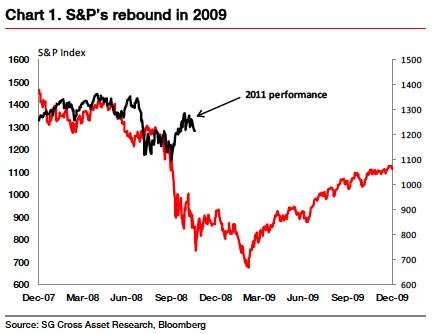
I’ve been having this same thought in recent weeks although markets will never perfectly mirror past markets. Given the high level of fear and the persistent Euro crisis, it doesn’t seem unreasonable that we could experience an extremely volatile and traumatic Q1 2012 ultimately leading to a panic low and a pretty decent rally thereafter. The fear levels in the market currently are eerily similar to 2008 when nearly everyone thought the world was ending. It’s clear that the Europeans can’t act on their problems until they’ve smacked them in the face. So, just like 2009, it might take a waterfall decline to force politicians into action. I’m not making any predictions (I don’t believe anyone can accurately predict market action more than a quarter in advance), but the SocGen note makes sense (via Business Insider):
“Next year is likely to present a similar profile to that of 2009, in our view, with an initial of severe weakness in the short term, followed by a healthy rally. The magnitude of the market moves may however be less significant than in 2008-09, however, on both sides. First, it looks for now that the peak-to-trough correction in risky assets may be less violent that three years ago, which also suggests that the recovery in global markets may also be less pronounced.
We are bullish on emerging markets in 2012, but only after the global backdrop has improved markedly, including on the front of the EU sovereign debt crisis. This means that we will likely have to wait until after the first quarter next year to see a strong recovery in appetite towards emerging markets. In the near term, the major market focus will remain on the severe market tensions, with the risk of an escalation of global financial stress. Against this backdrop, we retain a bearish view on EM for the next few months, before standing ready to be positioned for a broad-based recovery.”
Source: Societe Generale


Emerging Markets. Don’t make me laugh. Investing has devolved into s single bet.
What exists now is 1.00 correlation of most asset classes which are completely dependent on financial models which have failed. Only to be saved by politically corrupt governments. Risk on risk off. Why think?
http://www.ritholtz.com/blog/2010/11/the-end-of-stock-bond-correlation/
Those that track these events on a regular basis are worried, but from what I’ve experienced “normal people” seem to fight me more often than not when I point out that the world economy can get worse. Once I make an attempt to explain my thoughts, they immediately discard my arguments as they want to believe that the worst is behind us. When they do acknowledge that the economy may get worse, they do so with a detachment as if the situation won’t effect them if a worsening does occur.
“They” being my friends and family over the course of the last week! This is a very different tone from 2009. Maybe around the fourth of July their sentiment will have turned dire. At that point, equities may present buyers with a tradable bottom.
In all seriousness, I have no idea what will happen with sentiment if/when we test the 2009 lows considering how unthinkable it is for many. I’m not sure that if things get much worse that struggling people will remain confident.
A waterfall event is probably what is needed to force sovereign actors to act FAST. The only problem is that the actions might be catastrophic ( read: EMU break up). BTW, I think that’s where this is headed either way (EMU breakup), waterfall or no waterfall.
Not quite sure if it rhymes …
- NYSE margin debt has hardly declined at all in 2011 vs. 2008.
- commodity correction only 0.5 of 2008
I thought this was an intersting article which sums up the condition of the USA banking and European crisis. Data to back up another severe recession is coming. Gas is falling and falling here in California 3.53 a gallon.
http://www.businessweek.com/news/2011-11-24/bofa-swaps-soar-to-record-as-u-s-company-credit-risk-increases.html
“The Federal Reserve released criteria yesterday for capital tests measuring the strength of the largest 31 U.S. banks. The standards measure their wherewithal if the U.S. economy sours and major trading partners default on their debt. Lenders need to prove they have the capital to withstand a “severe” U.S. recession with 13 percent unemployment and an 8 percent decline in gross domestic product before they can increase dividends or repurchase shares.”
This is the worst 3-day start the DOW has seen since 1932.
Other investment banks are starting to crack, Goldman Sachs is under $100. Bear Stearns is facing a government investigation. Some are saying now might be the time to buy puts on the brokers and the XLF. Or is it too late?
‘So, just like 2009, it might take a waterfall decline to force politicians into action’.
Spot on. What we’re dealing with is a bunch of leaders who are, essentially, followers. In fact, the calculation may well be quite cynical. Germany will only get the leverage it needs to dictate terms once the extent of the alternative – absolute disaster – becomes crystal clear.
The market may soon oblige. What’s ominous to me is that this week we’ve seen a kind of slow motion market crash – but it’s not generated any panic.
Looking at various objective sentiment indicators & put/call ratios, they suggest that market participants are concerned, but not concerned enough to dump. It’s as if they’re stuck in a tunnel and they can see the oncoming train, but are telling themselves the driver’s bound to stop. August 2008, anyone?
Well, this is my favourite scenario. Bernanke cannot ease until the oil price comes down, because an expoldding oil price will harm the recovery. Then he will buy MBS.
But markets are difficult to figure out.
here’s my 2 cents.
europe in 2012 will be worse than us in 2009. us in 2012 will be worse than europe in 2009, though better than us in 2009.
however, things can get a whole lot worse than 2009 everywhere if japan joins the debt spiral party! their debt markets are beginning to shiver, and if they shake, then there will be a whole lot of shakin goin on!
SocGen has become the bear haven. Zero Hedge always steals their notes from Bob Janjuah, Dylan Grice and Albert Edwards. These 3 morons have been so wrong about everything that it’s amazing they have jobs. But they generate airtime for the firm because the mouthpiece that is Zero Brains posts every note they write and the morons that love having their brains beaten in by scaremongering just eat it up.
You’re right about SocGen. Go through their material of the past few years. It would be funny if not for it being so sad. What’s sad is that no matter how many times the guessers prove to be wrong, it never stops them from pretending that they can guess correctly (or better than random). How irrational!
That being said, it doesn’t necessarily mean they will prove to be right or wrong this time around. Every one of these crystalballers have about a 50/50 chance of getting any one prediction correct. The same for you and I. Good track record vs. bad track record: there is little difference in the odds of their NEXT guess being correct. Thus, I’m not quick to dismiss those who have been wrong any more than I am to think that those who have been right will be right again.
The markets will do what they do. Especially in an environment like this – where govts and central banks can and will interfere and manipulate whenever they want to – guessing is even sillier than usual.
all of a sudden this site became zerohedge?
There won’t be a collapse because everyone fears the bogeyman before he’s here – the sure sign the market will continue to rise. In 2k8 most people were blindsided by the downturn and nothing was prepared, not the case now, we’re at least aware of and trying to solve problems before they happen.
In the markets, when everybody sees it coming, worries about it and talks about it, it usually doesn’t happen. That doesn’t mean that a waterfall decline isn’t going to happen; it means that the proximate cause of such a decline will be something that the overwhelming majority never expected. Risk is very high, but this is when fortunes are won and lost.
Subprime was a symptom of a credit based economy reaching the Ponzi lending stage with the support of central banks throughout the West; it wasn’t the cause of the crash in the USA. The problem with European sovereign debt is a symptom of the same thing; it is not a cause. Deleveraging and massive write offs are a necessity in the West, and can be managed by means of a European banking recapitalization by the ECB similar to TARP, but in such environment externalities are amplified.
The Russian government might be crazy/wily enough to throw a match into the gasoline; perhaps asking for settlement of its oil exports in gold, or something similarly disruptive. Putin is a Russian nationalist who seems to see world politics as a zero sum game. Or the Middle East will further destabilize, leading to roughly the same kind of energy market disruption, with inflation in energy and food prices, deflation in pretty much everything else, and a substantial worsening of the Ponzi stage debt markets in the West, with an attendant dive in equities.
“No one saw it coming” is the usual refrain.
Anyone familiar with my position knows I am not calling for doom and gloom. Please don’t imply that I am. I VERY CLEARLY stated that I was not predicting this, but could envision a scenario in which it happens. I’ve been very consistent in calling for muddle through. And while I became bearish on equities a few weeks ago I explicitly stated that you should not short because govt intervention and excessive fears make this market spring loaded. Please familiarize yourself with my positions better before taking them out of context. Thanks.
“everyone fears the bogeyman before he’s here”. Don’t be so sure that he is not here. Maybe he is already here but hiding in the non-transparent quarterly reports and balance sheets of the largest European banks. They were leveraged up to 30 times capital, and already held who knows how much bad debt even before the haircuts they are gonna have to take on Greek debt, Portuguese and Irish debt, etc. By arguing that the bogeyman’s not here, are you arguing that the EU sov debt crisis is going to be solved soon, or are you arguing that it is not a serious problem and won’t have much impact on the U.S.?
Take a look at the “Business Insider” site on 11/25; there is an article on the 20 banks most exposed to GIIPS debt. The numbers are frightening. Absent a massive Eurozone bank recapitalization via the ECB, or a much more massive (and continuing) monetization by the ECB of GIIPS debt, the banking system in Europe is going to crash. EuroTARP seems inevitable, but the longer the ECB and the Eurozone wait the greater the chance that the situation can spin out of control. So far the depositor base is still mostly quiescent, but tipping points come quickly.
The numbers are far too large for the ECB to monetize periphery debt; a banking recap with ECB keystroke money, deposit insurance with keystroke money, and government control of the worst banks prior to their liquidation is the only way to avoid a 1932-style disaster and allow the GIIPS to take the write offs on their debt that they need to survive going forward.
A significant problem with The Eurozone is that each of the Eurozone members continues to act primarily from national self-interest rather than acting to do what is best for the Eurozone. This is ultimately the main barrier to a “bazooka.”
“There won’t be a collapse because everyone fears the bogeyman before he’s here – the sure sign the market will continue to rise.”
au contraire, mon frere, i think there is alot of lazy thinking among equity holders, assuming that the ecb will do a fed-type qe or that the eurocrats will somehow some way get it right. corzine basically bet his company using this logic.
the eurocrisis may be anticipated, but the resolution is not any easier…especially with so much of europe in as much denial about sovereign debt creditworthiness a the us was about real estate prices.
thought experiment: suppose at the beginning of 2008 everyone in the us was convinced that there was a dangerous housing bubble; would that have made it any easier to avoid the difficulties of late 2008-2009?
as the refrain from casey jones says, 5 long screams and the engine just gleams.
It is always hard to predict entire markets. Broad index funds and mutual funds with hundreds of stocks and turnover galore won’t work well in this environment. Only a careful stock picker can see that some equities are pricing in European doom and a double dip in the U.S.
In fact, BHB, many broad indexes are setting up for their biggest move in years.
http://jamesgoodeonthemoney.blogspot.com/2011/11/year-of-cat.html
Know this and the battle’s halfway won. You don’t need to have an opinion on the direction of the move, in fact it’s better not to. Just hang on to the trend, whether long or short, and let the market make you money.