

STILL NO RECESSION IN THE RAIL INDUSTRY
If rail traffic is any gauge the US economy is continuing to grow albeit at a meager pace. This week’s rail data is still consistent with a muddle through environment and not a recessionary environment. Total carloads were up 0.5% while intermodal traffic is up 5.2%. YTD carloads are up 1.8% which is about consistent with what we’ve seen from real GDP. Clearly, this is not an all encompassing gauge, but it’s served as a reliable warning sign of economic contraction in the past. It would be highly unusual for the economy to weaken substantially without a slowdown in rail traffic.
For now, it looks like this data is confirming my view of muddle through and not recession. It also shows that the Euro crisis is only going to spillover into the US economy if there are serious disruptions in the region that generate a Lehman Bros type of event. Other than that, the weakness in Europe is generally well known. Of course, the risks here remain enormous as Europe’s leaders have proven themselves close to incompetent at every step along the way. While we might be standing on the cliff’s edge, we have yet to fall over….
The AAR has details on this week’s rail report:
“The Association of American Railroads (AAR) today reported gains in weekly rail traffic, with U.S. railroads originating 299,591 carloads for the week ending Nov. 12, 2011, up 0.5 percent compared with the same week last year. Intermodal volume for the week totaled 244,972 trailers and containers, up 5.2 percent compared with the same week last year.
Ten of the 20 carload commodity groups posted increases compared with the same week in 2010, including: petroleum products, up 22 percent; metals and products, up 13.9 percent, and motor vehicles and equipment, up 13.2 percent. The groups showing a significant decrease in weekly traffic included: grain, down 18.3 percent, and primary forest products, down 11.4 percent.
Weekly carload volume on Eastern railroads was up 1.6 percent compared with the same week last year. In the West, weekly carload volume was down 0.2 percent compared with the same week in 2010.
For the first 45 weeks of 2011, U.S. railroads reported cumulative volume of 13,142,833 carloads, up 1.8 percent from the same point last year, and 10,340,944 trailers and containers, up 5.2 percent from last year.”
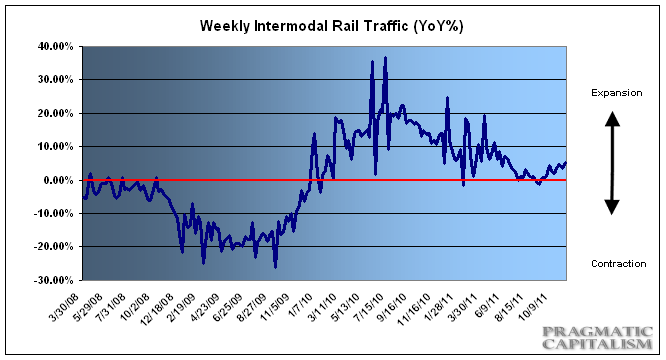


“It would be highly unusual for the economy to weaken substantially without a slowdown in rail traffic.”
Why not a structural adjustment to become less dependent on imports from overseas
Anticipation of increased tensions.
Either you’re talking about oil…. which I’d love to year your solution to oil dependence, because that’s not a US problem, that’s a global problem… or you’re (most likely) talking about China.
If you don’t like US dollars buying Chinese manufactured products, fine. Let’s hear your argument and your solution. Because if you expect Americans to suddenly get paid a wage as low as the Chinese do to make the products we buy from them you are absolutely insane. I don’t mean to throw insults, I mean that literally. You are not a dumb person so what I am saying is you cannot possibly think that the average out of work American is going to work long hours at a rate well below the current minimum wage building products they couldn’t afford.
A new top of the line iPhone costs something like $400 bucks (without a contract, I think). If the manufacturer were producing them on US soil with US labor that cost would be much, much higher. It would put the cost at a level that most people who currently can afford the phone, would not be able to. Apply this to the plethora (three amigos reference, and my Mom said I’d never learn anything by watching TV) of goods we import from China and you are looking at a starkly different US than we have now, one where American citizens are paid well below the current minimum wage and can’t afford most of the products that make us more productive.
I don’t know about you, but I prefer the US as is compared to that.
But, I fully welcome your commentary, your ideas, and strongly wish for you to offer your solutions to this problem you see.
” This week’s rail data is still consistent with a muddle through”
I’d prefer to say that it is consistent with an economy that has not yet caught up with the slowdown elsewhere in the world
Petroleum products up 22 pct is most likely domestic mid-continent crude oil production that cannot be moved by pipeline moving by rail. A big growth area. This would not reflect growing demand for products. It reflects new crude exploration and production techniques and the difficulty of building pipelines, especially permitting (See Keystone XL.) Of course this is still increasing economic activity, just not consumption.
Slightly positive news keeps trickling out. I wonder if the ECRI is worried about their recession call? Consumer spending has held up….so far.
Cullen- did u see page 21 article in F.T today.
“The number of railcars transporting oil in the US was up 19.4% in Oct. from a year earlier..”
“We anticipate that rail capacity will still be req. to move curde oil to the US Guld Coast from midwest throught next year as Seaway willnot be able to absorb all fo the volumes we had anticipated would be needed to be moved”
as a result of moving oil from cushing to the Gulf.
Is Rail traffic stronger at the expense of Truck usage ? What are the Truck shipping numbers how do they compare ? It is cheaper to ship with rail so perhaps Truck Traffic is down