
THE 1987 MYTH….

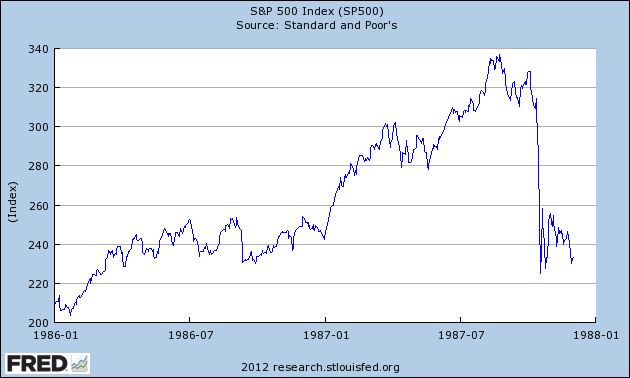
It’s not unusual to see the 1987 market crash bandied about supporting extreme claims.  This outlier event is often misrepresented by bears who are trying to prove why a certain market environment is at risk of a crash or a serious market decline.   In this morning’s Hussman letter, John Hussman mentions the 87 crash in response to the thinking that falling jobless claims are at odds with the potential of a market decline.  He says:

“A particularly instructive instance is 1987. The chart below shows the 4-week average of new claims for unemployment that year. Notably, the persistent downtrend in new unemployment claims provided no barrier at all to the October 1987 crash. I’ve chosen this particular counterexample because we presently observe the same unusually overextended market conditions that characterized the 1987 peak. These include an overvalued, overbought, overbullish syndrome, which has become increasingly familiar near both major and intermediate market highs in recent years, including the peaks we saw in 2007, 2010 and 2011. The 1987 peak also featured the same “exhaustion syndrome” I discussed a few weeks ago in Goat Rodeo (basically a recent “whipsaw trap” syndrome coupled with falling earnings yields).”

I don’t mean to target Dr. Hussman here (in fact I agree with his thinking that we’re overbought and overbullish currently), but reading this reminded me of this myth that we so often see – the myth that today somehow can be compared with the market crash of 1987.

Last year, just prior to silver’s big collapse, I discussed the elements of a bubble and how market disequilibrium forms.  I wrote:

Characteristics of bubbles:

  • Strong fundamental underpinnings. Bubbles do not merely appear out of nowhere.  Bubbles grow over a period of time based on strong fundamental underpinnings.  There is always a very good economic reasoning behind bubbles.  This feeds into the rationalization of its existence and justifies a “it’s different this time” mentality that later occurs.
  • Ponzi builds. A naturally occurring ponzi process begins.    As a recency bias builds (the tendency to overweight recent events and ignore historical facts) the system begins to exhibit herding behavior as more and more investors get in on “the only game in town”.   This becomes amplified by the media, those with a vested interest in this particular market, those who “throw in the towel” after wrongly betting against the trend, etc.
  • Illusion of stability within disequilibrium. The illusion of control increases as investors become increasingly confident in the market.  They increase their bets, increase price targets, etc.  Investors begin to convince themselves that it is “different this time”.  All of this is occurring as the system grows increasingly unstable.  I like to think of it like a spinning top.  When you initially throw a top into a tight spin there is a distinct order in its movements.  They are predictable and stable.  But as the top loses momentum it begins to spin uncontrollably.  The system becomes unstable, unpredictable and ultimately breaks down.  Bubbles work within the same sort of illusion.  What appears like a stable and self sustaining system is in fact increasingly unstable and entering an inevitable disequilibrium that breaks down.
  • Systemic collapse. All bubbles collapse.  It is never “different this time”.  As this prior herding effect begins to break down there is a flood for the exits as the herd reverses its controlled march into a panicked stampede.   The gig is up.  Collapse ensues.

The key element of any unstable market environment is the illusion of stability within disequilibrium.  What most investors fail to note leading up to 1987 was that the market had been on an incredible tear.  In the 22 months leading up to the crash the S&P 500 had rallied 60%.  In the 10 months leading up to the crash the S&p 500 had rallied almost 40%.    All the crash did was take us back to break-even.  The more important part is that this sort of upside move is an outlier event.  And while these kinds of moves might have been supported by improving economic data and earnings, they’re rarely justified by the extent of the ponzi effect and its ensuing disequilibrium.

Investors will often look at these events for a catalyst and a cause without realizing that the cause was right in front of them.  All you need is a good rear view mirror.  When a market enters this sort of a disequilibrium based on herding it always breaks.  And like the 2010 flash crash, the cause can be just as simple as “investor psychology changed”.

A simple (and stupid) analogy is Monday mornings.  Odds are that you spent your weekend doing something you enjoyed.  Maybe you watched a sporting event, attended church, watched the Grammys.  Who knows.  But then you woke up Monday morning and realized you were going to go to work and spend part of your day reading my boring thoughts on markets.  It’s the rollercoaster of emotion that is part of human life.  Stability creates instability.  It’s just part of life.  We don’t need some fancy explanation to know why Monday morning is no fun.  It just isn’t as great as the weekend, when you do whatever you want.  It’s the low in our rollercoaster.  The same rollercoaster occurs in the markets in a much broader sense with the herd driving the collective emotions.

I don’t know what’s going to happen next in the markets.  I would describe today’s market as one in which we’re all enjoying our weekend.  And Monday always comes.  But the point of this story is to show that some weekend’s are better than others.  They breed greater instability which gives the appearance of an even worse Monday when it comes.  Too often, we see people make comparisons to 1987 without realizing that that particular weekend was one heck of a good party.  The Monday (and Tuesday) hangover just so happened to wipe out the fun.  But be careful about listening to people who compare today’s environment or many others to 1987 (not that Dr. Hussman is calling for a crash).  Market bubbles will continue as long as humans exist, but these unstable environments are preceded by very specific events.
Cullen Roche

Mr. Roche is the Founder of Orcam Financial Group, LLC. Orcam is a financial services firm offering research, private advisory, institutional consulting and educational services.

More Posts - Website

Follow Me:
TwitterLinkedIn

25 Comments

  1. Mr. Market (aka Willy2) says:

    The US administration was at that time (1987) very vocally over the fact that they WANTED the USD to go down by 20 (50% ??) supposedly to improve exports. And the USD already had gone down significantly. Well, that was a signal for investors/traders to dump their shares. Which foreign investor/trader in his right mind wants to own a stock denominated in USD of which the value would predictably be going down significantly. Source: Martin Armstrong.

    And about the stockmarket: I see a bearish divergence that signals/could signal the stockmarket could take a (very) significant hit in the (very) near future. I saw the same divergence in june, july and early august of 2011.
    But the most interesting thing will be what T-bond yields will do during this “correction”. My best guess is going down even more for the final last push down.

  2. VII VII says:

    You can learn alot from Dr. Js weekly commentary. His recent under performance from 3/2009-2/2012 is where the real lesson is. His process has failed to deliver and capture the returns associated with what he calls a negative ensemble. It doesn’t mean it won’t but for now his transparancey of why he chose to take certain actions and getting a front row seat to see how this does or does not work is a vaulable teaching moment for anyone willing to pay attention.

    Somehow Cullen always brings this back to a more centrist viewpoint. Which has delivered much better returns to his investors and readers. Good piece CR-your site always makes mondays easier for me.

    • Cy Hailow says:

      @ VII

      Your reply shows you haven’t read Dr H’s article carefully! The ensemble methods were developed in response to RATHER THAN THE CAUSE OF his strongly acknowledged uderperformance in 2009-10.

      If you must critise at least get your facts straight please

  3. VII VII says:

    If I was invested in the SPX. I think I may have sent hate letters to Barrons for putting Dow 15,000. When the hell is Gene Epstein going to learn that contrary indicators includes what he writes.

    No one even flinched on that cover? Not even Ritholtz who posted an insert of New york Magazine weekend insert of the emasculation of Wall St. as a contrary bullish indicator. WTF? Because this is business interest as opposed to general interest? Look…if I’m walking through Burbank airport on Monday…barrons sits right outside the convenience store..below the L.A times, below the Journal but if I’m a lay person…all I see as I grab my snack and mag for the flight is Dow 15,000. Guess what…I buy the magazine. And it goes from business interest to genera interest real fast.

    To this…I would agree with Dr. Js overbullish ensemble.

  4. LRM says:

    @ VII

    I think you mentioned you were holding SDS and I wondered what your strategy is here. Do you have a level in the S&P at which you exit your position or do you add as it goes down a certain % as you build your position. Just trying to see how one goes about this.

    • VII VII says:

      @ LRM

      We put the trade on Jan. 18th SDS @ 17.50 limit. SPX around 1315. I’m down -6%
      I went 20% into this trade. So a couple of things here to add background.
      1. at the early stages of the rally it was not confirmed by high beta. (that has changed) This rally is being confirmed by high beta.

      2. Commodities- If this was an easing story or the enviornment was going to improve fundamentally then energy/Commodities should close the gap. Thus we were long 20% commodities as well. Given CCI a better risk reward. if in fact this was a new bull market. CCI has done well but nothing like some other higher beta.

      3. My next move into SDS has been placed @ 16.49 20% this would equate to something close to 1360 + or – on the SPX. WE sold our LQD to make cash available for this second trade.

      It’s a big trade. 20% then 40%. Were at the upper range of the market so this should work out well. The timing of missed opportunities to hold the lower trade at 1315 is the issue. We’ve been getting sell signals on everything that has moved since Oct. lows the last two weeks. Thus..I don’t know what the opportunity cost for my firm is given we wouldn’t be buying anything here anyhow.

      We sold our XHB, biotech, and other stuff back in early and mid Jan. We’ve been out of this move for 3 weeks now. Just reading Zero Hedge every day to make me feel better about my SDS trade. At least they agree with me.

      In the next month..I’ll post a gain on those trades I put in. I’m just waiting for the the bill to come for those who extended there stay. Soon we’ll be reading from all the smart traders how they got out of the trade they all placed at the October lows. All using completely contrary trading methods but somehow they all were correct.

      You know my trades. Laud me or throw tomatoes at me if you will. At least you know where I stand.

      • LRM says:

        @ VII
        OK thanks for the info.
        So you are in with one position and will double into it if S&P goes to 1360 correct?
        Now what about your protection on the bottom if S&P continues up . Do you have an ultimate level where you say this is not working and take the loss and get out?
        I not that 16.50 is a recent low on SDS and it has been getting close @16.51 today so you may get filled on second tranche soon.
        How long do you hold for your move in sideways action .
        I noted Cullen mentioned something about building a position over a couple of weeks and then expecting trade to stay on for up to 8 weeks.
        You previous comment was helpful and appreciate sharing your experience .

        • VII VII says:

          @ LRM-

          I am having sex with out a condom on this trade. I hear there is a floor under this market. When we start beleiving were protected by rising floors it’s hard for me to worry about my SDS working out.

          • LRM says:

            @ VII

            OK, thanks, you jump in and don’t worry how deep it is cause you know how to swim
            You have been clear and appreciate you candor.
            I had set a mental stop too exit SDS at S&P 1350 so I guess that is too close and I should give it more space.
            I am just learning how to do this and so don’t have a big position but the emotions are still there because there are $$$ involved and not just paper trade.
            I figured it would be better to add to position if it starts to move SDS’s way so wanted to seek your feedback
            Good luck and look forward to your positive report next month!!!

          • Hi VII. I’m on the other side of that. Except for a few (very few) out of the money puts I too am without protection. I would bet you a condom but all this talk about 1987 makes me think I won’t be able to pay up. I hope there’s room left on that side if things go bad over here.

      • Happy Swede says:

        “Just reading Zero Hedge every day to feel better about my trade”

        HAHA so true, have found myself on that site a bit too often lately. I don’t think they ever posted a bullish post. The world is always ending. Great way to confirm your bearish bias. Wish I could take the centrist post like Cullen.

        • VII VII says:

          @HappySwede-

          Zero Hedge is my financial porn- I hate to admit this to you all..but I love that site..it’s so dark and conspiracy ridden. Beowulf knows how much I love the depravity of man to counter Wall St. foolishness.

          I just love seeing a picture of warships in which very well could be off the coast of San Diego doing excercises but are reported as 1/2 mile from Iranian vessels. Or the decline in Electrical Power pointing to a recession.

  5. charlesM says:

    the annualized yield of 3M US Treasury Bills increased from 5.30% on 20.01.1987 to the high print of the year: 7.19% on 14.10.1987 – an increase of 189 basis points
    the yield of 30Y US Treasury Bonds increased from the low print of the year: 7.29% on 09.01.1987 to the high print of the year: 10.25% on 19.10.1987 – an increase of 296 basis points

    source : http://www.sniper.at/stock-market-crash-of-1987.htm

    1987 was so peculiar with all maturity rates going up and equities going up, a perfect collision route. why would one try to find any resemblance with 2012?

  6. Mr. Market (aka Willy2) says:

    The gold-silver ratio was climbing through the second half of the 1980s up to about 90. A level not seen after 1991 until late 2008. And in 1992 Citigroup was bailed out by a saudi prince. And the gold-silver ratio has been rising since late april/early may 2011. Not a good sign.

  7. David Merkel says:

    “Illusion of stability within disequilibrium”

    Very well said, in one short phrase. Kudos.

  8. Anonymous says:

    Cullen Roche wrote: “Illusion of stability within disequilibrium.”

    Mathematically Ljapunoff-Functions can be found for disequilibrium states. They pose limits on the path a system in disequilibrium can take and are one possible way to introduce the notion of stability in disequilibrium.

    A simpler text on this fact is:
    http://www.amazon.com/Modern-Thermodynamics-Engines-Dissipative-Structures/dp/0471973947

    • AWK says:

      Just curious, have you applied these to markets? I’ve used Lyapunov-Functions (this is the more common spelling I know) to develop some pretty powerful indicators, especially in combo with Kolmogorov statistics and fractal analysis. They are especially useful to determine true risk in a marketplace and the level of predictability. They don’t predict price per se though they do correlate highly with future volatility. Moreover, though they usually portend downside problems, they can also be used to predict upside breakout. Right now, these indicators are only a little elevated for the market and don’t give much cause for concern on their own. However, using them with some other methods for trend analysis, I see potential problems in early April. In my experience, these indicators don’t have much power beyond 90 days. But curious to hear results of others. I haven’t seen anybody that uses my approach but this paper has an interesting take: “Control Liapunov function design of neural networks that solve convex optimization and variational inequality problems” by Pazos and Bhaya. They discuss stock market forecasting using models built with these functions.

      • Dr. Oliver Strebel says:

        It was me pressing the send button too quickly in the anonymous posting.

        But sorry, I am not using Ljapunoff-functions in the context of investment. However thanks for the link. I think I will have a look at this paper, although I dont like neuronal networks.

        Either they are linear, then they fall into the well understood area of linear systems theory. Or they are nonlinear, then nobody understands completely under all circumstances what the network does. Hard convergence theorems are IMHO the exception in that area. But maybe I need an update for my knowlegde and the paper will be a good starting point :D .

        • AWK says:

          This paper just happens to invoke neural nets. My indicators don’t. However I want to add that “black box” neural networks that learn non-linear relationships can be dissected and explained by a wide variety of hierarchical clustering techniques – many of which are quite powerful modeling tools themselves, e.g., Random Forests, CHAID, etc. Then the hybrids can be rendered into very powerful predictive tools.

  9. Art Patten says:

    CR: “Systemic collapse. All bubbles collapse. It is never “different this time”. As this prior herding effect begins to break down there is a flood for the exits as the herd reverses its controlled march into a panicked stampede. The gig is up. Collapse ensues.”

    Have you read Didier Sornette’s book on market bubbles? Worth a read. In it, he points out that bubbles don’t always end in panicked collapse–sometimes they just deflate slowly.

  10. Ben Dover says:

    I only wish this was 1987. Wouldn’t it be nice to be able to buy the S&P at 340 again?

    I don’t really feel that 1987 was a bubble. Valuations were not hugely out of line considering the strong fundamental situation at the time. I think that people got nervous because the market had risen so far so fast, and so a correction was inevitable. I’m not exactly sure why it was so sharp.

    The fundamental situation is much weaker now. This doesn’t necessarily mean that I expect a 1987-style correction. But I certainly don’t expect to see anything like the post-87 growth going forward.

  11. Explorer says:

    Sorry but you totally underestimate 1987. The 1 year blow off was only about 20% of the story.

    The two highest 5 year growth rates in the Dow in recent times were to late 1987 and to 2000. to late 87 5 year growth was in the 95th percentile of grwoth since 1960. It was a truly extraordinary period.

    The rise from about 75 to 87 was incredible because of a huge rerating of PE’s.

    The rate of accumulation of surplus of Stock price growth over GDP growth was one of the highest from 75 to late 87 ever because of that re-rating of PE’s from the Oil Shock lows to the death of stag/inflation highs.

  12. flow5 says:

    Philosopher George Santayana said: “Those who cannot remember the past are condemned to repeat it,” In the area of economics it is more accurate to say those who believe economic history reveals eternal truths are doomed to error.

    The 1987 crash was directly the result of the FED’s extremely tight monetary policy. Presently (in early 2012), stocks are neither overbought nor undervalued. But the Fed’s technical staff subscribes to the fallacious Keynesian theory that the money supply can be properly managed via the manipulation of interest rates. I.e., the Fed’s monetary transmission mechanism is through the pegging of the FFR. However, there is only one interest rate that the Fed can directly control; the discount rate charged to bank borrowers. The effect of Fed operations on all other interest rates is indirect, varies widely over time, and in magnitude.

    That said, baring countervailing intervention, stocks will drop in the May & June period (but principally in June).

Contact Us:

Name:

Email:

Verification Image

Enter number from above: