
THE BALANCE SHEET RECESSION CONTINUES
Contrary to reports that consumers are only being forced to pay down debts, the NY Fed offers their own evidence showing that consumers aren’t merely being forced to pay down debt, but are choosing to pay down debt:
“So, U.S. consumers have been deleveraging. Holding aside defaults, they have indeed been reducing their debts at a pace not seen over the last ten years. A remaining issue is whether this deleveraging is a result of borrowers being forced to pay down debt as credit standards tightened, or a more voluntary change in saving behavior. There is evidence on both sides of this question. For example, the Fed’s Senior Loan Officer Opinion Survey indicates that credit standards were tight through much of 2007-10. On the other hand, the reduction in housing and stock values over the same period may have led families to want to reduce their debts, in an effort to restore their net worth. We hope to discuss these questions in more detail in later posts. Meanwhile, we will continue to post updates of household credit conditions on our website.”
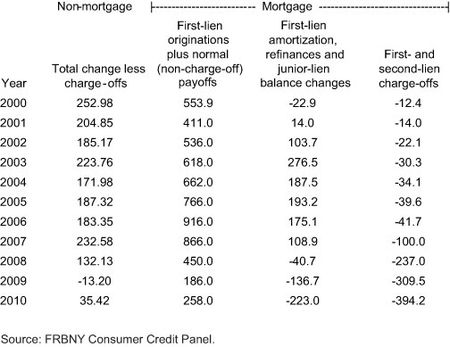
Consumers have recognized that they have an unsustainable problem. For now, de-leveraging continues to be the right path for the US economy (despite the Fed’s wishes of re-leveraging). As I’ve previously discussed, this balance sheet recession is likely to continue well into 2013, assuming that de-leveraging actually continues. If consumers re-leverage this will only add to the unsustainable environment that surfaced during the housing bubble. This all means the economy remains incredibly unstable. These levels of leverage are simply not sustainable and still pose the largest risk to the economy. For now, deficit spending is offsetting the impact of the de-leveraging and is helping to sustain marginal economic recovery.


22 Comments
Although I’m critical of the implementation details of QE2, I’d hate to think where we’d be now with no QE2 at all…
Would have been better if the Fedury had taken a bottom-up approach rather than a top-down one. Examples of a bottom-up approach would be tax-cuts, direct citizen dividends, loan principal modification, etc. A bottom-up approach lets a few hundred million minds decide where to allocate fresh vertical money. A recovering money multiplier leading to high inflation from credit expansion would be countered by raising minimum reserves and raising taxation.
A top-down approach (as we have now for QE2), limits allocation decisions to a few hundred thousand minds (if that) leading to poor results. The money fails to trickle down with sufficient speed and breadth to where it is needed.
Perhaps a bottom-up approach was not pursued as citizens were still deemed to hold an expansionary mindset? Such psychology would simply reflate bubbles.
However, if, like Japan, citizens have indeed been permanently mentally scarred from economic events, then a bottom up approach now would be desirable. Deleverage would continue without a deflationary effect and without punishing those who were prudent.
M,
I am curious. You appear to think QE has had a substantial positive impact. What makes you think this?
I don’t see much evidence showing that QE has done anything positive.
Thanks.
Well, it’s hard to know for sure. We’d need a time machine to go back and replay events minus QE2 to see what happened.
QE1: definitely. Without this I think we would have had a massive problem. It was essential to return banks to basic capital adequacy. Moving toxic assets to the Fed’s books effectively helped defuse a run on the shadow banking system. So I don’t see there as being any question that QE1 was a positive. What I am rather less than impressed with is the total lack of regulatory progress since then…
QE-lite & QE2: if you view QE2 as nothing more than an attempt to suppress long yields then yes, it’s very hard to make a convincing case that it is a net positive. As I’ve said before, easing the environment for mortgagees is offset by alienating fixed income investors. Reducing one risk increases another (the latter being more significant in my opinion). Then there’s the other side-effect of effectively undercutting social security recipients (payments are rate sensitive) which can be seen as either a positive or a negative depending on your angle. In other words, it QE2 is nothing more than a rate operation, then it’s a net negative (IMO).
However, as I’ve maintained since QE2 was first announced, I believe that it’s more than just a rate operation (and here’s where I see the positive). QE2 provides the politically acceptable/legitimate face of deficit spending and I’m not convinced that the govt could get away with the latter without the former (an international security mechanism if you will).
Deficit spending is absolutely necessary during this time (and I believe it is primarily targeted as a stealth State/Muni bailout, secondarily as a Main St bailout). I’m critical of where the spending is being targeted, but it’s essential nonetheless. In my opinion QE2 is closely coupled to this process and we wouldn’t have one without the other. Too many very large international eyebrows would be raised if the USA expanded vertical money without a means to easily sterilize it. Accepting this line of reasoning means that when I say no QE2, it translates to reduced deficit spending. Not good.
Quite happy to hear a counter argument on this point. If you can present a convincing case that broad scale deficit spending could be conducted without consequences from a lack of “international political legitimization” (QE2), then it negates my angle. In that case, what’s left is a simple rate operation and that’s a net negative.
Just to confirm, I understand perfectly well that a government can spend money into existence without bond auctions, sterilizing later via taxation if necessary. But I perceive this time to be different. There were huge numbers in play this time around and I perceive this to have changed the international political landscape, necessitating either QE2, or a deflationary shock for the US. Lack of QE2 (in my eyes) therefore translates to deflation.
QE2 is a nervous global financial system’s insurance policy if you will.
Hm, but as the MMTers keep hammering, QE is not deficit spending, it is an asset swap operation. No new vertical money has been created, right? What makes you think it is more than a rate operation?
And I am surprised you stress the international aspect – I see a much harder, indeed impossible problem to pass any fiscal package thru Congress, which is why they settled for the tax deal.
Mediocritas & Peter,
Am I reading you correctly that you believe the govt wouldn’t be able to spend without QE?
Cullen, I am not seeing QE as spending. This seems to me the conclusion from yours and other MMTers seeing it as an asset swap (i.e., a monetary as opposed to fiscal operation). In other words, no new NFAs created, only reserves in the system increase, but this is not the same as reserves created by vertical spending/tax cuts, because the non-govt sector’s propensity to save does not really change.
The government can vertically spend only up to a limit allowed by the appropriation process and even that with an asterisk of not hitting the debt ceiling and all the brouhaha around it. The tax package passed at the end of last year is the best it could do under the circumstances to act fiscally and not monetarily.
No, no, I never meant to imply that QE made the tax package politically feasible or in fact had anything to do with it. These two are unrelated. And you’re right that QE itself is a political liability both here and internationally, most of for the wrong reasons (the MMTers would be opposed to QE for its ineffectiveness.)
Gotcha. Sorry.
You’re reading me incorrectly. Treasury has been able to run up a deficit quite happily in the past without a QE program in place proving that QE isn’t needed for deficit spending.
But you’re getting close here to the main quibble I have with MMT, the concept that the government can spend money into existence without an equivalent bond auction a short time later. I might accept that this can happen, but it don’t see evidence that it actually does. In reality, it’s just a book-keeping technique, but that’s not the wider perception and the perception is all important.
There are international political factors on the deck here, particularly because the US controls the world’s reserve currency. Rapid expansion of the US deficit married with the usual bond auctions necessitates more involved participation by the Fed, as a much higher % of the auction’s purpose is being devoted to base money expansion and needs to be “legitimized” in an orderly manner.
Auctions are a swiss army knife of finance. One of the many roles they serve is to convince the world that US deficit spending can be forcefully sterilized by external forces at a later date should the government prove unwilling to enforce austerity when inflation picks up.
Don’t laugh, I’ll bet most US politicians believe it!
To pre-empt a possible confusion. This is a glass half-empty, half-full scenario. I’m describing the same thing as MMT a different way.
Said differently. QE2 has been going on for decades, the only thing that changed is that it became suddenly far more concentrated / obvious. It isn’t just a rate operation, it’s the approved way in which the Fedury creates vertical money.
In the past it was more discrete. For example (using Japan and USA):
1. Fedury decides that base money needs to expand
2. BoJury decides that base money needs to expand
3. Fed and BoJ talk.
4. Fed credits BoJ’s account (with USD) out of thin air & BoJ credits Fed’s account (with Yen) out of thin air.
6. Fedury and BoJury run auctions.
7. Fed sits on the Bojury bid. BoJ sits on the Fedury bid.
8. Deficit grows in Japan and America.
9. Media sees strong indirect action and reports that the economy is healthy.
The whole process was driven by the Treasury departments of each nation. They *created* the money, but only a handful of people actually understand what actually just happened. The media sees indirect interest and assumes that foreigners are financing US government spending but that’s not what just happened at all.
Both governments funded themselves and hid it behind a fake currency swap.
QE2 just cut the crap and made it more obvious because time was limited and the situation was FUBAR.
Hm, but Tsy cannot spend on what it wants without Congress authorization. No new vertical money is created that does not fall under one of the programs approved by Congress. (Actually, using terms like “money” is a bad form, we should really be talking NFAs.) So it isn’t like we can really deficit spend and hide it (though in the current circumstances it would’ve been nice to have the ability
)
It is true that the whole debt issuance thing is almost meaningless operationally but may be serving a purpose to allay fears of people who don’t see it that way.
Right, we don’t hide the spending, we put it right out there in the open for all to see and put it under democratic review (if you call what we have “democracy”). But we obfuscate the creation that goes with the spending to add an extra layer of confidence.
The whole thing is complicated by the international reserve currency status of the USD and the need for Eurodollars although it’s questionable whether the Japanese system (for example) is any less convoluted than the US.
Maybe if they taught MMT to kids in schools it would be possible to simplify things in two generations’ time. :-p
I think I agree with your take on the political cover for federal deficit spending. I also noticed that the Reps in Congress are itching to reign in the “autonomy” of the Fed Res Bank ; not that they are likely to succeed.
Right, it’s essential that the world believes that the Fed is truly an independent entity, keeping those spend-happy politicians in check. Reality is not so black and white of course.
Cullen,
I know what you mean when you say, “These levels of leverage are simply not sustainable and still pose the largest risk to the economy” but it is probably important for those less familiar with the topic to say it this way…
…These levels of PRIVATE SECTOR leverage are simply not sustainable and still pose the largest risk to the economy…”
You can go further:
These levels of PRIVATE SECTOR (HOUSEHOLDS ,not businesses) leverage are simply not sustainable and still pose the largest risk to the economy
How about financials? (Leverage of 1:45 is healthy?)
InvestorX
Correct. Sorry, I forget sometimes that others are not familiar with my outlook.
QE is nothing but a confidence game. In this regard, I think it has had it’s desired effect.
And confidence is great, but it needs to be backed up by a real improvement in fundamentals. I have argued that QE is like telling your blind child that he is going to become a world class archer. It’s great in theory, but it is simply setting him up for disappointment. In this environment there is little the Fed can do to actually improve the fundamental standing of the economy. Consumers are still bankrupt and that’s where the fundamental driver of growth must come from. The Fed’s actions are actually detracting from the worry spot in the economy by encouraging the US consumer to become further indebted….It doesn’t matter how confident the consumer becomes. At the end of the day their balance sheet is still an utter mess.
Couldn’t agree with you more. Most Fed action looks to me like a license to continue behavior that got us all in trouble in the first instance. This may be especially true for the TBTFs.