
THE DOLLAR DEBASEMENT MYTH & THE FED’S BALANCE SHEET

Mike Norman just posted a very good fact based story on the relationship between the Fed’s balance sheet and the US Dollar.  As I have often noted, the Fed does not print money.  QE2 is not money printing.  It is not debt monetization.  It will not cause high inflation.  It will not cause hyperinflation.  It will not cause a dollar collapse.  And three years into this massive Fed balance sheet experiment we have the facts.  Mike notes:

Below I give you the US Dollar Index and the size of the Fed’s balance sheet.

Date Dollar Index ValueFed’s Balance Sheet
3/14/2008            71.66                                        $921 bln
7/13/2011            75.24                                        $2.9 TRILLION!

Words don’t do this justice though.  I put together this chart showing the dollar index versus the Fed’s balance sheet over the last three years.  As you can clearly see – there is no real correlation between the size of the balance sheet and the USD.  None at all.   This has all been proven correct despite my repeated ramblings, yet the inflationists and fear mongerers still garner all of the attention. Clearly, people prefer to be scared as opposed to being told the truth.
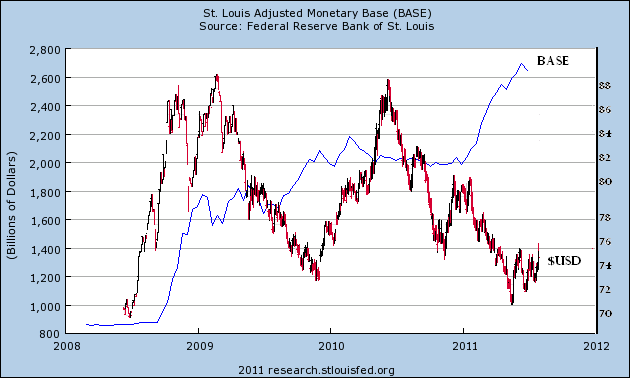
(As they say, a picture is worth a thousand words!)

Cullen Roche

Mr. Roche is the Founder of Orcam Financial Group, LLC. Orcam is a financial services firm offering research, private advisory, institutional consulting and educational services.

More Posts - Website

Follow Me:
TwitterLinkedIn

122 Comments

  1. james says:

    no, the fed doesn’t print money, it just magically “expands” its balance sheet out of thin air.

  2. GCTIII says:

    I understand the the Fed is not deflating or debasing the dollar and agree with that as it applies to MMT. However the actions of the fed,congress, and the president are making investors worried and these actions in my mind are causing the problem.

    Even though looking at MMT purely on the theory itself is fine. We tend to forget the action of the Government and the possible problems it is causing. I guess the human factor is not part of the equation. People are losing faith in the dollar, just my observation. This is causing it to go lower and in turn we are paying more for commodities or gold or something at the store.

    I do understand swaps , I have done many myself, But there is an underlying problem causing the devaluation. I am wondering what it really is besides fear. Maybe someone here can explain that. I know it is a function of swaps but currently there is more going on that is not being taken into account.

    • Cullen Roche says:

      Correct, but this is psychological. It’s sort of like thinking that you’re sick. You can’t think yourself into getting a disease. Eventually, you’ll snap out of it and realize that you don’t have it….

      • rhp says:

        love your optimism, Cullen, but psychology creates perceptions (or vice versa) and perceptions create actions….some of which can lead to unnecessary wars, or unnecessary defaults, or unnecessary abandonment of the dollar. North Korea need not be in a famine, yet human psychology there is creating untold misery. People CAN think themselves into misery (dis-ease) and not come to their senses before they die….I see it as a physician every day.

        I think GCTIII has a point. One thing that is puzzling me tho’ is the psychology surrounding gold and trsys, both of which are perceived to be holders of value at the moment. Seems diametrically opposed.

  3. pm says:

    Good presentation of FED balance sheet:
    http://www.frbsf.org/publications/economics/letter/2011/el2011-11.html

    Can anyone concisely explain the mechanics of a Treasury Security actually maturing on the FED’s balance sheet. I understand they can reduce reserves by selling via the open market desk, but what happens if billions of Treasuries mature in their possession if the Treasury cannot pay off? What account does the money come from if they can pay Off. Can the FED internalize the current situation by purchasing as much of the maturing securities as it can before August, reducing the risk that the Treasury will not have the cash flow to actually honor a maturing security being presented by someone outside the system? The FED now has the ability to create a negative in a Treasury account on the right side of its balance sheet. If the FED bought up Treasuries just prior to maturity and the Treasury could not pay off immediately, would such an account go negative thereby balancing out the increase in reserves created by the FED’s purchase? Such a situation would be reversed when the Treasury provided additional cash or sold more bonds at a latter date.

    Anyone have a good feel as to how this will work in reality?

  4. Another John says:

    Cullen,

    I love your work, but I couldn’t help noticing you falling all over yourself to reiterate your “respect” for everyone you criticize.

    “It is never my intention to make things personal. Merely to show others why I believe someone else’s argument is incorrect. I hope to always do so in a fact based manner and not a manner which directly disrespects someone else through the use of ad hominems or weak evidence….” – Cullen Roche in comments at 9:32pm on 7/13/11

    Via Twitter:

    “It astounds me how these “great” bond managers can totally misinterpret this stuff and do well.” – Cullen Roche @PragCapitalist on 7/12/11

    “John Mauldin is so full of shit that I can’t even repost his stuff half the time…” – Cullen Roche @PragCapitalist on 7/9/11

    Just a couple of examples.

    Note: I actually agree with these statements even though they could be characterized as less than respectful.

    Best,

    Another John

    • Cullen Roche says:

      I don’t really respect the people who are using politics to push an agenda based on bad economics. Most of the money managers I discuss don’t fall into that category. The Mauldin’s and Paul Ryans of the world do though….It is very hard to respect a man who pushes an idea based on politics rather than sound reasoning and hurts millions of people in the process. Gross and the others don’t fall into that category.

  5. Willy2 says:

    Yes, that ballooning of the FED’s balance sheet WILL kill the USD. But NOT today, tomorrow, next month or this or next quarter. Perhaps in 1st or 2nd quarter of 2012 or in the next 12 or 18 months. But the day of reckoning WILL, sooner or later, come.

  6. GCT says:

    Mr. Roche I asked you a question about spending past our debt limit a week or two ago. Your reply was we could be headed into bad inflation if we do that.

    If the government decides to increase the debt limit to 14.8 trillion dollar in todays economy, I feel we could be in real trouble. Yes this is a feeling as our economy is pretty much stalled and moving in first gear. I think we are going to have to do more and herein lies my problem. If we do not cut something and continue to spend we will exceed our natinal GDP this year. I am going to confess this does indeed scare me. I know about Japan but do not consider the USA in the same situation. We do not save in this country like the Japanese. What will happen if we do this? Based on studying your posts and some folks in these forums that do not have political agendas I have had to really change my outlook on money so keep up the good work.

    • Peter D says:

      (trying to repost a comment that did not go thru, apparently)

      GCT, the $14.8T figure includes something like 40% of intra-govt debt. This is the debt held by SS trust fund and other agencies of US govt, as well as the debt help by the Fed, which is also a brunch of US govt. So, this is an accounting fiction – the debt the govt owes to itself! Which means that the ubiquitous debt clock overestimates our debt by something like $6T!
      That said, even if we did have a $15T debt, that in itself doesn’t mean anything. The debt could be a symptom but not the cause of our economic problems. Actually right now our problems exactly requre the govt to increase its deficit (and thus debt) thru tax cuts and/or spending increases. The rules of Functional Finace state that:

      1. The government shall maintain a reasonable level of demand at all times. […]
      2. […] the government shall maintain that rate of interest that induces the optimum amount of investment.
      3. If either of the first two rules conflicts with the principles of ‘sound finance’ or of balancing the budget, or of limiting the national debt, so much the worse for these principles.

      Rule (3) above applies to our situation.

    • rhp says:

      GCT, since Peter D is commenting on part of the gov’t being a “brunch”, thought I might try to help out by using McDonald’s as an analogy.

      When you see that McD is continuing to increase the # on its billboard to “now over 10 billion sold”, do you get concerned? I don’t. Likewise, after finding this site and following for a few months, I don’t get concerned when I see “over $14 trillion spent into the private sector”. As far as I can tell (and others more knowledgeable than me can correct if I’m wrong), this figure is the total amount that the gov’t has “spent” into the private sector since the federal gov’t was created. It is the amount of money the gov’t has had to “print” to keep up with the growth of the US population and the US economy over the course of the past 200+ years.

      If revenues accruing to the gov’t had always balanced out the outflows, you would have the same amount of currency floating around that you had back a hundred years ago. In 1862, I believe the gov’t authorized the first “greenbacks” in the amount of some $300 million. Considering that Bill Gates alone has about $50 billion, I believe the gov’t has been doing OK in expanding the country’s money supply to make a few bucks available to you and me as well as Bill.

      The $14 Trillion (minus what Peter D mentions that we owe ourselves!) only becomes an issue when the amount of money circulating has no relation to the country’s productivity.

      Another way to think of it……..a 5 kg infant has about 350 mls of blood, a 1/3 of a quart. You’ve got about 5 liters. Our young nation didn’t need as much currency floating around. 200 years later, we need $14 trillion or thereabouts. Reduce that “debt” to zero and what have you got? Zero money in the private sector! Gov’t “debt’ all reduced to zero and we are all flat broke here in the private sector.

      The point Cullen and other MMT’ers are constantly trying to make is that the “debt” is not really DEBT! Once you get your mind around that concept, you will start uttering tons of profanities in disbelief until your nervous system adjusts to the new reality, and you will probably change your financial reading sites dramatically.

      OK, enough of my autobiography. Hope this helps…….

      rhp

  7. GCTIII says:

    Thanks for the replies. I thought the current debt ceiling was already at 14.2 trillion. I agree we need more deficit. No argument there.

    I did ask Mr Roche about increasing the debt past total GDP of the USA and he replied we could get bad inflation. So assuming politicians will increase the debt ceiling past that, I felt we needed to cut some governement spending. When I do try to do research the 14.2 trillion always comes up not the 6 trillion.

    Again thanks now I have a difference reference as to the debt. Honestly using this theory we should have just gave money to people and allowed them to pay back their mortgages and spent in the economy. That is hard to wrap your head around. What makes it even harder if I understand the theory you really do not need to tax anyone if you control the money.

    • Adam says:

      GCTIII,

      Just a couple clarifying items…

      “…about increasing the debt past total GDP of the USA and he replied we could get bad inflation.”

      Debt relative to GDP doesn’t cause inflation. However, if the government DEFICIT spends beyond the capacity to produce then you get inflation. As a side note, excess demand can come from any sector of the economy, not just the government.

      Taxes… While the government may not operationally need taxes for spending, it needs taxes to ensure there is demand for its currency. If you didn’t need to pay taxes why would you need the government’s money?

    • Peter D says:

      GCT, look here, for example:
      http://www.treasurydirect.gov/govt/reports/pd/mspd/2011/opds062011.pdf
      Intragovernmental Holding are 4.6T out of 14.4T – about 32%. So, I overestimated intragovernmental holdings, but that still leaves only 9.7T held by the “public”.
      Now, regarding inflation, how is that a concern right now when we are staring into the maw of deflation, with 20% un- and under-employed? To worry about the government “overspending” right now and causing inflation is like for a starving man to worry that if he eats he will get fat.
      Overspending is a concern – nobody says it should never matter – but not even remotely in the current situation.

  8. Sherman McCoy says:

    OK, then why do Jim Rogers and Felix Zulauf think your F.O.S.? Personally, I have no view on the inflation/deflation debate except of course for the fact that the U.S. government solves a lot of problems by inflating them away, and gets nothing from deflation.

    I know Zulauf’s and Rogers track record, your is still a mystery. Maybe if you shared audited numbers, and your current portfolio I could hold you in higher esteem than a pimple faced paper trading teenager.

Contact Us:

Name:

Email:

Verification Image

Enter number from above: