
Home » Most Recent Stories, Myth Busting

THE BOND MARKET DOES NOT CARE ABOUT HEADLINE INFLATION

15 July 2011 by Cullen Roche 12 Comments

Every time the inflation report comes out you get analysts and investors complaining about how the government excludes food and energy in the core prices.  There’s a very reasonable explanation for why they do so – the volatility created by these inputs generates a skew in the data that could lead to inaccurate conclusions regarding the true state of inflation.  Of course, even policymakers make mistakes using this data (often because they are being reactive to data rather than proactive), but the thinking behind this “ex food and energy” makes a great deal of sense.

Now, small investors are particularly irritated by this because all they see on a daily basis are food and gas prices.  We tend to be overly obsessed by that which is constantly in our face.  It’s one of the many biases that influence our daily lives and lead us to irrational conclusions.  Food and energy are just two of the hundreds of inputs in the consumer inflation data.  I constantly harp on the fact that housing gets a bum rap despite being the most important monthly consumer cost – by a wide margin.

But there’s a more important point here.  While consumers and small investors are busying complaining about headline inflation, savvy investors are busy worrying about the core.  This ties neatly into recent discussions on the bond market and why rates are so tightly correlated to Fed policy.  After all, the Fed has been abundantly clear that they are concerned with core inflation and not headline.  So it’s not surprising to see a very high correlation between bond yields and Fed policy.

But what’s even more interesting in this whole discussion is a look at the correlations between bond yields and inflation.  If you back the inflation data out over 20 years and review the correlations between headline CPI and core CPI you’ll actually find that the bond market cares very little about headline CPI.
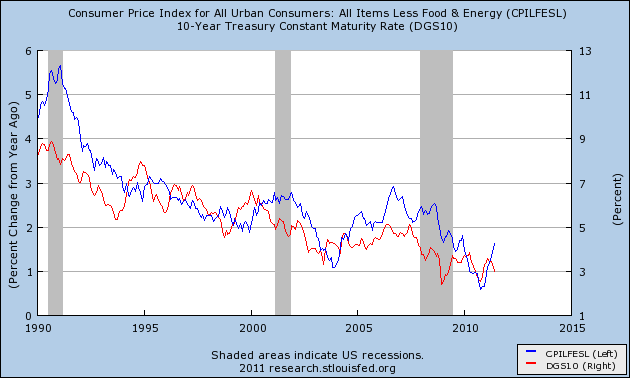
(10 year yields vs core CPI)
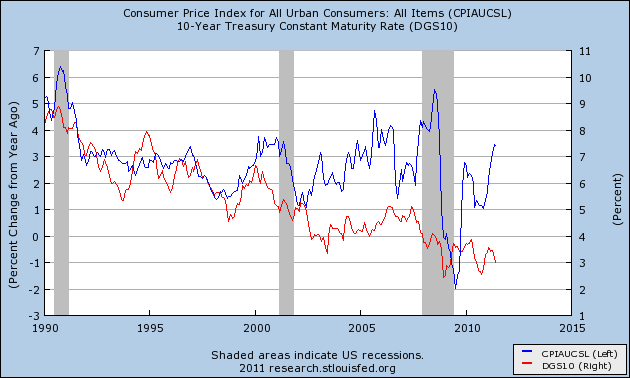
(10 year yields vs headline CPI)

If you run a little data analysis on these two data sets you’ll find a 83% correlation between core CPI and 10 year yields and just a 52% correlation between headline inflation and CPI.  The bottom line: the bond market doesn’t give a damn about headline CPI.  

Cullen Roche

Cullen Roche

Bio - Coming Soon.

More Posts - Website

Follow Me:
TwitterYouTube

Disclosures - Unless otherwise noted, authors have no positions in any securities mentioned and readers should never consider this to be investment advice. Always consult your financial advisor before acting on any ideas. Comments Guideline - Readers who denigrate authors or other readers will be banned without warning. This site does not tolerate any sort of reader abuse. The goal of this site is to create an environment that is conducive to learning and better understanding of the monetary system and the investment world. We expect readers to behave maturely and responsibly. We welcome and encourage intense and intelligent discourse, but the site adheres to a strict 1 strike policy. While it is your right to speak freely, it is not your right to behave childishly. Above all else, please enjoy the site. It is intended to be used as an educational tool and we hope the intelligent and mature debate will further that purpose. We hope readers will make an effort to respect that goal. Comments with excessive linking or foul language will be moderated before posting.
Comments
  • Sergei

    It is not about the markets given a damn but about the FED giving a damn. Markets just follow the FED

  • El Viejo

    Typo???? “core” instead of “headline” in 3rd paragraph: But there…

  • jswede

    yup. over time, headline – core = 0

    ever so slightly rounded, depending on your time frame.

  • Bob Barker

    Cullen:

    I’m confused. On the one hand, you always talk about how interest rates aren’t going to go up until the Fed wants them to because they set the rate and can pin it wherever they want. On the other hand, in this piece you say that the bond market doesn’t care about headline inflation, which implies to me that you think that there is, in fact, a bond market that can, in fact, care about inflation when it chooses to and can, in fact, raise rates when it wants to.

    So which is it? In other words, theoretically if there were true non-headline inflation, yet at the the same time the Fed wished to keep rates low (let’s assume there was a stagflationary scenario), then which would win out – would rates stay low courtesy of the Fedx or would they go up courtesy of the bond market?

    Thanks.

    Bob Barker

    • The bond market cares about what the Fed cares about. And the Fed cares about core. Clear?

      • Wh10

        But what would happen in Bob’s scenario? If the Fed cared about keeping rates low despite inflation, would the market follow despite negative real returns? Would primary dealers continue to rig the system so to say? I can’t help but think of Auerback’s Operation Twist article where he says the Fed must satisfy investor’s demands for decent returns given inflation. I guess alternatively, IOR could keep the FFR where the Fed would want it.

  • TPC:

    1 samll reason why the food & gas prices matter?

    “Now, small investors are particularly irritated by this because all they see on a daily basis are food and gas prices. We tend to be overly obsessed by that which is constantly in our face. It’s one of the many biases that influence our daily lives and lead us to irrational conclusions. Food and energy are just two of the hundreds of inputs in the consumer inflation data. I constantly harp on the fact that housing gets a bum rap despite being the most important monthly consumer cost – by a wide margin.”

    Of course it is (housing costs). But, for those folks out there who are so rich that they need NOT CARE about these costs and the remainder of the costs on your HH monthly budget balance sheet – of course your argument follows.

    For those of us who DO NOT qualify to be in the category above, (me for instance), you are left with trying to cut costs among the existing “degrees of freedom” left to you – and that is where food, gas, & energy costs matter a whole heck of a lot.(as well as discretionary spending)

    Reducing these costs are the ONLY option you’ve got left – in order to save more – or to just reduce your costs in order to pay debt down.

    That is why it matters so much and should NOT be so dismissively dismissed – SIR!

  • Mazama

    I downloaded the entire series of 1) CPI less food and energy and 2) CPI for all urban consumers. The series sans food and energy dates from January 1957, so there are 54 years of data to compare.

    Using a rolling 12 months year-over-year measurement provides 631 data points for each series and the overall average was 1) 3.07% average annualized CPI less food and energy and 2) 3.17% average annualized CPI for all urban consumption. It appears the two series produce a very similar result over long periods but do vary materially for some extended times.

    For the years in Cullen’s graph – 1990-2011 – the two series are very close at 1) 2.65% v 2) 2.78%.

    From 1958-1975 – pre-OPEC oil shock – the two series were 2.87% v 2.78%;

    During peak inflation 1976-1981 the two series were 7.98% v 8.88 as oil and food outpaced other prices;

    From 1982-2007 the two series are balanced on average at 3.80 v 3.66%;

    Most recently from Jan 2008 – June 2011 the rates are historically low but the differences between the two series widens to 1.74% for core inflation v 1.94% for head line inflation, which puts headline inflation 11% higher than core inflation which is the same RELATIVE difference that occurred during the post-OPEC shock of 1976-81.

  • ManWah

    From the emerging market prospective, the bond yield, Fed policy has a significant co-relationship with our inflation rate ( core or headline). Can someone tell me why is that? The emerging market burst happens when the real GDP growth in China less than US. Any comment?

  • “Food and energy are just two of the hundreds of inputs in the consumer inflation data.” If so why not include them ?

    Are they not the two most important component of any economy ?

  • Rate scan be manipulated downward to artificially stimulate the economy
    but once this has been done they can not be manipulated upward again with out causing a collapse. If your $500,000 house monthly payments where the same as your neighbor that payed $250,000 a few years before that means that any small increase = 100% more financing cost to you than that neighbor. That is why this is a catch 22.

    Once rates have been manipulated downward for an extended period of time its game over even if they would stop any manipulation its to late since lenders have little alternative but to pray and keep rates low so that the borrowers will be able to make there payments.

    Basically Alan Greenspan set out a “Lobster trap” to Ben Shalom Bernankee.

    As soon as he raised rates in 2008 the abusive credit house of cards started to completely collapse so he had no choice but to immediately reverted toward a rapid decrease in the fall of 2008.

    Its like having two meals at noon you will most likely skip dinner.