

THE SLOWEST NON-RECESSIONARY GROWTH SINCE 1947

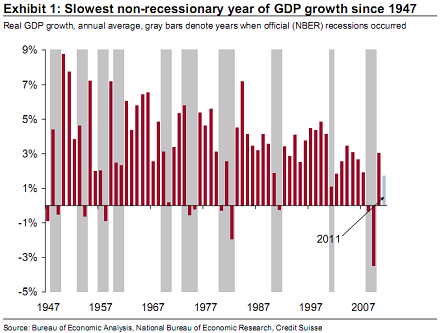
I know it’s all the rage to be super optimistic about the economy right now, but as one of the few people who cited double dip fears as vastly overblown last year (when many were calling for renewed recession) I think it’s important to maintain some perspective here and not get overly excited about the sort of growth we’re experiencing.   Yes, the economy is NOT slipping back into recession, but growth is also very weak.  In a recent note Credit Suisse does a nice job of highlighting the macro picture here with an emphasis on the weakness of this recovery:

• Economic performance improved in the final quarter of 2011. But the year overall was the slowest non-recessionary year of GDP growth since 1947 – hardly cause for a victory lap.

• Recent data make us more secure in our belief that the expansion will persist unimpeded in 2012. We remain skeptical that a new phase of sustained faster growth is upon us. We still expect 2012 GDP growth at 2.2% on a Q4/Q4 basis (2.3% annual average).

• In our last forecast review, we cited risks around that forecast as being titled to the downside. Risks appear more balanced now, due in no small measure to the ECB’s three-year long-term refinancing operation, which has reduced financial stress and the risk of a systemic panic in global financial markets. Reflecting more positive recent developments, our recession probability model has fallen to virtually zero from a local high of 35% in September 2011.

• The economy shows symptoms of a slowdown in potential GDP growth. The fact that the economy has not managed a single quarter above 3% since the early stage of the recovery is telling in itself. This may reflect structural change as much as cyclical disappointment.
 

Source: Credit Suisse

Cullen Roche

Mr. Roche is the Founder of Orcam Financial Group, LLC. Orcam is a financial services firm offering research, private advisory, institutional consulting and educational services.

More Posts - Website

Follow Me:
TwitterLinkedIn

17 Comments

  1. “The fact that the economy has not managed a single quarter above 3% since the early stage of the recovery is telling in itself. This may reflect structural change as much as cyclical disappointment.”

    Democrats have been in control of both houses of Congress from the 2006 mid-terms until the mid-term of 2010 and for the first two years of this Presidency they had a veto-proof, super-majority control over the legislative and executive branches of government.

    Even the most generous amongst us would have to accord some responsibility for this underperformance to the policies of this Administration.

    • VII VII says:

      If you wanted to get a thread going…there is no better way to incite the minnions. Discarding the historical facts that secular bear markets occur and are a result of years of debt buildup. There are severe consequences of debt buildup that well….4-5 years of one parties control can’t cure. This is not my stance but the great economists of all time. Thus while it may be popular to blame one party on some sites…I think the readers here will which are well informed will have a hard time deciding not if your politicing data(the answer is yes) but wether they want to take the time to respond to something so nonsensical.
      Both parties as well as many others are to blame. I thought the many great sites created since 2008s crisis had provided enough factual evidence to not be discussing this issue heading into an election. You’d simply have to ignore the factw to write what you just did. But if you wanted a thread. you’ll probably get a good one. Again…I hate politics..and this is why. Connecting the wrong information to push an agenda

      • hangemhi says:

        VII – nope, I think you squashed the potential with your brilliant answer.

        What I noticed in the chart was how the black line was so much deeper than previous black lines… deeper drops logically mean rougher recoveries. Plus we all know that neither party knows anything about MR, so they are unable to convince each other that their policies are the right policies. Of course I am learning the hard way that even though I undertand MR reasonably well, I can’t win an argument with friends who just flat out state “you’re wrong” “that makes no sense” and even “you’re an idiot” for believing in MR. So even facts and evidence eloquently presented are no match for ignorance. We’ll see. With Cullen’s passion and coming new site, who knows, maybe ignorance is about to meet its match. For now…. muddle through if we’re lucky.

        • “.. deeper drops logically mean rougher recoveries.”

          Empirically incorrect. The deeper the recession, the stronger the recovery which is in fact the reason why this recovery is described as the poorest on record.

          If you don’t think legislative initiatives and political stances don’t effect economic performance then clearly we have a premise that we diverge upon from the outset.

          I personally think that the pushing of Cap and Trade, an out of control EPA determined to raise the cost of energy, the incessant need for raising taxes, bashing of the banks and the rich, Obamacare, deficits, union card-check, blocking Keystone, and many other initiatives have led to a depressed economic confidence in the business community which I believe has directly held back business investment and employment growth. All of which are the policies of this administration and the Democrats controlling congress with a few exceptions – those Democratic senators who will not support Obama’s policies and have blocked most of these legislative initiatives. Thankfully I might add.

          My answer is as reasoned as yours and entirely logical from my viewpoint. I blame feckless Republicans under Bush for their stupid fiscal policies as well but the Nancy Reid and Harry Pelosi Congress made them look like bush leaguers by comparison in terms of useless and wasteful spending.

          If we had embraced the opposite policies of the above, I contend we would have had a much stronger recovery in this business cycle.

          • hangemhi says:

            me and my big mouth saying VII’s answer ended the political debate…. cause you’ve sucked me in with your GOP laundry list of talking points….

            firstly – sure, it should be a bigger comeback if it is a farther fall. What I’m saying is that it is a more difficult task. The deeper it is, the harder it is to climb out.

            secondly – are we not all on the same MR page here? That is that more spending is necessary to make up for the deleveraging private sector, among other things? I don’t see that on your laundry list. And spending is what the GOP is against – so are you a MRer, or not?

            Lastly, I find it humorous that people can say “economic confidence” has anything to do with a business person’s decisions to expand. What a joke. What do they do when they’re single and see a woman they’re attracted to? No confidence – no game – go home. See ya, get a real capitalist in the game. Meanwhile, if they walk into a bar and there are no woman to ask out, it does not matter how confident they are, they’re going home alone. The same idealogical wind bags talking about confidence will spend millions of dollars to effect the outcome of an election when they know the odds are vastly against them. They will spend millions on lobbying for outrageous laws that may or may not get passed. They make huge bets in hedge funds that more often go wrong. They have the confidence to do all kinds of other things – but not hire? Bunk. No demand, no hiring. Period end of story.

  2. MGK says:

    Cullen,

    We never seem to have problems identifying a contracting economy or one that is growing too fast (maybe the Fed does, but that’s another issues). In addition, the “concept” of a recession seems to have a specific definition, but somehow, it takes some opaque cabal of “experts” with perfect 20/20 hindsight to inform us that it occurred.

    The real issue is assuming that “growth” is anything >0.0%. There are several problems with this. You can predict no recession, but if we go through 4 quarters of 0.1% growth, you can pat yourself on the back for your prognostication, but it’s will still feel and behave like a recession. Furthermore, with if population growth exceeds economic growth, then even with postive economic growth, the per capita standard of living is still declining. Finally, if minimal economic growth is coupled with increasing economic inequality and the majority of resulting income from that little growth is going mainly to the 1%, it will still be regarded as insufficient growth.

    My point is that a single absolute number (GDP % change) is inadequate to assess the overall health of the economy and so arm wrestling contest about it are meaningless.

    • WolfePaq WolfePaq says:

      The National Bureau of Economic Research is the body that officially declares a recession or the end of a recession. They conveniently CHANGED their definition to end the current recession. So there is no double dip- we never came out of the lehman induced balance sheet recession.

      The old definition was a return to economic activity levels, now it is simply a positive GDP print.

      LEVELS MATTER!

  3. Junkie says:

    Hi Cullen,

    Recently, you have made some postings about expected levels of growth and inflation. And you have also said that you would be a buyer of US treasuries (at least if yields spike a bit).

    This interests/baffles me. Right now, the yield on a 10-year UST is 1.86% and the yield on a 10-year TIPS is -0.26% … this means that 10-year inflation is 2.12%. This means that one’s real yield is negative if you hold a 10-year UST to maturity at current prices!

    See here: http://www.bloomberg.com/markets/rates-bonds/government-bonds/us/

    Why would anyone chase negative real yields??

    I know that long-dated treasury yields are a function of expectations for short-term rates, but it would seem insane for people to accept a negative real yield over a 10-year investment, especially with such a massive risk of inflation and/or base rates rising over that period. Over an investment period of 1 year or more, surely USTs are a terribly precarious to hold your money right now?!

    The defining characteristic of the current era of global financial markets is, in my opinion, the massively distorted/repressed yields on US treasuries, and I would be most interested in your views, and those of other PragCap readers, on this.

    • Cullen Roche says:

      I don’t find tsys attractive right now, but people are seeking a safe liquid asset that yields more than a checking account. There’s a price appreciation component built in there also so don’t just look at the yield and for the potential for price appreciation.

      • Andrew P says:

        I just bought some TIPS. The yields are terrible, but (w the inflation adjustment) it is higher than the 0.3% that my savings account gets. And besides, I have to keep my savings account below 250K. I don’t trust ANY bank or credit union in a general collapse. Any amount above the FDIC insured limit is a high risk gamble. The broad stock market isn’t worth buying right now (although I am nibbling at certain sectors), so there really isn’t any good place to stash money. Anything above the FDIC insured limit that isn’t used to nibble on stocks goes into Tsys.

  4. Junkie says:

    You mean that prices could rise / yields could drop further from here?

    But all predictions I’ve seen seem to say that the 10-year yield could get at low as 1.5%, but not much lower. That’s only 36 basis points away from where we are now.

    Would you advocate buying treasuries in the hope of a 36 basis point gain in yields, in light of the massive downside risks of being long from here?

    • Cullen Roche says:

      I am not bullish on tsys at present. :-)

      • Andrew P says:

        I am not terribly bullish either, especially because Bill Gross IS bullish on Tsys (he has been consistently wrong of late). But you have to admit that there still could be some upside in Tsys. In principle, the 10 yr and the 30 yr could all get pegged at zero if Bernanke gets desperate enough. And the politics IS bullish for Tsys. Bernanke wants to stay in power, and that means he has to engineer Obama’s reelection, since all the Republican contenders have promised not to reappoint him (in my view, the Republicans made a strategic error by making this promise, but that is another topic). So, if Bernanke pegs the 30 yr rate at 1% this Summer (QE3), Obama recess appoints a new FHFA director who refinances all current mortgages at 2% regardless of LTV or employment status, and Bernanke buys up all the Fannie / Freddie bonds from the refinancing (maybe 5 Trillion worth of QE4 !!), Treasury rates will hit an all time low that will never be reached again – ever. It could be one final blowout. One last hurrah. ….. Or maybe not. Obama strikes me as a bit too cautious. He has radical roots, yes, but he strikes me as a little too cautious to do a refi plan as bold as I am describing. Time will tell.

        • Junkie says:

          wow, pegging the 30-year rate at 1%!! That would be quite something – I think it’s highly unlikely, however. Firstly, it would mean the Fed would need an unlimited size to its purchase program, which will never be approved. The QE programs thus far have involved setting a size, and not pegging a rate, and a proposal to engage in an uncapped program will never have legs.

          Secondly, growth would have to be negative before anything even close to that was put on the table. Thirdly, regard has to be had to inflation – I realise that we’re in a balance sheet recession and you can’t “push on a string”, but if you make saving so unpalatable then you risk some serious misallocation of capital and possibly also inflation.

          Cullen – do you agree?

        • But What Do I Know? says:

          This may be the reasoning that Bernancke follows, but all lowering Treasury rates does is suck interest income out of the economy. IMHO, QE is actually deflationary, since it removes some of the interest subsidy implicit in bond payments (if I understand MMT correctly, there is no need to issue bonds, bills, or notes to fund the government. Therefore, any interest the government pays on its debt is a subsidy.) Likewise, reducing mortgage rates is also deflationary since principal is retired faster (debt is retired–money goes away.)

          The economy is starved for cash flow–QE will only hurt more. Of course, BB sees it the exact opposite way, so he will continue with his “medicine.”

  5. wally says:

    While all the analysts want to treat the economy as a whole piece, the single factor now in the slow US economic performance is the construction industry. Peg that single industry back up to historic norms and we’re looking OK now.

Contact Us:

Name:

Email:

Verification Image

Enter number from above: