

THE “TRANSITORY” INFLATION….BERNANKE WAS RIGHT
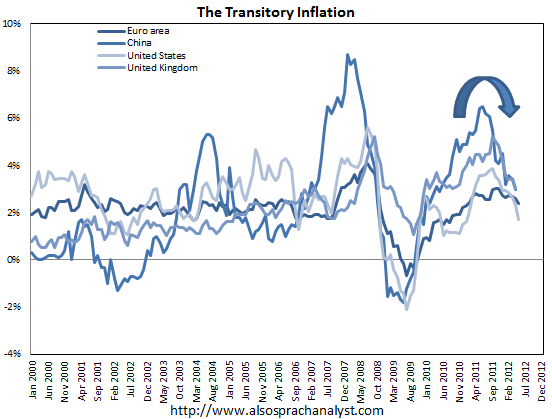
I don’t often give Ben Bernanke a lot of credit for the job he’s done. I am admittedly hard on him and perhaps unfairly so. But he deserves some serious credit for his persistent comments on inflation in the last 24 months. Dr. Bernanke was mercilessly mocked in some circles for calling the surging commodity prices following QE2 “transitory”. In early 2011 he was cited:
“I think my take on inflation right now is that we are indeed seeing some increases, obviously,” Bernanke said. He attributed them to “global supply and demand conditions.” But he reckons these prices “will eventually stabilize.”
“I think the increase in inflation will be transitory,” Bernanke said. But we added: “we have to monitor inflation and inflation expectations extremely closely because if my assumptions prove not to be correct than we would certainly have to respond to that.”
He was further mocked by some who said the inflation would prove global in nature and that the impact would eventually spread to the USA. But this excellent chart below from Also Sprach Analyst shows that Ben Bernanke was very right about inflation. He deserves a great deal of credit for his prescience on the inflation front.


30 Comments
Credit where credit is due.
Its a bit stickier in the UK, but nothing some sustained and reckless deficit spending wont fix
How about a tax cut?
-core CPI is still trending up!
-US inflation greatly benefited from a sharply rising dollar and falling home prices. both of these trends are about to revert
-in an economy with negative interest rates and very slowly rising wages inflaion rates of 2-3% hurt the average american more than 10years ago
careful, your making sense.
Europe and China are decelerating. I don’t see how Bernanke can take credit for that. Bernanke’s monetary policy has been a disaster for savers,is squeezing pensions and pushing people to invest in risky assets that in all too many cases will not perform as advertised. The low interest rate policy in my opinion played a role in MF Global’s Euro Trade and JP Morgan’s whale blow up.
a stopped watch….
I simply cannot understand the lionization of The Bernank. It’s like a doctor who tells you it’s great to smoke, gain weight, and not exercise, and then after your heart attack successfully performs bypass surgery on you. I suppose you thank him for saving your life, but would you keep him as your physician?
Well, let’s be honest – the consensus was almost always on Bernanke side. Just look at all key government bonds markets!
Also, no need to guess how he (and everybody else ih his cohort) would fight the new round of “evil” deflation….. Do not cry for savers, Argentina…..
A year or two from now, both Bernanke and Mauldin will be in the “got it right” corner.
History may save Bernanke by pointing out that Fed doesn’t work in a vacuum. Besides the lack of coordination among central banks at a time of economic mutual-dependency, the Fed cannot influence (in fact, probably by reverse psychology, actually antagonizes) its domestic Congress. And monetary policy without fiscal policy is a one-trick pony.
The fine theorists (such as Bernanke when he was helicopter Ben) who draw equations on a blackboard think the real world works that way. Rewriting the earlier Great Depression through different monetary policy is a nice meta-historical exercise. But while history may be kinder to Bernanke than I believe he deserves, the greatest good would come if it could sensitize economists to the difference between theory and practice.
witness Hilsenrath’s latest shill piece which is a first draft of Bernanke’s apologetic history:
http://online.wsj.com/article/SB10001424052702303505504577403970826823032.html?mod=googlenews_wsj
He may look even “smarter” if oil continues the trajectory some of the analysts I follow (that are slightly contrarian) are expecting for the rest of the year.
Bernanke gets what Bernanke wants. This will always be the case. Arguably the most powerful man on the planet.
At least the Chinese data is total misleading. Anyone who traveled there in a 10 years time frame can tell you that.
Somehow, China gets a pass on being a Communist nation. Good news or bad, it all has a purpose. Communists embracing Capitalism… like a German Shepard pretending to have the temperament of a Black Labrador. You’re going to get bit.
Cullen,
Just a question for clarification if you have the chance to answer.
As I understand it, CPI measures rate of change in the price of the products over a period of time without reference to wages or purchasing power.
So if milk cost $2.30 a gallon in Oct 2009 (as it did at my local BJ’s) and then proceeded to rise to its recent high of $3.40 that is inflation. However now that the price has fallen to about $3/gallon that is considered deflation.
Yet from my perspective the price has climbed by 60 cents a gallon over that time period which is approximately 10%/year ignoring compounding and the peak. The same would apply to gasoline as gas prices are now “deflating” yet they are twice what they were in 2008.
Why is the new price level considered deflationary when from a disposable income point of view milk costs more as a percentage of the budget than it did in the recent past?
Deflation is often used as the “boogeyman” to justify all kinds of policy decisions yet I find it confusingly difficult to separate deflation from inflation over time. Can you help?
Thanks
CW, the calculation is always YoY (year over year). You’re taking multiple years. So yes, you’re right, but for the sake of consistency economists tend to use a 12 month period for metrics like this. Hope that helps.
Cullen,
Thanks for the reply. Perhaps we need a new term to describe this rate of change over time, I guess an index set at a reference year is the most useful tool for resolving these price changes over time kind of like the Big Mac index for purchasing power parity.
In part, I believe it is this lack of “real-world” translation (calling it “deflation” when prices are much higher than their recent history especially with food and gasoline) that leads the public to mistrust the government and official statistics. We have had falling wages and higher prices since 2008 and this is called “deflationary” and yet from a person’s point of view this is an example of pure inflation.
Explains why people laugh at the notion of the hedonically adjusted IPAD price as proving inflation doesn’t exist
Welcome to the imperfect world of economics!
Without putting words in his mouth I hope, I think I’m with Conventional Wisdumb on this….its an argument over semantics and definitions. In other words, Bernanke is “right” according to the definitions Bernanke chooses to use. Little consolation to those of us who have to buy food and gas each week. So my meager interest income goes a little farther this month than last month, and that respite only lasts by the way until the next handout is telegraphed and bank speculation in commodities begins again….why lend when you can literally dial in profit in prop desk speculation.
As angry as I get over our “leaders’” attempts to support the banking cartel until they roll off all their interest rate derivative exposure, I really pity the poor in other parts of the world who consume corn and beans as a FAR greater percentage of their food intake. The retired and near retired may be getting poorer each day here, but we’re literally starving to death the overseas poor…..and no one pays any attention. krb
Don’t you mean ‘welcome to the world of central bank manipulation’?
This time last year every man and his dog was calling for tightening, so the Fed’s hands were tied (just a little twist later in the year).
And guess what, the world economy has slowed, and America along with it. Now, every man and his dog is begging the Fed to save the world again.
It’s just a game, so obvious, and the Fed’s only goal is to try to inflate their way out of this mess, cos deflation is game over baby!
So, maybe not now, but very soon, the whole world’s gonna be printing again, lead by Bennie-boy.
And CW is spot on, past inflation just gets baked in to the pie, it doesn’t drop out unless prices fall back below previous levels, i.e. deflation. And that will never be allowed by The Helicopter Man.
Got some real money, that can’t be printed?
Sounds like you’re looking for “disinflation:” A reduction in the amount of inflation.
I don’t recall Bernanke being mocked for saying the inflation was transitory, but for saying it was unrelated to QE.
Cullen,
It seems like “inflation” is used very broadly and arbitrarily. It’s often difficult to know what people mean when they talk about inflation. I have a few questions…
1) If the price of milk goes up from one year to the next, is that inflation? Or.. does the price have to continue to go up for ‘X’ amount of years? 2? 3? 5? etc.
2) Or is it only inflation if some basket of goods increase in price? Meaning, if the price of one item is going up then it’s not inflation? but if the price of many items is going up then it is inflation?
Inflation almost seems like the pronography adage: everyone knows what it is, but what’s considered inflation/pornography varies from person to person.
Any thoughts? thanks.
It depends. Inflation, in a macro sense is always the basket. So when people talk about headline CPI inflation is a persistent (year over year) rise. But there can be inflation in specific things and it can have a damaging effect on the economy (oil for instance). So we have to pay attention to both because both matter.
My preferred measure of inflation is the same one the Fed uses. The core CPI at a year over year rate. This offers a broad and long perspective, but cuts out some of the noise in the volatile elements. But nothing’s perfect in the field of economics as you know. It’s an imprecise science, if a science at all….
Bernanke is/was right only because he did what he always did: relied on Fed’s measures of inflation expectations (surveys + TIPs implied) and their own inflation forecasts. Is that clever or just doing what they always do (inertia)? Also, he knew it was transitory, because the Fed can always kill inflation when it wants to. Volcker proved that in spades. The question is what does transitory mean … I’m sure no one believe the BOE anymore.
I had a post in May about if QE2 really caused inflation.
If you look at the Price changes from the day QE2 started, a lot of commodities are not much higher, and in fact a lot are lower.
QE2 inflation scare was a joke.
I remember one guy at the peak made a 15min long video talking about the rising prices and added not only did the price rise, but the dollar fell, so the price increase is even more than advertised. Not only did that NOT make sense, but also he was dead wrong. I argued (this was way before I understood MMT/MMR) that most of the increases had a fundamental reaoson behind them (Oil being a big one b/c of the Arab Spring. Wheat was another one with the droughts around the world).
The hyper-inflation crowd was DEAD wrong, once again.
http://jerrykhachoyan.com/did-qe2-really-cause-inflation/
Your article shows prices from when QE2 officially started (Nov 2010), to May 2012, but QE2 ended in June 2011. If you look at the numbers from when QE2 was announced (August 2010) to when it ended (June 2011), commodities were up about 40% on average.
TAT,
Patrick’s comment is on the money. There has been a direct correlation between QEx and commodity inflation. It has been comical to hear Bernanke childishly take credit for the inflated stock indexes while denying anything to do with commodity inflation. He can hand out gift “liquidity” to whoever he wishes but he can’t control where the recipients put it to work…..claiming “fundamental causes” to explain 25-100% increases in all commodities from energy to grains to softs, etc., at a time when global demand is depressed, is an attempt at diversion. And no one has claimed that commodity inflation equals hyperinflation. If you think they’re the same you probably shouldn’t be commenting on either of them. krb
Sorry, didn’t mean to respond as “anonymous”….I’m krb.
I seem to remember the old saw….even a stopped clock is correct twice everyday. Bernanke has a little catching up to do, me thinks.