

The US Economy Needs a Minor Miracle to Get Back to “Normal”

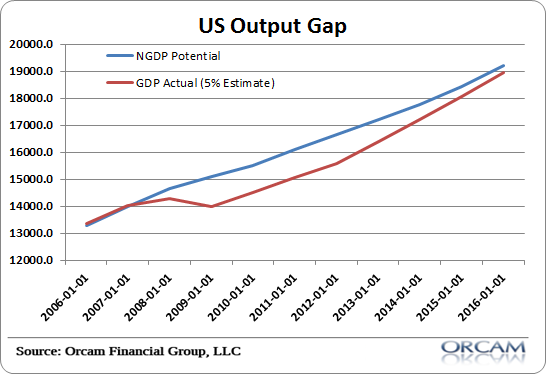
If we take a look at the output gap in the USA we can obtain a far better understanding of the hole that the Great Recession put us in.  Here are some of the ugly facts about the US economy:

  • The output gap peaked in 2009 putting us in a $1.1 trillion hole or about 8% of GDP.
  • The current output gap of $1.06T is roughly 6.82% of GDP.
  • The US economy has averaged 4.6% nominal GDP growth since 1990.
  • The US economy has averaged 3.8% nominal GDP growth since 2000.
  • In the last 3 years the US economy has averaged just 3.7% nominal growth.
  • In order to eliminate the output gap entirely the US economy would need to grow at 5% for the next 5 years.
That might not sound as horrible as you might have presumed. All we need to do is grow at the average nominal rate of the last 20 years and we’ll slowly, but surely get back to “normal”.   There’s just one problem.  The average post-war recovery lasts about 60 months or 5 years.  We’re now in year three of the recovery. That means we’re nearing our “due date”.  Either that or we’re dependent on 8 years of straight recovery without a recession.  History doesn’t like the odds of that occurrence.  The above math assumes no hiccups along the way.  And history says we’re likely to see a bump in the road in the coming few years.  Either that or we’d need to experience one of the longest post-war recovery periods ever.  I’d call that a minor miracle given the circumstances and continuing fragility of the US economy….
 

Cullen Roche

Mr. Roche is the Founder of Orcam Financial Group, LLC. Orcam is a financial services firm offering research, private advisory, institutional consulting and educational services.

More Posts - Website

Follow Me:
TwitterLinkedIn

32 Comments

  1. PeteST says:

    Fun times!

  2. Stephen says:

    And yet is not Bernanke on record as saying that this recpvery will indeeed take years.Be longer than previous recoveries. Has he not therefore implied that monetary support will indeed continue for much longer than normal.The problem is not the economic analysis that the recovery will take longer,but surely that the market as usual continues to front run it implying it will be achieved more quickly!!

  3. DJ says:

    Stupid question perhaps, but what makes one so sure that the NGDP potential curve is a fundamentally good level and not artificially boosted by excess debt and leverage? Is the NGDP potential artificially higher due to excess capacity?

  4. Johnny Evers says:

    I have a problem with the concept of the output gap. Sure, we could produce more cars, for example, but would that really solve our economic crisis?
    What do we really need in this country and how do we tweak the free market economy so we produce more of it?
    I suspect the real output gap is that as people we are not living up to our potential. There is too much laziness, selfishness and self-defeating behavior out there.

    • Jason H says:

      Ya, producing more cars would solve the ‘output gap’ –the ‘output gap’ is really just the amount of production that could be made if the millions unemployed were hired via funding from private sector or gov fiat to produce –and there’s tons to still produce because there’s millions without cars, homes, & the US can always use more power,electricity, etc to lower inflation, etc and the increased supply/production lowers & offsets inflation

      You can lower inflation by increasing supply or what rightwing Austrian economists/politiicans practice –austerity, which reduces demand (by laying off millions of workers, which reduces their spending power on businesses, and businesses then cut production/supply & layoff millions more workers too & the cycle repeats itself)

      … So the reverse of austerity by hiring 5-10 million unemployed to build cars (preferably hybrid or electric so the US is no longer dependent & at the mercy of oil oligopoly such as OPEC, which is the main driver of inflation) —increase in cars would lower prices of cars by increasing supply, lower inflation by lowering demand for oil, etc

      –and the increase in household sector with 5-10 million more employed with $40k+ incomes would boost sales/profits of businesses as those 5-10 million spend their new $50k+ incomes

      The US was producing & selling 16 million new cars before 2008.. then after the crash& stoppage in lending (50% of all new car sales are financed with autoloans that made the 16 million sales possible), new car sales dropped to just 8 million cars –and prices stayed about the same because car companies just cut production & laid off workers & reduced supply of new cars.

      Now that recovery is so low, new car sales inched back up to 12-14 million over the course of years & the auto companies hired thousands back & increased production so that prices also stayed about the same

      And if the car companies had enough demand by customers given money(via jobs or grants,whatever) or given financing or funds to hire milions more (like China does to build 18 million cars & 18 million new car sales per year, even bigger than the US) to produce millions more cars….

      it would become another economic boom just like the millions that were hired during the 1990s internet boom or 2000s housing boom (but without the bubble & speculation)

      Saying that there’s “too much laziness” is flat-out wrong & unethical value considering almost all people would prefer working a job that pays $40k+ per year rather than have NO income or on unemployment that pays just $100-500 per week (most on unemployment get paid only about $1,000 per month –unemployment pays about maximum 50% of your average salary for the past year so people get paid only $400-$2,000 max per month for 6 months) & welfare is about $300…

      you can’t live decently on that (live on your own home/apartment, car, entertainment) nor support a family on that low an income.. most people aspire to live on their own instead of with their parents & own their own car, provide for their family, etc

      • Johnny Evers says:

        Austerity is not a policy — it’s a consequence of having spent today’s money yesterday. The alternative to austerity is spending tomorrow’s money today.
        When car sales went to 16 million per year, it was because people were moving their purchases forward.
        We need to spark productivity in the right things. That means we need a more educated, more responsible work force that can create wealth — and not just mindless consumers.
        If we have that type of citizen, he might decide to produce more products and services that improe quality of life, not just build more cars.

        • Pierce Inverarity Pierce Inverarity says:

          Which is why one of the things we need to focus our deficit spending on is education and infrastructure and measures that promote private investment in R&D.

          • Johnny Evers says:

            Most R&D programs lead to better products. I wonder how we provide R&D to produce smarter citizens.
            I work with working class people, and boy do they lack simple life skills. What good does it do to build better phones for them if they can’t balance a checkbook or form healthy relationships.

            • Pierce Inverarity Pierce Inverarity says:

              R&D for smarter citizens is called education. We need to stop the political wrangling over “running out of money” and beef up cheaper education outlets and provide more vocational education options for those that could use it. Not every citizen is going to be, nor wants to be, a renaissance person. But most people like finding things they do well, doing them, and getting recognized for that work.

              • Jason H says:

                Yes, R & D is important & essential

                The US gov spent hundreds of billions (Trillions in today’s dollars) on educating millions (GI Bill that gave free university educations to all WW2 military families, when before only 5% could afford university… it later grew to federal finacial aid for college)

                The private sector is great & most people already know about their inventions but most don’t know that
                gov funding invented/developed antibiotics, MRI machines, GPS, internet, nuclear power, etc –and worse, there’s a meme among conservative circles that gov can’t create jobs & can’t produce innovation/invention… 50% of pharmaceutical R & D is funded by gov grants, mostly to universities

                Most research is done at the university level & funded by gov grants.. and like most businesses & business ideas as well as animal offspring & species out in the wild, the vast majority(at least 80%+) don’t make it but the most promising/viable goes commercial & survive

                This is why the Austrian rhetoric of “malinvestment” is so ignorant & harmful because the vast majority of things (businesses, species, offspring, etc) do NOT survive in the wild, marketplace where evolution weeds out & only the strongest survive…

                even Edison said he tried & invested his time/money/failed 1,000+ times trying to build a workable light-bulb before he succeeded with one (actualy, he plagiarized a working light-bulb from a British inventor ).

                There’s a reason why vast majority of animals have large litters to laying 100s of eggs at a time because vast majority do NOT survive in the wild marketplace… neither do businesses nor projects funded by private sector or gov sector.

              • winslow says:

                I can truthfully tell you from experience, many of today’s students are not interested in applying themselves to get ahead. It can be very frustrating. I don’t have the answer. Perhaps they really see what the future holds! Just look at the news media on a daily basis and it can be disheartening.

            • Jason H says:

              If you work with uneducated people, I can see how that discolors your views of society

              Anyways, those people need to be educated (on Monetary Realism economics, life skills, social skills, life skills, etc).. mandatory classes back in high school and needed to pass to qualify for any gov aid

              Something easily done via fiat/deficit spending (it’s all fiat :P

              You have to get rid of your ‘yesterday/tomorrow’s savings & spending that are often used in Austrian examples of people living on an island producing & saving fish, coconuts, gold, etc where those commodities represent production & savings/spending –they don’t apply to fiat currency systems because fiat spending now has no relation to fiat savings & fiat savings/spending has NO relation to actual production except to induce greater production if more fiat spending is spent to stimulate more production

              I know it’s a huge paradigm shift & economic model that’s the opposite of commodity-backed currency systems but you are trying to fit a square peg into a round hole

        • Jason H says:

          There is NO ‘today’s money’, ‘yesterday’s money’, or ‘tomorrow’s money –it is ALL fiat money.. you are trying to use commodity-backed money examples & terms for savings from Austrian economic models & examples of commodities (gold, fish, coconuts, etc that are often used to represent savings in outdated economic models)… having a federal government saving fiat or fiat surplus is pointless & irrelevent

          And making/educated more productive population is done through education/training, something that Austrians & other deficit hawks argue against as “unaffordable”

          They were the same that argued against free public K-12 high school educations (just like they are doing now)

          Do what most of Asia & Europe used to do before austerity, which is give free or almost free educations to the population to become more productive & educated in productive/needed degrees:

          According to studies, 80% of students in Asia major in science/engineering/medical degrees &
          whereas the majority of US students major in business degrees (finance, accounting, business admin, marketing, etc) & 2nd in the US is liberal arts

          There’s a huge shortage of medical personnel in the US(about half per capita in other nations).. so increasing supply of doctors, RNs, PAs, NPs, etc will decrease medical costs & increase medical supply, decrease wait times, etc & you can do that by investing in/building more hospitals (like Japan does, which the Wall St Journal decried as bad because it made hospital wait times almost zero,& lowered medical costs, & hospitals were now “unprofitable”, LOL –even though most hospitals in Japan are run as non-profits, unlike some of the ‘for-profit’ hospitals seen in the US) & giving FREE medical educations to medical personnel

          Of course, the same types of people that argued against free public K-12 educations & free university educations for military in the GI Bills in the US will argue againt ‘free’ university educations on making the US population more productive inscience/medical/engineering majors because they see ‘deficit spending’ via fiat as inflationary or ‘US can’t afford it, US is bankrupt, etc’

          You should google & read some of their deficit-hawk hysteria & writings (some on Youtube speeches from the 1950s too) from the 1800s to the 1950s on how the US will go bankrupt & collapse/hyperinflation they’ve been predicting anyday now –Rand/Ron Paul, Boehner, Cantor, McConnnel is just them reincarnated, LOL –same ‘chicken-little’ arguements repeated from 50-100 years ago

          • winslow says:

            The U.S. has built a wall around our medical system because it is profit-driven and not considered a life-necessity. Every little piece of the chain needs to make a profit. Eventually this will help bankrupt this country.

      • Dave says:

        It should actually be unnecessary to say that there IS “todays” and “tomorrows” money otherwise one doesn’t understand the money and credit system. And there is no such thing as fiat money without relation to production except if the fed starts to monetize govt debt.

        To me it seems very implausible to ramp up any supply to to fight inflation since manufacturing/industy is actually under deflationary pressure through oversupply and “frozen” liquidity. And demand isn’t catching up anytime soon unless the liquidity problem is resolved. This action of increasing supply would just have a statistical effect like the recent drop in unemployment rate.

        The (Austrian) austerity is an economic fact which is released by many individuals who are starting to save more and/or spend less. It is nothing that the govt can do or stop doing in the private sector. But govt austerity will have to come one day since it would be ridiculous to think that anything on earth can grow infinite – and certainly not debt.

        • Johnny Evers says:

          I recently got a lump sum offer on a pension. The pension is tomorrow’s money. MMR proponents would advocate that I take the lump and spend it, then count on some future money materializing.
          The idea that we can borrow money to pay for today’s spending only works if we can grow our income to pay the money back later, which works, until it didn’t — or, and this is what I suspect MMR really advocates, we print money later to pay the debts and then call that printing growth.

    • Cullen Roche says:

      Those could all be reasons for the output gap….There are many reasons why this economy is becoming less competitive and the fact that the quality of out output is losing its edge is likely engrained at least partially in the causes you mention….

      • Johnny Evers says:

        Hi, Jason: Neither one of us is going to get our way in the coming years, unfortunately.
        You want deficit spending on R&D, education and more spending for doctors — but what you are going to get is deficit spending on income grants to the retired and unemployed and health care spending on old people (which continues to make medical specialists rich but has no long term impact on our nation’s health.
        What I would like is a citizenry capable of taking advantage of the wonderful educational and economic opportunities already in place. What good is free higher education for people who don’t read? What good is vocational training for young people who don’t want to work?
        The Asian students you mention are taking advantage of our current educational system because they come from a richer cultural situation.

        • Greg says:

          “Richer cultural situation” ??

          WTF does that even mean? Are you referring to the fact that many Asian parents/authorities drive their kids/citizens to unreasonable expectations (think about the stories about Chinese Olympic athletes say) which include being the “best” all the time? If this is what you are referring to………….. no thanks! We dont need a world of hypermotivated bots willing to do everything and anything to get and stay ahead. Its not a poker game we are playing its a ride on a spinning orb we are trying to survive. How do we best survive?

          You think Steve Jobs is looking down now going “Yeah baby I won!!” Or do you think he is saying “Did any of the stresses I put on myself weaken my body and make it susceptible to the cancer that took me away from my children a few years earlier than I wanted?” While Im sure he is proud of his accomplishments I ll bet he’d sacrifice 25%……50% to have a few more years with his children.

          Nothing wrong with striving…… just depends on what you are striving for and willing to do to get there.

          • Colin, S.Toe says:

            The sense of balance that is always needed.

            On the same page as Cullen’s concern for the quality of life.

          • Johnny Evers says:

            If the stories about Steve Jobs are true, I’d say it’s more likely he’s in a warm place wishing he had treated people with more respect.
            :)

  5. Uncle Chuck says:

    What we consider “normal” is not normal anymore. We got to “normal” as the result of many things, among them the settling of the U. S., a HOUSING BOOM caused by the BABY BOOM and the introduction of credit causing a CREDIT BOOM; in other words; a real DEMAND for goods and services.

    With the “BOOMERS”, who abetted the BOOM, retiring (and dying) and no more land in the U.S. to be settled the conditions that created the “normal” are not there anymore so getting back to THAT “normal” will not happen. We need to stop talking about getting back to normal and start exploring ways of creating a NEW “normal” ’cause the old one just ain’t coming back!

    Also; this is NOT a Democrat, Republican or any other political thing; it’s an AMERICAN INGENUITY thing so the more we keep politics out of creating the new “normal” the more likely and quickly we’ll achieve it, otherwise we’re just spitting in the wind.

    Time to start thinking outside that “box” we’re always talking about.

  6. Bond Vigilante says:

    There’s a simple solution for this output gap. Start producing cars, start building houses, no matter whether there’s demand for those houses and cars or not. It certainly will help to jack up GDP. Problem solved.

  7. Bond Vigilante says:

    What justifies that NGDP continues to rise, year after year ?

  8. Dennis says:

    Since the 2011 fiscal year just ended 9/1/12, a review of the 2011 data shows corporate taxes are tiny compared to individual income taxes and payroll taxes. Interesting data in my opinion showing individual taxes went up 21% to $1.091 trillion and corporate taxes went down -5% to $0.181 trillion 2011 vs 2010. Does this mean our corporations are actually not paying 35% to the US Treasury? What are multinational and foreign corporations paying the US Treasury if anything on their profits on US sales?

    http://www.fms.treas.gov/annualreport/cs2011/receipt.pdf

    https://www.fms.treas.gov/fmsweb/viewDTSFiles?dir=w&fname=12092800.pdf

    http://www.fms.treas.gov/annualreport/index.html

    • Paul H says:

      You know these statistics might make one wonder why we strive to tax activities that provide employment for the country’s citizens at all.

    • Bond Vigilante says:

      Corporations have figured out how to legally evade paying taxes in the US.

      One trick is that a company opens a branch abroad and that company lends money to its mother company in the US. Interest paid on those loans to that foreign branch, eliminates the profits made in the US and then that company doesn’t need to pay taxes on their US profits.

  9. Rich L says:

    A few thoughts on the subject-

    What we have now IS what’s normal. It’ a variant of what happened when we switched from an agrarian society (80% farmers) to ~5% today. Making things today is much less labor intensive, irrespective of source of origin. Manufacturing is being eclipsed by services.

    Much of production is not captured or measured in dollars. Just look at your own blog; if it had a firm name on it there would be a paycheck and a role in measurable GDP. Music also…. How much of the output gap is accounted by that factor?

    The US, as a conceptual producer, is a whole lot better able to handle this change than most countries. But it will be VERY HARD for anyone not sharp enough to play in this pool. What will China do when this hits them full bore?

  10. Greg says:

    Agree with most of this analysis Cullen but I dont like the title since it implies we need some sort of “Act of God” to right this ship. As if we mere mortals cant do this ourselves.

    Thats destructive for two reasons 1) It plays right into the hands of the Phill Gramm types who call this recession imaginary or mental and by default would then lead to 2) Deification of someone who “gets us out” of this mess. We dont need to elevate the status of anyone here to the level of deity, too many modern denizens of the right are quick to do that already.

    There are non miracle solutions to our situation which you have talked about before. Reducing the average guys taxes so he can pay down old debts AND consume in the present (currently only one or the other is occurring for far too many people). Increasing the level of Govt investment in certain sectors of our economy (infrastructure, health care, education) and looking at better ways of preventing future financial collapses via our regulatory sytem.

    • Cullen Roche says:

      Yes, perhaps the headline is a bit hyperbolic. My apologies. But I really think it would be a minor miracle if we went 8 straight years without a recession….Which is really what’s required here. In economic terms, that’s a minor miracle. No?

Contact Us:

Name:

Email:

Verification Image

Enter number from above: