
THOSE DARN ITALIAN BOND YIELDS….
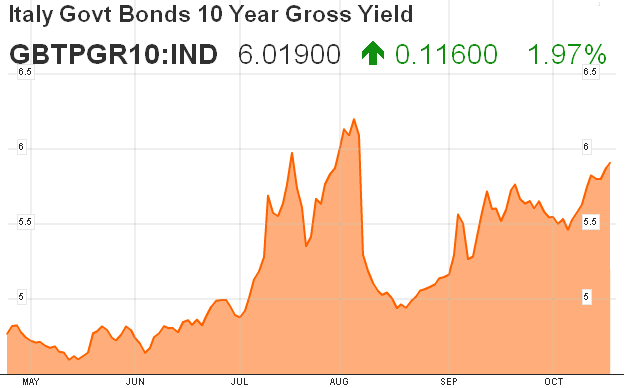
This whole crisis is playing out according to plan so far. The current plan (EFSF) and ECB action does not go far enough in keeping market participants from fearing periphery debt. So, we’re seeing Greece play out all over again in Italy. The ECB won’t commit to open ended QE (as in setting the Italian rate) so we’re seeing the rates continue to surge as market participants realize that Italy’s budget woes are not going to get resolved via fiscal austerity.
As I’ve mentioned on several past occasions, this is the indicator to keep an eye on. If the Italian 10 year surges over 7% (the so-called breaking point for their fiscal situation), then the whole game gets kicked to a new level. The ECB can intervene as they did back in August, but the market will continue to push the envelope as they realize the ECB is only a loose buyer of the bonds. A 7% 10 year on Italian bonds might just be the trigger point for E-bonds? Either way, it’s hard for me to imagine that we’re not going to see a situation in the coming months where the markets don’t force Europe into some sort of fiscal action on the sovereigns themselves.


I don’t think they have months.
They will be forced into action, but when? And with riots on the streets, can they pull it off? It will take threat of war, and total disunity, to force this fiscal union. That is years down the road, though.
Cullen- Alot of intersting stuff this morning.
Hidden in the back bottom page 21 of F.T is an article…”Eurozone banks use of Emergency overnight ECB lending has risen to almost 5bn(euros) the highest in more than seven months”…
Does this not sound like March of 08?
Alot of good articles on QE and bail outs of Eurozone…
I was reading the thread yesterday on the Ron Paul discussion and you guys really nailed it. I forget the comments but the TPC regulars have figured out many of the solutions needed to fix what ails us. I have seen more and more references indirectly picking up pieces of MMT.
When this chart you posted is flipped right to left…then I will know European Central Banks and policy makers are reading your site. Until then to infiniti and beyond with Italian yields.
Here’s a nice addition to the discussion:
http://dailybail.com/home/holy-bailout-federal-reserve-now-backstopping-75-trillion-of.html
I think Hussman said it best in his note this Monday: “My impression is that this may be the best opportunity to reduce risk that investors are likely to see for a while.”
Since Im sort of a newbie…
When being able to set their own rate on bonds, would the Fed/ECB just simply say, “When rates are above X% we’re going to buy it.”
And that simply forces rates to stay at the max point before the central bank steps in and purchases it?
So long as they do more than just “say” it. As long as they commit to buying unlimited amounts of the target bonds at the target rate then yes they can hold that rate. As the monopoly issuer/supplier of those reserves they can do it, its just a matter of actually doing it.
Cullen,
Why do you think that Germany will go the route of fiscal union and integration? A smaller core EMU maybe a better way for Germany in the long run.
If they’re going to remain in a union of any sort they need to create a sovereign union. This is the only way they can fix the trade imbalances that result. So, you either revert back to the one govt & one currency format or you go full bore into one huge govt and one huge currency. They have the currency. They just need the govt with full fiscal union.
They’re the only two logical choices. Germany could defect, but I don’t think the odds of this are very high. I think they have no choice but to agree to e-bonds at some point and move forwards towards fiscal integration.
Cullen, what is it about having a smaller core EMU are you addressing? It is possible that EU can fracture into smaller unions. Before there can be fiscal union, or before any group can agree on an issue, there has to be a division of sides. Those who need fiscal union and those who can’t stand being a fiscal union with ‘those’. This is the forming of a new government you are discussing, a new state, a new identity. That everyone will go along is ludicrous. What is apparent is there isn’t a sign of this side taking yet, which means participants are not seriously considering fiscal union. This divide must happen first. For the full union to look the same as the EU, one side must be able to bully the smaller. With no strong force, it is certainly possible for the soveriegns to form two or more full fiscal unions, or the core to form their own fiscal union. There is a logical scenario of a Balkanization of unions, which is what the commenter is asking? Are you not responding to this because your analysis has already ruled this out? You are a very complicated person to understand what you think sometimes, Cullen.
Problem is, it’s basically Germany vs everyone else. So, who ever is on the other side of Germany’s trade surplus will have to understand that they’re likely to suffer a Greek result at some point in their history. This is what the trade imbalance will cause. There’s no way around it. If Germany were to break off into the Euro North with France and a few other countries they’d drive the other members inevitably towards an unhealthy imbalance. It might take a long time, but it would happen. And then they’d have achieved nothing. Also, Germany doesn’t want to break up the EMU because which ever currency they move into will surge. This will crash their domestic economy. So, they don’t want to risk economic collapse just to avoid a fiscal transfer.
The transfer union is already a reality anyways, things like EFSF and lending via KFW is just a way to disguise this so the voters don’t realize what’s going on. The next government can then just admit to as much (if it’s not again Merkel, but it’s really a choice between Herpes and Gonorrhea here), that the money guaranteed and lent can not be recovered unless the lending is perpetual or EU transfer payments are dialed up a few notches. This also strengthens the link between EU economies: The more debt the Germans are on the hook for the less it makes sense to let the others default and go their own way. Right now it’s just accounting tricks to disguise the transfer payments as assets (they even make a spread on the money the lent to Greece). Now all they need to do is ease off the austerity for the periphery so they can keep on buying BMWs.
Really what the German government is doing is subsidizing the export industry because the domestic economy is so weak that there would be rampant unemployment if they did not do so. While doing that they have to levy excruciating taxes on the productive (no offense) half of the population. Either way the trade imbalances have to persist for Germany to keep going.
Germany is going down no matter what the government does. The decisions that wrecked the economy were made a long time ago, it’s all on life support now.
I don’t think the EZ needs to fragment (although the EU may have to). They just need to put Greece out of its misery and move all the others into a partial fiscal union. The problem with Greece is that they deliberately abused their EuroZone privileges to party on everyone else’s dime and now are saying “either you bail us out or we take ya’ all down with us”. The Greeks paid Goldman Sachs to hide their debt so they could party. The Germans cannot tolerate any solution that lets the Greeks party on. Once they throw Greece under the train, they can transfer all powers related to bank supervision and deposit insurance to the Federal level, and give a new EuroZone Parliament limited taxing power. This will necessitate establishing a EZ-wide judicial system and penal system, since if you have EZ taxes you need a way to enforce them.
A fair solution for Ireland would be to transfer the portion of its onerous debt that is attributable to banking issues to the Federal level. Ditto with Spain, France, and Portugal.
Now, once you have a true Federal Government at the EuroZone level, maintenance of the larger EU might become untenable and states (like the UK) that are not in the Euro may have to leave or join the EuroZone. This would probably be a good thing and keeps in line with the KISS principle (Keep It Simple Stupid).
Well if they just let the weaker sovereigns default, wouldn’t that cut off the lending that financed the trade imbalances in the first place?
The euro is really Germany and France. So if some of the weaker members chose to depart would that be such a disaster?
Also fiscal integration would almost certainly require long, intensive bargaining and then would need to be approved by the voters in all the European countries. And the way the crisis is developing, I kind of wonder whether the Europeans have that much time.
“Well if they just let the weaker sovereigns default, wouldn’t that cut off the lending that financed the trade imbalances in the first place? The euro is really Germany and France. So if some of the weaker members chose to depart would that be such a disaster?”
Forcing the periphery to balance out means you are forcing them to stop importing and forcing their incomes so low that they can’t net save. A major side effect will be significantly lower exports for the core EMU nations which means higher unemployment. If they leave the EMU you’re likely to have the same drop in exports by current core as Forex markets would likely make imports very expensive. While I agree fiscal union may not be politically possible anymore it sure would be the least painful solution all around.
The italian government, like the greek government, actually needs a giant shake up/out. And the parliament is also dysfunctional. Too much hangers on. A good old fashion default would actually FORCE such a shake up. In those two countries they easily could do with 50% less government employees. And then they’re able to pay the rest a better wage because they would be more productive. Like Greece, Italy benefitted from being in the Euro and were able to postpone the necessary reforms.
Italy barely made it into the EMU. Only with the help of a special one time taxhike they were able to meet the EMU criteria in 1999.
Cullen, I agree fiscal integration is the logical and probably the right thing to do. But that may be a political impossibility in the foreseeable future.
Based on the data I have seen and conversations I have had, German public is not ready to accept a full fiscal union with the rest of Europe.
Can Merkle sell a fully integrated EMU to her people? I have my doubts.
A simple extrapolation gets me mid-january. A similar extrapolation of the DOW:GOLD ratio indicates a bottom in gold in january-february. I imagine that’s when all TSWHTF.
Every time I think the ECB will step in and do whatever it takes in terms of sovereign bond purchases to end the crisis, there is a rumor or leak that places the issue in serious doubt. I am beginning to think that this is all purely intentional; i.e., that the ECB gets the maximum impact for its limited sovereign bond purchases if the bond markets remain highly uncertain about when the ECB purchases will occur and in what amounts and durations. If the ECB instead sets a rate target and says “I dare you” to the sovereign bond market, its balance sheet might soon hold every periphery debt instrument in the world’s secondary market as bondholders dump them en masse at artifically high prices paid by the ECB to maintain its rate target.
I think there are also legal constraints to the ECB buying bonds.