THREE THINGS I THINK I THINK
1) How will we know when the QE2 trade is over?
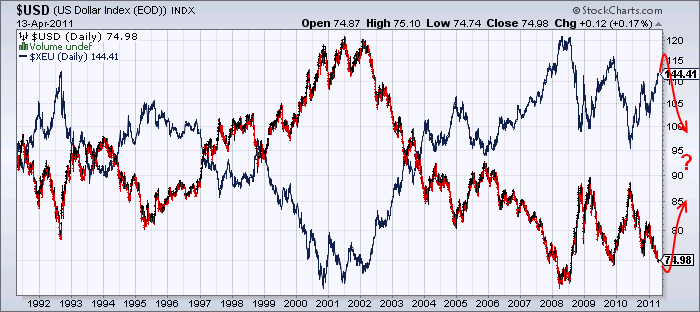
It’s about that time when the smart money is beginning to think 10 moves ahead in the chess game. And in this game, the only piece worth focusing on is QE2. QE2 ends on June 30th and traders are already jockeying for position. How soon will the QE2 trade end? No one can tell. It could be a sell in May or it could be a sell the news. But one thing will be very clear when it occurs – the US dollar will stage a counter-trend rally.
One of the primary fuels during this speculative fervor has been the decline of the dollar. With the exception of a brief period in November no sector has benefited more than commodities. As I’ve previously discussed, this hasn’t generated some great economic benefit for the United States (that wasn’t already occurring), but it most certainly has translated into speculative behavior.
The dollar’s decline was relatively benign until the ECB began forecasting rate hikes earlier this year. And the usual inverse correlation can be seen in a sizable Euro rally. The end of QE2 will be seen as a pseudo form of tightening and a step in the direction towards US rate hikes. This could be an excuse for short covering and a USD rally. And while that doesn’t necessarily mean the commodity bull market is over it is likely to put a dent in the QE2 trade.
When currencies converge?
When will it happen? As I mentioned above, the timing is impossible to know, but if I had to venture a guess I’d say we’re closer to a EUR/USD bend in the trend as opposed to a continuation of the trend. And we all know what they say about the trend and friends….
2) Collapsing lumber prices portend a weaker economy?
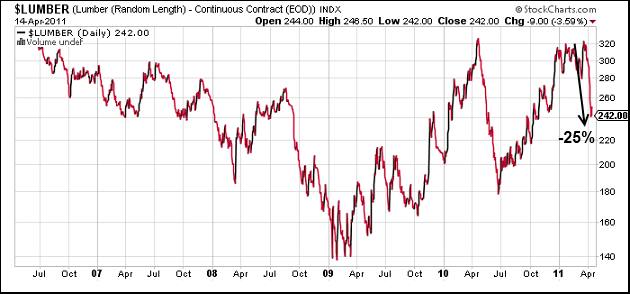
Did you completely miss the utter collapse in lumber futures in recent weeks? I certainly did. In just the last 3 weeks lumber futures have fallen 25%. The Wall Street Journal says the decline has been due to a number of factors including fears of slowing Asian demand, weak US housing markets and excess supply:
“The recent decline in lumber futures was blamed on increased first-quarter mill production that met stagnant domestic demand and exports that were strangled by shipping bottlenecks.
China emerged last year as a dominant buyer in western U.S. and Canadian lumber markets. Mills responded by ramping up production to meet export demand and take advantage of an expected seasonal surge in U.S. house construction as spring arrived. Yet shippers couldn’t keep up with export sales to China and the spring housing demand failed to materialize, creating an oversupply problem that fueled the selloff, which started late last month.
…Despite the growth in Chinese demand, the U.S. remains the top market for North American lumber, so when the U.S. housing market is dormant, lumber futures prices soften, said Jamie Greenough, a broker and lumber market analyst at Global Securities Corp., a securities and commodities brokerage in Vancouver, B.C.”
Lumber prices have had a very close correlation with the US economy. While prices appear to have stabilized in recent days you have to wonder if this isn’t a sign of more serious weakness overall. One thing is for certain – the US housing market remains mired in a deep recession.
3) Why does the cost of a house get such a bum rap?
Whenever I talk to someone about inflation in the current environment and I tell them housing costs are near their lows they always reply: “sure, but I don’t buy a house every month”. Well, that might be true, but most Americans pay their mortgage every month – so you kind of do buy a house every minute of every day if you think of it in terms of the duration of the loan. Unless you paid in full upfront (which most homeowners don’t) you’re in a persistent state of buying the home. You could actually argue that you buy your home more often than you buy anything else because you can be damn sure the bank is calculating their loan value by the millisecond. Okay, that’s an exaggeration, but why do people downplay their largest monthly expense?
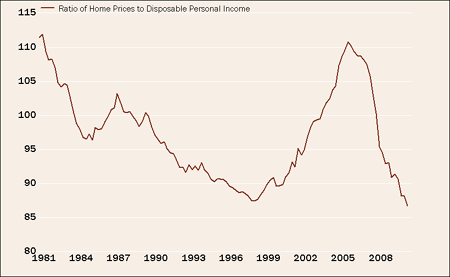
With interest rates near all-time lows mortgage refinancing is very beneficial – even after the recent rally in rates. In addition, new buyers are swooping in at a 30% discount in the real estate market. In essence, homeowners are able to lock-in deflationary prices in the current environment. That’s a significant price decrease for a vast majority of Americans. While many other prices are rising, housing has rarely been more affordable. Some recent charts from Liz Ann Sonders at Charles Schwab put this into perspective:
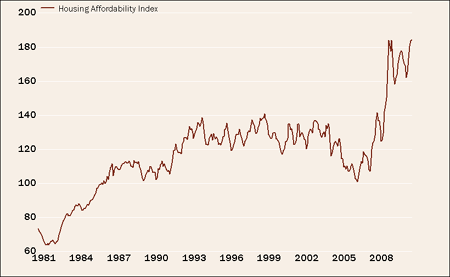
It’s no coincidence that the Housing Affordability Index troughed with inflation in the 70′s!

Inflation?
The moral is, the cost of owning a home has plummeted in recent years and this accounts for the majority of one’s monthly non-discretionary spending! Whether you are looking to purchase a home or have an old mortgage you are able to take advantage of significant deflation in your largest monthly expense. This isn’t an attempt to downplay the damaging impact of inflation in other markets, however, when assessing the bigger picture it is very important that we keep things in perspective. According to the BLS, housing related expenditures account for 47% of total consumer expenditures. The price you see on the gas sign every day isn’t nearly as important as the one you see on your monthly mortgage statement. And there is absolutely zero inflation in that payment.


56 Comments
These 3 things never disappoint.
USD.EUR -> another psychologically driven nonsense trade like the QE trade, since the EUR money supply is/ will be way tighter than the USD supply.
+ demand for EUR is increasing due to the debt crisis, in combination with the inability of europeans to monetize deficit spending!
+ demand in USD is shrinking due to increasing destructive deficit spending,
+ more and more countries trying to trade in other currencies than the USD.
That should be a cushion for a continuation of the EUR rise. But since flawed mainstream consensus is, indebtedness -> falling currency, there might not be the cushion.
Lost me at point one. No one is monetizing their debt and solving the European debt crisis with more debt seems less of a credible plan to me than what your statement implies. Not to mention how you pay off that debt when you are slowing your economy with austerity measures.
Sostegno, why did the last 30 year auction go so well that Mr. Sarcastic Santelli of CNBC gave the auction high marks ?
A few thoughts I had after reading this article. I don’t disagree that there is zero or even negative inflation in the housing payment, but I don’t think it helps the majority of people as much as you would think.
1. The cost of the house gets such a bum rap because most people “brought” the housing asset during the bubble. Since houses are a leveraged and relatively illiquid asset, most homeowners are unable to benefit from rising or falling prices in housing.
If the price of the house decreases, the average homeowner does not and cannot see the benefit of reduced monthly payments because they are unable to refinance. This occurs because a large percentage of homeowners are upside down on the house or behind on payments. This is without taking into account homeowners who have bad credit, negative amortization loans, ARMS, home equity lines.
Note that the last three causes actually increase the monthly costs of housing — a net deflationary effect.
2. In some markets, I would argue that affordability has not yet hit a bottom. I believe Cullen that you reside in the State of California. I know for a fact in LA, Orange County, and the Bay Area that house prices have yet to dip below the beginnings of the bubble in 2002-2003.
I would also argue that rising rates will further deflate the cost of homes as the price of the asset becomes harder to finance — and thus sustain — since housing is the most leveraged financial transaction that the average American will make in their lifetime. However, Proposition 13 makes this beneficial to future buyers since the property tax is almost fixed as a percentage of the purchase price. This creates the incentive (at least in California) to wait to purchase housing when financing is costly and the asset price depressed. It is a net deflationary effect on housing prices.
3. I do agree that inflationary concerns are mostly overstated. I would argue that the real danger of continued low interest rates is not inflation, but rather deflationary effects that can occur as a result of leveraged malinvestments. In fact, one only has to look at increased mergers and acquisitions — and the layoffs that often result from such activities — to see the deflationary effects that can occur from low rates.
Agreed On #1 Wulfram
RE is more a balance sheet issue for homeowners – not a daily expense.
Actually with a lower valuation and similar monthly payments – the payments are inflationary vs the lower valued property.
Cullen:
Point 1 timing: difficult to know, that’s right. For QE1, the trade begun 2-3 month after the beginning of the program, and ended the exact day it ended. For QE2, the trade begun 2 month before the official announcement of the program. This time, everybody is sure to be long to end June (just need to take a look at investor’s letters or blogs).
Do you remember the paper from Nomura i send you, about the “bubble learning experience”? The conclusion was: ” the second time, market participant will go out of the market before they were for bubble 1″. Bottom line: smart money will anticipating the end of QE2 this time.
If you take a cross market and asset look, you can see huge distribution patterns on DM index, as well on EM markets, and commos (excepting the booming precious and oil). I will not bet of a “mai 2010 bis repetita”, but right now, the risk is clearly asymmetrical for the long un-hedged…
if you think there is going to be any serious tightening in US monetary policy in the run up to a presidential election, i own a bridge in Brooklyn i can let you have for a modest sum.
Actually, there is inflation in my mortgage payment–I just received the notice this month that my monthly charge was going up. Why? Because my property taxes and insurance are escrowed–and the bank increased my payment roughly 3% to cover them.
The mortgage payment may not increase, but that doesn’t mean the costs of homeownership won’t (especially if the chatter about limiting the mortgage interest deduction comes to fruition). When you buy the house, they have you trapped. . .
Probably because not everyone has been able to refinance due to negative equity. The cost of housing hasn’t decreased even if homes prices are lower.
three things always a must read.
man, am i glad i built my place myself with cash.
boatman refuses to rent money…..only thing i rent is beer.
rising ECB rates n fact 95% of spainish home owners have quickly reset variable interest rates and spain was the european leader in the housing bubble in europe means goldmans wrong–they will be bailed out…..hpow’s that workin’ out for greece per now 13% bond rates?…..hey-oooo
Great stuff Cullen. I still have no idea how you run this site, run a biz, and run a life. If you have kids, I’d probably start to ask if there are two of you:)
I try to understand as much as I can about the Chinese economy and it seems to me they are at the very early stages are slowing down. Although everybody has been saying that for months so it is really tough to predict. They seem to hold the key to commodities. QE2 will play a role too and you just never know how much speculation is in the current price. Realizing futures are very leveraged, I wonder if we get another huge spiral down that overshoots to the downside as forced liquidation takes place.
Well, I’ll be honest. Before I started the website I used to read research all day. I am not a really active trader so while I keep tabs I am not frantically doing anything. So, now that I have the site, I just write about what I read about. To be honest, not much has changed since before. Except that I have thousands of really smart people I can bounce ideas off of now. I am not lying one bit when I say that one of my favorite parts of this site is reading the comments and interacting. I have learned more than any of you could possibly know and it’s because of the incredibly smart people that come here and critique the posts every day. I am really greatful.
Cullen,
I believe I speak for many readers when I say I would like to express my profound appreciation for your pragmatic approach to discovering truth in the world and helping others benefit from your wisdom. You prove to me on a daily basis that you are wise and intellectually honest; we need more like you in this complicated world. Thank you!
I not only second the motion, I 2 by 4 it….
Cullen, have you read todays piece in the Daily Telegraph by Jeremy Wariner. He seems to think multiple defaults are certain but their timing could be delayed by months. He brings up a Finland election on Sunday as a possible trigger for an acceleration of the process. I did not know that Finland wielded such clout in the EU ECB universe. Any thoughts on the actual timing of defaults in the EU?
Gosh. You know. I’ve searched this topic in and out and I don’t know if I have ever been more conflicted. There is no telling what will happen there. It seems like some form of restructuring is absolutely necessary. But the problems are largely under control I think. I wish I had a great answer here, but I just don’t. I’ll be really surprised if the Germans let this all spiral out of control. There is too much to lose and the lesson of Lehman is firmly entrenched in the ECB’s minds….
I have been saying restructurings with prolonged pain. In other words, muddle through without any major shocks. Unless the people rise up. Then all bets are off. If you start seeing riots in major cities again then turn risk off….
Thank you for your humbleness, Sir! It says a great deal about your character…
I have to say I agree with this. Pragcap is one of the best no-nonsense resources on monetary theory, economic policy, and personal investing that I’ve run across. I appreciate the viewpoints expressed daily in the articles — especially when they challenge the popular misconceptions of our times. Resources like this site should be required reading in our education system.
I only wish that our national debate on governance was as engaging and free from vitriol as the discussions on the site. Keep up the good work Cullen.
I’ve always felt that inflation is to a large part a function of ones income and is not felt in the same way evenly by everyone. The higher your income, the smaller percentage of that income is spent on food, fuel, medical etc., and this is where the price increases are occurring. Contrast this with someone in a lower income lever or those retired with a modest savings living on a pension and or Social Security. By the time they pay the house payment and car payment there isn’t much left to begin with and these price increases be it food, fuel, medical or whatever although they may be somewhat small in the big picture are a larger portion of their total income and a big deal to them as it ravages what is left of their disposable income. In their situation inflation is being felt on almost everything but their house payment Unfortunately for many of these people their house payment is in fact fixed as they have refinanced their home years ago. I know that in my case I refied about 10 years ago at about 5.5% and although I didn’t catch the bottom tick in rates, the additional drop in rates really wasn’t enough to justify refinancing again. Many people I know are pretty much in that same situation and I suspect this could apply to many who lived in the same home for ten years or more. I would guess many of us who follow the financial markets and frequent these sites aren’t in the same situation income wise and don’t see things in the same way as those in the lower 50% income level do but it is at least something to consider.
One of the positives it seems to me is that the decline in home prices is really a huge longer term positive for those who will be, over the coming years, purchasing their first home. This seems to be largely overlooked but for the younger generation with no current rent expense but who will be looking at it in the not to distant future, although they may not realize it now, deflation is alive and well and could end up being a big positive towards their future cost of living.
HMMMMM!
I did a search on this page and nowhere did I find ‘QE3′.
What gives the dollar its value is its yield potential since it like other fiat currencies have been hyper inflated (at least the ones present in bank accounts) many moons ago.
Unfortunetly for dollar holders it has for some time been eating its own tail to keep its belly full.
Speculation in such vital commodities such as oil ,raw materials etc.
This feeds into the destruction of home values and soon M3.
The only mechanism to stop this deflation is Gold.
All those yield chasing but functionally useless dollars need to flow into a useless metal.
The dollar and financial markets as we know it is toast.
I think you’re over-thinking things relative to QE2, equities and commodities.
Whether or not you view QE2 as the direct cause/driver of higher asset prices, one thing is for sure – QE2 is like the hall pass you receive in high school to go to the bathroom. In high school, that hall pass was a license to be immature and have fun. Sure, if you actually had to go to the bathroom you might go, but along the way you might poke your head in a friend’s class, you might go to your locker, you might visit the vending machine, you might meet your girlfriend in the library, etc. My point is, QE2 is the same thing, but a license to speculate in financial assets. People are going to utilize that until they can’t, which suggests prices should go higher until it ends, at a min…
How can the dollar stage such a broad rally when the yields are set to fall? Improved sentiment is not enough.
3. on housing
Wulfram – good points. In addition, it is necessary to remember that it is not only current “affordability” (with which i do not entirely agree) is important, but also future expectations. And these come in two parts:
- An average house holding period is 5-7 years. Besides loosing some % of price on buy/sell transaction, future price change should also be incorporated. I assume, significant portion of market participants expects them to be stagnant or go down.
- Property taxes expected to go up. Mortgage interest deduction might be eliminated. Another drug on expectation.
This, plus expectations/experience of stagnant incomes, creates significant negative momentum in housing despite low “affordability”….
Point of order here.
Does everyone not think the end of QE2 is priced in already!! It’s been a fact for months now and the Pubs hold the House.
For all those shorting commodities, watch the hell out.
Chinese growth should continue to sizzle for another five years. After thinking about Chanos’ position, I reviewed again that white paper from HSBC that provides a province, city, and even lower-level breakdown.
Do you know how much rail they are adding? How much public housing???? Lumber might be down but that’s because in China they build with concrete and steel.
There will be a good time to short commodities, but now is not that time imho.
Is the end of QE2 priced in? I would suggest that the smart money is short or already hedged a 100%. They were in on the Tepper call back in September knowing they could drive it up further to unload their size. Now they’re waiting for the suckers who added to their length to start to panic and sell into down days. Notice the constant distribution since February? They’re trying to get out without starting a violent move down.
i would agree with p11 that the end of qe2, no announcement of qe3, and no short term interest rate rise through the end of 2011 is pretty much accepted and priced into market.
i think you can’t get in or out of the market based on qe2 end analysis. rather, i am looking at the war between a (slowly) increasingly recovering economy vs. higher energy costs. i am betting (for now) that the ramp up in business activity, generally, will continue and oil cost has reached its short term maximum. all bets are off if there are protests in riyadh.
i would agree that the $ will appreciate soon with qe2′s wind down, and i view that as sanguine for an investor, on balance.
Nothing is priced in about the end of QE2. Wait till April 27th when Bernanke has to reveal whether it’s over or not. Nobody thinks he’ll do it even though the FOMC governors have been out in the media lately acting like it’s over. Then the minutes come out in May which should hopefully shed some light. By then, the end of QE2 or beginning QE3 will begin to be priced in. If Bernanke doesn’t mention it all in the FOMC meeting this month, then expect volatility to really take off this summer. He typically likes to give the market a heads up before actually doing something. Just like last summer before the QE2 official announcement.
As for the housing, you need a job before a house. If the rate is going higher, the payment is going to be higher too. The budget debate about the tax incentive of mortgage interest is uncertain. Therefore, the housing market is uncertain. If its bottomed, or close to a bottom, it will certainly not go up like before for a long time. if you look at the historic data (Rogoff book), it takes 6 years for housing to be bottomed, and this bubble was a lot bigger than the historic norm.
I am going to apologize to everyone leaving comments in advance. I am slammed today so posting and comments will likely be light….I might get around to it this weekend. Apologies.
gee, cullen, i filed my taxes weeks ago…
I wish I was doing my taxes. It would probably be more enjoyable that what I am working on….
Lumber is an extremely small futures market. Daily volume is less than 1,000 contracts. When I first visited the Chicago Merc some 20 years ago, I was given a private tour. While my host was showing me the various pits, I asked, “Where is the lumber pit?” Turns out the lumber pit was one guy on the edge of the cattle pit. This guy handled all the orders. This market may go up and down limit more than any other. So when you look for significance in lumber, keep these things in mind. Few markets are as easy to manipulate.
What’s interesting is that timber REITs have hardly noticed the dramatic drop in lumber futures. PCL, the largest of them, is down 5% from its recent highs.
Too true!! I laughed out loud reading this…
Best post of the thread, Midwest….I guess wood and pork futures have a lot in common…
End of QE2??? I thought the BOJ kicked off QE3 already with the recent flooding of the currency markets that occurred after the earthquake.
I’m a timberland owner and a logger so the decline in lumber is something I’ve been watching. However the characterization by Mr. Roche of what has occurred in Asia as fear of a fall in Asian demand is counter to what the WSJ piece says and counter to my experience. The US supply has not been able to keep up with the Asian demand as the WSJ piece clearly stated. The shipping bottleneck has led to excess inventories sitting in US mills.
Moreover if you will look at the lumber chart you will see a peak and trough in 2010 approximately twice as bad as what we have experienced so far in 2011 and yet we didn’t fall off a cliff between then and now.
Did Mr. Roche even look at the chart he published or the WSK excerpt he quoted?
People making comments on ones area of expertise is seldom confidence inspiring. If they’re that bad on what we know, are they equally bad everywhere else?
Uhhmm for future reference, “Mr. Roche’s” comments are not those in grey, those are the one’s made by outside sources. Do you deny that the housing market is still in a deep recession?
Please try to attribute the commentary to the correct sources and leave any agenda at home, or in the woods.
Mr Roche wrote, in his first sentence under number 2), “The Wall Street Journal says the decline has been due to a number of factors including fears of slowing Asian demand, weak US housing markets and excess supply:” followed by a blockquote from the WSJ which did not mention anything about slowing Asian demand but, if anything, the opposite.
That was the point I made and it is correct.
For some reason you cannot tell what Mr Roche wrote as opposed to what was a quote from the WSJ, while falsely accusing me of same and then ask me whether I deny something which I made no reference to.
I did attribute my commentary to the correct sources, unlike you, and my only agenda was correcting the inaccuracy of what he said. Perhaps you could first work on your reading comprehension and then determine whether the sky is falling and whether lecturing is your true calling.
Sorry, the article itself mentioned it. There is a link to the article….I’m not a journalist so don’t expect high quality writing and editing….It’s my sloppy fault.
So are you upset that he didn’t reprint the entire article? I have read the entire artile. I don’t see anything that is contrary to the original commentary.
From the WSJ,
The selloff “started when the China hype folded,” said Ashley Boeckholt, sales manager for Sherwood Lumber Co., a lumber wholesaler based in Islandia, N.Y.
Mills increased production in January in anticipation of increasing Chinese demand, as exports rose in the fourth quarter last year. But when it failed to grow as expected, the market ended up having too much wood. Many traders had taken long positions in the futures market with expectations export demand would rise.
At the same time, lumber brokers said the U.S. market for new houses remained mired in a sea of excess inventory, leaving retail lumber dealers with adequate supplies to meet the little new housing business they have. The U.S. Commerce Department recently reported new-home sales dropped 17% in February from a year earlier, falling to their lowest level in nearly 50 years. The National Association of Realtors reported a 9.6% decline in existing-home sales for the same period.
Despite the growth in Chinese demand, the U.S. remains the top market for North American lumber, so when the U.S. housing market is dormant, lumber futures prices soften, said Jamie Greenough, a broker and lumber market analyst at Global Securities Corp., a securities and commodities brokerage in Vancouver, B.C.
Further fueling the free-fall in prices are expectations for a surge in sales to Japan that hasn’t materialized. Talk of the need for thousands of temporary houses led mill operators and traders to anticipate rising lumber demand, yet natural disasters tend to depress demand initially, and some market participants may have had unrealistic expectations for the potential spike in buying, Mr. Greenough said.
You accuse me of having an agenda, misquoting Mr. Roche and ask me if I deny something I never claimed. When I point out your errors, rather than admit them, you bring up those portions of the article he specifically didn’t quote [and which also do not describe a fear of falling Asian demand but rather anticipated greater demand that hasn't materialized] and ask me another non sequitor about reprinting the whole article that had nothing to do with my comment.
Are you the official PragCap goal post mover?
This is pointless. Please accept my apologies.
finally a man i could vote for.
hey brian b, i am the official pragcap gadfly. you trying to move in on my turf?
I wont allow anyone to dethrone you Chris!
Cullen: “I am not lying one bit when I say that one of my favorite parts of this site is reading the comments and interacting. I have learned more than any of you could possibly know and it’s because of the incredibly smart people that come here and critique the posts every day. I am really greatful.”
Yep, agreed. This is one of the best sites for combining the practical matter of investing with the theoretical (and not so theoretical) ideological frameworks. I generally don’t read comments on other sites, but I make it a point to read the comments here. So I applaud you, CR, on maintaining a civil cafeteria in which we can all critique the flavor of the moment without (usually) throwing food at each other.
… even if I won’t be using any of your ‘special seasonings’ combinations because you won’t tell us what’s in them.
(And, a-hem, grateful, not greatful)
in an alternate reality, comments section here would be the flip side of zerohedge’s….talk about having to wade thru drivel.
Sorry for horning in on your turf Chris.
Mr. Roche, a friend at the CME emailed me the WSJ article yesterday which I read in full and, as I said above, the Asia story is not so much falling demand, although that is certainly possible in the future, but an unreasonable level of anticipated extra growth in demand that has not materialized and a temporarily plugged transport problem to Asia that has temporarily caused a glut at west Coast mills.
The domestic housing market has been a very real disappointment this spring, but as you can see by the chart you posted lumber is prone to some gawdawful price swings fairly routinely, including the one that was twice as large and just as steep last spring and summer.
The July contract was limit up today and the day before yesterday so I’m hopeful the drop has bottomed. We’ll see.
hey vatar, u reckon the CPI is low because of all the no-mortgage-payers living free for 28 mos.?….40 % of CPI is equivalent rent.
Hi All,
With regards to housing prices, it looks like they may be getting closer to their historical trends, at least based on the charts shown at http://www.ritholtz.com/blog/2011/04/case-shiller-100-year-chart-2011-update/ and http://mysite.verizon.net/vzeqrguz/housingbubble/. What are the odds that housing prices will dip below the trend? Thanks.
Cullen:
Hope whatever troubles you this weekend is resolved favorably. I routinely rave about your site, and the commentators here. It is truly exceptional, and something I am willing to stake my reputation on, by sending clients and friends here, knowing that they are entering a site with excellent writing, with respectful and intelligent commentary.
While I only know a little about investing, and nearly nothing about lumber, I do work in the trenches of mortgages, as a loan originator, and know a lot about that.
Right now, housing affordability really IS news.
Here is a real example.
Single borrower makes less than $20/hr, roughly half the median HH income for our area. We are looking at a home at $230K, with a payment, including taxes and insurance, of about $1450, with 5% down. It would rent out pretty comfortably at $1500. Rents are beginning to rise in the Seattle area.
The home is quite nice, decent shape, good area, good schools, 2500 sqft, suburban. Room enough to add roomates to supplement income, or start a family.
Nothing weird about the loan, it’s a 30 yr fixed, and a Fannie REO.
While home prices may decline further, it would take a major change to make them more affordable. Interest rates are about 0.5% higher than they were 5 months ago, but home values dropped about 5%, roughly cancelling each other out.
While the declining prices are a loss for those of us who own property now, it is VERY good news for those that want to buy.
As for refinacing to lower rates, the HARP program is still available, allowing many borrowers to refi to good rates, at up to 125% LTV. The program unfortunately excludes many that have non-Fannie Freddie loans (most subprime, option arms, and some Alt A).
The subprime loans are falling off (wish I had a reference as to how quickly, and to how many are left), Option Arms are still a problem, Alt A are mostly a problem because borrowers cannot document sufficient income (there are no almost no stated income loans done anymore). It’s too bad, because MANY of those stated income borrowers ARE making payments, and CAN afford them, they just have unusual income that won’t fit into current Fannie/Freddie and FHA guidelines, and lenders just won’t do loans outside that box.
Of course, you absolutely cannot refi without an income (job)!
We need to keep focusing on the real solutions to the economy such as getting the willing and able workers back to work.
According to H&R block/via IRS records the average household filing taxes in my income range collected $4,400 in unemployment benefits (using 2008 returns data). That is a truly shocking stat, and UE is certainly no better now than it was then.
BTW, do you have stats or a chart that shows the length of UE troughs? It seems we’ve been in the very uncomfortably high UE zone (greater than 7%) for a longer period than I can recall in my lifetime.
Just curious, and a little bit lazy…
My two cents are in the mail….
Thanks!
OK, I stopped being totally lazy.
According to this site
http://www.tradingeconomics.com/Economics/Unemployment-Rate.aspx?Symbol=USD
or this
http://data.bls.gov/pdq/SurveyOutputServlet
we are almost as long at the 8% range as we were in 81 to 84. At the 7% level, our current malaise is not nearly as bad as it was from 80 to 85.
Sure was a great run of under 6% UE from 1994 to 2008.
I’m sure Cullen can make the point clearer than what I’ve attempted.
“A complete psychological rejection of the sovereign currency”.
Is it not more of a rejection low purchasing power.
Economic growth is being measured in money, and money is not always wealth.
” GDP is not a measure of real, physical production of goods and services,
The Canadian dollar is now at 104 to the US yet it purchases 20% less, are they getting richer ? There homes are now worth more in dollars but how have they changed?
Vertical money and Excess Credit creates inflationary distortion that always end in bubbles.
Anonymous was First.