
VISUALIZING THE BOOM/BUST EUROZONE CRISIS…
Europe has been saved, right? Not so fast. The recent “fixes” in Europe are all coming at the most opportune of times. The global economy is overcoming fears of a double dip and banks are eager to purchase sovereign debt on the back of generous ECB guarantees. But the bigger problems remain. Europe’s trade imbalances will persist as the single currency continues to wreak havoc on the region. And austerity will continue to result in weak economic output and unsustainable sovereign debts. And at the end of the day the thing that frightens bond investors is the long-term sustainability of the periphery countries to overcome their budget goes (the trade imbalance and lack of growth will feed this beast). Given the continuing austerity it’s unlikely that the periphery nations will be able to fix their budget woes without fiscal aid.
In his latest investor letter David Einhorn provided us with a nice visual of how this crisis keeps repeating itself. We move from announcement to announcement with fears being alleviated and then re-emerging as budget woes come back to the forefront. He summarized it as such:
“The market embraces these announcements as eagerly as the media, behaving as if any and all communication is equally constructive, and likely to yield a solution. The market continues to rise until the day of that summit, as all ears await a Grand Communique. Within minutes of any proclamation, the market may cheer with a final, celebratory spike. Upon evaluation of the actual statement, it becomes clear that either nothing has truly been agreed upon, or the plan is insufficient, impractical or just won’t work. The market sells off and the crisis deepens some more. Lather. Rinse. Repeat.”
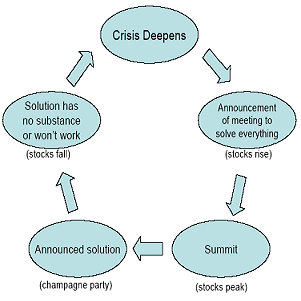
Einhorn states the 2012 might be the “fall of the Euro” and the 2012 catastrophe that the Mayans predicted. I still don’t think this is even remotely on the table. The Europeans are moving (inching) towards greater unity and will not allow a sovereign default to ravage the area as Lehman brothers did to the USA. But that doesn’t mean the pain in Europe is over. If anything, their lack of greater action (moving towards fiscal union or creating a permanent and sustainable financing mechanism) means the crisis is likely to re-emerge after the “champagne party” ends…


55 Comments
Very resilient markets despite the horrid Euro-zone situation.
Will Germany relent?
Cool! Free money on the ground if one wants to trade it.
Cullen, do you trade Euro assets based on these types of predictions, or is this all too speculative for you to get involved?
I owned some German equities last year when the world was ending, but that was a rental. My general approach is steer clear here. We could be recovering or we could be staring into the abyss. You’re betting on ignorant politicans either way….
Agreed. I think that the benign market environment is actually a major negative in terms of the prospect for real progress. There’s no sense of urgency. Euro leaders are more likely to make bad decisions (or no decisions) in a benign market.
Nothing like a crisis to get some action – right now…its a matter of “what crisis??”
Rodger Malcolm Mitchell believes that Euro countries should ” declare that henceforth, they will pay all bills, now denominated in euros, at the rate of one [sovereign currency] for one euro, and after a certain date (perhaps one year off), all taxes must be paid in [sovereign currency]. Instantly, their debt becomes easily manageable.”
Any thoughts?
Sure, if you dont mind crashing the global banking system. The sovereign debts would immediately devalue as they are now denominated in [sovereign currency], wiping out numerous European banks and potentially causing a cascading failure of global finance.
A commenter here posted a great interview with Martin Wolf the other day. Here is an excerpt regarding potential Greek withdrawal and reintroduction of the Drachma,
“If Greece leaves, what would that mean?” Nobody is absolutely sure, but it probably would mean that the debts of the Greeks that had been contracted inside Greece would be re-denominated in a new drachma. Their value would collapse perhaps 50% to70% depending on what happens to the exchange rate. The banks would almost certainly implode and have to be taken over all by the state. It would immediately be a huge crisis in Greece. Of course, those Greeks who still had money in Greece would be the less-savvy people, who would lose enormous value in real terms. Those companies who borrowed outside Greece would be bankrupt because of the balance sheet effects.”
http://advisorperspectives.com/newsletters12/pdfs/Martin_Wolf_on_the_Eurozone_and_Beyond.pdf
For what it’s worth, Wolf’s solution seems equally implausible, essentially saying that the developed world needs to spend less or export more and that Asia needs to spend more or export less…
What makes Greece, or any of the PIIGS, that much different than Argentina?
In january of 2002 Argentina defaulted on it’s debt, within the next few months allowed the peso to float. Their currency depreciated, inflation ensued. But the following year, and up until the 2008-2009 worldwide recession, Argentina was on a path to prosperity…
“… the GDP jumped 8.8% in 2003, 9.0% in 2004, 9.2% in 2005, 8.5% in 2006 and 8.7% in 2007.” (wikipedia)
So sure, of course there is turmoil in the aftermath. But with proper policies, the country regains is monetary sovereignty and is back on solid footing, right? Further, if they look at what the Argentine government did.. learned from the successes and mistakes.. couldn’t the Euro countries make the transition even smoother?
Why would Greece, or any of the PIIGS, following a similar path, have much different of an outcome? Why would they crash the global banking system, when Argentina did not?
Thoughts?
This may help, http://graphics.thomsonreuters.com/F/09/EUROZONE_REPORT2.html
Click “Bank Exposures Map” on the left.
I’m not an expert on the Argentina default. Lets say that the Argentina default caused spectacular losses at US banks. If the situation was severe enough (as it was in 2008/2009), the US, as sovereign issuer of its own currency, has the flexibility to support its banking system by injecting money into the banks and preventing collapse.
From the link above, you can see that there are significant exposures to Greek debt within the Eurozone. Lets say that a Greek default causes severe issues for French banks which held Greek debt. France, as a member state of the Euro, does not have the ability to print Euros and prop up its banks, which could potentially result in the failure of various French banks, which in turn…
Maybe the Greece issue isnt big enough to cause a chain reaction of bank failures in states which do not control their own money. Italy and Spain are certainly of sufficient size however.
I have difficulty imagining a scenario in which some or all of the PIIGS exit the Euro without the result being a complete breakup of the Eurozone.
“I have difficulty imagining a scenario in which some or all of the PIIGS exit the Euro without the result being a complete breakup of the Eurozone.”
I think that’s the biggest concern. If Greece exits, the fear would be that the Italians, Spanish, Irish, et al decide the EMU-dictated austerity is not worth it and also bail.
Argentina issued their own currency. Greece does not.
As long as Greece remains in the Euro, they will be unable to depreciate / devalue their economy as a whole – they can only internally devalue; that is, devalue those aspects of the economy that are fixed within Greece – labor, unmovable assets and public services.
In order to create competitive exports, although labor is an important cost component, corporate debt is denominated in Euros and is depreciated only to the degree that the Euro as a whole does – much less than if Greece issued their own currency. So corporate debt becomes a higher relative expense than prior to internal valuation. Which makes it difficult to issue new corporate debt for investment.
So, labor must accept a much higher burden of the devaluation process – reduced wages, higher taxes and lower government services. Not a recipe for growing demand.
Since the government does not issue its own currency, they are unable to deficit spend to the degree necessary to create demand. And there is no EZ mechanism to transfer funds to Greece to reduce the impact of the demand destruction, such as in the United States.
So the government debt write-off may resolve Greece as a short-term ongoing European financial issue, but it will not help Greece restart economic growth.
Instead, Greece needs to re-establish their currency – leave the EZ. But if this debt write-off goes through, there will be intense pressure on Greece to remain in the EZ. Most likely, Greece will need to sign a new commitment to the treaty as a precondition of the write-off. Otherwise, the banks would agree to eat the Euro debt and then Greece goes back to the drachma? Never happen.
It was me. I am glad someone noticed. Truly, IMHO, a must read piece.
I am referring, of course, to the MF interview.
Thanks, Octavio.
Does Wolf ‘get’ the MMT/monetary realist understanding of fiat currencies (vs the Euro)?
He certainly seems to. And, extending that perspective, he also addresses the role of Current Account Balances in relation to the USD’s reserve currency status.
Wolf doesn’t buy into MMT all the way. I’m building Monetary Realism with a couple of other guys. We’re filling in all the holes in MMT and eliminating the politics from the reality. The theory will be separated entirely from the operations. It will be nice to have an operational framework that just focuses on reality and doesn’t get bogged down by all the political bantering.
MR or MMR (Modern MR)?
Um, you decide?
Both already have current associations, but MMR’s is more positive
MR = Mental Retardation
MMR = Measles, Mumps, Rubella (vaccine)
Actually, the latter is not only positive, but a good association for Modern Monetary Realism…it can inoculate against bad economics!
In that case, let’s not shorten it.
I’d be particularly interested in a more thorough analysis of the Current Account Balances/Reserve Currency nexus.
Best of luck,
Colin
Good. Because that’s going to be one of our primary differences with MMT….
Great (this is where MMT seemed weakest – much better than arguing over the JG).
Good place to establish a new and needed framework.
And I should say, what we’re really doing is eliminating the EXTREME politics from the reality. Of course we can’t eliminate politics entirely. What we’re doing is sort of like taking Austrian econ and making sure that the Rothbards are not confused with the rest (something they should have done years ago)….MMT as is, is the extreme left arm of economic theory….We’re putting up a fence.
Any of these other guys have blogs?
Yes. Some very prominent. Details to come though. we have to hash out some details before I start splashing things all over the internet…
Great, looking forward to it!
“But the bigger problems remain. Europe’s trade imbalances will persist as the single currency continues to wreak havoc on the region.”
Quite right, the problem is all about the trade and CAB imbalances within the Eurozone.
See more about testing the limits of trade divergence and the potential solutions in http://ppplusofonia.blogspot.com/2011/12/eurozone-crisis-tests-limits-of.html
Latest on Greek deal (HT ZH)
http://www.nytimes.com/2012/01/19/business/global/hedge-funds-may-sue-greece-if-it-tries-to-force-loss.html?pagewanted=1&_r=1&seid=auto&smid=tw-nytimesbusiness
Felix Salmon says it’s Greek default on March 20.
http://blogs.reuters.com/felix-salmon/2012/01/18/greeces-game-plan/
They should just let Greece go. Greece is already in a Depression, it will just become a greater depression, but get over quicker. If a default on Greek bonds makes some German and French banks insolvent, so be it. It that is enough to do them in, those banks should not be a going concern anyway.
I still think the UK (which has its own sovereign currency) is an accident waiting to happen. A bug looking for a windshield. The UK’s financial sector has debt at 600% of GDP. The City of London is much bigger than the whole country. The UK will probably do an Iceland, but without the favorable outcome of Iceland, as the UK is much more susceptible to severe political unrest.
But it won’t be called a default, it will be an “agreed-upon write-off”.
Domestic European politics will determine what happens in Europe. And a united Europe is not nearly as popular with local electorates as it is with financiers. As the standard of living for the former declines (so that the latter may remain “confident”) this unpopularity will grow. And this year we will see elections in France.
We’re playing with a deck full of wildcards, but I think the biggest here is the new sanctions on Iran, and what this will mean, long-term, for energy prices across Europe. And remember: so far we are seeing a very mild winter.
Did Germany expect all of this to happen? As in, make the periphery dependent on them (Germany) to manufacture and export? Did they always have a strong export economy, or did they shift into high gear when the euro was being adopted?
Im too young and too new to a lot of this still to remember everything. I was growing up still when they were planning the euro.
So Euro ends in 2012 ? So buy Northern Euro bonds… Nice view.
Look at these numbers folks:
Foreign-claims-of-PIIGS as % of GDP:
Germany = 21%
France = 34,1%
The Netherlands = 30,5%
Belgium = 25,2%
Switzerland = 11,5%
Great Britain = 18,8%
Italy = 3%
USA = 1,3%
Italy = 3%
Sorry but I’m continuing reading about implausible solutions. The only plausible position on this blog is from Cullen Roche. Then we can speak about irrationalty, folly etc… impossibile to make money betting on that.
I believe that Germany will make the terms of the loans to the Greeks so onerous, that Greece will be forced to default. This is similar to what happened to the Germans after WW1. Lord Keynes commented on the German problem in his book, The Economic Consequences of the Peace.
I will reiterate what I said here yesterday before the Dow Jones Financials Index ripped 6% today – buy Euro financials hand over fist against the XLF as your hedge!
Also, what if the bears’ worst possible outcome comes to fruition (Greek default) and the Euro rips higher because Greece exits the single currency?
Cullen – I am really pumped to hear more about Monetary Realism. MMT has never quite sat right with me, but I trust your opinions. Filling in the foreign sector issues will be a huge plus also. Do you have any economists on board with it?
Ignored in all this is the fact that EU countries must forgoe currency sovereignty
when adopting the EURO. For each adoptee, the EURO is an externally generated currency, similar to gold, which specifically means each EU country must maintain a positive foreign trade balance to secure sufficient EUROS to meet it’s foreign exchange (oil) obligations.
Thus all EURO adoptees, are not sovereign Currency Issuers. The UK refused to adopt the EURO and remains the sole EU country still a sovereign currency issuer, and the sole EU country with out default risk.
As Bill Mitchell mentions again and again, the solution for the EU is either the return by individual countries to their sovereign currencies, or Fiscal Union, with the ECB funding the individual governments to the extent necessary to restore full employment in each of them.
Again, I say that if you really want to understand MMT you need to stop listening to Cullen and go to Bill Mitchell’s blog and get it from the source.
Cullen is a not warmed over Neo-Classical Economist who is trying to co-opt MMT for the express purpose of destroying it.
And for the record, my email is: goprisko@publicresearchinstitute.org
and if you have problems with me, you are welcome to email me directly.
Don’t expect me to tolerate prattling. You’d best have cogent arguments.
Based upon the real world, and definitely not on Neo-Classical Economic Rubbish.
Dr. George W. Oprisko
Executive Director
Public Research Institute
Please familiarize yourself with my work before writing comments that are totally off base. I’ve been writing about currency sovereignty and the Euro for as long as I’ve been writing this website. I’ve described the inherent imbalances caused by the lack of sovereignty in great detail. I compared the Euro to the gold standard TWO years ago:
http://pragcap.com/the-inefficient-market-irony-behind-the-euro-crisis
Bill Mitchel has been saying that the Euro needs to break-up. I’ve been the one beating the fiscal union drum endlessly for the last few years. So far, it looks like I am going to be the one who is right….
And no, I have no interest in blowing up MMT. I consider Warren a good friend and I have no interest in hurting his incredibly brilliant contributions to economics. But it’s not my fault that they’ve embedded extreme leftist theory in what is really a fantastic framework for understanding modern money. This also doesn’t mean I am going to engage in MMT group think just because some MMTers believe certain things to be fact, when they are clearly theory….
“extreme” leftist is a bit harsh i think Cullen… left wing yeh certainly, possibly by US standards its extreme (not having a pop at the US! views are different can understand that) certainly know a few americans who would hear the JG and go for their guns though as some socialist invasion!
Yes, in the US it is extreme left. In Europe its the center.
But we are talking about economics and, as Cullen consistently points out, the US is an unmatched economic engine. We’re talking economics, that’s all. I lean right politically because it applies to me more. But I align with a lot of what would be called lefty if not socialist policies in the US on the social front. I would literally fight for some leftish social standards in the US (I personally consider that we don’t have federal laws granting gay marriage rights in direct opposition to the ideological liberties this country stands for) .
But saying that the JG does not, at the very least, smell of extreme socialism, ESPECIALLY at current unemployment levels, is insane to me.
Respectfully
Is it harsh? Are there any Euro countries running this program? I think even by European stds this program leans left….I dont mean to make it sound personal, but let’s clear the air here. There’s an arm of MMT that is as far left as the Rothbards are right….it really skews a pragmatic perspective….
I don’t see why forcing everybody to work for the government at a low wage should be described as “leftist”.
The left used to stand for better conditions and standards of living for the working classes. Would a JG help in reaching that goal? I doubt it.
Government job programs are generally associated with socialism.
War – or defence in general, for that matter – is also a government program and yet it definitely should not be associated with socialism.
Defense is a necessity. A man playing guitar on the street under the JG is entirely unnecessary….
But, what if lets us have more Naked Cowboys???
“Bill Mitchel has been saying that the Euro needs to break-up. I’ve been the one beating the fiscal union drum endlessly for the last few years. So far, it looks like I am going to be the one who is right….”
Come on, Mitchell is just stating his personal opinion: that break-up would be better for all of Europe. Doesn’t mean it will happen though. The future is unknowable (even for a smart guy like Cullen Roche
) and there are many possibilties for the end game in Europe – deeper union, paralysis, partial or total dissolution, etc.
Anyway, even if fiscal union ultimately prevails that does not mean it’s the outcome that maximizes the well being of the peoples of Europe. Yet in a democratic polity this is all that should count, for economic and political solutions should be there to serve the people, not the other way around.
With all due respect Dr. Oprisko, you are completely off base here. Cullen has continually stated the Euro experiment can only come to one of two conclusions: break up, or fiscal union. There are innumerable articles in the archives of this site where he articulates this. I’d suggest you actually familiarize yourself with his writings before coming here and attempting to put him down.
Is it just me or does this read like a 419 scam email?
anyway factually incorrect its not just the UK who doesnt use the euro Sweden doesnt either.
” I will not tolerate any prattling”
Your funny Doc. U just came into Cullen’s business talked shit in front of his customers….then u ..here’s the kicker…u left your business card with his friends and as you left u said….I will not tolerate
Rattling. OMG…this is too good. I’ve seen it all. …
Doc u should learn some manners. How is a doctor so I’ll-bred.
Prattling…so u come here and talk shit then you set how your going to be spoken with. Oh brother.
Cullen..u really got to Doctor douche…he lost his marbles coming here…he probably can’t sleep at night. Your site and success have him doing some foolish things. Like leaving his contact info . I’m still laughing at the….prattling comment.
Well Some MMTers tried to keep you in line and now your about to do what they never could…and theyre losing it.
Can’t wait to see your new site…I’m sure you won’t allow any prattling.( I’m exempt)
I pad misspelled mess above sorry
The term ‘Monetary Realism’ has already been coined by Merrill Jenkins (deceased 1979) in his ‘Treatise on Monetary Reform’. Jenkins is referred to by his followers as the first ‘Monetary Realist’. There is a Monetary Realist Society based in St Louis (with a facebook page) which continues to propagate his ideas.
Funnily enough, Jenkins absolutely detested fiat money, calling it “the greatest hoax on earth”, and was a gold currency/ competing currency advocate. Members of the Monetary Realist Society appear to be mainly rightwing so-called ‘libertarians’, Ron Paul supporters and conspiracy nuts.
Good. Since he’s gone and I own the URL he won’t mind when we rework the entire thing.
Jenkins published a book called ‘Free Money’, which weirdly enough is also the title of Rodger Mitchell’s magnum opus.
