

What About an Inflation Gauge for the Average Middle Class Family?
One of the common responses to my recent post on inflation (and its low levels) is that inflation in the things that matter most is well above where the overall index is. This is a fair critique. The BLS lets us break-down the data into segments so we can actually create a fairly good inflation reading for particular items.
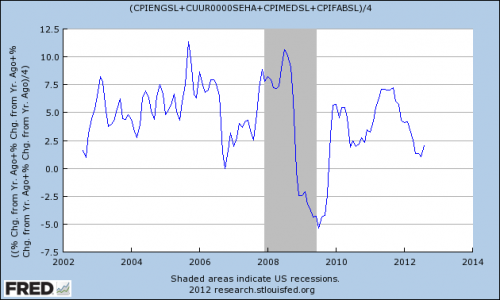
In the index below, I’ve taken medical, food, beverages, rent and energy indices. The goal is to focus most on those indices that hurt an average middle class family the most. These are the things they can’t live without. So we’ve eliminated many of the things that might bring the index down and skew it towards the appearance looking lower than prices actually feel.
What’s it say? It tells a slightly different story than the headline index. But it’s still below the historical average of 3.5%. And the most interesting part is that this index has surged over the last 10 years. You can see that the averaged reading over the last 10 years has been well above the long-term inflation average of 3.5%. Perhaps that explains why many people feel this disconnect between the government data and their actual costs. The latest reading of about 2% is still historically low though. But with gas prices now surging again we might be feeling more inflation pain for the middle class….


21 Comments
That also tells the story of negative real rates over the last decade creating one of the important conditions for a housing bubble… and leading to falling savings rates – encouraging consumption over savings, etc. We need more markets and less govt in the way rates are determined, if we don’t want to be stuck in a boom-bust cycle.
Markets are especially good at boom-bust, you know.
Limiting boom/bust might be one reason for a measure to limit the total amount of credit/debt (‘inside’) ‘money’ the banking system can create. It seems like such a measure would entail market (as opposed to CB) setting of interest rates pretty much across the board.
See also my reply to krb below
Great idea Cullen! Could you please provide a link to the source data used and how it is calculated? I keep track of my household expense using accounting software so have the ability to calculate rising costs fairly accurately. While I like your intent, 2.5% still seems outrageously low, at least from my experience, and I wonder if it has to do with “rent equivalent”, “hamburger price replacement for steak price”, or some other massaging the BLS does.
I think your pursuit of accurate inflation data is heroic….I’m not exaggerating! I also suggest some fairly simple categories with definitions to make it even more realistic, for example……
1. Young person still in school
2. Young couple with kids still renting
3. Young couple with kids paying mortgage
4. Middle age couple, no kids, paying mortgage
5. Retiree, house paid off
Maybe there should be more categories, I don’t know. Some inflations will be experienced equally by all groups, such as food and heating costs. But it becomes quickly evident that each group will have VERY different inflation experience on others…….for example, in the past you’ve given a lot of weight to low mortgage rates as an offset to ramping food and energy costs…..but you can see that only helps 2 of 5 categories of people described while the others get hammered. I also believe the “rent equivalent concept is a smokescreen…….as people are leaving apartments to buy homes rents drop while home prices rise, and as homes become unaffordable or underwater home prices drop and rents rise……its silly and not realistic to treat them together like BLS has done in the past (and maybe still does?).
Anyway, I’m just thinking out loud but appreciate your effort….good work and good luck with this idea! Thanks, krb
krb,
If you are interested in more on limiting bank created credit/debt/’inside money’, see my reply to Tom (also preceding discussion) at
http://pragcap.com/ask-cullen#comment-126445
CST, I will read and respond.
If you set the 2002 starting point at 100, what would the number be today?
Probably above 150?
… And then chart wages alongside.
I’d like to second this.
Cullen I think you’ve got a good idea here. Maybe create a unique new inflation index of the things that hit middle and income people the hardest. I agree with Johnny that it seems relevant to track wage /salary grwoth along with it.
Very illuminating chart. I’d like to see it with education added since a BA/BS is almost required for even lower middle class jobs.
Agreed. It would probably look a lot worse.
College costs are one area of inflation that is directly driven by government spending. As more of the cost is paid by grants and government student loans, the colleges can charge higher tuition. Prices rise to whatever level the market can bear. The same thing is probably true with medical costs.
Noit sure if that is true. The number one driver of increased college costs is the DECREASE in direct government subsidies to colleges over the past 30 years.
A very good source for an analysis of college costs is the book “Higher Education?”
Here is a link to learn more.
http://highereducationquestionmark.com/
I do not think the change of government subsidies are measured in inflation.
I was surprised to read your view, because my initial reaction was “why wouldn’t ‘easy money’ have the same inflationary impact on college costs as it does on home costs?”. If you are upright and have a pulse you can get student loans in almost unlimited quantities…..my kids are at that age so I know, and much different then when I borrowed for school. And this was taken off the front page of the website you linked to…..
Andrew Weighs In on Student Debt in a New York Times Op-Ed on May 12, 2012
May 13, 2012
By Andrew Hacker
Question: Why has the cost of college tripled, in real dollars, over the past 30 years? Answer: Colleges know that whatever they charge, students will pay, largely by taking out loans. The Reason: Only colleges can grant degrees, an award most young people think they must have.
Yet the shameful truth is that too [...]
Now, you sound like you’ve done the research so I’m sure you’re right about the impact of reduced subsidies on college costs. But it raises another question……has govt simply replaced subsidies with easy to get loans, and if so, how do you define what the college inflation is? Even if college “cost” hasn’t changed much, the impact on me and my kids is still highly inflationary as my payments replace what was formerly paid for through govt by subsidies. I had always assumed huge cost increases but it now sounds more like cost shifting. Thanks for the eye opening comment! krb
Cullen – I know you don’t give recommendations but can you point me to what I should consider if I’m looking at replacing treasuries with MBS. That is, I can’t convince myself that is a smart investments even with the Fed buying MBS because of the what the Fiscal Cliff (and potential global slowdown and this marginal inflation) will have on those with mortgages. I don’t think I see the whole picture – any insights of what other factors to consider.
Consider that MBS will get a little bit riskier on Jan 1, as the unlimited Congressional guarantee behind Fannie and Freddie will expire. They will no longer be the equivalent of Treasuries.
Thanks! I’m in the middle class, and like most people I feel a disconnect between the official inflation rate and my own personal rate, but I never would have guessed inflation for the middle class is as high as it is. Things might be a little better for me, since I pay a mortgage rather than rent, and because housing prices have been flat in my area throughout the housing bust.
You guys don’t get it, if the things you need don’t increase faster than “headline” inflation and your salary, then NGDP targeting isn’t working! (Now I wonder why that doesn’t apply to Goldman bonuses … )
I think there is some sort of human time frame that is never added to these charts. I think there needs to be a mathematical formula that incorporates the human time frame reference. It could be called the “Use’ta” formula. It takes into account the human emotional feeling of what they “Use’ta” pay for something and then factors in the emotional attachment to the item based on a need scale along with an overall daily use factor as a % of our daily output ability minus this “Use’ta” formula.
I think it would help people understand better that they Use to pay X amount for this, but it cost them in X amount of real labor for it.
This would sort of be an efficiency factor.
I don’t see that ability on the FRED charts. Maybe I should email them and ask if they can make one.
Medical share of CPI-U is ~7%, medical share of GDP is ~17%.
CPI-U medical share is severely under weighted against reality.
“I’ve taken medical, food, beverages, rent and energy indices. ”
Did you equal weight these 5 categories? If so it would not reflect inflation accurately. For example someone spends 10x+ on rent than he does on beverages – assuming someone is not an alcoholic.
Obviously everyone’s experience is different but a weighted measure such as
35% rent
25% medical
20% food
15% energy
5% beverage
could be a standard
I’d also run a second series for those who are dealing with secondary education costs as medical and college have both outpaced wages by a wide margin (education MORE than medical) the past few decades.
Also what are all the areas you excluded? Aside from clothing and automobiles? Because looking at your series if US inflation has been around 2% and these categories have been mostly above that total inflation rate the “everything else not included in this chart” bucket must be negative over the past decade.