
WHAT TO EXPECT THIS EARNINGS SEASON
Another earnings season is right around the bend and it’s shaping up to be very similar to the last 6 that we’ve seen. In short, cost cuts have created very lean balance sheets and corporations are leveraging up these lean balance sheets to generate respectable and “better than expected” bottom line growth. The result is an environment that continues to be unappreciated by the majority of investors.
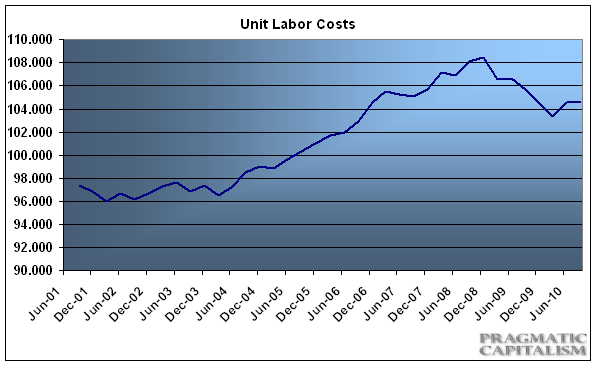
The largest single cost input for most corporations is labor. During this recession we’ve experienced a near unprecedented decline in unit labor costs. As I mentioned yesterday, this massive cost cut is causing extraordinary pain on Main Street, but is actually helping to generate healthy margins for Wall Street. Although the cost cutting appears to have troughed in the last few quarters labor costs remain very low by historical standards. Rising input costs have started to put pressure on balance sheets, however, on the whole we should see fairly stable margins as long as unit labor costs remain low.
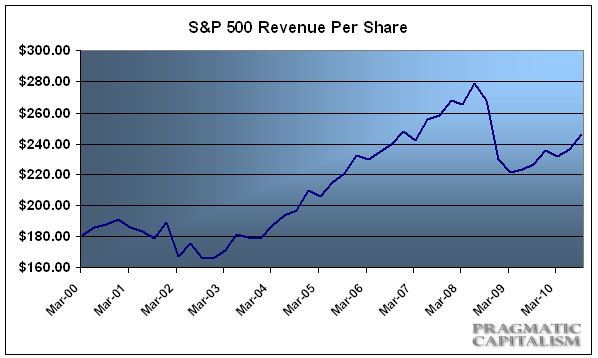
Revenues have been unspectacular in recent quarters, but low single digit domestic growth combined with double digit growth from Asia is helping to drive S&P 500 revenues per share in the right direction. So, we’re seeing continued cost cuts and relatively good revenue growth.
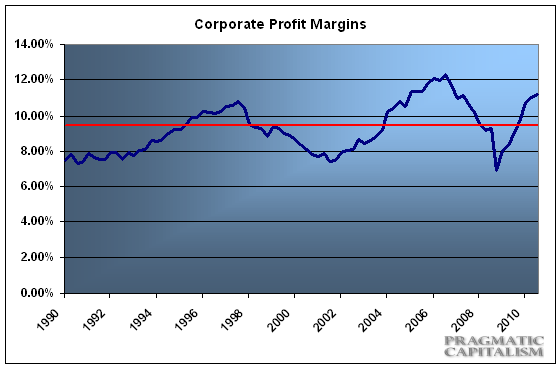
What does that mean? It means nice fat margin expansion. Although margins are still off their all-time highs they are fast approaching those levels. I would expect to see some stagnation in margins in the coming quarters as revenues continue to tick higher and costs continue to move north, however, with margins at record highs we can expect to see continued profit expansion.
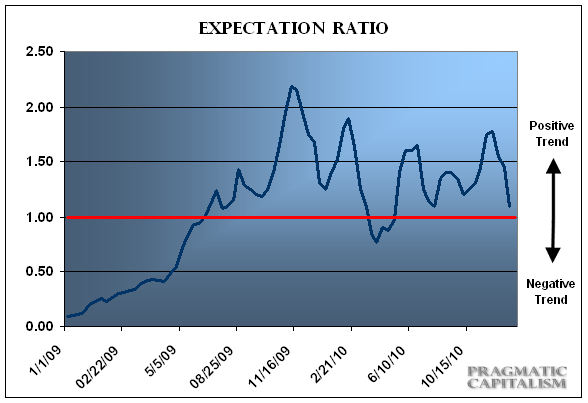
What does it all add up to? It likely means we’re in for another quarter of “better than expected” earnings. The deeply negative sentiment and solid bottom line growth has created an investment environment that is ripe for outperformance. This is best reflected in my Expectation Ratio which has now forecast very strong earnings trends since Q2 2009. Based on the recent reading of 1.45 we can be quite confident that the state of corporate America remains quite strong.


aaah, as per yesterday the heartless bitch again…..boy, could i tell you some stories about them…..oooh
the main street/wall/DC street disconnect is starting to get roots….tho its fine to be riding this secular bull in my own way.
when cullen descibes the biggest thing he has learned in the last 2 yrs. i listen.
Sorry boatman. Comments got hung up in spam for some reason.
aaah the heartless bitch again per yesterday……the main street/wall street-DC disconnect expands.
when cullen descibes his epiphany of the last 2 years you best listen.
All this is true and obviously in anticipation of a good earnings season the market has been drifting higher lately. Still, it has been an unusual market environment characterized by relatively low volumes and lack of real conviction. Since the mild correction in November we have not had a follow through day. The fundamentals are good as explained by TPC but the technicals are not aligned.
Boomer – the one technical I follow religiously now, to the exclusion of all others, is price. From a technical standpoint, that seems to confirm nearly everything TPC discusses in this earnings expectations snapshot.
Am I missing something that better explains the strength of the market other than price?
B Ferro,
I may be a stickler, but after a correction I look for a follow through day in the strict technical definition given by William O’Neal: at least 1.7% daily increase in one of the major indexes accompanied with a significant increase in the volume. We have not had a follow through day after the November correction. The meaning of the follow through day is that a reversal in investors’ mood has happened and they decisively have moved to the bullish side again buying large volumes at higher prices. Of course, there are other ways to determine if this transition has happened. Anyway, I believe it is important to monitor the price/volume dynamics, not just the price. So far, the price/volume dynamics is what keeps me half invested instead of fully invested since the beginning of December. I am getting tired of being under-invested but I’d rather stick with my investment principles than get too opportunistic. The moment the model I follow switches to “buy”, I am ready to commit the rest of my cash because I fully agree with everything TPC says and with the bullish Goldman prediction for the first half of 2011.
So bullish – combined w/ the Fed this will be the best bull market in history from an upside in compressed time standpoint. New highs for the SPX by June.
The only problem is that multiples are getting very streched and QE won’t last forever…
Markets are getting clearly ahead of themselfs, but these are unshortable markets
Why are your corporate profit margins different from others, namely, Goldman, Morgan Stanley, JPM, Factset, and other data sources? In aggregate, the chart for corporate profit margins is considerably higher than Wall Street and other data sources. I agree profit margins are at historical highs, which is not sustainable. It can last for a period, but as empirical research suggests, one should buy when margins are depressed, i.e., buy cyclical stocks when margins are low and PE’s are high, and sell them when margins are at highs and multiples at their lows. We have a little to go on margins, but the risk vs. reward is not favorable. It is not hard to understand; however, it is counterintuitive to buy at high PE multiples and sell at low PE’s. The absolute and relative outperformance of buying cyclicals, other industries or sectors at peak or near peak margins is a trap that is known on Wall Street, but seldom conveyed to the public. It is this fact among many others that I was fortunate to learn from Avi Nash when he was at Goldman. I was surprised to see Morgan Stanley’s report on margins, which details the performance of the markets three to six months prior to peak margins.
I am calculating the data differently. I prefer to use corporate profits as share of GDP. Smooths the data.
You’re correct that the time to be overweight stocks is when margins are depressed. But that doesn’t mean margins can’t remain high (and contribute to earnings expansion) for many years after they’ve plateaued. Margins peaked in 97 and 2006 during the last cycles. I’ll keep a close eye on the data, but for now there’s nothing to really be alarmed about.
I agree trends can continue unabated for a time, but one needs to contextualize that margins and other measures will revert to their mean. The linear extrapolation occurred during the periods you highlighted, in 1997 and in 2006. This occurrence is typical, but when you overlay normalized profits, sales, etc. over an investment cycle and the longer business cycle, this provides an investor the prospective needed to implement an effective investment strategy. It is not to discount that profitability cannot continue, but without additional products or innovation, the incremental increase will become harder to achieve.
Moreover, the trend in margins using either method to calculate the level is analogous to the level of the affordability index at the peak of the housing boom, which was a three standard deviation event. Obviously, the level of margins for the market is not that extreme; however, one standard deviation above and increasing needs to be monitored, for it will peak and revert to below the mean. Hedging is paramount at this stage, and right now, there is a lack of hedging. This could be problematic in the future, but the timing of when volatility comes back to the market is too hard to determine.
The DCF valuation that Wall Street analysts and strategists are using to value stocks should be adjusted to account for normalized earnings not just peak earnings, which will provides a better idea of what the true margins are for companies. Global growth will affect what margins are, but it does not account for the 250bp increase in margins.
At issue is the massive intervention by central banks to insure growth and profitability, which has resulted in artificially low interest rates and high assets prices globally. This is evident when looking at the relative trade, stocks vs. bonds, but one has to be pragmatic about delta between the E/P yield of the market compared to bonds. It will normalize on both fronts, so an investor must be pragmatic during this period for the intervention by central banks around the world will eventually come home to roost. As the title of your blog, Pragmatic Capitalism, is apropos for the investment climate be are in. Thank you for your contribution.
Deeply negative sentiment? Not based on investor surveys
Not long-term surveys….
In case anyone’s interested, Meredith Whitney on CNBC this morning:
http://www.cnbc.com/id/15840232/?video=1738621708&play=1 (Part 1)
http://www.cnbc.com/id/15840232/?video=1738688706&play=1 (Part 2)
Thinks Q1 will be okay, but come Q2 issues will arise.
Donald Trump’s looking to get into the Presidential Race. Pounding the Bash China and Opec Drum. This could get interesting for mkts.
The funny thing about Donald Trump is I actually believe he would make a very good president! We would get to see if he really is as ruthless as he likes to think he is.