

Home » Most Recent Stories

WHERE ARE RATES HEADED? 3 SCENARIOS

31 January 2012 by Cullen Roche 9 Comments

One of the hotter debates going on right now surrounds interest rates and whether the great bull market in bonds will continue.  My base case has become bearish on Treasuries after having been bullish last year before the big surge in bonds.  In a recent research piece Nomura offered three scenarios for interest rates.  I agree with their scenario B in which they view increasing odds of QE3 in Q2 and a rise in yields as the standard portfolio rebalancing plays out as a result of more easing:

“in Figure 1 we show scenarios (with a base case) of the next potential moves where we do not envision the range lasting for much longer.

  • Scenario A (20% probability): US data continues to be strong, with a weak 10yr auction as investors try to ascertain a higher coupon at the refunding, and then Japan begins to sell into year-end (March), along with a potential agreement around Greece quickly reverses this week’s Fed-induced rally, pushing rates higher into summer.
  • Scenario B (60% probability; our base case): Either US data begins to wane because of seasonality, or European fears resurface, which leads the Fed or ECB to QE in Q2. However, even if data continues to be strong, the initial rise in rates would be met with buying from “value investors”, leading to a temporary range before more easing comes, favoring risk assets.
  • Scenario C (20% probability): European fears flare-up and data fades even faster, leading to risk assets (stocks etc) rolling over, helping USTs. The question here is does this happen now or after we hit 2.16%? Either way, whether there is a rebound or new long range will be determined through how bold central bank actions are. Rates would rally first before anticipating a positive catalyst from the Fed‟s and/or ECB‟s next easing move, therefore breaking us to a new lower range.”
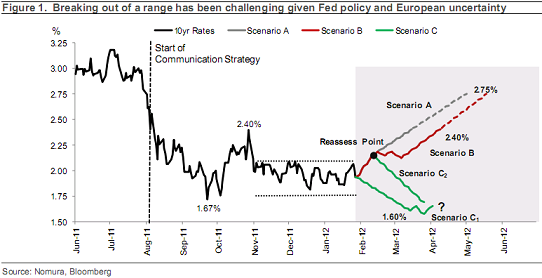
Source: Nomura

Cullen Roche

Cullen Roche

Bio - Coming Soon.

More Posts - Website

Follow Me:
TwitterYouTube

Disclosures - Unless otherwise noted, authors have no positions in any securities mentioned and readers should never consider this to be investment advice. Always consult your financial advisor before acting on any ideas. Comments Guideline - Readers who denigrate authors or other readers will be banned without warning. This site does not tolerate any sort of reader abuse. The goal of this site is to create an environment that is conducive to learning and better understanding of the monetary system and the investment world. We expect readers to behave maturely and responsibly. We welcome and encourage intense and intelligent discourse, but the site adheres to a strict 1 strike policy. While it is your right to speak freely, it is not your right to behave childishly. Above all else, please enjoy the site. It is intended to be used as an educational tool and we hope the intelligent and mature debate will further that purpose. We hope readers will make an effort to respect that goal. Comments with excessive linking or foul language will be moderated before posting.
Comments
  • Doomonyou

    Is there a rate below which investors will simply not buy the 10 year?

    I already find it amazing that with the Fed openly targeting two percent inflation that the 10 year would trade at that number.

  • VII VII

    QE pushes rates up and then QE ends and rates go down. Hilarious if it wasn’t true.
    Good post CR and view by Nomura to wrap there hands around possible outcomes.

  • Bob Barker

    Cullen – I don’t understand your bearishness given that you have said in the past that the Federal Reserve can pin the rate wherever they want. If the Fed wants to keep rates below 2%, then your logic says that they can and that no one can do anything about it. So are you going back on that, or are you saying that you think the Fed will willingly let rates rise? And if it’s the latter, why do you think they would do that given their usual modus operandi? Thanks.

    • The best way to think about interest rates is to think of the bond market like it’s a dog on a leash. The Fed lets the leash out sometimes and traders will take the market where they think the Fed should go. The Fed yanks the dog back in-line on occasion though. I think there’s a risk that the dog will get out ahead of the Fed a little bit here and then the Fed will yank it back in place. I prefer other assets right now….

      • Jay

        Fair enough, considering the 10-yr yield is at 1.799 as I type. But I still think there’s a good chance yields go as low as 1.5% at some point this year, per Gary Shilling’s prediction.

    • jt26

      One thing TPC has noted in the last few years is that when QE is involved, expect the *opposite* of what is logical to happen. I.e. if Fed announces QE, you’d expect interest rates to move down, but interest rates actually move up and vice-versa. It’s a market dominated by money flow, risk on/off and not economic logic.

  • CHET

    I don’t have any personal knowledge of interest rates, but a friend of mine does. He worked for the NY FED for years and retired when his job at Bear Stearns ended with the company folding. He feels rates will stay low until after the election at the least, likely not rising until the economy improves, which is anyones guess. I’m not sure this adds any value to the conversation, but I threw it out there anyway.

  • hankster

    The fed will let the market tank and keep treasuries bid up if it comes down to it,they will eventually have to pick one or the other.

    But I am still finding other bonds with “value” in a land of low yields.The 30 year treasury yields 2.93%,I could still buy 30 year(A+) Muni zero with a 6% yield (tax free,so it’s more like 8.5%).That’s over 300 BP over treasuries (550BP if you count the tax advantage)and less risk to interest rate fluctuations.

    I would not touch treasuries here,although they could continue to catch a bid.But there is still some value if you shop around for other options,not everything is junk bonds and treasuries.

  • Larry

    There’s an article on Gundlach in latest Forbes issue. Gundlach won’t buy any bank bonds for his fund due to banks exposure to Europe. He also says that muni spreads are not wide enough to offset their risks in this environment.
    http://www.forbes.com/forbes/2012/0213/investing-jeffrey-gundlach-rise-interest-rates-recession-pick-poison.html

    He would rather take interest rate risk than default risk at this time. I’m staying with 15% in Gundlach’s DoubleLine funds – he’s got such a good track record. He more than doubled Bill Gross’s return last year!