WHERE DOES THE MONEY COME FROM?
Where does the money in the economy come from? What is the budget deficit? What is the national debt? In this video, adorable bears and bunnies prove that they know more about our monetary system than every single person in elected office today:
Adorable bear: “The National Debt is the amount of money to the penny that the federal government has created since it began creating dollars. It includes all of the dollars held by the public plus all of the dollars held by foreign companies that have done business with the U.S. There is no taking it back. Paying off the National Debt is impossible and it makes no logical sense to think of the National Debt in the way we have been taught.”
If that sparks your interest read more here.
* Thanks to reader Mark for the video & PaulJ & Trader’s Crucuble for the script.


Nice video.
So the national debt is exactly how many US dollars are out there in the world? So if the Clinton surplus stayed until the national debt was “paid off”, there would be no more US dollars in existance?
Also, is it a coincidence that GDP is ~15 trillion and the national debt is ~15 trillion?
Tom, this video doesn’t get into the real details, but the problem with America trying to run budget surpluses is that we are a trade deficit nation. That means we are constantly sending dollars overseas. So if the government doesn’t offset that impact with deficit spending then the private sector has trouble acquiring enough financial assets to grow. This is why Cullen and some other MMTers say the Clinton surplus helped drive the private sector into debt. If we ran a surplus right now the economy would absolutely get demolished because of the weak private sector and trade deficit.
Thanks. I basically get MMT, as Ive been reading up on it for about 6 months now. But those 2 questions above are ones that have lingered.
So the national debt equals how many dollars are in existance? And if the national debt is retired, there would be no more dollars in existance?
Tom,
Think of it like this. If the govt wanted to be “rich” tomorrow what would they have to do? According to your textbooks they would have to increase revenues. Obama’s been saying this for weeks. “We need to increase revenues”. Well, if the govt wanted to really become “rich” they could just tax us of 100% of our USD assets. Just take all those dollars back! Then they’d have this enormous surplus with which to spend! Of course, the pvt sector would be poor, but who cares if the govt is rich right? Wrong. Taxes serve to regulate aggregate demand. That means that the only risk from too little or too much taxation is the threat of inflation. If we tax too little we could cause very high inflation as demand outstrips capacity. If we tax too much (as we do now) then you get, well, look around you…..
I should add. The national “debt” is a misnomer. As the video implied, it’s illogical for a currency issuer to “finance” its spending. The bond market is a gold standard relic. So, the debt is not really debt. We don’t pay it back because we owe it to ourselves. When you are watching TV and some buffoon comes on and compares us to Greece, households, corporations, etc you need to turn it off so your brain doesn’t become further poisoned. Sadly, this thinking is prevalent. Obama and just about all of our leaders have been saying these things for the last few weeks. Bill Gross says it is in his monthly letter. These people quite literally do not understand how the US monetary system works. And I can prove it quite simply by showing them make no distinction between a currency user and a currency issuer….It’s frightening to say the least….
Some MMTers like to refer to the national debt clock as the national savings clock because what it really represents is the private sector’s (mostly) savings….I talked about this here the other day: http://pragcap.com/whoa-thats-a-lot-of-private-sector-savings-i-mean-debt
Thanks Cullen.
But yeah, I pretty much get MMT as much as any non-economist type can without studying it for years. Im on Mosler’s site all day besides yours Cullen
and read as much as I can.
But those two specific questions are one that still linger:
If the US “debt” was paid off, there would be no dollars in existance anymore? Since deficit spending creates dollars by spending them into existance, it creates national “debt.” But if you paid off all of the national “debt” then all the dollars ever previously put out there are now taken back?
And, is it a coincidence that we have roughly a 15 trillion economy, and the national debt is also roughly 15 trillion? Is there a correlation between GDP and the debt?
It’s a vague question. Let me elaborate. Technically, we could “pay off” the national debt via an idea like the trillion dollar coin. The Tsy mints the coin, the Fed accepts it, the debt goes away and the Tsy agrees not to “finance” itself via bond markets anymore. That’s clearly not going to happen. But operationally, there is nothing stopping us from doing that.
The only other way to “pay off the debt” is to tax it all back. That means the govt would have to eliminate every single outstanding US govt liability via a tax. So, grandma doesn’t get a savings account. Instead, she gets a nice big tax. But again, that’s illogical for obvious reasons. The govt can’t just eliminate our savings and expect things to end well. There’d be a civil war so fast you wouldn’t be able to find a good gun to buy.
I think it’s a bit of datamining to conclude that the debt and GDP have a high correlation. Now, they have SOME correlation because the govt has to make the financial assets available for the pvt sector to benefit, but the pvt sector’s ability to create output has much more to do with the ingenuity and creativity of the pvt sector than it does with the govt’s spending plans (although, there HAS to be some positive correlation for obvious reasons)….
Thanks for the quick responses Cullen, Peter, and everyone else
Cullen
Your answer to Tom has left me a little confused. Why would paying off the debt leave us with NO savings? Paying off the debt could just be paying no interest on your cash savings correct? Its moving your savings account to a checking account as Mosler likes to say. We would still have “savings” it just wouldnt be earning anything…… correct? All the govt would really saves is interest payments as I see it.
Yes, I used the checking account to saving account example above…Sorry if I misspoke.
Tom, yes, you’d still have coins outstanding as well as whatever dollars the US govt loaned to the private sector (thru its bank the Fed) or exchanged with private sector’s assets such as real estate. Technically, the govt could continue to either not tax or to loan to the non-govt sector the means to pay taxes. Which is as ridiculous as it sounds, as far as I am concerned.
Peter D
Please healp.
Would some please help me understand the bond part of MMT.
I know selling Tsy do not fund spending. But somehow these transaction get into the deficit of national debt. And MMT critics say we are borrowing to spend money.
I have learned that the purpose of the FOMC auctions are to set or target the federal funds rate – the interest rate banks charge for the loan of required “reserve” funds to each other.
I understand this is a pure monetary operation, not a fiscal operation.
I think the Tsy are sold to the Fed. Or is it to the primary dealers?
Who buys the Tsy? How are the transactions mechanics carried out – what accounts are affected?
Does this action add to either the deficit or the debt?
Pleas help me connect the dots.
This should help you out:
http://neweconomicperspectives.blogspot.com/2010/11/yes-government-bonds-add-to-private.html
“Taxes serve to regulate aggregate demand.”
So they really SHOULD HAVE taxed individuals more back in the 70s-80s when there was inflation? (And possibly taxed corporations less to stimulate modernization etc to boost production)
Hey Cullen,
You are a GOP supporter!!
“Taxes serve to regulate aggregate demand. That means that the only risk from too little or too much taxation is the threat of inflation. If we tax too little we could cause very high inflation as demand outstrips capacity. If we tax too much (as we do now) then you get, well, look around you…..”
Increasing the amount of USD by cutting taxes and not by Gov expenses!!
That will help for USD stability?
Indeed all about it is if you issue “money” that can be considered as standard gold, because behind it is a country that never goes hell… What if not is EUR?
My question is: how can we calculate the amount of USD to issue (debt) if it is the world reserve? That’s mean even in recession and debt crunch US need to issue more USD (debt) to support the emerging countries growth? QE3??
re:”Taxes serve to regulate aggregate demand.”
I think I would leave the “aggregate” part out. The top 1% have been getting most of the tax breaks and income inequality is at it’s highest since the Great Depression whereas the middle class is getting the shaft. If taxes were reduced by the same amount (let’s say 50% of what the middle class currently pays) as taxes were increased on the top 1%, the change in aggregate demand would change dramatically.
Tax relief for the middle class has a very different effect on the economy than tax relief for the wealthy.
Tom,
As I understand it. The National debt is how much has been spent, not necessarily how much is in circulation… since debt rollover does happen.
And someone correct me if I’m wrong, but what this means is, if the Govt tried to pay off the debt, this years tax revenues would pay off next years debt due, and so on. Until you unraveled the process and get to $0.
Wait a second, I was doing the math and trying to figure it out and what I said doesn’t make sense. Now I’m completely lost.
Say you start off with $0.
Year 1 –
The Govt creates a 5 year treasury for $100 out of thin air and credits your account by $100.
Year 2 -
You buy this treasury from the Govt for $100. Now there is $0 in the economy and the Govt has $100, you have a treasury.
Year 3 -
The Govt credits my account by $500. They use the $100 from you (hypothetically) and create a 5 year $400 treasury.
So now the Govt has spent $600 but there is only $500 in circulation.
Now things start getting fuzzy for me when we bring in the act of taxation.
Year 5 -
The Govt taxes $100 from me and pays off it’s $100 debt to you.
Now this is the part I don’t understand. If the Govt takes the $100 from taxation and the debt is relinquished. Then what now backs the $100 you have?
So after year 5… the numbers would be
We would have $500 (my $400 + your $100).
And there would only be $400 in debt (the $400 treasury the Govt owns).
Can someone explain what is wrong in this picture and how taxation plays a role in the relationship with debt?
akphidelt, you got it right – the debt is the cumulative deficit, that is, the difference between spending and taxation. so, you’d have total spending of $500 but total debt of $400, because $100 were taxed.
Peter,
So accounting wise what backs the $100 discrepancy between taxation and debt? I thought all dollars had to be backed by debt?
akphidelt:
“So accounting wise what backs the $100 discrepancy between taxation and debt? I thought all dollars had to be backed by debt?”
The govt spent $500 and taxed back (that is, “unspent”) $100. $400 is out there backed by the debt. The discrepancy is not between taxation and debt but between cumulative spending and debt. Do this answer your question?
Alright, well I’m still a little lost here.
What happens when a tax debit is used for a debt credit.
Aka.. the Govt taxes $100 (debit)
The Govt spends $100 to pay off a treasury (credit)
Now, the debt decreases by $100, but there is still $100 in the system that is not backed by debt?
“What happens when a tax debit is used for a debt credit.
Aka.. the Govt taxes $100 (debit)
The Govt spends $100 to pay off a treasury (credit)
Now, the debt decreases by $100, but there is still $100 in the system that is not backed by debt?”
The govt paying of the Tsy will be, under current institutional arrangements, rolling of debt. So, it will pay off $100 (+interest) and promptly issue new debt for $100+interest.
Ahhh, alright this makes a little bit more sense. So regardless of taxation coming in when the Govt pays off debt, it replaces the debt with more debt?
So in the example above. The Govt would debit $100 via taxation. Credit $100 to the debt owner. And issue $100 of debt. So this would bring us back to the point where there was $500 in money and $500 in debt… is what you are saying?
Yes, this is the story. I guess in your example the total spending was $600, with $100 taxed away, which leaves us with $500 in cumulative deficit, aka debt.
akphidelt-
This is an awesome answer to your question by Stephanie Kelton over on New Economic Perspectives: http://neweconomicperspectives.blogspot.com/2010/11/yes-government-bonds-add-to-private.html
She uses a kind of visual double-entry bookkeeping in her explanation that I found hit the perfect level of both detail and simplicity.
And I now see that you’ve posted this exact link lower down in the comments. Next time maybe I’ll read the whole thread before I open my mouth.
that’s accurate but you didn’t really address either of his questions…i’d also be interested to hear explanations on both from Cullen or anyone else.
I’ve read that only US coins would remain in circulation which dovetails nicely with the coin seigniorage option.
Correct, except that what is commonly called National Debt does not include currency and reserves, which are by formal accounting also part of our national debt. And yes, if this complete amount of national debt (ie, including currency and reserves) were to be “paid back”, we would have no money left. If instead we merely started “paying back” serious portions of only the bond debt, which is what most people are referring to as a good thing, we would be shrinking our monetary base in a manner sufficient to inflate significantly the values of the remaining money (currency, reserves & bonds), which is to say we would begin a period of hard deflation. To put this into perspective, outstanding currency is a bit less than a trillion, reserves run a bit less than $2 trillion, and bonds run at $14 trillion, which means that MOST of the benefits of this deflation would accrue to bondholders (the very wealthy, corps w/ large retained earnings, and foreign countries with large holdings,)
I’d rather have those two bunnies in congress…
This is genius. Love me some Traders Crucible.
Hahahaha…
“Yes, learning simple things can be hard”!!!
Cullen, you must add that the original script was written by the reader PaulJ! Credit where credit is due.
Done!
Very good! But why is it kept secret? I don’t see any advantage in denying how fiat money moves. This is something I don’t understand- a country that avoids knowing how it is financed. And look at the misery it causes.
I don’t think anyone is actively keeping it a secret, like a conspiracy. Discussions like this almost always revolve around partisan poltics and people get drawn to lines of rhetoric instead of lines of logic.
It mainly stems from the inability to understand that the govt entity is not revenue constrained. It would be like trying to convince someone that there is no such thing as time. As finite (or revenue constrained) people we are deeply entrenched in this simple fact. Changing that line of thinking and understanding it requires a radical new way of thinking about things….Most people don’t like to change their thinking because that requires a lot of effort and the admittal that your old line of thinking was wrong….
The power of govt rests on two monopolies— the monopoly of violence and the monopoly of currency. The violence part comes easy (maybe a little easy), the peace activist said, “there’s no difference between throwing fire on a baby and throwing a baby in the fire” wasn’t being metaphorical”. If you’ve seen the Robert McNamara documentary Fog of War, perhaps the most disturbing part was about his stint as am Air Force colonel under General LeMay.
Robert McNamara: I was on the island of Guam in his
command in March 1945. In that single night, we burned to death one hundred thousand Japanese civilians in Tokyo. Men, women and children.
Interviewer: Were you aware this was going to happen?
Robert McNamara: Well, I was part of a mechanism that, in a sense, recommended it. …
Robert McNamara: LeMay said, “If we lost the war, we’d all have been prosecuted as war criminals”. And I think he’s right.
Robert McNamara: He, and I’d say I, were behaving as war criminals.
http://www.quotes.net/movies/4060
However, the monopoly of currency is just as important (though, of course, more benign) but less widely understood. Just as society would fall apart if civilians were free to launch their own firebombing raids, the currency would collapse if everyone could just create money (perhaps with a laser printer) whenever they wished. And yet, the govt is allowed to create money, indeed, must create money whenever Tsy spends per appropriation warrants. I suppose its no surprise that the only type of counter-cyclical spending (and industrial policy for that matter) Congress has consistently supported is “military Keynesianism”.
http://en.wikipedia.org/wiki/Military_Keynesianism
The US Founding Fathers understood both monopolies just fine. Just read the US Constitution.
True, but none of the Founding Fathers are Fox News commentators.
Seconded. Anthropologists struggle with these issues all the time.
“It’s easy to see the appeal in a home economics metaphor. Plenty of people are struggling to make ends meet or worse, suffering with low incomes and high costs of living. Using their past experiences people frame the distant, seemingly alien mechinations of Congress in terms of what they already know. People think, “If I’ve maxed out my credit card then its time to cut it up.” But the government has not maxed out its credit card. Its not even remotely the same thing. The metaphor of the family at the dinner table paying bills and opting to eat hamburger instead of steak works first as a Goffmanian frame: it makes the world make sense by organizing inputs in terms of that which is already known, ie. experiences rooted in the past” (http://savageminds.org/2011/08/07/home-economics-and-the-nation-against-the-state/).
David Graeber’s new book, ‘Debt: The First 5,000 years’ (2011, Melville House), provides a good, anthropological discussion that begins with Mitchell-Innes.
As I understand it, the majority of the dollars in existence were created by the commercial banks through Fractional Reserve Banking and that this dewarfs the amount spent into existence by the government. This very important part seems to be missing from the discussion. Does anyone care to comment on this?
Does anyone care to comment on this? GordonGekko
Yes. Seigniorage would also be an excellent way to pay off private debt too. We could:
1) Ban any further credit creation by the banks. This would be massively deflationary as existing credit was paid off. So …
2) Send monthly and equal bailout checks to every US adult citizen, including savers, equal in total to the amount of credit paid off the previous month.
Thus the entire country could become debt-free without disadvantaging savers.
Doing this would drive all Treasury rates to zero since the Treasury would have so little need for bond issuance. Where would savers put their money securely if Treasury and Savings bonds were not available? Banks are only good to the FDIC insured limit, and only a fool exceeds those limits in any one bank. Where would savers put their money in a pure seigniorage econonmy? I guess in jars, vaults, stocks, and by stuffing gold bars under matresses.
The Reserves are set and regulated by the Gov’t via the CB…..
So while Fractional reserve banking does add to the money supply, it does so based on the reserves allowed in the system by the Fed.
That’s my understanding.
It is not missing. If you noticed, the bear says that if your dollar comes form the bank, then you borrowed it. So, you’d have to pay it back. Yes, it is possible to have a system based entirely on credit but it is highly unstable. That means that the private sector as a whole has zero equity position. As Warren Mosler likes to say “Federal deficits support income and add to net financial assets,
which is the financial equity and income that supports the credit structure.”
Peter you always say things so much better than me!
GGek: Remember, those FBR don’t make money (permenantly) because you’re borrowing it, you have to pay it back (with interest!).
FRB creates money like me paying for something with a Credit Card does.
“Yes, it is possible to have a system based entirely on credit but it is highly unstable. That means that the private sector as a whole has zero equity position.”
Wow! You just described the Euro.
Why? The ECB is still the creator of NFAs in the Eurozone, from what I understand.
Hi Peter,
“Why? The ECB is still the creator of NFAs in the Eurozone, from what I understand.”
AFAIK, the Eurosystem is operationally not much different from the US System, meaning government spending, not the ECB, adds net financial assets to the non-government sector (otherwise the ECB could simply solve the problems in the Eurozone by adding NFAs).
The Euro member states have accounts at their NCBs (like the US Treasury’s TGA at the Fed) and accounts at major commercial banks (the equivalent of the TT&L accounts) and spending is done exactly like in the US.
The big difference is this: Banks that got credited with Euro reserves as governments spent can wait e.g. for a German treasury auction instead of participating in a Greek auction to buy government bonds with their Euro reserves (or they can eagerly sell Greek bonds and buy German bonds in the secondary markets driving up Greek refinancing rates). This is not the case in the US. US Banks have simply no other choice than to buy USTs with their USD reserves if they want risk-free interest (plus eligible CB collateral). And the market knows this.
Ok, so the Greek government’s NCB account can run out of Euro reserves between auctions (like in the US no overdraft is permitted). The market obviously knows that Euromembers can get insolvent (-> bond vigilantes). So the circle closes and we ultimately get to the present situation caused simply by the DIFFERENCES between the member states (and no adequate construction like e.g. Mosler bonds / fiscal union etc. to prevent this).
Another slight difference in the Eurosystem: Refinancing (providing Euro reserves) is done mainly by the loan style (lending facilities etc.):
Banks pledge eligible collateral (mostly government bills/bonds) at the ECB to get Euro reserves e.g. at the main refinancing operations (that take place every week). AFAIK there were (almost) no (P)OMOs involved (this changed since the financial crisis, especially since ECB’s QE).
But again (like in the US), the ECB has to provide the necessary Euro reserves if it wants to control EONIA (Euro overnight rates) or (after QE) pay IOR (through the deposit facility). So this is no major difference to the US system.
Mitch
So, Mitch, the EU govts create Euro NFAs by selling their bonds. The issue is that those NFAs can really change their value vs. the currency – Euro, right? As ESM point out here: http://feedproxy.google.com/~r/CommentsForTheCenterOfTheUniverse/~3/G0mSVhhqxE4/
So, the injections of NFAs still happen via the fiscal authorities of the EU nations (in the form of bonds) but the fact that these NFAs loose their value precipitously makes them less suitable to support the equity structure of credit?
“The issue is that those NFAs can really change their value vs. the currency – Euro, right?”
No, not directly, because in the secondary market the bonds (and Euros) just change hands.
If somebody sells Greek bonds at 50% of par value in the secondary market, the one who buys can hold till maturity and get par value plus interest and makes the profit that the seller lost (plus interest).
So the NFA added by Greek government spending didn’t change their value in Euros if the bonds are paid at par at maturity. You only get a problem if they are not paid at par… which can happen in the Eurozone, but not in the US (which is, of course, why UST prices are quite stable).
Mitch, these are great insights. Not being a European, I have always been somewhat confused about the exact mechanics at work there. This is really great info.
Mitch,
I’d be interested in your opinion on something else. Do you think it’s realistic to assume that a Euro bond will become a reality? As you likely know, I believe the EMU has to move towards unity and not away from it. And the Eurobond is the next logical progression. Any opinions on it?
Thanks,
CR
Hi Cullen,
Yes, you are completely right, Eurobonds are the logical progression (btw I think Eurocrats understand this well). Like you, I myself don’t see any stable long-term alternative to this (imo some forms of “hybrid” structures like the ESFS/ESM (pretending to just give a loan to the periphery “that will be repaid in the future”), and even good (but mostly ignored) periphery funding alternatives like the Mosler bonds etc., are only part time solutions).
But of course there are many questions and variables in the implementation of Eurobonds (how do voters in different Euro countries react to step by step full fiscal union plans / loss of sovereignty/probably democratic structures? How fast can it be done? etc.).
The only thing I’m pretty sure about is that Eurocrats will push for it hard (even if German politician pretend to do otherwise, which is certainly countered at some point from Non-Germans (and Germans themselves) with the argument of German historical guilt etc.), because they finally understand (even if hesitantly) it is the only stable long-term solution for a currency union, and if the Euro is gone or somehow trimmed for socio-economic reasons, the EU is gone/trimmed, and in the end the Eurocrats themselves are trimmed/redundant.
Also this would be seen as an incredibly big political, almost ideological, failure. No Eurocrat can stand this etc.
Short answer to a complex topic.
I can’t see into the future, everything is possible. I personally believe full fiscal union will happen, and not a (partial) Euro-breakup, but am I sure about it? No way.
Mitch
Sorry for the format.
Add: In general the ECB writing the cheque is also a possible solution (which is perhaps some indirect form of Eurobonds).
The ECB had to give up “independance” and set rates for the Euro members at which it would buy indefinite amounts of gov bonds.
Then the markets knew that the periphery can’t run out of “money” between auctions because of too high interest payments. The death loop is immediately broken.
The ECB would hold till maturity and compensate for eventual market “risk” when setting higher bond rates with “negative liability” balance sheet entries like the Fed does etc.
Regarding credit risk it obviously had to ensure there are no defaults of the periphery (which is the goal of buying up gov bonds at a special price level in the first place).
So the ECB’s capital is safe, no need for future capital injections from the NCB’s.
The ECB would also likely want the right to directly intervene in the fiscal policy of the periphery as condition for “giving up independance”. Etc.
But I think this scenario would be seen at least as problematic as a fiscal union, I guess (in line with the ECB be seen giving up “independance”, which goes against its goal of “monetary stability”).
It obviously reveals to the (German!) public that in a fiat world you can always construct a system in which solvency itself doesn’t play a role (German nightmare! They don’t want to hear this! I guess the Germans will more likely be convinced to participate in a transfer union [because of their historical guilt they accept to be the ones who deliver and the others are the ones who receive -> Versailles part 2] than to just let the ECB “print money” indefinitely and “give it” to the periphery).
Also the public sees the true undemocratic face of the ECB that now (possibly) intervenes with their everyday lifes more directly etc.
So in the end there is no way around coping with public opinion / voters / democratic structures etc., which are the bottleneck for the Euro’s future.
Thanks, I think this is what I meant. There is a risk of there will not be a par exchange at maturity. This means that the Greek govt needs to continue to offer higher and higher yield on its bonds to be able to sell them – and it cannot have an overdraft at the ECB, so, this is the only way for them to inject NFAs into their economy. Which is why Warren suggested first that the ECB just makes a per-capita distribution to the EU govts and then, recently, that the Greek govt guarantees repayment of tax liabilities with its bonds (thus reducing the discrepancy in price at maturity.)
I think I get it. More or less.
Bank money nets to zero which means that there is always an asset and a liability attached to it. So yes, in a sense, you are right that there are a huge number of dollars in existence due to FRB, but that doesn’t mean they are creating net financial assets for the pvt sector. They are merely helping us get deeper and deeper in the pvt sector debt hole….the whole cause of this mess to begin with…..
Thanks for the replies, I am not suggesting that the dollars created through FRB are solely a net financial assets of the private sector. What I am pointing out is that large majority of dollars in circulation have been created by the FRB process and not government spending. The Government spends some dollars into existance and then through FRB the commercial banks take those new dollars and through itterations of creating new coorporate and private loans multiply those new dollars many many times over. I getting the feeling that not everyone on this site is clear about that … but that is mechanism for how the majority of the dollars out there were created.
Right Gordon, but as the bear would say: “where did the banks get the money from”?
this video is absolutely brilliant!
What about a billion dollar truck load of $US that is blown up and burned to a crisp in Iraq and no one wants to come forward and claim it? And also money buried in the back yards for the past 200 years and forgotten? Dollars lost at sea during wars, etc? Are these accounting errors unimportant? Are they unimportant because the debt clock(or savings clock) itself is unimportant?
“The National Debt is the amount of money to the penny that the federal government has created since it began creating dollars.”
I tend to think that this is an absolute falsehood. But perhaps I am wrong, but then when debt to annual GDP was 20% of the economy, exactly who “created” all those dollars that traded EACH YEAR? We had a $2T+ economy that grew big time under Reagan, yet at the start the debt was at $1T.
Where did all the extra $$ come from?
Don;t confuse the size of the economy with the amount of NFAs out there. Yes, you can have most of the economy supported by credit.
See my reply to GordonGecko above:
http://pragcap.com/where-does-the-money-come-from/comment-page-1#comment-67414
The trick is what money is buying Govt debt? It’s my understanding that banks purchase Govt debt sort of like they lend you a mortgage. It’s a loan to the Govt. If this is the case then Reagan can simply say I want to spend $1 trillion on the military, go borrow it, spend it… and then as the money circulates in to investors/foreign hands, they then buy the treasuries from the secondary market.
I might be wrong, but this is the only thing that makes sense to me.
AkPhiDelt,
Its nice to see someone who’s trying to learn here, too many show up and just have snarky criticisms and have nothing but a closed mind to offer.
“It’s a loan to the Govt. If this is the case then Reagan can simply say I want to spend $1 trillion on the military, go borrow it, spend it… and then… ”
The US government does not “Borrow” to fund its spending. NOTHING funds the spending of the US Governemnt, they just spend, hit keystrokes, that’s it. They have a bottomless purse of US Dollars and Congress controls the purse strings.
Treasury Bonds issuances are performed to allow the FED to hit the overnight right, they do not fund the government’s spending.
Understanding this was difficult for me a huge step in understand MMT as a whole.
Best regards
Chris, thanks for the kind response.
However, it is under my belief, after having the conversation in the Discussion Forum on Vertical Money creation, that the Govt does in fact need “funding” by law. But this is where I believe the money creation happens. The Govt “borrows” money from the banking system… just a little accounting trickeration going on, and then it has “financed” it’s spending.
I may be wrong, but that is the conclusion I came out with after the conversation.
Here was the article that started this…
http://neweconomicperspectives.blogspot.com/2010/11/yes-government-bonds-add-to-private.html
And the author even says a little note towards the bottom.
“** One caveat: I did something here that adherents to MMT may wish I had not done – I began with the payment of taxes rather than with government spending. As we in the MMT tradition consistently insist, spending must, as a matter of logic, precede taxation in the first instance (for it would be impossible to collect dollars from the private sector unless they had first been spent into existence by the public sector). But in the real world, the Treasury receives tax payments on a daily basis, and government checks are clearing bank accounts on a daily basis as well. So there is really no objective beginning point or ending point. You can begin with spending if you prefer. But it will not alter the result.”
Let me know what you think?
AK,
You’re trying to find the middle of a circle. It’s a pointless endeavor. The system is still technically adhering to a gold standard system where we borrow. So, it’s sort of like you tied your shoes together on day 1, couldn’t run for the next few days and on day 7 decided you needed to run again. Now, you’re trying to figure out at what point you learned how to run. Your conclusion is that you learned to run on day 7. But the truth is that you could always run. You just decided not to. Govt money, by definition, is always created when it is spent. Focusing on the political constraint is the logical equivalent of convincing yourself that you couldn’t ever run. Of course you could, you could run from day 1!!!!!! That’s when the learning (money creation) happened!. It didn’t happen on day 7….
akphidelt, what Stefanie is saying here is this: think of a bathtub. Govt spending is the facet and taxation+bond issuance is the drain. For the tub to have any water at all it has to come from the faucet (spending). So far so good. Now add a law that says that you cannot add water to the tub before you drained an equivalent amount. This is the funding requirement. So, any time you add water to the tub, it will look like it is the same water just drained. So, you could describe the situation as if indeed there is a feedback from the drain to the faucet and the water added comes from the drain, but this is just an illusion.
I am not sure it helps, and whether I am even addressing your question
Look at us getting fancy with the analogies. I like yours better.
In the real world, if I am not mistaken, banks, in addition to non-banks, purchase treasuries. As a result, you can see a net add to deposits when the govt deficit spends (the money that buys debt that akphi is looking for). So it depends what kind of bath water you’re talking about. The bank reserve bath water doesn’t change, but the deposit bath water can.
Right, the non-bank PD’s do not hold reserve accounts. But their bank’s reserve account still gets debited as their deposit account is debited when they buy the tsy.
Cullen- are there also bank-PDs with reserve accounts that can bid in treasury auctions (in other words, they don’t bid with their deposit accounts)? Otherwise I don’t think my hypo could work under current arrangements.
Right! I should have been more clear. The bank PD’s are the ones with reserve accounts.
Excellent. I guess banks can bid as non-PDs as well.
Cullen, do you know why the “Reply” button disappears after a comment thread reaches a sufficient length? It makes it confusing when threads get really long, and you’re not sure where the best place to reply is. I wonder if there is a way to fix this functionality. I do see it happen on a lot of blogs though.
The threads will just keep extending to the point where you can’t write much…..The max depth is 10 comments…..Annoying, but that’s the comment system I have on here now….
To make this clear, you can imagine the govt deficit spending $100, but nonbanks don’t purchase the treasuries. Only banks do. So nonbanks have $100 in deposits whereas the banks have the $100 in tsys on their balance sheet, with a net change in reserves of 0. There’s day 1. In the future, if govts issue more bonds, people use that deposit money to buy treasuries. So deposits are determined by the balance between nonbank/bank purchases of treasuries as well as loan creation.
Peter
More please sir on how Bond issuance is the drain? Taxation I get, but the FED confuses me.
Wait a minute. I get it (I think) when we buy treasuries we are loaning the money out of the Money supply back to the govt right? So when a bank loans us money it is a temporary increase in the money supply and when we loan money to the govt by buying bonds we are temporarily taking money out of the money supply. Yeeee Haaaa I love this site!
Yes, you got it. I guess MMT view would be better rendered by saying that bonds are siphoning the money into a separate compartment in the tub, not really draining it. Need to think about it a bit.
Haha, two very interesting analogies there.
But in the real world, doesn’t it really not matter what comes first? Even if the Govt had to get a bank to “lend” them money to purchase the debt and then the Govt credits an account. Isn’t that the same thing as the Govt crediting an account then getting the bank to loan them money?
That’s how I see it. Doesn’t matter. If you want to be in the banking business, then those are the rules you play by.
All government bond issuance must be paid for with reserves, which means they came into existence from prior government deficit spending or as a loan from the FED.
If the government issues bonds in value more than its prior debt spending it will net drain reserves from the system. When this happens the FED will have to add back those reserves to preserve its interest rate target. When the government then spends those funds into back into the economy it will increase total reserves and the FED will reverse the reserves it add to again preserve its interest rate target. In the end it is nothing more than a temporary loan to the Treasury until it can spend the dollars into existence to fund the bonds. In the end, the bond issuance is just a conversion of zero interest barring dollars into interest barring bonds.
The fact that we haven’t updated our laws to account for the correct operation of our monetary system is just plain stupid.
“… and people get drawn into lines of rhetoric instead of lines of logic.” Well said.
Interesting video. But I didn’t hear anything new.
Maybe I am a dummy, but I don’t buy all of it. Sure the government is simply a dollar printing press. The rest of us do our take outta loan, worktopayitoff lives. We get used to the extra business when the government has a small and reasonable deficit, and when the government does not spend that money, business slows down. But, at the end of the day, fiat money is a psychological in nature. Why do I choose dollars vs monopoly (the game dollars) versus Zimbabwe worthless billion dollar notes? All are paper? All are in denominations? Only some have psychological value.
People are immersed in price. The modern economy gives us constant information about the price of anything we want, and the change in price tells us whether to buy now or later. Seeing the price of gasoline change makes an immediate change in my buying patterns. Likewise, if I can move to a different city with lower taxes or for a better job, I will do that, as will most folks. Government prices are only a small part of this system. The churn of the economy is a constant effort to provide goods at lower prices.
I agree that a quick effort to balance a budget is a mistake, just as an abrupt price change in oil causes a recession.
Keating, I am in the process of arranging an arm wrestling tournament between a few billion people who want dollars. If you don’t want yours we’d love to have your contribution to the tune of your entire life’s savings and all other dollar denominated assets. After all, there are over $15T in total US output each year that people want to buy. I have only been able to get my hands on a very small portion of that so I am doing extra curls to train.
John Williams of hyperinflation fame is in the tournament already (he only accepts payment in USD – http://www.shadowstats.com/subscriptions/credit_card). I plan to face him in the first round. I am pretty sure I can take him.
Let me know if you can make your contribution soon.
Cullen
PS – Do you get my point? I am being a smart ass obviously, but you can’t compare the USA to Zimbabwe unless we have foreign denominated debts, total collapse in production, or regime change, war, or some other extreme factor that might lead to hyperinflation…..If you’re not convinced about my position on hyperinflation you might be interested in this:
http://papers.ssrn.com/sol3/papers.cfm?abstract_id=1799102
Can I PLEASE get in on this arm wrestling match?
So if the govt spends less into the economy then there will be less savings?
Ok, then since the military is a big pathway from the govt printing presses into the economy then is it time that we beat our swords into plowshares? Won’t that mean less savings and more spending and more demand and more jobs and more GDP?
Won’t that mean less savings and more spending and more demand and more jobs and more GDP? El Viejo
You forget about private debt. How else shall it be paid off unless government spends? But of course it is absurd that the government wastes that money on military conquests and other boon doggles.
So savings and paying off private debt are parallel pathways, but to ramp up debt repayment both of those will probably ramp up and to do it the govt needs to ramp up the presses, but that causes further deficits unless you could just feed money from the govt directly to the indebted through say a jobs program similar to the WPA?
unless you could just feed money from the govt directly to the indebted through say a jobs program similar to the WPA? El Viejo
Since the indebted were driven into debt via a government backed and enforced counterfeiting cartel, then why screw around with make work? A direct bailout is more just.
Periodic debt forgiveness is mandated for even honest debt (Deuteronomy 15). How much more so then for debt to counterfeiters?
But since savers are also cheated by the counterfeiting cartel (of honest interest rates), then a universal bailout is more appropriate.
Sort of a govt sanctioned year of jubilee?
I was thinking more along the lines of an interest free loan direct from the govt, but the banks and CC corps wouldn’t like that would they? So in a way the banks have a strangle hold on the indebted here just like they do with Greece.
Sort of a govt sanctioned year of jubilee? El Viejo
I don’t know how long it would take to pay off all US private debt with no increase in the money supply. 15 years?
Yeah, this morning NPR said, private debt was 90% of GDP. Don’t know how accurate that is, but it sure seems like we’re gonna be at this for a while.
The number of people making minimum payments to Credit Card companies would probably anger me if I knew it. It has been one of my pet peeves that CC rates didn’t come back down after the inflation of the 80′s went away. They’ve frozen federal salaries for three years. That will bring wages back in line a little with the private sector.
I’ve long maintained that there will be no easy answer with this and that we should be trying every little thing we can. The big counter argument to raising taxes on the rich (that it won’t make a dent) angers me as well. We should be applying every tool we have and we should be focusing on getting those that are indebted out of debt as soon as possible. Hopefully, the congressional committees that will be looking at this before the deadline will apply every tool we have.
You know, in the book/movie “Too Big to Fail” Lehman failed because they didn’t have access to the discount window. At the bankruptcy proceedings the lawyers for Lehman told the judge that two more weeks might have saved Lehman. I wonder if we have run out of time as well for the indebted in this country. Govt is famous for too little too late.
Do you know who is responsible for the video? I wonder if there will be a sequel on govt borrowing.
Sorry, I switched locations and computers. El Viejo
Do you know who is responsible for the video? I wonder if there will be a sequel on govt borrowing. Anonymous
“*Thanks to reader Mark for the video & PaulJ & Trader’s Crucuble for the script.” Cullen Roche
I hope there will be a sequel. US Government borrowing is obviously a favor for the rich and the banks. It should stop as soon as possible. This country is supposed to be “of, by and for the people” not usurers and counterfeiters.
hostile Mark? Ha Say it isn’t so!
So the basic premise of MMT is that the government should create money in any amount required and use taxation to control demand? I can see how that would work domestically, although I suspect this system is bound to have drawbacks. If the US dollar was to be replaced as the world reserve currency would the MMT theory be viable?
“government should create money in any amount required and use taxation to control demand?”
Sounds Good does it not? Ever wonder who gets most of the created money and if it is taxed back in the same proportion. The deficit is the money supply how convenient.
“and use taxation to control demand?”
It does not control demand I think it simply neutralise’s the money that was used to pay Government spending. Its a neutral offset. Anything above this is the deficit that stays in the economy so the economy needs to grow in real term for it (the fiat money) to retain its valuation.
I liked the video…until it spewed an outright falsehood.
The Nat’l Defecit = all the $ in existance? Seriously? Sorry, but that’s an outright lie. I didn’t realize that during the Clinton years, we had negative dollars in circulation.
And all responses to this point when previously brought up in comments have been deflected and the subjects have been changed, such as steering the question towards the same old Trillion $ coin idea.
How about a straight answer instead of a deflection? Did the video get it wrong? I think it was an error that nobody here wants to admit.
ummmm, before using strong words like “lie” and looking silly, why won’t you first learn the difference between “deficit” and “debt” (the video talked about the latter and Clinton never retired the debt) and maybe read some of the comments above explaining things you might have trouble with?
Nice…as always, another deflection, but no real answer. Par for the course.
This was not a deflection. You are misunderstanding the difference between a budget deficit/surplus and the national debt.
ummmm, you need to be spoon-fed? Debt is the cumulative deficit. Clinton ran surpluses for several years, which reduced the debt a little bit, but did not eliminate it.
I think par for the course to your comment would have been to tell you to scram, as you are too lazy to even check the basic definitions and read the comments in this same thread.
hmm…though I will be more careful about the debt/defecit distinction in the future…kind of important
It’s obvious you haven’t learned the fundamentals to MMT or the operations of your current monetary system. One of the key components in MMT is that it is stock-flow consistent with national income accounting. National Income Accounting produces an accounting identity (like a law of physics it can’t be violated) which states:
Net Government Spending MUST EQUAL Net Savings of Private Sector + Net Savings of Foreigners (inverse of the trade deficit)
So during the Clinton years when the government was running a surplus, BY ACCOUNTING IDENTITY, the private sector must have been taking on debt (because foreigners were also net savings because we were running a trade deficit). How do you think we got into such a mess? The government has repeatedly put the private sector into a situation where debt accumulation was the only way to grow the economy. The private sector can go bankrupt!
I’m thinking of getting a Sectoral Balances Tattoo…..
Cullen…PETER D….TOM…Akphidelt(Arkansas Phi Delta Theta?)
Enjoyed your conversation. It helped me alot. Thanks for the questions and the TPC readers taking the time out of their day to respond. It was very helpful. I only worry my clients are missing out on my TPC addiction.
Sometimes I wish your TPC sweatshop wasn’t opened 24 hours so I could get some work done…or better yet I wish I could fill that prescription of Adderal so I could focus. I’ve got 3 monitors and one I just keep hitting refresh every 10 minutes on Cullens site…OY.
“I’ve got 3 monitors and one I just keep hitting refresh every 10 minutes on Cullens site…OY.”
Switch to Google Reader
I had to Google Google Reader..OY. Thanks Peter D.
CULLEN- I’m reading Paul Brodsky QBAMCO-latest missive e-mailed to me today.
Your thoughts on Paul and have you had a chance to read his piece today?
There is no need to grow the size of Government spending in order to have a deficit. Cut the spending and if and when it gets to a level that would create a balance budget or surplus simply cut taxes so that we still have the money supply growing. This way you could have government total spending back toward 19% and an increase in the money supply.
Brilliant! Thanks for all the different ways you explain this stuff. It helps getting through my thick skull
Is the Fed’s paper on Modern Money Mechanics outdated? http://www.rayservers.com/images/ModernMoneyMechanics.pdf
I thought the government creates the initial money, but our Fractional Banking system is what spread it 10x (or whatever) through the economy… meaning 9/10 of the money in the system is created by banks, not government, correct? The idea that government creates all money doesn’t seem to align with the Fed’s paper, at least as I understand it.
who creates the reserves?
Hey Cullen. I’m a big fan of yours, but think the video’s description has one fatal flaw: money can indeed be “created” by the banking sector… not every dollar has to come from the government. THis is essence of credit growth and leverage. Loans are made on a small capital base and economic activity then produces new growth in the money supply. Am i off here?
No you’re right. The script should be improved so people don’t dismiss it as hogwash for this reason. The script actually does recognize banks create money, but it’s more implicit than explicit. What the video says is that if the bear gets money from the bank, then it’s a loan. In other words, attached to that money is a liability, so no new assets are created. Only the govt can spend money in the form of net new financial assets.
Understood. Thanks for clarifying.
The initial money created (spent into existed) by the government is the only part of the money creation chain that is not tied to a liability, and is thus a net addition to the money supply in circulation. But for those of us initially confused, all of it – whether the initial deposit created by the government, or the 10x credit based “money” which is created by the fractional banking system – is “money” is the practical sense of an exchange medium.
I wonder… how does the net addition of money (i.e., our national debt, I guess) compare with the net interest owed on the credit created by the fractional banking system? I’d curious to that data.
WH10 has this dead right. Bank don’t create net financial assets. They create debt based money with an asset and liability. The video touches on this, but if you don’t understand that concept you won’t really get it at first.
Cullen I have a problem with this: Well one of them ha ha ha………..
“Debt based money with an asset and liability”.
Bank clients liabilities are not always against an Assets. Often the assets are not necessarily there when the loan is issued. The loan is created with the bank excess reserve and can be landed for the creation of a large future infrastructure (Asset)for example the asset is not there when the loan (electronic credit) is issued. Did Money not preceded production ?
Did Money not preceded production ? first
Excellent question!
The only reason money exists is because of production.
I don’t argue that asset backed money is not brilliant; I argue that the way it is implemented amounts to counterfeiting for the benefit of banks and the so-called “credit-worthy”. Many of our problems from unemployment to the trade deficit would be insignificant if the population had not been looted of its purchasing power for the sakes of banks and major borrowers.
Banks don’t lend reserves. Who cares they lend much more.
Endogenous provides base money on demand and broad money is created by the banking system.
Although no new money was physically created in addition to initial deposit, new commercial bank money is created through loans
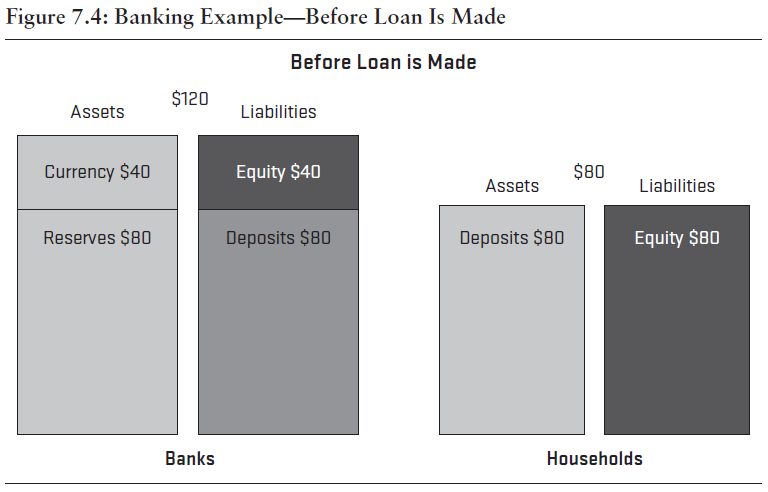
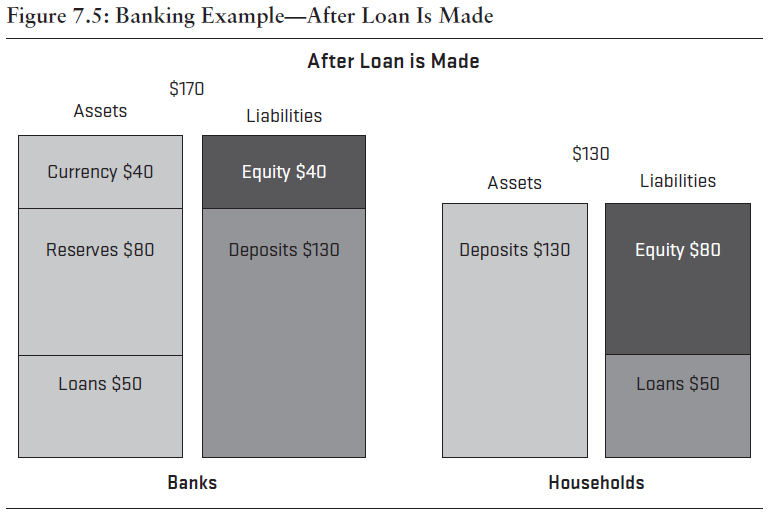
You’re not understanding. When banks create money by extending credit (loans create deposits), this occurs completely within the banking system and results in a liability for the bank (the deposit) and a corresponding asset (the loan). The customer has an asset (the deposit) and a corresponding liability (the loan). This nets to zero.
The customer has an a new electronic created asset (the deposit) and a corresponding liability (the loan). This nets to zero. Numerically it does.
Could someone help me better understand whether FRB creates money out of thin air. When TPC said” Right Gordon, but as the bear would say: “where did the banks get the money from”?
Do banks not add money that otherwise did not exist. If there is a post that makes this more clear, that would be appreciated. I am still having trouble seeing the difference between the money created by FRB and government spending money into existence.
LRM,
This is from my treatise:
MMT is based on a horizontal and vertical view of money. This is important in differentiating between the public and private sector and how each impacts the money supply. The vertical component describes how the consolidated government (Fed and Treasury) transacts with the banking system in an exogenous form. The horizontal component describes how the banking system utilizes state issued money to transact within the banking system. It’s very important to make this distinction because only the consolidated government can create net new financial assets. All horizontal banking transactions net to zero. As Randall Wray says:
“Credit money (say, a bank demand deposit) is an IOU of the issuer (the bank), offset by a loan that is held as an asset. The loan, in turn, represents an IOU of the borrower, while the credit money is held as an asset by a depositor.”
Banks merely leverage the currency introduced into the system via vertical transactions. The following description of this horizontal and vertical relationship comes courtesy of Warren Mosler:
When the government “spends,” the Treasury disburses the funds by crediting bank accounts. Settlement involves transferring reserves from the Treasury’s account at the Fed to the recipient’s bank. The resulting increase in the recipient’s deposit account has no corresponding liability in the banking system. This creation is called “vertical,” or exogenous to the banking system. Since there is no corresponding liability in the banking system, this results in an increase of non-government net financial assets.
When banks create money by extending credit (loans create deposits), this occurs completely within the banking system and results in a liability for the bank (the deposit) and a corresponding asset (the loan). The customer has an asset (the deposit) and a corresponding liability (the loan). This nets to zero.
Thus vertical money created by the government affects net financial assets and horizontal money created by banks does not, although its use in the economy as productive capital can increase real assets.
The mistake that is usually made is comparing what happens in the horizontal system with what happens at the level of government accounting. At the horizontal level, debt is the basis for horizontal money creation. Therefore, it is often assumed that debt must be the basis for the creation of money by government currency issuance. This is not the case.
Thank you TPC for your response. I have read that area of your work more than once and I need to read it a few more times to definitively displace my old belief system. I admit that I have said to people that banks don’t use money on deposit to create loans and that they just ” create it out of thin air” . Do you feel that people should not say this as it confuses the FRB process with the real money creation via government spending
Horizontal “money” is not created out of thin air.
The credit taker always has to pledge collateral (the bank has to secure that it is adequate) and the bank its capital.
I admit that I have said to people that banks don’t use money on deposit to create loans and that they just ” create it out of thin air” . LRM
Banks DO create money from “thin air”. They create a deposit in exchange for a promise to repay that deposit PLUS interest that does not even exist in aggregate!
It’s a clever but filthy business.
“Banks DO create money from “thin air”.”
The process of lending is a simple balance sheet extension of the bank and the credit taker which is obviously “out of thin air” (it’s just an entry in the balance sheets that nets to zero).
But the “credit money” (a claim on “real money”) created in this process is pledged by the capital of the bank and the collateral of the credit taker.
But the “credit money” (a claim on “real money”) created in this process is pledged by the capital of the bank and the collateral of the credit taker. Mitch83
Yes, except you forget the “counterfeiter in chief”, the Fed, is always ready to back up the banks with “real money” which is also from “thin-air”.
Banking is a filthy counterfeiting racket despite the pretense otherwise.
“Yes, except you forget the “counterfeiter in chief”, the Fed, is always ready to back up the banks with “real money” which is also from “thin-air”.”
No, banks need eligible CB collateral to refinance at the CB (again a balance sheet extension) to get “real money” (reserves), also when the CB buys securities outright in OMOs it merely swaps these securities for reserves.
So again, these are collateralized balance sheet extensions / asset swaps, not “money printing out of thin air”.
But bank lending to non-banks is never reserve constrained anyway, all that matters is CAPITAL.
And CBs can’t inject capital.
But bank lending to non-banks is never reserve constrained anyway, all that matters is CAPITAL. Mitch83
They are not reserve contained because the central bank makes sure they are not reserved constrained so your argument is circular.
And what is capital for but to cover loan losses? Then why don’t we have mark-to-market to recognize those losses? Because the banks then go under?
And CBs can’t inject capital. Mitch83
The Fed pays interest on excess reserves. That is a risk-free gift to the banks. Also, when the Fed buys crappy assets at full price that is also a gift to the banks. So, yes the Fed is injecting capital.
F Beard,
QE did not inject capital. It was a net drag. For instance, the banks lost roughly 12B in interest income (tsys gone) and earned 1.5BB (IOER). Anytime the Fed reports a profit it is at the expense of the pvt sector. And they’ve been reporting some whopping profits lately….
I said this many time before it started, but all I heard was how it was “money printing” and debt monetization.
I said “crappy assets”, not US Treasuries. Perhaps I am mistaken but hasn’t the Fed also bought MBSs or other non-US Government debt?
QE1 took even more interest income out of the market. But it added stability by making a market. Probably a worthwhile investment, but that’s debatable.
Cullen.
Qi does increases the excess reserves yes or no.
What can banks do with excess reserve (that they are not doing now) other than lend several times there reserve?
They are allowed to invest it.
Reserves are used for only two purposes – to settle payments in the overnight market and to meet the Fed’s reserve ratios.
Most people are taught the money multiplier theory which is just flat out wrong. Banks don’t lend reserves. Banks are capital constrained. Loans create deposits. Not vice versa.
FWIW Bill Mitchell reviewed a Bank of International Settlements paper last week in which they concluded that loans create deposits.
http://bilbo.economicoutlook.net/blog/?p=15383
…just on the small section of this discussion that deals with FRB. Some countries, e.g. Australia, don’t have reserve requirements imposed on banks by the central bank.
ThIs cartoon explains why it is hard to understand vertical creation of $US (Uncle Sam’s dollars), but does not explain horizontal creation of debt $US (bank debt $US dollars). There is another great video for that. See http://paulgrignon.netfirms.com/MoneyasDebt/ or the older version under required viewing: http://wherestheinterest.com/ my understanding is that the vast majority of $US in circulation are debt $US issued by banks and these debt $US require interest payment. The “Debt Ceiling” has nothing to do with this debt.
Dennis,
I’m fairly certain this has been addressed elsewhere in this thread.
But are you talking about the ‘creation’ of money via Fractional Reserve Banking? Because eveytime money is ‘created’ by a bank loaning money (aka someone borrowing money from a bank) there is a corresponding liability created. So it would seem like its money created out of thin air- in a way it is, but its negation is created at the same moment, netting to zero!. Banks do not create new net financial assets by lending/FRB, only the government can create new net financial assets.
Dif Chris, I think we are on the same page here. If someone could pay off the $14 trillion that is on the Fed’s books, there would still be $US debt dollars in circulation, a lot of them. These $US debt dollars carry with them interest. So if there were no debt obligation by the government (Treasury bonds etc), and no debt held by the public THEN there would be no dollars at all. I understand that each dollar created by the bank is really a loan, and not an asset. Also non-bank finacial institution are creating $US debt dollars. So the cartoon is off a bit, because most of the dollars in circulation are debt $US dollars. The Grignon cartoon explains this way better than I can. see required viewing: http://wherestheinterest.com/ you have to wait 17 seconds before the Grignon cartoon starts.
Dennis,
I always feel it necessary to mention that is great to interact with respectable, professional commenters, such as yourself, on Mr. Roche’s site- because there are so many showing up here daily with absent minded negativism.
I have to say I’m not 100% following, perhaps because its 11:18 here and I’m more than one whisky in. But what I’m not following is the ‘monetized debt’ aspect of that video/link ( i just skimmed it, apologies if I mis-read) but the ‘debt denominated dollars’ isn’t computing for me. The US Government spends dollars into the private sector, this spending is IN NO WAY funded by anything. Not by tax receipts, not by bond issuances.
Am I off base in what you’re getting at? I feel like I am but I want to continue the conversation.
Best regards
Sorry for copying your comment into mine- I do that so I can see it while I’m writing my response and forgot to delete it.
Dif Chris, Sorry it’s so late for you — I live on Maui these days. The reason we are ON the same page is that Government creates the real money we have by spending money into the economy. BUT, and this is a big BUT, banks are allowed to loan funds right? The law permits the banks and now other financial institutions to use Uncle Sam’s fiat currency so you can’t tell the difference between debt $US and Uncle Sam’s $US. My ONLY point is that the cartoon says that if Uncle Sam were not in “debt”, then there would be no money. Actually, the banks and other financial institutions are allowed to lend into existence $US that they do not have. These $US are only backed by a promise from the borrower to pay the money back, plus interest. In the meantime, those dollars are in circulation. Actually about 95% of all the money in the world is borrowed and carries with it interest (Usury)! So there is a LOT of money that is not accounted for in the cartoon.
As this circle goes around and around, who is going to pay that interest? Answer: Nobody because the system is flawed. If you are really really interested in horizontal money creation, and what can be done about this HUGE problem, get Paul Grignon’s DVDs. I assure you this will be worth more than another bottle.
Dennis,
I’m more than a little jealous that you’re in Maui, way more.
I think you are correct, we’re just going to keep going round & round (trying to find the beginning or center of a circle, as Mr. Roche likes to say).
I fully understand the nature of horizontal money creation, we just disagree. I have no problem with it because there are no new net financial assets created- because the liability is created at the same time. I don’t have a problem with this as long as proper laws/regulations exist and are upheld for the borrower to put up proper collateral (AND capital down upfront) so that should they defualt on the ‘debt backed dollars’ they’ve been given, the lender can ‘extinguish’ the liability (the debt) with the borrowers collateral. Plenty of examples in just the past 5 years of this NOT happening and the ramifications, but for the most part it does happen.
And as far as that whisky goes… well its pretty damn good whisky (Glenmorangie 10), so if I’m going to spend my money on something to educate myself about monetary economics, the creator had better be an economist or someone who trades (ie has skin in the game) based on understanding of monetary and macro economics. Grignon is a filmaker and admitted on his own website that his representation of FRB was misleading! I’ll take the thoughts of Mosler, Wray, Fulwiler, Roche et al over Grignon’s more often than not, unless we’re talking the creation of film stock instead of fiat currency.
“As this circle goes around and around, who is going to pay that interest? Answer: Nobody because the system is flawed.” Is this a Hyperinflation prediction?
Best,
Chris
Dif Chris, I don’t think this is inflationary, the reverse. The Usury we’ve witnessed from the out of control mortgage companies during 2001-2009 caused a major transfer of property from ordinary folks to the loan sharks and banks. The loan originators got their fees, the banks traded the loans they created from thin air into real dollars for themselves, and passed on a huge problem loans to others. Then our Uncle Sam via Fanny Mae and Freddie Mac made good on these bad loan packages buying them up with Uncle’s deficit spending. So when you say, “I don’t have a problem with horizontal money creation”, well I do. But maybe what you are saying is that you share MMT’s understanding of horizontal money creation, and so do I. It’s a mess! From the beginning our constitution should have said that Uncle Sam should never be allowed to “borrow” money (e.g. create a “National Debt” treasury bonds etc.). There was as is no reason for this. In my mind this translates to Uncle Sam being a participant in the horizontal system as well. Since Uncle Sam did this however, and created a mechanism for savings, then they should also have been allowed to spend money into the economy. The vertical insertion of funds is vital because otherwise, where’s the interest due going to come from?– is not happening. MMT explains that we are not using the power of our money system correctly.
Hi Dennis,
“If someone could pay off the $14 trillion that is on the Fed’s books, there would still be $US debt dollars in circulation, a lot of them.”
No. Demand deposits etc. created through commercial bank loans to the private sector are not “real” Dollars, but CLAIMS on “real” Dollars (btw this is why there can be bank runs, namely to replace claims on “real” Dollars with “real” Dollars, which are in shortage).
Only currency (in bank vaults and in circulation) and reserves held by banks at the Fed are “real” Dollars. These “originate” from government spending, from nothing else. So the movie is right.
Anyone have any history on payment of the revolutionary war soldiers? What was the first expenditure for the new govt.? I do remember a pro Reagan deficit argument back in the 80′s that the national debt right after the revolution was huge compare even to WWII.
One of the first taxes, of course, was the whiskey tax. Was that an attempt by the fore-fathers to get rid of whiskey as money?
El Viejo,
Whisky tax- I doubt it, they probably realized they could tax it fairly heavily without affecting demand (Beacuse, I mean, who doesn’t like whisky)?- meaning it was a good form of revenue!
Do you feel its fair to compare debt of the nation when its currency was commidity backed to when it was a sovereign monoply issuer in a floating exchange rate system?
Best regards!
Here is another source for understanding how banking and horizontal money works:
http://www.khanacademy.org/video/banking-1?playlist=Banking%20and%20Money
Be careful with that video. It is not 100% accurate. It propagates the money multiplier myth. This is not accurate! Banks don’t lend their deposits!
Here is part of the script below. Can someone explain the “another discussion” when Ed asks “why does the government borrow money to pay for the deficit?” I am confused on this point.
me: We’re going in circles again. The government doesn’t have to borrow, it is the creator of the money. It creates money at will out of thin air as needed. It does not necessarily lead to inflation. That depends on how the government spends the money.
Ed: Then why does the government borrow money to pay for the deficit?
me: That’s another discussion. We can talk about that some other time.
Ed: OK. But what about the National Debt?
Because when we closed the gold window in 1971 we didn’t clean up the now outdated laws on the books. They prevent the government form overdrawing its account at the FED which cause some additional hoop jumping; but in the end reserves must be created (spent into existence or loaned from the FED) before debt can be bought.
The govt still uses a bond market because they never changed the system when we went off the gold standard. It’s part of why there is so much misconception. But make no mistake. Bonds fund nothing. They serve as a reserve drain that helps the Fed hit its overnight rate. Nothing more. Please see my section on the bond market here: http://pragcap.com/resources/understanding-modern-monetary-system
Cullen,
I’ve read your paper over and over again. Yes, I understand that the FOMC operations does not fund the spending, only to hit the target rate. However, is it not true that FOMC operations adds to the deficient and debt is some manner? Isn’t this what the deficient hawks scream about?
Yeah, the really misguided people out there say the Fed is monetizing the debt. That’s wrong. If the bonds don’t fund anything then monetization doesn’t really occur during a process like QE. If you want to be really technical about QE then we have to realize that what the Fed has done has actually reduced the size of the deficit by reducing the net interest income to the pvt sector. So, it’s funny when you hear someone screaming about how grandma is losing her savings while also saying that the Fed is monetizing the debt. It’s a contradiction based on myth and misunderstanding….
TPC: I have read statements that the creation of Treasury debt to reflect federal deficits “sterilizes” the deficit spending, and that QE asset swaps (keystroke money from the Fed in exchange for Treasuries that then go on the Fed’s balance sheet) undoes any “sterilization”. I think I know what they mean; in effect the issuance of Treasury debt to reflect deficit spending in like amount converts purely vertical keystroke money into something similar to horizontal money that mostly nets to zero because the vertical NFA (deficit spending) is “sterilized” by the creation of a corresponding debt. QE reverses the sterilization process.
It’s like the bank making a loan unconstrained by reserves that creates an asset in the borrower’s hands (loan proceeds) and an asset in the Bank’s hands (the loan or promissory note with interest at NPV) and a liability in the Bank’s hands (the deposit obligation) and a liability in the borrower’s hands (the obligation to repay the principal plus interest). It’s mostly a wash, and so the bank’s creation of money (the deposit) out of “thin air” has been “sterilized”. If the bank unilaterally forgives the debt the transaction has been “unsterilized”, in a consumer version of QE.
Do I understand the concept of “sterilization” in the context of monetary operations (as compared to FX) correctly?
To be very technical, sterilization is the process that a central bank uses to offset the effect of capital flows through issuance of bonds. It doesn’t apply to deficit spending, but I think I understand your question anyway.
This idea that bonds somehow sterilize spending is highly debatable. This gets into the moneyness of bonds vs cash. What is cash really? Cash is just a govt liability with no interest attached to it. If you look at the cash in your wallet and a 30 year t-bond you’ll notice that they’re remarkably similar looking. One just happens to guarantee an income stream. This is why, when the Fed implemented QE, I said it would do nothing. All they were really doing was altering the term structure of their outstanding liabilities. In addition, this sterilization idea assumes that the bonds don’t represent some desired savings. If the Fed changed all the bonds outstanding for cash would the desire to save suddenly disappear? Would people stop saving money? I doubt it…..You just wouldn’t earn any interest on your savings….
My sense is that “sterilization” as I have described it is seen as a necessary alternative to “greenbacking”, which is said to be the direct creation of money by the Treasury without the involvement of a central bank or the gold standard and without the creation of a corresponding government debt instrument. Continentals during the Revolutionary War and Greenbacks during the Civil War are the examples, if I recall correctly. Greenbacking is the creation of vertical NFAs (dollars) with no balancing mechanism or restraint, other than the common sense, good faith and good judgment of our political and bureaucratic leadership. It’s like a bank creating a deposit without a loan to “sterilize” it.
The fact that there could be a platinum coin minted that could redeem the entire “national debt” of the USA for a thousand dollars worth of platinum (kudos to Beowulf) tells me that “sterilization” via Treasury debt is more Kabuki theater than an actual mechanism of substance.
this is definitely somehow related:
http://www.ritholtz.com/blog/2011/08/h-r-2768-would-cancel-1-6-tn-in-treasury-debt-held-by-fed/
“The Hill reports Rep. Ron Paul introduced legislation on Monday to cancel the $1.6 trillion of federal government debt held by Federal Reserve”
I am sorry to all of the Ron Paul supporters out there, but this man is utterly clueless. His proposal would destroy all of the Fed’s capital. He wants a balanced budget amendment. That’s sheer madness!
I was thinking of it from the sterilization angle: in some sense, aren’t the bonds held by the Fed a “tool” that they can use to “drain” cash from the system at some point by selling the bonds back to the market, and to manage interest rates? (no economic affect to this, of course – just a rate affect). Un-QE, essentially.
He wants a balanced budget amendment. That’s sheer madness! Cullen Roche
Someone should inform Dr. Paul that a balanced budget is the equivalent of banning gold mining under a gold standard.
In what sense is cash a government liability? Because it can extinguish a tax obligation? Earlier you said that vertical money (which is what I understand cash to be) was money created without a corresponding liability. These two statements seem to contradict.
Yes, it is a liability in that it allows you to pay off your tax obligation. I should have been more clear.
Bonds are not reserve but cash is. When the fed purchases Bonds it increases the bank reserve. Fed Reserve says Reserve can also be invested by banks = Equity up commodity up. QI over = Bank are out who is now holding the bag?
Seems like… volume of money created by, and circulated by our government is critical because the more traditional “velocity” factor of money is stagnant. If it’s stuck, pump in more volume to keep things going?? If velocity picks up, reduce volume. Is that the message??
question: when you say: “The National Debt is the amount of money to the penny that the federal government has created since it began creating dollars” do mean because you consider treasury notes/bills/bonds “money” just like cash? because otherwise:
next question: if the Treasury sells $1T in bonds tomorrow, does the amount of “money” that has been created in history change? No, right? Not until/unless the government spends that $1T that they “took in”…. ???
Fiscal policy is money printing so yes, spending can be thought of as altering the money supply. This is why I said, before QE started, that altering the form of paper would not cause runaway inflation and would not increase economic growth.
yes – I understand how spending alters the money supply: it increases it. But I don’t understand how selling debt increases the money supply.
to clarify my question:
it seems clear that selling debt increases the “National Debt,” right? – but this post claimed that “The National Debt is the amount of money to the penny that the federal government has created since it began creating dollars” – and yet, I don’t see how selling debt increases the money that has been created.
is there the implicit assumption that after debt is sold, that money “raised” by the Treasury is then spent? even though Cullen has gone to great lengths to hammer home the point that debt doesn’t “fund” any spending?
Bonds are only issued by Congressional mandate in accordance with the size of the budget deficit. Bond sales don’t give the govt the ability to spend more money. The national debt is = to non-govt savings of US bonds.
Isn’t the mandate in place as a “sterilization” mechanism? I am focused on this point because the Treasury market doesn’t fund anything, and yet it exists for more than just a reserve drain. Is “sterilization” real or is it psychological?
Also as to Ron Paul’s proposal that the Treasury debt held by the Federal Reserve be extinguished: why would the fact that such transaction would wipe out the Fed’s capital matter? The Fed can always create infinitely more capital as the issuer of the dollar, no? Isn’t concern as to the Fed’s capital balance a gold standard artifact?
On sterilization. If I take your savings account and transfer it to a checking account have I materially altered your spending & saving habits? This is the difference between holding cash and bonds.
The Paul decision would result in an insolvent Fed. It would be a political nightmare. I know RP wants to just get rid of the Fed, but this isn’t the way to go about doing it. I don’t think he’s thought through the chain of events that would occur here.
Hm, Cullen, isn’t that a somewhat strange comment coming from an MMTer? The Fed cannot really be insolvent, being the scorekeeper of the US dollar. I know most people don’t realize this, but what could really happen when the Fed just declares a loss? Maybe you’re right and this will cause some political turmoil, but maybe you could elaborate on that? I remember Scott Fullwiler being very nonchalant about the possibility of the Fed running a negative equity.
There was a related discussion on Winterspeak (http://www.winterspeak.com/2011/02/can-central-bank-make-loss.html), but I am not sure I get the implications from it. Maybe JKH may elaborate.
Don’t get me wrong. I know the Fed can’t “run out of money”. But it would cause great political turmoil in my opinion. It won’t happen though so it doesn’t matter does it?
Cullen wrote:
“Bonds are only issued by Congressional mandate in accordance with the size of the budget deficit.”
ok – thanks – so I guess your point is that by definition, bonds are issued in response to net spending that has already been done, right?
“Bond sales don’t give the govt the ability to spend more money.”
- yes – I fully understand that.
“The national debt is = to non-govt savings of US bonds.”
-BECAUSE this is, by Congressional mandate, equal to the net “deficit” spending that has been done, right? Do I have it right now?
“Bond sales don’t give the govt the ability to spend more money.”
- yes – I fully understand that.
Do you ?
Assume the treasury targets $0 TGA — it cannot be negative.
1. the treasury wants to spend $5b during some time. tax inflow is $1b during the same period
2. Selling $4b worth of bonds gives the treasury ability to spend $5b during the same period.
(2) contradicts your understanding of “Bond sales don’t give the govt the ability to spend more money.”
– Bankster
I’m not sure what you’re saying here. Are you disagreeing with “Bond sales don’t give the govt the ability to spend more money” ???
do you disagree that the government could just spend the money anyway (create new money) without selling debt? (To my understanding, this is a key point of MMT, and the main point in the “we own our own currency” discussion. Are you saying there’s a legal reason why the gov’t cannot do this? Apologies – I am not up to date on my Congressional Monetary Mandates)
The overdraft rule has been covered very thoroughly here.
http://pragcap.com/discussion-forum?mingleforumaction=viewtopic&t=114
KD: Are you disagreeing with “Bond sales don’t give the govt the ability to spend more money” ???
Sure I do. How can the treasury keep its GA non-negative without selling bonds ?
KD: Are you saying there’s a legal reason why the gov’t cannot do this
It’s called the no overdraft rule, i.e. TGA must be >= 0, actually >= $5B.
That’s the current operational reality.
–Bankster
ok, so then MMT’s “we don’t need to sell debt in order to spend money” is false in our operational reality… of course, we LIVE in our operational reality… I’m guessing that MMT’ers would respond that we don’t actually need this operational reality, and that it’s just a political choice, and that we should remove it? ???
in other words, Bankster-Anon – you’re saying that we have to do this because of the laws – but MMT is saying (and I agree) that mechanically, we don’t actually need to sell the debt to spend the money (although LEGALLY we do).
Kid, read the links I post for you. I am handing you the answers on a silver platter. Via Scott Fullwiler in the link I already posted:
The Fed is legally prohibited from giving the Tsy an overdraft. This means that the Tsy must have balances in its account before it can spend (or at least a positive balance by the end of the day–I can’t get the Tsy to come clean and tell me whether or not they receive intraday overdrafts; seems to me that it’s virtually impossible for them not to given the pure volume in/out and the complexity of keeping track of the number of agencies spending each day). This means that either it has balances in its account or it calls them in from the TTL accounts.
The Fed is the only place reserves are held, so I don’t know what “reserves from the Fed” means. To settle an auction, there is either enough reserve balances already circulating for that and for banks to hold the desired buffer by the end of the day, or the Fed adds the difference to make sure there is. Whatever reserve balances are circulating are doing so only because they were either (a) spent into existence, or (b) some other change to the Fed’s balance sheet. It doesn’t always have to be (a), that is.
Don’t confuse reserve balances with NFA. The only source of more NFA is more deficit.
Primary dealers, unless they are themselves banks, do not hold reserve accounts, so they don’t pay with reserve balances. Their deposits at their bank would be debited as they buy a tsy and their bank’s reserve account would be debited.”
KD: I’m guessing that MMT’ers would respond that we don’t actually need this operational reality, and that it’s just a political choice, and that we should remove it? ???
Most likely.
From the horse’s mouth:
Mosler: “under current institutional structure, as presided over by Congress, the Fed isn’t allowed to let the Tsy go into overdraft.”
and:
“non-bankster” anon: “And the entire debt ceiling fiasco is evidence that in actual fact borrowing precedes spending”
Mosler: “yes, that’s the current institutional reality”
There is no intraday overdraft facility either.
“seems to me that it’s virtually impossible for them not to given the pure volume in/out and the complexity of keeping track of the number of agencies spending each day). ”
That’s why they keep the $5b buffer. They do have computers, too, volume does not matter.
Bond auctions are settled with reserves. The fed supplies the reserve if needed. Otherwise, they already exist in the banking system. So, as Cullen likes to say, the overdraft debate is like trying to find the middle of a circle. The analogy Cullen used the other day was good. If you tie your shoes together on days 1-7 and then untie them on day 8 when did you learn how to run? Did you learn how to run on day 8 or were you always able to run? The US government does the same thing. At the beginning of the existence of the sovereign dollar, they had to make it available to bond buyers. Then they implemented a political constraint that gives the appearance as though those dollars didn’t exist before the bonds did. Obviously, that’s not right. You could always run from day one. Just like the dollars existed before the overdraft constraint was implemented.
MMTer: “At the beginning of the existence of the sovereign dollar, they had to make it available to bond buyers.”
Why obsess with day one ?
On day one, the treasury sold bonds and got gold coins from the lenders, hypothetically. On the due day, the lender came for his gold coins and got back paper FRNs instead “to be redeemed at par”. Hey, presto — fiat currency was born.
A currency historian may have a better story to tell
Day one is all that matters. It is the point at which we became a self funding unconstrained monetary system. The fact that the gold standard system still is intact does not matter (except if you’re into accounting shenanigans and semantic debates). When Nixon closed the window he removed all linkage to gold. It was the USA essentially saying, “we are no longer dependent on the amount of gold we can dig out of the ground.”
Cullen, Bankster – new comment below…
Cullen,
I just wanted to say thanks. I first came across your site last year when you wrote the piece about quantitative easing not being money printing. I honestly thought you were a quack. In retrospect, it looks like you were one of only a handful of people who actually understood QE and how it worked. Thanks for all you do.
David
Thanks David. I caught a lot of grief for my position on QE. Turns out it was pretty much dead right.
Fiscal policy isn’t really “money printing” because it is “sterilized” by the goods and services obtained by the government when it spends. Someone had to give up something of equal value to get the money. Wouldn’t “money printing” be a helicopter drop of currency that is simply given away (or at least given in excess of the true value of whatever goods and service were bought)? For example, if Obama issued an executive order tomorrow giving all federal employees a 100% raise for the same hours of work, and Treasury simply created the money to fund the raise in a greenbacking operation not sterilized by bond issuance, then that would clearly be “money printing”-I think. This model was a tried and true method of currency abuse and raw inflation in Latin America in the 1980s, wasn’t it?
Fiscal policy isn’t “sterilized” by goods and services. It adds net new financial assets to the pvt sector. If you want to say that its multiplier effect is contingent upon how efficiently the money is used then that’s much more accurate. But fiscal policy is most certainly money printing.
NFAs are added but real assets (goods) or productive services are surrendered in exchange; OR, transfer payments are made to retirees, public assistance recipients, etc. where nothing of value is exchanged for the NFAs. It’s an efficiency, multiplier, real economy issue. I get it (I think). Is it better to build the TVA and buy real assets for the public good with deficit spending than to make transfer payments to prop up amorphous aggregate demand and create keystroke money to TARP the TBTFs?
Sorry if I seem naive, but this is like the Fantasy Football of money.
Cullen
Adorable bear: “The National Debt is the amount of money to the penny that the federal government has created since it began creating dollars….
The above statement threw me off a bit. I thought the government does not need to back the creation of currency with debt. Doesn’t the US govt. spend money before it issues the debt? Does the US govt. need to issue Tsy bonds for every dollar it spends? There was some idea about creating a 1 trillion dollar coin without issuing any Tsy bonds…The US govt. did not do this…. but did it ever spend and not issue Tsy bonds?
I guess it will clear to a lot of people if you just say… “The money that US govt. spends is not backed by Tsy bonds or any particular material”. And GDP need not correlate with debt or number of dollars in circulation.
Ponder this scenario… The US govt. spent 1 trillion dollars to pay wage of US president. The president deposits this in his savings account and does nothing with that money. So what is the GDP growth because of this new 1 trillion dollars. Isn’t this what is wrong with economy today. Federal Reserve and US Govt. tried to stimulate economy, but the majority of that did not help increase the GDP?
“is there the implicit assumption that after debt is sold, that money “raised” by the Treasury is then spent?”
There is — deficit spending increases NFA = sold bond to Peter + Peter’s cash to Paul.
tax inflows + bond sale proceeds are spent almost immediately, treasury maintaining small buffer that cannot go negative due to the no overdraft rule, i.e. treasury does not have a credit line with the feds. That (the no overdraft rule) has been discussed ad nauseam at the mosler site. Hence the coin idea to bypass the no overdraft rule.
thanks – so as i wrote above:
when Cullen writes: “The national debt is = to non-govt savings of US bonds.”
that is BECAUSE, by Congressional mandate, the bonds issued are equal to the net “deficit” spending that has been done, right? Do I have it right now?
Kid:
“the bonds issued are equal to the net “deficit” spending …Do I have it right now?”
I believe you do — minus some residue in the TGA yet unspent. Treasury general account(TGA) targets $5b or thereabout. Taxes and bond sale proceeds flow in, spending, including “deficit” spending, flows out.
– Bankster.
“is there the implicit assumption that after debt is sold, that money “raised” by the Treasury is then spent?”
The above was in response to Kid’s comment — could not add to his comment properly.
CR As a long time reader of your site I am aware that the overwhelming majority of people do mot understand the working of the US monetary system. Your site has been a great learning experience and I appreciate your time and patience. Question Given the misunderstanding in the general population along with stock market participants , the bond market seems to understand it perfectly. Your market calls and MMT stance seems to be confirmed by the bond market on an almost daily occurrence. What’s makes the bond market understand what no one else can? Thanks
The US bond market is highly correlated to Fed policy. I need to write a post on this so readers can visualize. Will do later today.
Strongly looking forward ot that post!
Hi Cullen,
I guess I just have a mental block. You say loans create deposits and not reserves. I thought deposits create loans, no? I go to the bank, deposit my money with them. My demand deposits, term deposits, CDs, etc. are all liabilities to the bank. They typically pay me interest on my deposits with the longer tenors paying higher rates. They then take my deposits (and the collective deposits of all the other customers of the bank)and make various loans of varying maturing, e.g. car loans, personal loans, college loans, mortgages, etc.
I just don’t understand how you claim it is the other way around, i.e. loans create deposits. I think I need some very simple visual diagram or something!!!! thanks in advance
No deposits don’t create loans; banks create money and seek the reserves (set on bank regulations, ie. Basel II) later. If this were true, it would mean ‘reserves’ create loans (because money would have to be introduced a priori, via reserves, by the central bank). Loans are made against capital (stock), so if the bank has X capital it can create Y loans.
In the typical customer loan experience… you sign for the loan… the bank credits your checking account for the amount of the loan. The bank does NOT transfer those funds from some other depositors account, it just magically creates them. You spend the loan money by writting the check. As the check clears at the bank the bank pays the check with reserve balances it has (which may have come from deposits). Deposits fund the payment operations of a bank, but not the loans.
Also, when you deposit your check in the bank, think of where the money is coming from. If, say, it is your paycheck, then your employer’s account will get debited. But where is the money int he employer’s account coming from? If you start chasing the dollars, you’ll discover the underlying loan (from some bank) or govt spending. So, deposits can be created by both loans from the banks and govt spending. But loans from the banks come out of thin air.
Anonymous,
I have a brief section on this in my primer which you might want to read in its entirety:
Lastly, this also shows that banks create money entirely within the banking system. As was said above:
“When banks create money by extending credit (loans create deposits), this occurs completely within the banking system and results in a liability for the bank (the deposit) and a corresponding asset (the loan). The customer has an asset (the deposit) and a corresponding liability (the loan). This nets to zero.
Thus vertical money created by the government affects net financial assets and horizontal money created by banks does not, although its use in the economy as productive capital can increase real assets.”
So, contrary to what we are all taught in school, loans actually create deposits and not the other way around as the money multiplier would have us all believe. When a bank makes a loan it debits the Loans Receivable account on its books. To balance this transaction it will create a new liability in the name of the borrower. This loan will create a deposit somewhere else in the banking system (possibly at the same bank) which will cause this new bank to also account for its new liability (the deposit) and change in reserves at the Fed.
The best way I can describe the process is that during a non-balance sheet transaction, assets are exchanged (your goods for my money). That exchange generates income and expense for the parties.
During a balance sheet transaction, liabilities are exchanged (your promise to pay for my deposit). This exchange generates assets (for the bank – a loan, for you – cash).
What commits you to the transaction is your ability to pay (your liability). What commits the bank is their ability to generate a deposit (their liability).
CR, When the dollars are ‘created’ don’t we, the U.S., owe the Fed that amount of money? And where does that ‘debt’ come into play when we talk about our ‘National Debt’? Isn’t this the debt we pay interest on? If the Fed is not part of the government, do we really owe the money to ourselves?
Is the Fed not part of the govt? They turn over 97% of profits to the US tsy. That my friend, is ownership. Don’t fall for the politically independent nonsense you hear in the media….
F. Beard wrote:
You forget about private debt. How else shall it be paid off unless government spends?
Have you paid off your credit card debt?
If so, what did that have to do with Government spending?
Maybe you got raises.
Give yourself more “credit.” You can save yourself, without the savior government breathing money into existence.
Don Levit
You can save yourself, without the savior government breathing money into existence. Don Levit
Sure but then my savings would come out of someone else’s loan principal. So my saving would cause someone else’s loan default unless additional temporary money (so-called “credit”) was lent into existence to perpetuate the rat race.
“I’d say, if that’s the case, then just give direct mortgage relie”
F. Beard Here I found 33,000 $200,000 mortgage gone with the wind for you.
U.S. Defense officials still cannot say what happened to $6.6 billion, sent by the planeload in cash http://nexus.2012info.ca/forum/showthread.php?3481-6.6-Billion-Stolen-and-the-US-Defense-Money-Plane
Yep. Trillions for useless wars but not one cent of just restitution for the victims of the government backed usury and counterfeiting cartel.
Debt: required as working capital in any modern economy. Time is money. The debate will always be how much is optimum and socially fair.
NFA (net financial assets) myth of government deficits: NFA is an accounting definition … what’s important is net financial value (NFV), which CAN be created by bank lending (and without government deficits). Example 1: you (privately) loan me $1 to discover antibiotics. NFA=0 … NFV>>0.
Government deficits are promoted as an indirect way to reduce the balance sheet recession (via NFA>0). I’d say, if that’s the case, then just give direct mortgage relief. Not only does it address the issue directly, but the government already has the liability, and it will clearly prove whether there is a balance sheet issue or not. Otherwise, all those deficits will go to CIA/Homeland security guys, state bureaucrats etc. making $150-200k, and saving the money for their Italian vacations, or will go to Haliburton.
“I’d say, if that’s the case, then just give direct mortgage relief. Not only does it address the issue directly, but the government already has the liability, and it will clearly prove whether there is a balance sheet issue or not. Otherwise, all those deficits will go to CIA/Homeland security guys, state bureaucrats etc. making $150-200k, and saving the money for their Italian vacations, or will go to Haliburton.” jt26
Bingo! But let’s not forget that so-called “credit” creation cheats savers too (of honest interest rates) so a universal bailout using seigniorage is much more just and much more politically doable too.
Of course to prevent the problem from reoccurring, all government support for usury and counterfeiting should be abolished.
what’s important is net financial value (NFV),
Exactly there is no need to spend so much on as you mention “CIA/Homeland security guys, state bureaucrats etc. making $150-200k, and saving the money for their Italian vacations, or will go to Haliburton.” in order to maintain responsible deficit spending that can funds an appropriate money supply increase to oil the economy.
As we often observe people confuse Debt with Deficit or Accumulated deficit with Debt but I think that proponents of deficit spending also tend to confuse Total spending with Deficits as if more spending was needed in order to maintain a deficit. When they think like that NFA sound better than NFV.
Numerically every thing is possible unfortunately the real world does not work this way for very long .
Numerically every thing is possible … first
Not if the gold bugs have their way. Then in order for the government to deficit spend it would have to buy or borrow gold from those who have it.
Anyone who thinks that is libertarian is deluded; it is fascist privilege for private interests.
It would have to buy or borrow gold from those who have it.
Bear. Did the Government not buy Gold whit paper at one time?
Gold mines would deliver Gold to the Government against the paper and it would simply dilute the Gold backed currency. The more it changes the more the same.
Simply a more sophisticated illusion. No ?
Simply a more sophisticated illusion. No ? first
A much more expensive one and very damaging to the environment too as people rushed to “mine money”.
Bear.
I am not in favor of Gold money but Gold mining as certainly not diminish with the arrival of fiat money.
It is also completely stupid to tie the creation rate of government money to the mining rate of a shiny metal.
Another thing I thought of reading these comments is that it would be impossible to tax back all of the money created. A significant portion of it is held by foreign companies. How would we tax them?. We would effectively be buying back their money but what would we buy it with? Or I’m not thinking properly.
America owes foreigners about $4.5 trillion in debt. But America owes America $9.8 trillion. So if the government was to pay the debt (Not realistic) but technically the money would move out progressively over a period of time from tax payers to Government and back to lenders mostly in the US economy How is this taking money away?
Cullen/Bankster/Winterspeak/Scott Fulwiler/anyone else – can someone help me with Winterspeak’s piece here:
http://www.winterspeak.com/2010/10/federal-reserve-should-run-overdraft.html
I’m confused by his example of what happens if Treasury buys a TV from china.
1) Treasury writes a check to China.
2) China deposits the check in a Federal Reserve system bank
3) Treasury’s account is debited, China’s account is credited.
so far so good. but then Winterspeak adds
“The total number of outstanding dollars has not changed.”
Doesn’t the total amount of outstanding dollars owned by the private sector (ie: CHINA) change? it’s increased by the amount they sold the TV for – the amount that Treasury paid them. China’s financial assets – I’m guessing you’ll call them reserves – are larger – are they not??? What if China walks into the bank and pulls out their money in crisp $100 bills? then have their financial assets increased? then has the total number of outstanding dollars not changed?
then, Winterspeak says:
“When the Chinese manufacturer then buys a Treasury bill, it writes a cheque to the Treasury and the Treasury’s account is credited, while the Chinese manufacturers account is debited. Again, the total number of outstanding dollars has not changed.”
This I get, assuming you treat “treasury bills” and “reserves” or “deposits” both as “dollars,” which i think is another key subtlety of MMT that confuses a lot of people (myself included). China previously held $100 in reserves, now they hold $100 in T-bills. Their net financial assets certainly have NOT changed by the government’s “borrowing,” as Winterspeak notes in the next paragraph.
However, weren’t the net financial assets of the private sector changed (increased) when the government SPENT? This is where my brain is smoking again. Government borrowing doesn’t change net financial assets, but government spending must…
actually, maybe that’s the whole point…. Eureka???
Hm, I guess what Winterspeak meant is that the reserves that existed in the Tsy account at the Fed just moved to the Chinese account at the Fed. This is true, but kinda out of MMT paradigm. MMT regards the Tsy’s account at the Fed as an accounting fiction. The govt always creates NFAs when it spends and destroys them when it taxes, even though it may put the tax money in its account at the Fed. So, in some narrow technical sense Winterspeak is right, but my guess is he really winter-misspoke (haha).
“The govt always creates NFAs when it spends and destroys them when it taxes,”
ok good – that makes sense…
Kid:
” Treasury writes a check to China…”
It’s too vague a description to be quite sure what he/she means.
Interbank obligations are settled in cash sitting at each bank account at the feds. The cash sitting there is special by virtue of its location and purpose — to settle interbank obligations. The treasury is just one of the feds clients that also settles in interbank cash.
So, what happens when the treasury pays the boc is just the change in the ownership of a chunk of the interbank cash, not its amount.
Likewise, when the boc sells a chunk of the interbank cash to the treasury by getting an equivalent amount of bonds from the treasury.
On the other hand, the part of interbank cash with the exception of the TGA is usually called reserves. So, buying a TV by the treasury moves interbank cash from the TGA to the boc account at the feds thereby increasing the amount of the cumulative reserves. Selling a bond to the boc has the opposite effect.
A simpler way to look at that is to realize that only the feds can manufacture/destroy total interbank cash by buying/selling bonds. The treasury can drain/inject the existing interbank cash through bonds sales, taxation and spending.
Forgot to sign: Bankster
Bankster – I think the point was to see what happens when Treasury spends money. If you don’t like the China example, think of
a) Treasury ups unemployment benefits from $500/wk to $600/wk or
b) Treasury spends $1T on stimulus to build new roads, or dig holes and fill them in or
v) Treasury buys TVs from Sony, or from J&R computer world, or from GE, or whatever.
in each case, I hope that net financial assets are created (As was my understanding, and as Peter confirmed above)… otherwise I’m totally lost.
then, the next point is that if Treasury “finances” this spending by selling bonds, it doesn’t “do” anything – no net financial assets are created or destroyed – this is the key point, and an interesting epiphany for me, although there is an interesting side discussion to be had around MMT’s treatment of “Cash” and “treasury bonds” as essentially equal in terms of purchasing power.. but i’ll save that for another day
Kid:
The treasury creates NFA not just through any kind of spending.
If it taxes Peter to spend on Paul, it is the same as if Peter spent directly on Paul without using the treasury as a conduit. No NFA increase occurs.
In the current operational reality, the treasury may sell a say $1 bond to Peter and spend the $1 on Paul. Therefore, combined Paul and Peter hold $2 of government paper combined. Thus, the private sector NFA grew up by $1. That process also goes by the name of “deficit spending” (as opposed to tax funded spending).
In the MMT willed reality, with no bonds at all, the treasury/central bank combined entity would just manufacture $1 and spend on Paul thereby increasing NFA by $1.
If it taxes Peter to spend on Paul, it is the same as if Peter spent directly on Paul without using the treasury as a conduit. No NFA increase occurs.
True, but the real underlying process is that the Treasury destroyed the money it taxed from Peter and created the money it gave to Paul. MMT is clear about that: only spending in excess of taxation – i.e., the deficit – is creating NFAs.
In the current operational reality, the treasury may sell a say $1 bond to Peter and spend the $1 on Paul. Therefore, combined Paul and Peter hold $2 of government paper combined. Thus, the private sector NFA grew up by $1. That process also goes by the name of “deficit spending” (as opposed to tax funded spending).
When is sold $1 bond to Peter it exchanged one asset (reserves or cash) for another (bond) so no new NFA was created. When it spent $1 on Paul it created $1 in NFAs.
In the MMT willed reality, with no bonds at all, the treasury/central bank combined entity would just manufacture $1 and spend on Paul thereby increasing NFA by $1.
I don’t think this is correct, if I understood what you meant. The already mentioned link
http://neweconomicperspectives.blogspot.com/2010/11/yes-government-bonds-add-to-private.html
explains why this is not the case, but I think my explanation above is also sufficient.
Just noticed this, but:
“I’m confused by his example of what happens if Treasury buys a TV from china”
For purposes of this example, think of deposits held at the Fed (i.e. deposit liabilities of the Fed) as split into three categories:
a) The deposits the US Treasury holds
b) The deposits China holds at the Fed. This could either be China’s direct deposit with the Fed, or an indirect deposit via the reserve deposit of a US commercial bank that China uses to clear with the Fed. Winterspeak appears to have assumed the latter case in his example; i.e. China holds a deposit with its clearing bank, and the clearing bank holds reserves at the Fed. It doesn’t matter. Either case will do.
c) The deposits held at the Fed by all others, which are mostly reserves of US commercial banks
First, when he says “again, the total number of outstanding dollars has not changed”, he means that the sum of these deposits at the Fed hasn’t changed – i.e. a) + b) + c).
Second, in terms of the NFA effect, non-US-government net financial assets increase when the Fed credits China’s account. This banking transaction, which increases consolidated US government liabilities to non government, corresponds to the creation of NFA through deficit spending of the government (at the margin) when it writes the cheque to pay for the TV.
The increase in China’s bank account at the Fed (or its clearing bank’s reserve account) is an increase in non government claims on the consolidated government.
The corresponding decrease in Treasury’s account at the Fed is directly associated with this, but in and of itself has no NFA effect, given the net zero consolidated effect for Treasury and Fed together – i.e. the debit to Treasury is an decrease for both a Treasury asset and a Fed liability, which on consolidation nets to zero net effect.
Third, there is no effect on NFA when China buys a Treasury bond using its money on deposit at the Fed (or using it’s clearing bank’s reserve account at the Fed). One consolidated government liability (non government deposit at the Fed) is replaced by another (Treasury bond).
JKH, what an opportune timing for you to chime in!
Care to comment on this just above this thread:
http://pragcap.com/where-does-the-money-come-from/comment-page-1#comment-67835 ?
What would happen if the Fed took a loss on its holdings of US Tsys? Of course the Fed could also take a loss on its holdings of ABS, for example, but the porfolio of Tsys is much larger, I think. Seems to me some people may freak out but ultimately nothing really should happen?
Peter,
These things can be confusing, moving back and forth between the consolidated economic view of government and the de-consolidated institutional view. It’s the institutional view that presents the various “self-imposed constraints”, and you can extend that constraint notion as far as you want. Fed capital could be viewed as one of those constraints.
Fed capital is reasonably important at the institutional level. Among other things, it’s supposed to reflect central bank “independence”. It is possible for the Fed to take losses, and if it used up its capital in doing so, it would have to be recapitalized. Recently, there’s been an accounting change though, which as I understand it allows the Fed to move losses into a “negative liability” account instead of being taken out of capital. The idea is that following such a period of losses, subsequent future profits would be retained instead of being remitted to Treasury, until those profits fully recouped earlier losses and fully reversed such a “negative liability”. This is a workaround to having to go and get more capital instead. There is some rationale to this accounting change, as the Fed has been earning extraordinary profits in the past couple of years, due to very positive QE-related interest margins, and has remitted them to Treasury. If it had not remitted them to Treasury, it would have had a substantial retained earnings buffer to withstand losses at some point.
As far as the consolidated economic view is concerned, I look at it roughly as follows:
The main components of the non government NFA position are central bank reserves, central bank issued currency, and Treasury bonds. That doesn’t taken into the netting effect of any private sector assets held by the Fed, but it’s a rough cut at the net “funding” position of the government that you get when you put Treasury and Fed balance sheets together. Working with that as a simplified model, that’s all the balance sheet is – a net liability position. If you translate that to assets, liabilities, and equity capital, the consolidated position looks like the net liability position (the liability counterpart to non government NFA), and a negative equity position of the same absolute value.
This is a weird “balance sheet” and it’s probably not wise to push the model too far in that direction. But in fact, the effective negative equity of the consolidated position is what makes the institutional capital of the Fed moot when looking at the consolidated economic overview. It simply isn’t material to the consolidated economics. The economics of MMT NFA, which are very understandable and defensible, simply force out a corresponding negative equity position from an accounting perspective.
That said, Fed capital is quite relevant according to the institutional framework. The problem with Ron Paul’s “proposal” is that it is so radical in terms of its institutional capital effect. There would literally be a write-off of most of the assets of the Fed, driving its institutional capital into a trillion dollar plus negative equity position. The “negative liability” accounting change I mentioned above really wasn’t intended to deal with that kind of radical institutional capital effect. In fact, Paul’s proposal is so dramatic that it would require an institutional overhaul of the Fed and Treasury anyway.
Bottom line is that the institutional Fed capital position isn’t important to MMT economics, but it is important for institutional based operations and politics.
Thanks JKH, but when you say “Bottom line is that the institutional Fed capital position isn’t important to MMT economics, but it is important for institutional based operations and politics”, can you explain a bit further, what actually can happen? I just don’t seem to grasp what actual events will correspond to Fed’s going deep into negative equity territory. Will the member banks demand money back (what money? reserves?)? This is all kind of mind-boggling. Because the Treasury having an overdraft at the Fed is essentially the same as the Fed writing off its holdings of Tsys, but the current arrangements simply mask this fact, right?
Anyway, appreciate your time in replying to all this.
Peter,
The risk has to do with the Fed’s earnings, and how interest rate risk affects earnings.
If the Fed ends up tightening monetary policy at some point, it will start increasing the interest it pays on excess reserves.
At the same time, the interest it receives on the QE bonds its holds is fixed over the life of the bonds.
E.g. suppose the Fed receives 2 per cent on a bond. Suppose it hikes the interest on reserves up to 3 per cent over some period. Then it has a negative spread and a loss on that bond, until it matures.
Realistically speaking, I think the Fed has quite a bit of room to hike rates before it would run into any significant problem. And it won’t be hiking rates materially for a long time.
Nevertheless, that’s the nature of the risk that’s mostly in question – interest rate risk due to an asset-liability mismatch; i.e. short term funding (reserves) against longer term assets. This sort of mismatch issue is the same as what the Savings and Loans Industry hung itself on 20 years ago. But again, I really don’t think it’s going to be a material issue for the Fed.
BUT – it IS a consideration in doing more QE, as more QE leverages the interest rate mismatch somewhat higher.
Also, as I said, they have a new accounting mechanism where they can move these losses temporarily into a negative liability, instead of writing down capital. I think the interest rate risk I described is mostly what they were thinking about in doing this.
The other type of risk is credit risk – which they have in their Maiden Lane and mortgage portfolios to some degree. Credit losses will deplete capital as well. I don’t have a good handle on the degree of risk there – it depends on the macro economy outlook.
The Ron Paul “proposal” is the nuclear one for the capital position, because if they disappear their bonds, that has to be a charge against capital, which would be huge. If they disappear their bonds, there’s no longer any income to recoup the capital loss either, so the negative liability accounting option wouldn’t apply. I think Paul’s proposal was another way of saying – get rid of the Fed entirely – which he would love to do anyway.
Thanks, JKH! I think I understand what evens could happen for the Fed to take losses, no problem. My question is more about what does this mean in the real world. because the Fed is a bank only in its name. It is the issuer of currency, so, it cannot be bound by the same operational realities as other banks. Ron Paul wants to end the Fed but so do MMTers (at least consolidating it with the FA). Today Mike Norman is praising the proposal:
http://mikenormaneconomics.blogspot.com/2011/08/ron-paul-introduces-bill-to-cancel-16.html
So, the question again what actual events occur when the Fed declares a loss of 1.6T? The member banks freak out (and then what)? Bill Gross commits suicide? Unpredictable?
Dunno – Mosler throws a beach party?
As I said though, if the Paul idea ever were implemented, it wouldn’t be done under current institutional arrangements. Although it’s conceivable that the bonds would be replaced by an internal transfer of funds from the Fed to Treasury, which would avoid the capital write-off, because it would replace the bonds with an alternative interest earning non-bond accounting asset. It would be interesting to know if anybody on Paul’s team has actually thought this through.
BTW, you might be interested in this, or not, as another variation on all this stuff:
http://neweconomicperspectives.blogspot.com/2011/08/coin-seignorage-and-inflation.html?showComment=1312321340431#c4915974349480089615
Also, it’s not a proposal unless it proposes the actual institutional effects. That’s why its very interesting that he’s documenting it now (presumably). I’ll be interested to see what the various options are for institutional arrangements. Could make the platinum coin look like a warm up for the main event.
JKH, you nailed it here:
This is Paul’s backdoor way of politicizing the Fed through a pseudo insolvency.
Also:
IF the Treasury had an overdraft at the Fed, there is no impact on the Fed’s capital position. The overdraft shows up as a negative liability, offset by an increase in bank reserves as a positive liability.
IF the Fed “wrote off” the value of its Treasuries, as per the Paul proposal, Fed capital is reduced by the same amount. Because of the size of the Treasury portfolio, capital becomes severely negative.
The MMT perspective implicitly reflects the consolidation of Fed and Treasury balance sheets from an economic perspective. Treasuries as assets of the Fed are offset by Treasuries as liabilities of Treasury. This is an accounting consolidation that effectively eliminates those Treasuries from that consolidation perspective. Since it is only a consolidation of those existing balance sheets, it does not affect the fact of Fed capital on the Fed’s balance sheet.
Paul’s idea is implicitly more than that. It is the elimination of Treasuries from the Fed’s own balance sheet, which would immediately impact Fed capital. Of course, this would also eliminate them from Treasury’s balance sheet, and on a consolidated basis. But it is much more than a mere accounting consolidation of Treasuries that still appear on both balance sheets.
Cullen,
Seems the Chinese rating agency downgraded the US because of “risk to solvency”
I’m not sure if they don’t get it or probably more political.
http://news.xinhuanet.com/english2010/business/2011-08/03/c_131027663.htm
Wait a second. I just thought of something from our previous conversation above. So according to how the country works, it would literally be impossible for us to pay back or even pay down the debt? If every $1 is backed by a corresponding debt, and $1 is created through a credit. And every $1 of debt paid for is replaced by $1 of debt to compensate for the original $1 creation, then it would be impossible to pay down the debt?
It seems that the legal construct is that the Treasury market and taxes fund federal spending, and that the operations of the Fed and Treasury (e.g., the no overdraft rule) as defined by law and regulation are designed to maintain and support the funding concept. The legal fiction that the Fed is independent of the Treasury and of the government, although both the Fed and Treasury are agencies or departments of the unitary enterprise known as the federal government, further supports the funding concept.
The platinum coin proposal recently floated points out a statutory loophole that exposes the funding concept as a fiction. QE1 and QE2 demonstrated the elasticity of the dollar as the Fed acquired a variety of financial assets in excess of a trillion and a half dollars, including mortgages and Treasury instruments, via keystroke money created by the Fed.
MMT sees through the funding concept to the fundamental reality of the US government as the sole issuer of the world’s reserve currency and owing its internal and external debts in its own currency, which it can create in infinite amounts if it really wants to do so. The Fed and the Treasury are both part of the federal government. Any default in payment will be elective or political in nature, because the USA can never run out of dollars and the Fed could redeem all federal debt at par with a few keystrokes if it really wanted to do so. Inflation is the only true risk for dollar holders and users, and laws and regulations (that could be repealed tomorrow) supporting the funding fiction are the only constraints on the creation of dollars by the government.
The MMT truth is that taxes don’t fund federal spending and the Treasury market doesn’t fund federal spending, although federal law, regulations and journal entries pretend that they do. Many of these laws and regulations are carried over from the days of the gold standard.
After 228 comments in this thread, and months on this site, did I get that right?
So, its FDR all over again
Many people spend their lives trying to make money, but my experience shows that almost no one really understands what money is. For lack of a few concepts, most people place themselves at a tremendous disadvantage to the few who do understand money and how it works.
It seems almost inconceivable that something of universal importance could be universally misunderstood, at all levels, from child to economics professor. But there is a very convenient reason for all the confusion surrounding something as simple as money: profit motive. We’ll pinpoint who benefits from widespread misunderstanding, later.
Before we move forward, ask yourself the question, “What is money?” Have you ever been asked?
“The study of money, above all other fields in economics, is one in which complexity is used to disguise truth or to evade truth, not to reveal it.” – John Kenneth Galbraith
What is money?
Most people are inclined to point to a distressed note, olive in color, tucked neatly inside their wallet. Everyone knows that these paper “Federal Reserve Notes” are money, right? Wrong. A paper note is “currency.” Currency is about the only thing in the world that is not a form of money.
Money is any tradable asset.
An asset is “tradable” when it carries some tangible value, that is, when it is something that people value. A house is money, because people desire homes. A car is money. A paperclip is money. A service is money, if it is desired and can be traded for other things.
So what is the paper note in your wallet? Isn’t it money, too? Well, a paper dollar bill does have some tangible value, I can write my grocery list on the back of it. For the most part, paper is worthless. A paper note is “currency.” Currency is an accounting system for money. It is difficult to haul your vacation home to market for trade, so we carry currency instead. Currency in isolation, without backing assets, is worthless.
Assets are money. Currency is a paper accounting system for money. Paper is worthless without money.
It follows then, that the total value of any accounting system for money, or all the currency in circulation, is always equal to the amount of money that backs it. There can be a billion dollars of currency in circulation, there can be a trillion, there can be a quadrillion, or there can be a single dollar. The number of paper dollars, or the number of zeros printed on those dollars, does not matter. The sum total of all circulating currency always accounts for the total amount of money in existence, and nothing more.
This concept is critical to understanding what happened in 2008, and what is about to happen in 2009, and beyond.
So we know:
MONEY = any tradable asset
CURRENCY = a paper accounting system for MONEY
And so:
CURRENCY/MONEY = the amount paper per asset = PRICES
The amount of things an asset commands in trade = VALUE
VALUE almost never changes. The VALUE of a house is four walls and roof over your head, so it always commands a similar house in trade, regardless of their PRICES. PRICE can be anything, it is meaningless with respect to asset VALUE. PRICE, while initially arbitrary, should be stable. However, as we will uncover shortly, the people who do understand money will have none of that.
“Money is any tradable asset.
An asset is “tradable” when it carries some tangible value, that is, when it is something that people value. A house is money, because people desire homes. A car is money. A paperclip is money. A service is money, if it is desired and can be traded for other things.”
I disagree with your definition, John. Not all assets are money. Money serves as a unit of exchange, and the last time I checked, my local grocery store wouldn’t take a share of my house in exchange for a gallon of milk.
Kid Dynamite wrote:
There is an interesting side discussion to be had around MMT’s treatment of “cash” and “Treasury bonds” as essentially equal in terms of purchasing power.
Actually, Bruce Webb over at Angry Bear believes Treasuries to be more valuable than cash, for Treasuries pay interest.
This would include Treasuries in the SS trust fund, which are unfunded – new monies must be raised to cash the Treasuries in versus simply liquidating the cash.
His thinking seems to be that the SS trust fund is full of gold ingots.
Or, to look at it another way, Medicare Part D is fully funded, even though it is a pay-as-you-go system, with 75% of payments coming from general fevenues, with an immediate budget impact.
Seems to me that Bruce would agree with a lot of what MMT has to say.
Don Levit