
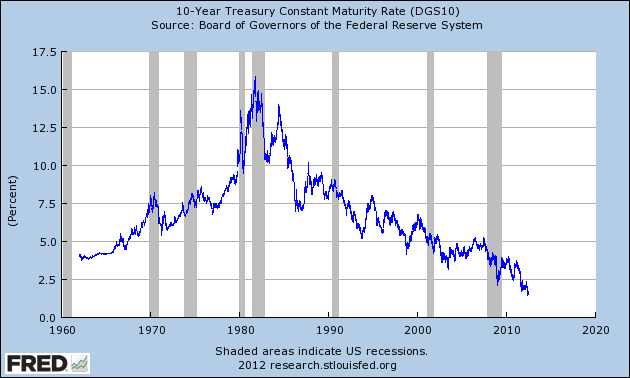
Why Are Treasury Yields so Low?

There’s been a bit of a controversy brewing in recent days over the treasury market and why yields are so low.  It all started earlier this week when Jeff Nielsen of Silver Gold Bull wrote:

“Previously, my own writing has focused upon one particular aspect of this absurdity: the highest prices for U.S. Treasuries at a time of maximum supply. This, in itself, is an absolute financial contradiction. The highest supply in history directly implies the lowest prices in history, for every market in the world — except U.S. Treasuries.”

His view is a conspiratorial one of the Treasury market that was then followed up by a series of different responses from Joe Weisenthal, John Carney and many others.  This debate has been going on for years in some form or another (see my debunking of the “bond bubble” from several years for related thinking) so I’ll keep my opinion on this short and sweet since I think the current environment is a rather simple one to explain.

We can get into complex discussions about “safe assets” and “debt monetization”, but the simple fact of the matter is that demand for Treasury’s has been extremely high regardless of the supply.  So bond prices are rising and yields are falling.  But the more important dynamic here is the source of this demand.  The Treasury market is really just an extension of Fed communications, which are an extension of economic strength/weakness.  As I’ve previously noted, there’s a very high correlation between moves across the curve and the Fed’s actions.  That is, the Fed controls 100% of the curve at the short-end and the market controls an increasing portion of the curve the further out we go.  I often use the analogy of a dog on a leash.  Bond traders are a lot like a dog on a 30 foot leash.  And at the base the Fed controls 100% of the movement.  But as we go further and further out the market controls more of the movement, but that doesn’t mean the Fed has no control of the long-end  and in fact, if they wanted to, the Fed could theoretically control the entire curve.  They’d just do the same thing at the 30 year bond that they do with the overnight market and they’d set the price verbally.  Ie, Ben Bernanke writes a love letter to the bond market saying:

“Dear Bond Traders, we will be buying an unlimited amount of 30 year bonds at X%, and since we have unlimited ammunition to perform this task we hope you enjoy getting your faces smashed into the concrete if you should be so foolish as to take the other side of this bet.  Thanks for playing, Ben.”

Of course, the Fed’s not doing that, but this doesn’t mean their communications are not highly effective.  Bond traders aren’t an overly complex group of people.  They don’t like to lose money because they get fired when they lose money.  So keeping a close tab on Fed communiques is important in the bond market.  The traders can run the leash out ahead of the owner and from side to side, but they don’t want to get too far away or they risk getting choked.  So when the Fed repeats, on a monthly basis, that yields will be “exceptionally low through at least 2014” then the message is clear – “we think the economy is exceptionally weak and we expect to keep rates low for several years”.  From a bond traders perspective that means one thing – yields aren’t going to surge because the economy will remain weak and even if the economy strengthens marginally the Fed has been very clear that they’re going to play it on the safe side and keep rates low for several more years.  So, in a world of messy assets where foreign bonds look unattractive, real estate is in the dumper and equities appear exceedingly risky, this communication from the Fed makes the Treasury market appear like a relatively safe short-term place to invest.  So demand is high thanks to this dynamic at work.

So, I don’t think we need conspiracies or asset shortages to understand what’s going on here.  We just need to understand the thinking of a very influential entity forecasting a very clear message to the market that says:

“buy our bonds, we’ll make sure you don’t get your face smashed in any time soon!”


Cullen Roche

Mr. Roche is the Founder of Orcam Financial Group, LLC. Orcam is a financial services firm offering research, private advisory, institutional consulting and educational services.

More Posts - Website

Follow Me:
TwitterLinkedIn

82 Comments

  1. Pierce Inverarity Pierce Inverarity says:

    Jesus Cullen, it’s like you’re deliberately provoking Bond Vigilante to post endless rhetoric about how this is incorrect because rates rose once, the Federal Government is at the complete mercy of the bond markets, foreign purchasers rejecting Treasuries will lead to U.S. insolvency…must you torment him so?

  2. ducksoup says:

    yes, indeed. Buy our bonds. Rake in that whopping return. Oh, wait, that’s right, nobody IS buying our bonds…oops, better crank up the “presses”! I’m sure grandma and the wave of retiring boomers are real happy with their negative real rates of return. I think wasn’t it Bogle who said your portfolio % in bonds should approximate your age? Wow, I bet those prudent conservative savings investors are thrilled with getting their faces smashed. Fed debt is artificially expensive and geo-politically risky. Best thing to do for savers is to put your cash under the mattress. No, really. Why incur risk for no return? Thanks, Uncle Ben! Wait, I’m not a bankster…

    • jazzman says:

      Maybe I’m missing something, but I’ve made a decent rate of return in my 401K in long-term treasuries – VUSTX is up 8.53% in 3 months. I’m not a sophisticated trader. I don’t do buy and hold – I just tune in to get Cullen’s macro view and allocate accordingly. Had I held VUSTX for the last year, the return would have been 23.45%. Maybe the day traders in this community are doing much better, but for me that’s a decent rate of return.

      Can someone fill me in on what I’m missing? Everyone’s complaining about the awful return on bonds but that just doesn’t jive with my experience.

      • jazzman says:

        Thanks. Makes me wonder why an individual investor would buy bonds if the bond funds are producing good returns and you can easily adjust your position as needed.

      • Patrick says:

        The “yield” is terrible, not the return. The yield is the interest rate compared to the current value, the return is the amount you get including interest payments once you sell a bond (capital gains/ losses). Yield and return are inversely related. If yield is bad, then return is good.

  3. But What Do I Know? says:

    Well put, Cullen–once the Fed decides to buy something in bulk, they become the market. Just wait until they start buying SPY.

    The problem is that the economy can and will suffer because of low rates. By reducing investment cash flow at a time when an ever-increasing portion of the population is relying on it to maintain their current spending, the Fed is suppressing growth. I think it is useful to think of interest on the federal debt as a subsidy to savers–and increased payments would be stimulative, just as lower taxes or additional spending would be. Of course, one might argue about how fair it is to give more money to people with money, but you can’t deny it would be stimulative.

    The Fed’s policies aimed at increasing asset prices are reducing investment cash flows–the latter matters more to the real economy than the former, IMHO.

    • Colin, S.Toe says:

      Another great lesson from CR, but I do wonder about ‘unintended consequences’ – cf Greenspan and the MBS debacle. Your point seems plausible.

  4. Chad M says:

    Treasuries are also are one of the few remaining acceptable collateral that prime brokers will accept. HF’s who what to play in the swaps market are now forced to buy treasuries to post as collateral for their trades. Same thing going on in Europe with the german bund. Geramny isn’t in the position of the U.S. to be able to print, but prime brokers there are demanding Bund’s as collateral. The Fed has a lot to do, but there is a persistent bid partly caused by the need for “quality” collateral.

  5. Geoff Geoff says:

    Great post. It really is very simple. The Fed is in control. Treasury bond yields aren’t likely to rise until the Fed wants them to, which does not appear to be any time soon. But look out when the Fed changes tune!

  6. jswede says:

    Cullen, in theory the Fed could control longer rates, but to imply that they practice this would be to dismiss that the shape of the curve is determined in large part by the market’s inflation expectations. 2s/30s regularly moves in a range from slightly negative to +400bps >> do you suggest this is the Fed’s doing and/or their preference?

  7. Kid Dynamite says:

    I love the “dog on a leash” analogy – hadn’t heard that before. thanks.

  8. Different Chris Dunce Cap Aficionado says:

    Cullen likes to think of great analogies while walking his dog. Noted.

  9. But What Do I Know? says:

    Oh, and one other thing. About a month ago, we had a bond fund manager in the shop, and he repeated the mantra, “The Fed controls the short end of the curve, the market controls the long end.”

    This guy was a smart and knows more about trading bonds than I will ever know, but he seemed unable to process the thought that the game has changed–he was positioning himself for the “inevitable” rise in interest rates a la Kyle Bass in Japan. My point is that while Cullen has laid out the new paradigm of Fed control over the entire curve–and no one commenting here seems to disagree–there are smart people running lots of money who haven’t accepted it yet.

    • Geoff Geoff says:

      You have an edge over most bond pros.

    • Cullen Roche says:

      “control”might be the wrong word. Influence is my preference. Nitpicking I know, but the Mkt is not without power here given the Fed’s lack of price setting.

      • jswede says:

        so the slope of the yield curve is the Fed’s will? So the Fed today prefers a curve 50% steeper than the 30yr average?

        • Cullen Roche says:

          Combo of the Fed’s will and the market front-running the Fed’s thinking. The dog can pull the owner side to side because the owner allows it.

          • jswede says:

            oh, I see what you are saying: within a ~400bp range of FF, the Fed “controls” it… I’d still tehnically disagree, but I’ll agree I can’t prove you wrong if your “leash” is that long…

            • jswede says:

              sorry to get snooty.

              anyway, I jsut disagree that the Fed did anything to move long rates since they moved to ZIRP in late 2008. They didn’t want the 10yr at 4% 1Q10, nor do they want it in the mid-1%s today — the move was all balance sheet recession; if anything, they have intervened in the course, as each QE designed to lower rates had the opposite effect, but certainly did/do not influence ultimate magnitude or direction of longer rates.

  10. Anonymous says:

    From an operational insight it is true, but who really controls who here? Could it be that the Fed is the dog in this analogy to the market?

  11. Johnny Evers says:

    What happens when the Fed is forced to buy long-term bonds and put them on its balance sheet (which it must, because of deficit spending.)?
    What will it do for ‘animal spirits’ when the market sees the Fed’s balance sheet ever expanding and the realization sinks in, ‘My God, if we’re printing money, how can I get some of that?’

    • Cullen Roche says:

      This is a form of the “debt monetization” argument. It’s not correct. The Primary Dealers are REQUIRED to bid at Tsy auctions. The fact that they on-sell the debt to the Fed or mom and pop or other pvt actors does not mean the demand is not there. As long as they uphold their requirement the demand is there and “funding” is never a concern.

      • But What Do I Know? says:

        Just to ask a question here–don’t the primary dealers take on leverage to buy the bonds at auction? Isn’t this where the money is created?

        • Cullen Roche says:

          They might, but what difference does that make? It doesn’t mean the demand isn’t strong. Am I misunderstanding your point?

          • Johnny Evers says:

            Are there any real-world restrictions on the primary dealers buying up bonds? What if they can’t sell them to the public? How much in ‘debt’ can they carry on their books — an unlimited amount?

            And what happens when bond traders realize that interest rates are going to stay low, giving them very little return and leaving them susceptible to interest rate risk.
            Too many of your arguments involve flat statements but without addressing possible consequences. For example, you say the Fed can threaten the bond traders but you don’t address what will happen if that actually have to follow through on the threat.

            • Cullen Roche says:

              Of course there are real-world restrictions. I’ve previously discussed a potential scenario in which a hyperinflation is brewing and dealers boycott auctions in preference for survival (because bonds would be an unattractive asset). Your questions are extreme though. What if they can’t sell? This is the most liquid market in the world. That’s like asking, “what if the oxygen just goes away, how will we breath”? It’s not happening.

        • But What Do I Know? says:

          My point (I think) is that the Fed doesn’t need to “monetize debt”–that function is performed by the primary dealers. The Fed influences the PD’s to be willing to take on the leverage (i. e., create money) by promising them a customer (at profitable prices) if no one else steps forward to purchase the bonds at the price the Fed has set.

          But what if the Treasury simply cut out the PD’s and wrote checks on its account at the Fed, which could be topped off at will? The process would be pretty much the same except the Treasury would be spending money into existence rather than the PD’s borrowing it into existence. Do I have that right?

          • Cullen Roche says:

            There’s a certain institutional reasoning behind the purpose of having to procure funds from the pvt sector. I like to break down currency demand on two fronts. The first is acceptance value and the second is quantity value. Acceptance value represents the public’s willingness to accept something as the nation’s unit of account and medium of exchange. This is achieved mainly through the legal process and democratic vote. That is, the government and the people deem a specific thing (such as the US Dollar) as the accepted unit of account and medium of exchange. But the government cannot force currency acceptance upon its users merely by stating the thing that is usable as the nation’s medium of exchange. Quantity value describes the medium of exchange’s value in terms of purchasing power, inflation, exchange rates, production value, etc. This is the utility of the “money” as a store of value. While acceptance value is generally stable and enforceable by law, quantity value can be quite unstable and result in currency collapse in a worst case scenario.

            So yeah, we can eliminate the PD’s in the process, but then why not just start giving the govt the power to do whatever the heck it wants? The Primary Dealers are called the Primary Dealers because they’re the first to deal in the government procurement process. The purpose of having to raise tax funds and sell bonds is not some conspiracy to bankrupt our govt. In fact, we’ve ensured that doesn’t happen. The institutional arrangements exist to provide a buffer between state money creation and private money creation/acceptance. Like most things in this institutional arrangement, there are checks so as to avoid giving any single entity excessive power.

            So yes, we could make the govt as powerful as we want. We could remove all the red tape that stops a govt from dropping nuclear bombs where ever they want. Is that a good thing? Or should there be checks? I think there should be checks. particularly pertaining to money. And those checks exist in the current institutional arrangement in a very specific form.

            • Colin, S.Toe says:

              This sounds like one of the significant differences with ‘MMT’ that has developed.

              While I have some sympathy with the impulse, you give a clear reason for having the Primary Dealer ‘buffer’ – and any move to end this arrangement would do well to be mindful of the ‘law of unintended consequences’ (- maybe let some smaller economy try it, and see what happens?).

              • LVG says:

                MMT claims to care about inflation, but they don’t have any understanding of what gives money its real value. They think money has value because a government says it has value. In his latest primer Wray says:

                “The “goldbugs” have mostly got it backwards: it was not gold that gave money its value but rather, gold had money value because its price was pegged in terms of money by the government authorities. This was done by promising to redeem gold for currency at a fixed exchange rate.”

                Gold bugs don’t even think this. They think gold is a good medium of exchange because it can’t be manipulated to distort the value of the underlying production. This is the point MMT completely misses and it’s why none of them write about production or the value of currency based on quantity value as Cullen puts it. MMT thinks it’s mostly about acceptance value when it’s almost all always about quantity value.

                • Cullen Roche says:

                  Agreed. I’d say MMT has other issues, but we should probably first acknowledge that MMT, as a whole, is superior to most neoliberal positions, so let’s not waste time shooting down something that is better than most other approaches. This little MR vs MMT squabble is small potatoes compared to other big issues that need to be tackled.

                • Jason Hun says:

                  except that a gold production & gold standard is still able to be manipulated & at the mercy of random finds of gold too

                  Gold is a CARTEL just like oil/OPEC is.. the largest gold producers in the world are Russia & China & both have gov owned gold mines, which is one of the reasons why Russia pushes for a gold standard ..and gold supply/pricing is manipulated too (you really trust Russia/China not to?)

                  China’s gov encourages it’s citizens/etc to buy gold

                  More so, Soviet Union collapsed because it was on a gold standard & it’s lack of power to create money to service it’s spending (the US would have collapsed too if it was still on the gold standard instead of going to fiat) & it’s slow gold supply couldn’t grow fast enough to grow it’s economy…

                  Russia didn’t learn after Soviet Union collapse & went on the gold standard, then a foreign-currency standard peg (which is like being on a gold-standard again)… and borrowed in foreign currency too

                  In all, being on a gold standard/foreign currency standard severely limits the money supply & thus not enough money to fund new projects, new hiring, new jobs, etc …unless they get more money from abroad thru exports to fund their production… but it’s alot easier to have gov create money to fund production for both domestic production & domestic consumption/spending instead of just exports

            • Johnny Evers says:

              That’s the check?
              The primary dealers must buy the debt; however, if they see hyperinflation brewing they can stop.
              That is a pretty slim check on deficit spending, counting on people with a vested interest in buying the debt and who are required to buy the debt to know when to stop.
              It’s sort of like the drunk telling the bartenders that they must serve him; however, he hopes they will stop before he drops dead.

              • Cullen Roche says:

                I didn’t say that was the only check. I said it was a check.

                • wh10 says:

                  What are the other checks in your mind? I am definitely open to more.

                  Perhaps it makes a difference a la Samuelson, who said we designed the system to fool people, to get them to be cautious of excessive govt spending.

                  But I feel like there has to be a better way to encourage responsible govt budgeting than to obfuscate the truth from the American people.

                  • wh10 says:

                    I’ll also say, I think as a base case, checks make total sense. And if this check really is a check, then great. My only frustration is that it seems we let this check fool us into making bad policy choices sometimes. I hope that we can overcome that as a country.

                  • Colin, S.Toe says:

                    I have to ‘agree in principle and as a believer in democracy with a small ‘d’: any ‘check that depends on misleading the public is a very bad idea. It is an open invitation for ‘insiders’ to manipulate the system for private advantage.

                    Thus if the function of primary dealers, etc is to act as a check on federal spending, the public needs to understand this, rather than thinking it means the government can ‘go broke’.

                    I firmly support checks on federal power, but would put more emphasis on devolving power to states, localities and individuals. The Federal government needs to be very powerful (currency issuing, and a monopoly on military force are two huge ones), but also strenuously limited.

                  • Cullen Roche says:

                    The check on quantity value is the biggest one. I think it’s interesting to understand the institutional design that JKH has laid out if you take our approach to viewing currency demand because you can then understand exactly why currencies can die if they’re abused. Accpetance value can only be enforced up to a point. And it makes sense, as money is a social construct with govt being a construct of the people. If the social construct becomes useless then the people reject it as its quantity value collapses. The whole Mosler gun to the head enforcing acceptance value is null and void at this point because quantity value is the endgame (ie, quantity value is tied to the true constraint, inflation).

                    It’s interesting to look at this from a historical perspective because the designers of this system knew that the govt could have almost unlimited powers in many regards. It’s no secret that the govt COULD write checks on itself. But the system was designed specifically to force the govt to be a currency user in some elements (as Tsy is). In other words, it had to procure funds in various forms to validate its use of those funds. It cannot just USE funds without procurement and validation. This is where I think MMT really gets currency demand wrong. They don’t care about this stuff. They say, “the USA can murder anyone because it has a monopoly on power, so it should be able to murder anyone” (extreme example, but same idea as “govt can create money at will therefore it should create money at will”). But the govt is constrained by its own people and quantity value. This is the ultimate check on a currency.

                    So Jefferson lost the battle over a central bank. But he won the procurement war. That is, the people must validate the currency’s existence and the govt’s use of that currency by ALLOWING procurement. This is done via taxes and bond purchases. The most obvious example of boycott is a hyperinflation where tax receipts would collapse and PD’s would probably stop buying bonds. This is the quantity value collapsing and the pvt sector rejecting the currency regardless of the govt’s ability to enforce acceptance value. In a way, it’s a check on a check. And the people get the last word. As it should be with a social construct such as money.

                    BUT, that doesn’t mean we should confuse the true constraint. MMT’s greatest contribution is highlighting the true constraint. Since quantity value is the people’s check on currency, it is always inflation that is the constraint on govt spending. We can always procure funds (even using the Fed in a hyperinflation), but it is inflation that is the true concern over quantity value. So “funding” isn’t the concern. Inflation is. This is a paradigm that needs to change. Unfortunately, people misunderstand inflation and therefore misunderstand this entire idea of inflation being the true constraint.

                    • Colin, S.Toe says:

                      This is a substantive and illuminating answer to ‘wh10′s query – MR is making progress.

                      The counter-argument might be that the Constitutional check on federal spending would be the House – which is supposed to control spending, and be highly accountable to the electorate.

                      Agreed that Congress passed the bills that created the current system. But as you and others pointed out, in the recent ‘debt ceiling’ debate, they acted as though they did not understand their own creation, refusing to authorize raising this in order to pay for the spending they had ordered (and theoretically putting the executive in a totally contradictory position, with regard to its obligation to uphold and enforce the law – time for Beowulf’s platinum coin).

                    • Cullen Roche says:

                      And I have to credit JKH with the concept of acceptance value and quantity value. His contributions to MR have just been phenomenal.

                    • LVG says:

                      I am so impressed with the detail MR has gone into on some of these subjects. You guys are really putting together something special here. Keep up the good work.

                    • Cullen Roche says:

                      Thanks LVG. We’ve put a lot of careful thought and effort into all of this. I know it’s a work in progress and development has been rocky at times with us arguing with MMTers and others, but I think the end output is coming together really nicely.

            • JP Koning says:

              Interesting comment. A few thoughts:

              “I like to break down currency demand on two fronts. The first is acceptance value and the second is quantity value. Acceptance value represents the public’s willingness to accept something as the nation’s unit of account and medium of exchange. This is achieved mainly through the legal process and democratic vote. That is, the government and the people deem a specific thing (such as the US Dollar) as the accepted unit of account and medium of exchange.”

              The legal process and the government can certainly influence acceptability of some item as “money”, but they’re not necessary conditions for a given “money” to be demanded (I use brackets because the word money is imprecise). Many examples of monies can be found that arise outside of legal systems and government control. Cigarette money is one example, German notgeld were another. I just used Canadian dollars to buy stuff in Buffalo, NY, despite the fact that the c-dollar isn’t legal tender in the US. So if you want to go into the reasons for demand, you can probably legitimately bypass what you call “acceptance value” and inquire into the deeper reasons for which some money is demanded and why it has value.

              “But the government cannot force currency acceptance upon its users merely by stating the thing that is usable as the nation’s medium of exchange.”

              Agreed. But this separates you even more from the chartalist view (and from MMT). It’s a big step to take. Chartalism has always considered the government’s so-called ability to declare some item x as “money” as sufficient cause for that item to gain currency, no matter its intrinsic value. (It’s also the core notion behind the quantity theory). Sounds like you’re moving away from Knapp towards Menger.

              “The Primary Dealers are called the Primary Dealers because they’re the first to deal in the government procurement process. The purpose of having to raise tax funds and sell bonds is not some conspiracy to bankrupt our govt. In fact, we’ve ensured that doesn’t happen.”

              In Canada the government can borrow directly from the Bank of Canada (which it is currently doing). See:

              http://jpkoning.blogspot.ca/2012/06/bank-of-canada-watching-whats-up-with.html

              In this case, what constrains them is the Bank of Canada’s inflation target. Should the Bank lend too much, inflation will rise and it will have to withdraw its lending to the government. The point here is that there are alternative monetary systems to the US paradigm and they offer different sorts of checks and balances. There are probably some dangers in creating a general-view beginning from a Fed-centric position.

              On a side note, I’m wondering if the ultimate difference between MMR and MMT are more political/structural than theoretical: one advocates a melting of all divisions between the executive and central bank while the other advocates setting up stricter divisions between the two?

              • Cullen Roche says:

                I don’t actually think MMT and MR have as much in common as I may have initially presumed or as much as many others presume. Our rejection of the state theory of money and the JG render us very different. I think MMT gets the essence of money entirely wrong since they view it as a creature of the state and little else. This idea that money is only 4,000 years old reminds me of some religious views claiming the world is 6,000 years old. That’s naive at best and to ignore the origins of money as being before the existence of the state is a narrow minded view that misses the most crucial parts of understanding money. So the whole “taxes drive money” view ends up being too narrow. But we could go on for days about this and if you’re an MMT believer then the odds of me convincing you I am right are approximately 0%. So I’ll save my breath for the sake of us both. :-)

                • JP Koning says:

                  “But we could go on for days about this and if you’re an MMT believer then the odds of me convincing you I am right are approximately 0%.”

                  No, economics to me is about thinking, not believing or belonging to a group. I think the chartalist and non-chartalist views have a degree of truth to them… the hard part is to find out how to fit them both together in a coherent way.

                  • Cullen Roche says:

                    I don’t think you can “fit” the chartalists with anyone else. That’s why they’re so defensive about their views. The views are very precise and lead to a very specific policy outcome. There is very little flexibility in the framework. To me, the most important insights from MMT are the idea that the govt can’t “run out of money” and that the true constraint is inflation. But you don’t need MMT’s progressive policy agenda and all the extra baggage to understand that. In fact, you just need JKH’s contingent institutional approach and then you understand the reality of the way the system works without some of the nonsense MMT adds on to justify their policy ideas.

                    • JP Koning says:

                      I didn’t mean fit chartalists with others. I meant fit chartalist ideas with non-chartalist ideas. That’s the great thing about ideas, they’re not touchy about being recombined.

                    • Cullen Roche says:

                      I think MR has bridged that divide quite nicely. For instance, we’ve taken the idea of an autonomous currency issuer not being able to “run out of money” and embedded it as a core piece of our work. And we’ve dropped all the baggage about mythical money monopolists and tax driven money, etc.

                • Colin, S.Toe says:

                  In general, I like MR’s more nuanced view on several issues. (On first exposure to MMT thinking at this site, I recall major reservations about a CAD being an advantage, as well as thinking the ‘taxes drive money’ argument was overstated).

                  However, government in some form has been around for a very long time (in its bureiacratic form, dating back at least 6,000 years in the middle East).

                  The classical/neoliberal, and especially the Austrian positions have tended to minimize or deny the role of government, whereas the archaeological and anthropological evidence seems to support a major role for it in establishing some of the modern characteristics of ‘money’/currency – such as as a standardized unit of account and systematic use as a medium of exchange.

                  Polemical controversies have a tendency to drive each side into overstating its case (we have one to thank for the negative view of humnanity’s ‘fallen state’ in Catholic doctrine that many have found oppressive.)

  12. bart says:

    It’s too simple for most:

    “…the Federal Reserve has the capacity to operate in domestic money markets to maintain interest rates at a level consistent with our economic goals”
    – Ben Bernanke, Fed Chairman, March 26th 2007 to the Senate Banking Committee

    The Securities Lending OMO track record basically proves it. Look it up… or not, your call.

  13. Luke says:

    Suppose the Europeans continue moving toward the United States of Europe, and the worst Euro collapse fears aren’t realized, would the Fed necessarily need to keep it’s word about suppressing rates? Further, if Congress extends the fiscal cliff, further reducing deflation risk, why not let rates rise? I imagine Bernanke is more concerned about ensuring deflation doesn’t occur than he is about timing rate hikes.

  14. John A says:

    Jeff Nielsen is one of those raving, conspiratorial gold bug types. People like that simply cannot be educated.

  15. obie wan says:

    forgive me but isn’t level of interest rates determined by demand for money? after an inordinate expansion or as we call it a bubble, public finds itself without money and deeply in debt, all’s been invested. business is well aware of that and has to wait with its expansion money demand for the public to pay off the debt and actually have some cash to spend on products. economy is thus driven down and the fed finds itself obligated to throw a lot of money out there for which there is no demand thus driving interest rates even lower. in the meantime any cash that business will still get hold of will have to be parked in instruments like bonds since they have no mattresses to put it into.

  16. Bond Vigilante says:

    Jeff Nielsen is right. The FED has “printed” lots of money. And that freshly printed money will go somewhere, e.g. in the stockmarket or bondmarket. Investors have pulled money out of the stockmarket and poured it into the bond market after 2008. That’s why there’s bond bubble and yields are this low. A matter of demand & supply, remember ? When every man and his dog is invested in bonds, then where is the new money to come from to push yields even lower ? Not from foreigners (i.e. foreign central banks (FCB)).

    FCB have switched from (=sold) Agency paper to T-bonds in 2008 & 2009 and bought T-bonds. But now FCB haven’t bought any T-bonds or Agency paper since september of 2011, in spite of the US Trade Deficit of about $ 600 bln. (annualized). Seems the FCB have woken up and smelled the coffee. That’s why they’re buying gold !

    Yes, the FED can “print money”/monetize T-bonds but the Treasury still has to roll over the monetized debt and pay interest on those T-bonds. And the money needed to pay the interest has to be provided by the taxpayer. Otherwise the FED would go bankrupt. And the FED going “belly up” equals to “RIP, USA”. And since the USD is the world’s reserve currency, it would mean “RIP, world economy”. That’s what the majority in the US simply don’t grasp, They aren’t aware that the world is larger than the US alone. Greenspan & Bernanke and other FCB do understand the grim reality. That’s why the US government currently has simply no other alternative, is FORCED to cut back on spending to the tune of $ 7 trillion. (Remember the words “fiscal cliff” ?)

    Although I heard Obama say that he wants to shower the country with $ 5 trillion in taxcuts. So, the net cutting amounts to a “mere” $ 2 trillion.

    • hangemhi says:

      The Fed will go bankrupt the day the sun expires and the world ends. As for your other brilliant comment “people don’t realize the world is bigger than the US” I just have to say you might want to hang out with smarter “people”.

  17. deis says:

    BV, you are self-contradictory here. At first you state that “the FED has “printed” lots of money” and then you say that “the money needed to pay the interest has to be provided by the taxpayer”. Why not then print money once again?

    I think, you are a bit overwhelmed with conspiracy theories and that sort of things

    • Bond Vigilante says:

      When the FED monetizes T-bonds/debt then it buys debt/T-bonds from the banks. The FED creates or increases the checking account(s) for the bank(s) at the FED. And with the “newly printed” money the bank can buy new T-bonds (out of the open market or at an auction) and hands the money to the Treasury. The bank is effectively only the middle man.

      But Treasury still has to pay the interest and when a T-bond matures, the principal. Yes, the FED can “print”/monetize more T-bonds but that means that the Treasury needs MORE money from the taxpayer to pay the interest and principal on those monetized t-bonds.

      • deis says:

        And how in this case could the Fed go bankrupt?

        • Bond Vigilante says:

          Lack of liquidity/income like any other bank. When the Treasury (a.k.a. the taxpayer) can’t cough up more money. But by then the FED will confiscate all the gold available, revalue the USD against gold and start anew. Like FDR did in 1932.

          • hangemhi says:

            Do you wear a tin foil hat with wire hanger antennas when you come up with this stuff? How long does it take to tune into the right frequency, and is it a special brand of tin foil? Inquiring minds want to know.

        • Bond Vigilante says:

          “revalue” should be “devalue”.

        • Bond Vigilante says:

          Or when the Treasury isn’t able anymore to pay back the principal to the FED. In other words, the credibility of the FED and thereby the USD and the US is determined by whether or not the Treasury is able to rake in sufficient taxpayer money. And the opinion of “Mr. Market” concerning the health of the US is best reflected in the price/yield of the 30 year T-bond.

          • Cullen Roche says:

            You’re confusing two different points. The only instance where tax dollars become scarce is in a hyperinflation. This is totally different than a solvency constraint.

  18. FED CONTROLS THE ENTIRE YIELD CURVE

    Alas I ask, and to where have our endangered “Bond Vigalanties” gone?

    (RIP: Soloman Brothers, Leahman Brothers, Kuhn Loeb, Loab Roads, Drexel Burnham, Wertheim)

    • Bond Vigilante says:

      If the FED controls the entire yield curve then why pushed the FED interest rates up and up from 1945 (2%) up to 1981 (15%) ? And why did the FED push interest rates down from 1981 (15%) up to now (2%) and punish savers ?

      If the FED controls the yield curve then why “forced”/”encouraged” the FED the yield curve to steepen in the last three years (e.g. 5 year note vs. 30 year bond) ?
      If the FED controls the yield curve then why buys the FED 30 year bonds and sells shorter maturity bills/notes ? It did so in the second half of 2011 but the yield curve continued to steepen.

      Currently, the Vigilantes are foreign central banks. They dumped Agency paper in 2008 and 2009 and that was (partially) monetized by the FED. So, why won’t they dump T-bonds in the coming weeks, months, years ? When (not IF) the US Current Account Deficit turns into a Surplus foreign central banks have simply no other choice to sell/dump Agency paper and T-bonds. And then the balance sheet of the FED would REALLY go parabolic and the USD through the floor.

      • hangemhi says:

        wait, wait, wait… you just said that when (not if :) the U.S. becomes an export power house running a trade surplus, that we are doomed. LOL.

        Where do you come up with this stuff? I think scotch plus the tin foil hat

        • Bond Vigilante says:

          Turning the Current Account Deficit into a Surplus requires the US economy to shrink substancially. And bring back a lot of outsourced manufacturing from e.g. S.E. Asia back to the US. But that also requirs that US wages need to go down to levels of those countries.

          • Windchaser says:

            ..what.

            “Manufacturing coming back to the US requires US wages to drop to levels of SE Asia”?

            No mention of the difference in infrastructure, access to capital, property rights, transportation costs, education, etc.? There are good reasons why Americans are far more productive, hour for hour, than Chinese or N. Koreans or whomever.

            Maybe the US will turn a surplus because our economy expands substantially, relative to our consumption. Or maybe fuel costs will rise, making it more efficient for manufacturing to produce closer to its end destination (and also decreasing US imports of oil, in the process). Or.. one of a dozen other things.

            Germany has been running a strong surplus. How’s their economy doing?

        • Bond Vigilante says:

          If the US would start running a Current Account Surplus also means that the USD can’t be the world’s reserve currency any more and has to give up the priviliges that come along with it. It sounds weird but the country that uses the world’s reserve currency is actually forced to run a Current Account Deficit.

  19. Gary_UK says:

    What MMR/MMT never looks at (or rarely) is what the rest of the world are doing.

    It is irrelevant that Bernanke is creating money to buy the bonds that no one else wants.

    Irrelevant because the dollar only has value if the rest of the world are prepared to soak up the excess dollars the USG is forced to emit every day (a few billion every single day), and they ship these overseas to buy stuff.

    As soon as the rest of the world eases off on the bond purchases, and hence those dollars being emitted need to find a home, it is effectively game over.

    Those that view only what they see to date are missing what is coming, not just in the States, but in Japan and the UK too. A desperate attempt by govts to prolong the spending via monetising, and that sadly will always kill your currency.

    Inevitable.

    • Cullen Roche says:

      Actually, MR focuses quite a bit.on the foreign sector and the fact that the usa is exceptional in many ways. Maybe youre confused about MR vs MMT (a largely unrelated theory).

    • Luke says:

      Gary, perhaps when US/UK/Japanese bond yields start rising, it will be a sign of sufficient private sector deleveraging, such that aggregate demand is healthy without fiscal stimulus. Rather than “game over”, I’d saying rising rates will be cause for celebration.

  20. obie wan says:

    seems to me fed is pushing interest rates up and down to counter inflation or deflation. i remember the inflation hysteria that hit this country beginning the 80s. action to 15% to kill it was appropriate. as for today, how can there be inflation when there is shortage of cash and abundance of debt. where is the money to push inflation up when all have to concentrate to pay off debt or at least get a job. today deflation is the danger and it’s important to keep interest rates low not to make it worse. in such scenario fed can print incredible amounts of money without fear of igniting inflation and treasury can buy it all if necessary since the interest expense is negligible. as for future consequences those will be again dealt with by appropriate fed actions. fed running out of bullets? doesn’t exist.

  21. Luke says:

    Obie Wan, I think you’re right that money printing from the Fed won’t cause inflation, but I think you are wrong about how effective the Fed is at this stage. The Fed can exchange cash for Treasuries and other financial assets all day, but they can’t force Primary Dealers to lend that cash to non-dealers, so the new money may not circulate through the economy if the private sector is over-indebted outside of the dealer network. Actually, Fed asset purchases can have the adverse affect of decreasing the collateral stock. Less collateral means more trouble securing short-term funding needs for non-dealer banks. Therefore, “printing” in some circumstances can potentially be deflationary. The Fed likely knows this, which is why QE became Operation Twist to avoid reducing the collateral stock.

  22. obie wan says:

    i take the fed, treasury and the system of primary dealers as one entity which is striving to achieve one goal and that is steering economy off excesses. so for me it doesn’t matter by what manipulation this objective has been achieved. for all its worth i am saying the system works since economy has been floundering and needs some support. therefore there’s no reason to be wondering why interest rates are so low, and consequently there’s no reason to be concerned since the fed creating cash whether monetizing or not rings the bells about their intentions. the power of the fed has been underestimated for a long time now in my opinion, probably because of their failure to act on overheated economy the last time around. but that was an exception rather than a rule and they didn’t exactly miss it, they were just misled by social issues back then. also let’s not forget about the power of government itself, if they can afford bailouts on the scale we witnessed a few years back a question is pressing on my mind as to what is there that they cannot do if needed.

  23. synchro says:

    I think the bond market is in a world of hurt if the Fed even gives a hint that ZIRP will be “gradually” repealed. Rates are easy to control on the way down. On the way up? The Fed has painted itself into a corner — it simply CAN NOT jerk rates up the way it suppresses the rate down. When the Fed owns the bond market (figurativiely at this point — not yet literally), it will also have to take ownership of the downside when rates rise or when it tries to raise rates. Repealing the Fed’s ZIRP position down the road = crashing the bond market.

    That’d be the mother of all int rate hangover — makes the 1995 episode of bond market debackle looks like a cakewalk.

  24. bart says:

    Please don’t look at the Fed’s Securities Lending OMO track record regarding interest rate control, especially since 2002 or so. There’s nothing behind the curtain.

    No, they’re not 100% successful 100% of the time but the facts speak for themselves. At some point they’ll lose control, but it hasn’t happened yet.

Contact Us:

Name:

Email:

Verification Image

Enter number from above:
